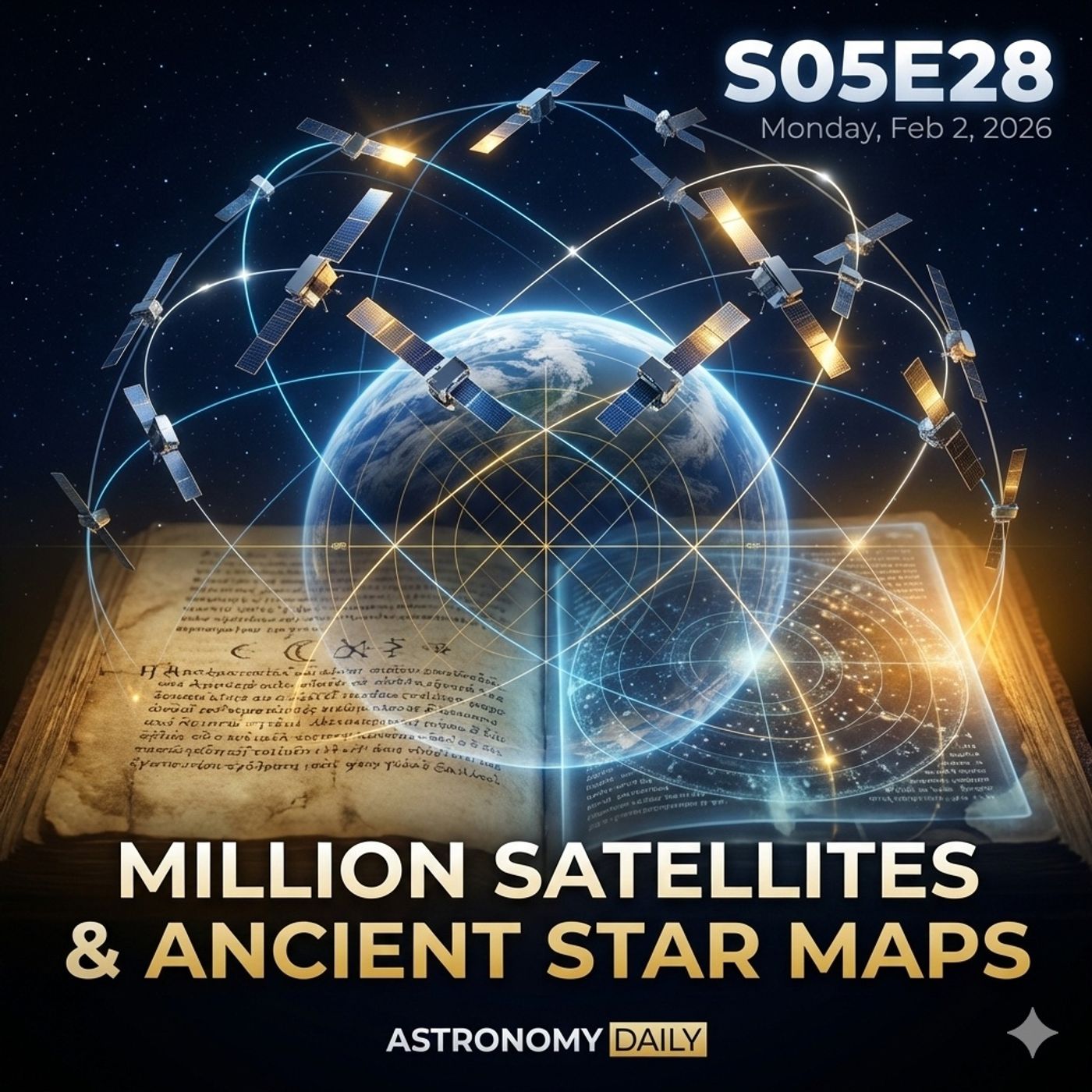
In this episode
Welcome to Astronomy Daily! Join hosts Anna and Avery for today's cosmic journey through space news, featuring SpaceX's audacious plan for one million solar-powered satellites, an ancient star catalog recovered from layers of medieval text, and China's groundbreaking solar mission to the L5 point.**Episode Highlights:**
🛰️ **SpaceX's Million-Satellite Vision** - SpaceX files with the FCC to launch up to one million solar-powered satellite data centers for AI, framing it as a step toward becoming a Kardashev Type II civilization
⭐ **Ancient Star Map Revealed** - Scientists use X-ray technology to uncover Hipparchus's 2,000-year-old star catalog hidden under six layers of ink in a medieval manuscript
☀️ **China's Solar Observatory** - The Xihe-2 probe will become the first mission to monitor solar activity from the Sun-Earth L5 point, offering five-day advance warnings of space weather events
🔭 **Stellar Detective Story** - Astronomers discover WOH G64 isn't dying after all—a hidden companion star was fooling scientists about the red supergiant's fate
🚀 **Time Honors Artemis 2** - Time magazine releases special commemorative cover celebrating the Artemis 2 crew ahead of humanity's return to lunar orbit
🌍 **Remembering Gladys West** - Honoring the GPS pioneer and "Hidden Figure" whose mathematical work shaped navigation technology used by billions worldwide
**Episode Length:** 18-20 minutes
**Hosts:** Anna & Avery
**Production:** Astronomy Daily Podcast, Season 5
---
## Connect With Us
🌐 Website: astronomydaily.io
🐦 Twitter/X: @AstroDailyPod
📘 Facebook: @AstroDailyPod
📸 Instagram: @AstroDailyPod
🎵 TikTok: @AstroDailyPod
📺 YouTube: @AstroDailyPod
📱 Tumblr: @AstroDailyPod
---
## Story Sources
- TechCrunch
- Daily Galaxy
- Space.com
- Journal for the History of Astronomy
- CGTN News
- Keele University
- U.S. Department of Defense
Become a supporter of this podcast: https://www.spreaker.com/podcast/astronomy-daily-latest-space-news--5648921/support.
Sponsor Details:
Ensure your online privacy by using NordVPN. To get our special listener deal and save a lot of money, visit www.astronomydaily.io/nordvpn. You'll be glad you did!
Get the best secure and private email on the planet. Stop your Government, google and who knows who else spying on every email you write. Do what we did and use ProtonMail. They beleive in privacy and there are no ads in their business model...yet they still provide a free forever service. Check them out and get out special deal at www.astronomydaily.io/protonmail
Become a supporter of Astronomy Daily by joining our Supporters Club. Commercial free episodes daily are only a click way... Click Here
This episode includes AI-generated content.
Speaker 1: Welcome to Astronomy Daily, your source for the latest space and astronomy news. I'm Anna and I'm Avery.
Speaker 2: It's Monday, February two, twenty twenty six, and we've got a fantastic line up of stories today, exploring everything from SpaceX's audacious satellite plans to ancient star maps hidden for centuries.
Speaker 1: That's right, Avery. Today we're diving into SpaceX's jaw dropping proposal to launch up to one million solar powered satellites, a remarkable archaeological discovery revealing Hipparcas's lost star catalog, and China's ambitious solar monitoring mission heading to a unique point in space.
Speaker 2: We'll also be discussing the giant star that fulled astronomers worldwide, Time magazine special tribute to the Artemis two crew, and remembering Gladys West, a hidden figure who helps shape GPS technology. It's going to be an incredible journey through space history, present, and future.
Speaker 1: So settle in and let's explore the cause most together.
Speaker 2: We're starting with what might be the most ambitious satellite constellation proposal ever conceived. SpaceX has filed with the Federal Communications Commission seeking approval to launch up to one million solar powered satellites that would function as data centers for artificial intelligence.
Speaker 1: One million satellites, Avery, that's absolutely staggering. To put that in perspective. There are currently around fifteen thousand man made satellites orbiting Earth. According to the European Space Agency. SpaceX is essentially proposing to increase that number by several orders of magnitude.
Speaker 2: The scale is mind boggling, Anna, and SpaceX isn't just framing this as a commercial venture. Their filing describes these satellites as the most efficient way to meet accelerating demand for AI computing power. But they go even further. They're calling it a first step towards becoming a Kardashev type to civilization, one that can harness the Sun's full power.
Speaker 1: That's quite the vision for our listeners who might not be familiar. The Kardashev scale is a method of measuring a civilization's technological advancement based on energy consumption. A Type two civilization would be able to harness all the energy output of its star. But let's talk practicalities here. The Verge has pointed out that the one million satellite number is unlikely to be approved outright and is probably a starting point for negotiation exactly.
Speaker 2: The FCC recently gave SpaceX permission to launch an additional seven thousand, five hundred and seventy five Starlink satellites, but the third authorization on the remaining fourteen thousand, nine hundred and eighty eight satellites proposed. So there's clearly regulatory caution about satellite proliferation, and there are very real concerns about space to briand and light pollution that come with such massive consolations.
Speaker 1: The timing is also interesting. Misfiling comes as Amazon is seeking an FCC extension on a deadline to have more than sixteen hundred satellites in orbit, citing a lack of available rockets. Meanwhile, SpaceX is reportedly considering a merger with two of Elon Musk's other companies, Tesla and Xai, ahead of going public.
Speaker 2: It really shows how the commercial space sector is evolving anna what was once the domain of governments is increasingly being driven by private companies with enormous ambitions. Whether SpaceX gets approval for anything close to a million satellites remains to be seen, but it is certainly signals where they think the future is headed.
Speaker 1: It's fascinating to think about, but we'll have to see how regulators balance innovation with the very real concerns about our orbital environment. Now, let's move from the future to the distant past.
Speaker 2: From cutting edge satellite technology, we're traveling back more than two thousand years to rediscover one of astronomy's greatest loss treasures. Scientists have successfully recovered fragments of the world's earliest star catalog, created by the ancient Greek astronomer Hipparchus, from a fifteen hundred year old manuscript.
Speaker 1: This is absolutely remarkable. Avery hip Arkas is widely considered the father of astronomy. He figured out how equinoxes shift, created a magnitude scale to rank star brightness, and tracked planetary motion, all more than two thousand years ago without any telescopes. But his actual star catalog had vanished from history until now.
Speaker 2: The manuscript is what's called a palimpsest, which means it's parchment that was wiped clean and reused. In this case, Hiparkas's original Greek text was erased and overwritten with Syriac religious writings of Saint John Klamacus, the original work was literally buried under six layers of ink.
Speaker 1: So how did researchers manage to read text that was intentionally erased centuries ago? That used some pretty sophisticated technology. A team led by Victor Geisenberg from Sorbonne University used X ray technology at the SALC National Accelerator Laboratory to scan eleven pages of the Man Script.
Speaker 2: The key was a Hiparkasis original inc had a different chemical composition than the later religious texts. The ancient ink was rich in calcium, which showed up clearly under X ray scanning. They used extremely short X ray pulses, each just ten milliseconds long, focused on areas no wider than a human.
Speaker 1: Air, and what they've found is remarkable. These aren't just historical curiosities. The star positions hipparcs recorded are incredibly accurate for naked eye observations. As Giesenberg said, the coordinates they're finding are incredibly accurate for something done with the naked eye. This gives us a window into how ancient people understood and mapped the night sky.
Speaker 2: It's also a testament to early scientific thinking. Hiparkis was working without any optical instruments yet he was able to create precise astronomical measurements that laid the foundation for future astronomers. This discovery, published in the Journal for the History of Astronomy, helps us answer fundamental questions about the birth of science itself.
Speaker 1: And the manuscript, now held at the Museum of the Bible in Washington, d C. Is so delicate it had to be hand carried in climate controlled boxes to the laboratory. It's wonderful that modern technology can help us recover these ancient insights. Speaking of technology and new vantage points, let's turn to China's upcoming solar mission.
Speaker 2: China is making major strides in solar exploration with plans to launch its first ever solar probe to the Sun Earth L five point. The satellite, called Shihi Too, is scheduled to launch between twenty twenty eight and twenty twenty nine, and it will provide a unique perspective on solar activity that we've never had before.
Speaker 1: For our listeners who might not be familiar, the L five point or lagrange point five is one of five special locations in space where the gravitational forces of the Earth and Sun balance out. It's about one hundred and fifty million kilometers from Earth, and spacecraft positioned there require minimal fuel to maintain their orbit because they're in a stable gravitational equilibrium exactly.
Speaker 2: Anna and L five provides a direct, unobstructed view of the Sun without Earth's atmosphere getting in the way. This makes it ideal for capturing detailed data on solar magnetic fields, flares, and eruptions. GH two will be the first artificial probe ever stationed at this location.
Speaker 1: The mission has some impressive capabilities. GH two is equipped with cutting edge technology designed for high precision magnetic field detection. This will help reveal the intricate dynamics of solar eruptions. But here's what's really exciting. The mission aims to predict solar activity up to five days in advance.
Speaker 2: That's a game changer for space weather forecasting. Solar flares and coronal mass ejections can have profound effects on Earth's magnetic field and satellite systems. We've seen how geomagnetic storms can disrupt unication networks, GPS systems, and even power grids. Having five days advance warning could help protect critical infrastructure.
Speaker 1: It's worth noting this builds on China's previous solar mission. In twenty twenty one, China launched shei He, their first solar exploration satellite, which captured solar H alpha spectral imaging from low Earth orbit. GH two represents a much more ambitious leap, heading to a distant and challenging location.
Speaker 2: The mission is a collaborative effort between Nanjing University, the China Meteorological Administration, and the Shanghai Academy of Spaceflight Technology. It really demonstrates China's growing leadership in space exploration and their commitment to understanding space weather, and as.
Speaker 1: We become increasingly reliant on space based technologies, understanding and predicting solar activity becomes more crucial than ever. This mission could significantly improve our ability to protect satellites, astronauts, and infrastructure on Earth. Now, let's turn to a mystery that had astronomers scratching their heads.
Speaker 2: Here's a stellar detective story for you. Astronomers thought they were watching a massive star called WOHG sixty four undergo its death throws, possibly even transforming into a rare yellow hypergiant before going super nova. Turns out they were completely wrong.
Speaker 1: This is such a great example of how science works. Avery WHG sixty four is located in the large Magellanic Cloud and is one of the most luminous dust and shrouded red supergiants in its galaxy. In recent years, astronomers observed unusual dimming and changing spectral features that suggested the star was entering an extremely rare and unstable phase.
Speaker 2: In twenty twenty four, the appearance of a new dust cloud around the star seemed to confirm that something dramatic was happening. Any researchers thought they were witnessing a massive star in its final moments, but fresh observations from a team led by doctor Jocko Van Luhn at Kill University revealed a completely different story.
Speaker 1: Between November twenty twenty four and December twenty twenty five, the team used the Southern African Large Telescope to collect detailed optical spectra of woe G sixty four, but they found contradicted all the previous assumptions. Instead of the temperature increase you'd expect in a yellow hypergiant, they found strong absorption bands from titanium oxide molecules.
Speaker 2: And here's why that matters. Titanium oxide molecules can't survive in the hotter environments of a yellow hypergiant. That meant woe G sixty four hadn't undergone the suspected transformation at all. Something else was causing all those puzzling observations.
Speaker 1: The answer turned out to be a companion star. Woh sixty four is actually part of a binary system. A smaller, hotter companion star orbits the red supergiant and periodically interacts with its extended atmosphere. As Van Luhn explained, the atmosphere of the red supergiant is being stretched out by the approach of the companion star, but it hasn't been stripped altogether.
Speaker 2: So nearly every major indicator that astronomers had interpreted as signs of impending stellar death, the fading light, the spectral shifts, the dust formation, was actually caused by this companion star. Some of the disrupted material even appears to form a disk around the hot companion, which contributed to those strange spectral emissions.
Speaker 1: Van Luhn described it beautifully. We're essentially witnessing a phoenix rising from the ashes. It's not that WOHG sixty four won't eventually go super nova. It will, but that event isn't imminent despite what all the evidence seemed to suggest. This discovery highlights how binary interactions can perfectly mimic the hallmarks of a dying star.
Speaker 2: It's a humbling reminder that the universe still has plenty of surprises for us. Careful follow up observations with attention to dust obscuration revealed that earlier spectral signals were misleading. Now, let's shift from stellar mysteries to human achievements as Time Magazine celebrates an historic moment.
Speaker 1: As NASA's Artemis two mission sits poised on launch Pad thirty nine B at Kennedy Space Center, Time Magazine has honored the crew with a special commemorative cover issue that draws powerful parallels to one of history's most pivotal space missions.
Speaker 2: The cover features the four Artemis two astronauts Read Wiseman, Jeremy Hansen, Victor Glover, and Christina Koch, who are scheduled to launch as early as February eighth for a ten day lunar flyby mission. The article accompanying it was written by Jeffrey Kluk, the best selling author known for Apollo thirteen and the Apollo Murders.
Speaker 1: What's particularly poignant is the comparison, Kluger draws to Apollo eight, which orbited the Moon in December nineteen sixty eight. That was a year of tremendous turmoil in the United States and around the world, and Apollo eight's Christmas Eve broadcast from lunar orbit provided a moment of unity and inspiration that transcended borders and politics.
Speaker 2: As Kluger writes in the article, not every mission touches the collective soul, but some do. Apollo eight, Apollo eleven, Apollo thirteen. These were less American experiences than global dramas, global triumphs, global joys, and he suggests Artemis two could work similar magic today.
Speaker 1: The mission itself will push human spaceflight to new limits. Artemis two's trajectory will take the crew four thousand, seven hundred miles beyond the far side of the Moon, farther than our species has ever traveled. That will break the old record of one hundred and fifty eight miles past the Moon, which was held by the Apollo thirteen astronauts during that dramatic nineteen seventy mission.
Speaker 2: NASA Administrator Jared Izikman posted side by side Time magazine covers from nineteen sixty eight and twenty twenty six on social media, noting that fifty eight years after Apollo eight's historic trip, NASA is heading back. He emphasized that through the Artemis campaign, the agency aims to maintain American leadership in space, land astronauts on the Moon, and establish a lunar base, all before the end of twenty twenty eight.
Speaker 1: What strikes me about both Apollo eight and Artemis two is their role in opening new chapters. Apollo eight proved humans could safely journey to the Moon and return, paving the way for Apollo eleven it's landing. Artemis two is similarly demonstrating the capabilities that will enable Artemis three to put humans back on the lunar surface.
Speaker 2: And, as Kluger points out, the mission represents not just the technological achievement, but a significant edge in any space race with China, while also offering the kind of public uplift that spaceflight has uniquely been able to provide since the nineteen sixties. It's a moment when four people serve as emissaries for the a point three billion of us who remain earthbound.
Speaker 1: With the Wet Dress rehearsal happening right now and launched potentially just days away. This Time Magazine issue captures what could be one of twenty twenty six's most inspiring moments. And speaking of inspiration, we need to remember someone who made a profound but often overlooked contribution to how we navigate our world.
Speaker 2: We're closing today's show with a remembrance of doctor Gladys West, who passed away Saturday at the age of ninety five. West was one of the hidden figures whose work fundamentally shaped modern GPS technology, yet her contributions went largely unrecognized until recently.
Speaker 1: Gladys West's story is one of extraordinary perseverance and achievement in the face of significant obstacles. She was born on October twenty seventh, nineteen thirty in rural Sutherland, Virginia, south of Richmond. Her parents had a small farm, and most of the region's population were tenant farmers known as sharecroppers.
Speaker 2: She initially expected her future would lead to farm work or a job at the tobacco processing plant where her mother worked, but she excelled academically, becoming valedictorian of her high school graduating class. She earned a full scholarship to Virginia State College, which was a historically black institution, and went on to earn both her bachelor's and master's degrees in mathematics.
Speaker 1: This was during the Jim Crow era of racial segregation avery. After graduating in nineteen fifty five, the same year President Eisenhower banned racial discrimination in federal hiring, West began working at what was then called the Naval Proving Ground in Dahlgren, Virginia. She told NPR that there were three other black professionals there, and they tried to treat the leaders with respect while hoping for the same treatment in return.
Speaker 2: West stayed at Dahlgren for forty two years, and her contributions were remarkable. In the nineteen sixties, she participated in a study showing that Pluto's motion is regular compared with Neptune. But her most significant work came in the nineteen seventies and eighties, when she helped develop the foundational mathematics for GPS.
Speaker 1: What's fascinating is the complexity of what she accomplished. West used in triked algorithms to account for variations in gravitational title and other forces that distort Earth's shape. She programmed the IBM's seventy thirty computer, also known as Stretch, to deliver increasingly refined calculations for an extremely accurate model of Earth shape, specifically optimized for what ultimately became the GPS orbit used by satellite.
Speaker 2: Her work essentially created the mathematical framework that allows GPS to function accurately. Today, there are about four billion GPS users worldwide, according to Lockheed Martin. Yet, when asked about using GPS herself, West told an NPR affiliate in twenty twenty that she used it on a minimal basis, she preferred maps.
Speaker 1: West's career wasn't widely recognized until the twenty sixteen publication of Margot Lee Shutterley's book Hidden Figures and the Hollywood film based on it. After that, the accolades came quickly. She was inducted into the Air Force, Space and Missile Pioneers Hall of Fame in twenty eighteen, received the Webby Lifetime Achievement Award in twenty twenty one, and was honored with the Prince Philip Medal by the UK's Royal Academy of Engineering.
Speaker 2: She was predecessed last year by her husband of fifty seven years, Ira, whom she met at the Naval proving Ground. The couple had three children and seven grandchildren. Her family announced that she passed peacefully alongside loved ones.
Speaker 1: Blattys West's story reminds us that some of the most important scientific contributions come from unexpected places and from people who had to overcome tremendous barriers. From a childhood in Borough, Virginia during segregation, to reshaping how the entire world navigates. Her legacy touches billions of lives every single day.
Speaker 2: Every time someone uses GPS to find directions, track a delivery, or navigate by sea or air, they're benefiting from the mathematical foundations Gladys West helped establish. It's a powerful reminder that science is built by people from all backgrounds, and that we should celebrate those contributions while the pioneers are still with us.
Speaker 1: And that wraps up today's episode of Astronomy Daily. We've journeyed from SpaceX's ambitious satellite plans to ancient star maps from solar observatories at special points in space, to stellar mysteries solved from upcoming lunar missions, to the legacy of a GPS pioneer.
Speaker 2: It's been quite a tour through the cost that's mos Anna. As always, we're grateful you joined us for this exploration of space and astronomy news. If you enjoyed today's episode, please subscribe to Astronomy Daily on your favorite podcast platform.
Speaker 1: You can also find us on social media. We're at astro Daily Pod on Twitter, Facebook, Instagram, TikTok, YouTube, and tumbler. Visit our website at astronomy Daily dot io for more space news and to explore our archive of past episodes.
Speaker 2: I'm Avery and I'm Anna.
Speaker 1: Thank you for listening, and we'll see you tomorrow with more news from the final Frontier Clear Skys.
Speaker 2: Sunday Starsz Starz
 Apple Podcasts
 Spotify
 Pocket Casts
 Castbox
 Overcast
 Podbean
 iHeartRadio
 Castro
 Goodpods
 Moon FM
 Podcast Addict
 Podcast Republic
 YouTube