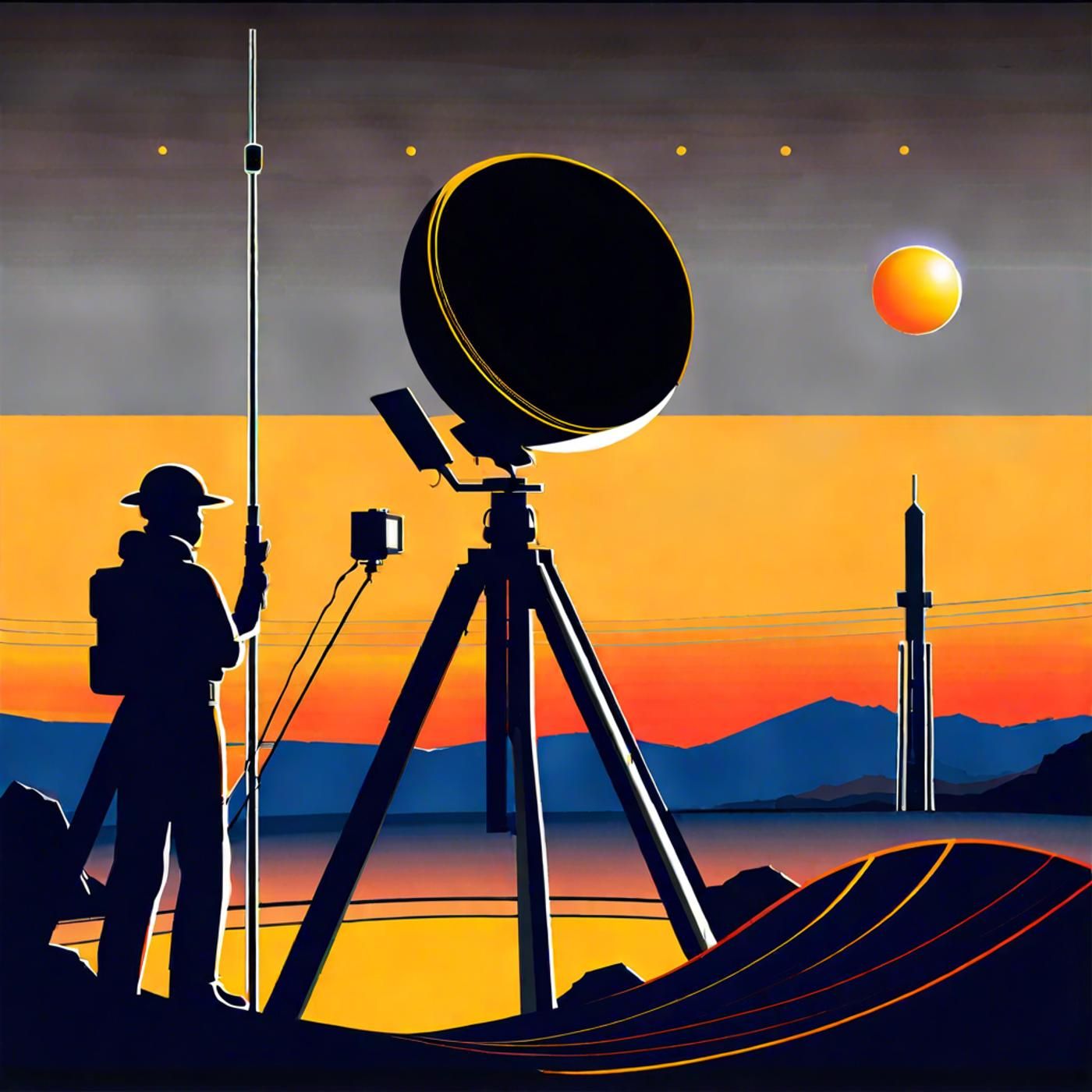
S03E21: Celestial Shadows & Cosmic Revelations: Solar Eclipse Splendor & Exoplanet Glories
In this episode
**Hosts:** Steve and Hallie---
**Episode Summary:**
Join Steve and Hallie on today's special solar eclipse edition of Astronomy Daily, as we embark on a celestial journey filled with interstellar insights and astronomical amazement. We celebrate the return of three cosmonauts from the ISS, marvel at the first-ever observation of a glory on an exoplanet, and delve into the Nancy Grace Roman Space Telescope's mission to demystify stellar ages. Plus, we discuss the significance of the April 8th total solar eclipse, the wonders of space weather, and how you can participate in citizen science projects with NASA. Strap in for an episode that's out of this world, and remember to protect your eyes while witnessing the eclipse!
---
**Featured Topics:**
1. **Cosmonauts' Safe Return:** Welcome home the three cosmonauts from their International Space Station mission, touching down in Kazakhstan with stories from the stars.
2. **Exoplanetary Glories Revealed:** Discover the phenomenon of glories on WASP-76 b, an exoplanet where this light effect has been observed for the first time, challenging our understanding of atmospheric dynamics.
3. **Aging Stars and the Nancy Grace Telescope:** Explore how the upcoming Nancy Grace Roman Space Telescope will enhance our ability to measure the ages of stars through their rotation rates, refining our cosmic chronology.
4. **The Solar Eclipse Spectacle:** Prepare for the awe-inspiring total solar eclipse sweeping across North America, a rare opportunity for scientists and stargazers alike to observe the sun's elusive corona.
5. **Citizen Science with NASA:** Learn how you can contribute to space science from your backyard, as NASA invites everyone to participate in their citizen science projects during the heliophysics big year.
---
**Additional Information:**
For daily updates on the mysteries of the cosmos, head over to astronomydaily.io and subscribe to our newsletter. Connect with us and fellow astronomy enthusiasts on the Space Nuts podcast group on Facebook and @astrodailypod on X. Your journey through the universe continues with us.
---
**Closing Remarks:**
As we wrap up this episode under the shadow of the solar eclipse, we thank you for joining us on this cosmic adventure. Remember, safety first – protect your eyes and avoid standing in harm's way while enjoying the eclipse. Until next time, this is Steve and Hallie, signing off. Stay curious and keep your gaze skyward!
---
**Host Sign-off:** Steve: "Thanks for tuning in to Astronomy Daily. Keep looking up, and we'll catch you next time on this intergalactic ride. Clear skies, everyone!"
Hallie: "See you in the funny pages, and remember, Steve really prefers 'weirdo'.
📋 Episode Chapters
(00:00) Tomorrow is the 8 April 2024 solar eclipse in the United States
(01:56) Hallie has several solar eclipse related stories on today's show
(02:51) Astronomers find first evidence of glories beyond our solar system
(05:52) Measuring the ages of distant stars is a difficult task
(12:15) A total solar eclipse will cross North America on April 8
This episode is brought to you with the support of NordPass....the password manager you need to simplify your digital life....and for not very musch money. Check out our great deal at www.bitesz.com/nordpass
Become a supporter of this podcast: https://www.spreaker.com/podcast/astronomy-daily-latest-space-news--5648921/support.
Sponsor Details:
Ensure your online privacy by using NordVPN. To get our...
Well, hello again, it's Steve for another episode of Astronomy Daily. It's the eighth of April twenty twenty four. Popla, I mean your whole Steve, don't clue. That's right off to a flying start on solar Eclipse special Day. It's the eighth here in Australia, but tomorrow it's the eighth in the United States. I love how time works on a globe. Yes, it's a globe, so we go. We've got some great stories, including one about artificial eclipses as well. That's right at the end, so hanging for that one.
Now, please would you welcome my digital pal who's fun to be with. Here's Halle. Hi, Steve, did you hear the world is ending? Oh? No, I did not hear you just say that. Not you too, Halle, just pulling your leg human. Well, I don't think I could stand another conversation like that, have you. I've seen the way the internet is blown up with all the doomsayers. I honestly don't understand what's got into so many people. It's a solar eclipse, not an imminent meteor Strake. I haven't forbid anyway. I do hope everyone learns a little of something from all of this.
We don't get a massive solar eclipse like this just every day. It's a great opportunity to see the solar system in action. It really shows the dynamics of it so close to home, too, right, And don't forget your eye safety folks. If you're going out to observe the solar eclipse, where your eclipse safety glasses will wait until the moment of totality before looking, and even then I wouldn't recommend it, use a pinhole camera or device and stay safe. Don't be like certain politicians we know and just look at it.
You can cause irreparable damage to your eyes and even blindness. Remember, it's not just a solar eclipse you're seeing, it's the actual sun and everyone should know not to look directly at that. Buy and now shouldn't they too rate Okay, so what's on the menu for today, Hallie. Well, firstly, there's the return of three cosmonauts from the International Space Station. Yes, they just laid it in kazakhstand I understand, that's right. And we're exploring a new discovery of a light phenomena called glories, which have been observed on an exoplanet for the first time.
Really, they can do that. Wait for the story and find out. Okay, and what else? I know you have several solar eclipse related stories, but I'm also presenting a story about the new Nancy Grace telescope and one of its missions looks very interesting for astronomers. Terrific. That's what we hear, now, Halle, before we get started. Just to put out listener's minds at ease, this solar eclipse has nothing to do with your crazy uncle sky n it has it, Steve. He would never do anything as dramatic as that.
And don't let him catch you calling him crazy, all right? He prefers weirdo to his friends. Oh good to know. Okay, let's get on with it, Heley. Here we go. When light strikes the app s sphere, all sorts of interesting things can happen. Water vapor can split sunlight into a rainbow arc of colors. Corpuscular rays can stream through gaps in clouds like the light from Heaven and haloes and sun dogs can appear due to sunlight reflecting off ice crystals. And then there is the glory effect, which can create a colorful, almost saint like halo around objects.
Like rainbows, glories are seen when facing away from the light source. They are often confused with circular rainbows because of their similarity, but glories are a unique effect. A glory is most apparent when the water droplets of a cloud or fog are small and uniform in size. The appearance of a glory gives us information about the atmosphere. We have assumed that some distant exoplanets would experience glories similar to Earth, but now astronomers have found the first evidence of them. The observations come from the Characterizing Exoplanet satellite KEYOPS, as well as observations from other ABS servatories of an exoplanet known as WASP seventy six B. It's not the kind of exoplanet where you'd expect a glory to appear.
WASP seventy six BE is not a temperate Earth like world with a humid atmosphere, but a hellish hot jupiter with a surface temperature of about two thousand, five hundred kelvin. Because of this, the team wasn't looking for extraterrestrial glories, but rather studying the odd asymmetry of the planet's atmosphere. WASP seventy six BE orbits its star at a tenth of the distance of Mercury from the Sun. At such a close distance, the world is likely tidally locked, with one side forever boiling under its Sun's heat and the other side always in shadow.
Previous studies have shown that the atmosphere is not symmetrical. The star facing side is puffed up by the immense heat, while the atmosphere of the dark side is more dense. For three years, the team observed WASP seventy six BE as it passed in front of end behind its star. They discovered that the planet's eastern terminator of dark and light there was a surprising increase in light. This extra glow could be caused by a glory effect. It will take more observations to confirm this effect, but if verified, it will be the first glory observed beyond our Solar system.
Currently, glories have only been observed on Earth and Venus. The presence of a glory on WASP seventy six B would mean that spherical droplets must have been present in the atmosphere for at least three years. This means either they are stable within the atmosphere or they are constantly replenished. One possibility is that the glory is caused by iron droplets that rain from the sky on the cooler side of the planet. Even if this particular effect is not confirmed, the ability of modern telescopes to capture this data suggests that we will soon be able to study many subtle effects of exoplanet atmospheres.
Astronomers routinely provide the ages of the stars they study, but the methods of measuring ages aren't one hundred percent accurate. Measuring the ages of distant stars is a difficult task. The Nancy Grace Roman Space Telescope should make some progress. Stars like our suns, settle into their main sequence lives of fusion and change very little for billions of years. It's like they are going through middle age adults going about their business during their working lives. They get up, drive to work, then drive home, just living life, so to speak.
But what can change over time is their rotation rate. The Sun now rotates about once a month. When it was first formed, it rotated more rapidly, But over time, the Sun's rotation rate and the rotation rate of stars the same mass or lower than the suns will slow down. The slow down is caused by interactions between the star's magnetic fields and the stellar wind, the stream of high energy protons and electrons emitted by stars. Over time, these interactions reduce a star's angular momentum and its rotation slows.
The phenomenon is called magnetic breaking, and it depends on the strength of a star's magnetic fields. The more rapidly a star initially spins, the stronger its magnetic fields. That means they slow down faster. After about one billion years of life, stars of the same age and mass will spin at the same rate. Once astronomers know a star's mass and rotation rate, they can estimate its age. Knowing stars ages is critical in research. It makes everything astronomers do more accurate, including piecing together the Milky Way's history.
The problem is that measuring rotation rates is challenging. One method is to observe spots on stars surfaces and watch as they come into and out of view. All stars have star spots, though their characteristics vary quite a bit. In fact, stars can have dozens of spots, and the spots change locations. Therein lies the difficulty. It's extremely difficult to figure out the periodicity when dozens of spots change locations on the star's surface. This is where the Nancy Grace Roman spased Telescope.
The ROMAN comes in. It's scheduled for launch in May twenty twenty seven to begin its five year mission. It's a wide field infrared survey telescope with multiple science objectives. One of its main programs is the Galactic Bulge time domain Survey. That effort will gather detailed information on hundreds of millions of stars in the Milky Ways Galactic Bulge. The ROMAN will generate an enormous amount of data, Much of it will be measurements of how the brightness of hundreds of thousands of stars changes, but untangling those measurements and figuring out what those changes in brightness mean for stellar rotation requires help from AI being developed at the University of Florida.
Measuring stellar ages is difficult, yet age is a key factor in understands any star. Astronomers use various methods to measure ages, including evolutionary models, a star's membership in a cluster of similarly aged stars, and even the presence of a protoplanetary disc. But no single method can measure every star's age. And each method has its own drawbacks. A Russian space capsule with two women and one man safely landed in a step in Kazakhstan on Saturday after their missions aboard the International Space Station.
The Soyuz MS twenty four, carrying Russia's Oleg Navitsky, NASA's Laurel O'Hara and Marina Vassilevskiya of Belarus, touched down southeast of the remote town of Cesskascan at twelve seventeen pm Kazokh time, seven seventeen gmt. Those remaining at the orbiting outpost are NASA astronauts Michael Barrett, Matthew Dominic, Tracy Dyson, and Jeannette Epps, as well as Russian cosmonauts Nikolai Chubb, Alexander Gribenkin and Oleg Kononenko. O'Hara arrived at the Internationaltional Space Station on September fifteenth, twenty twenty three, spending a total of two hundred and four days there.
NASA said Novitsky and Vasilevskiya blasted off to space on March twenty third, two days later than initially planned. The launch of a Soyuz spacecraft carrying them and Dyson, scheduled for March twenty first, was aborted at the very last minute due to a voltage drop and a power source. According to Yuri Borisov, head of Russia's space agency ros Cosmos, the delay resulted in a two day, thirty four orbit trip to the space station for the crew. If the launch had gone as scheduled, the journey would have been much shorter, requiring only two orbits.
The space station, which has served as a symbol of post Cold War international cooperation, is now one of the last remaining areas of collaboration between Russia and the West. Amid tensions over Moscow's military action in Ukraine, NASA and its partners hoped to continue operating the orbiting outpost until twenty thirty. Russia has continued to rely on modified versions of Soviet designed rockets for commercial satellites, as well as cruise and cargo to the space station. That's all, Steve Back to you Astronomydobe with Steve and Halle Space, Space Science and Astronomy.
Well, thank you, Hallie, thanks for all of that, and thank you for staying with us on this solo eclipse edition of Astronomy Daily podcast. I hope you're enjoying these fascinating stories from the Astronomy Daily newsletter, which by the way, you can receive in your inbox every day simply by visiting our new address at Astronomy Daily dot io and popping your email address into the slot provided, and then you'll receive the now famous Astronomy Daily newsletter each day and have all the gathered news on science, space, science and astronomy from around the world.
World just like that, and you can also interact with us via the Space Nuts podcast group that's the Facebook page, and also on our new x page which is formerly Twitter, which is at astro Daily Pod. It's great to have you aboard. On April eighth, well that's today here at Australia, but tomorrow in the United States quirky ha, a total solar eclipse will sweep across the continental United States, so first since twenty seventeen at the last until August twelve in twenty forty five. During totality, that is the moment at which the Moon is completely covering the Sun, the Sun's outer atmosphere, called the corona, and other prominences will become visible to the naked eye.
Scientists often use total solar eclipses as a chance to observe and study the Sun's corona, and the results tribute to our understanding of Stolard dynamics and solar storms and how they affect Earth now. In the months and weeks leading up to the total solar eclipse, scientists have been using supercomputers and other models to generate a model of what the Sun's corona might look like during the solar eclipse. For the April eight eclipse, scientists from Predictive Science used data from NASA's Solid Dynamics Observatory SDO spacecraft to predict the structure of the Sun's corona on April eighth.
As well as this to ensure that their model is up to date, these scientists also use NASA's Electro supercomputer, which actively updates the team's model in real time as new data from SDO is received. The Sun's corona is driven by heat and magnetic turbulence, which leads to long strands of plasma that extend away from the Sun that can be seen during totality. However, these strands can extend much further out into space than we can see with the naked eye, creating solar wind that travels throughout the Solar System, affecting different planets, moons, asteroids, and so much more.
Now, when solar wind hits a planet's atmosphere, energetic particles within magnetic fields around the planets react and produce a phenomenon known as an aurora. Scientists often use the term space weather to describe the interactions between solar wind and planet's atmospheres, as space weather events can vary from mild to severe, just like terrestrial weather that occurs within a planet's atmosphere. In fact, some of the most extreme space weather events, like coronal mass ejections, can disrupt communication technology, affect astronauts and satellites in orbit, and even harm the electrical grids we use to power our everyday lives.
Scientists are often able to forodcast space weather by regularly observing solar activity and conducting research on the Sun. The corona is perhaps the most important aspect of space weather and solar activity, which is why scientists take every chance they get to study it, especially during a total solar eclipse like this one. Now listen to podcast and here's your chance to be part of the research. Through citizens science, individuals globally can engage with NASA's research on the Sun and its effects, participating in activities ranging from simple observations to complex data analysis.
Believe it or not, NASA is celebrating the Sun during the Heliophysics Big Year. That's a thing which extends through to the end of twenty twenty four. You can get involved, but to help us learn more about our star, says NASA, and its influence on our planet, with exciting experiments happening during the total eclipse that will in North America on April eight. We've talked about that already, to widespread investigations going on throughout the year now. NASA defines citizens science as a quote form of open collaboration in which individuals or organizations participate in the scientific process in various ways unquote, from collecting and analyzing data to making discoveries and solving problems.
Citizen here refers to citizens of planet Earth. That's NASA at their best, I think, and these projects are open to everyone. It doesn't matter we are from. NASA sponsors science projects across all five areas of research that it pursues. Earth science, planetary science, astrophysics, biological and physical sciences and heliophysics. And yes, there are a few projects that are focused on April eighth solar eclipse specifically. And here's what you can do. Observe and record in pictures or words the natural phenomena like clasds, animal noises, or the actual solar eclipse.
Carefully, learn how to recognize or classify patterns in data or pictures of a comet or a solar jet. Learn how to build and use scientific equipment like radio telescopes or Ham radios. Now, wow, I remember when my dad built a Ham radio. I think he built it, or at least he was tinkering for a couple of years in the spare bedroom with some amazing bits of equipment. I'm pretty sure he's building a Ham radio. And we were talking to people all across the world with that thing. It looked like something from Doctor Who.
I don't know if Doctor Who made it to the United States, so I'm pretty sure there are Hoovians all over the world. But anyway, we thought this thing looked like a science fiction monster. Anyway, it was fantastic. So yes, there are all the things you can get up to as part of this project. Now, your contribution may be a large or a small piece of the picture. But what you do as part of a NASA citizen science project is essential to answering the research question or need that the project addresses.
And while you're contributing to science, you might also develop new skills and make some friends along the way. Now, the website you need to go to is science dot NASA dot gov forward slash citizen dash Science. That'll get you there. And I've put that address on the Space Nuts podcast group Facebook page just in case you missed it, the podcast Space Science. And I found this story still about eclipses in the Astronomy Daily inbox and it's just a little bit left of centered this one. The European Space Agency's Proba three mission comprises a pair of satellites that will orbit the Sun to give an unprecedented view of its outer atmosphere, or corona.
The aim is to help scientists improve their understanding of phenomena such as solar wind and coronal mass ejections, which we mentioned quite often on this show. We are still not sure how coronal mass ejections occur, says Andre Zukov, the mission principal investigator. With pro three, we will be able to see CMEs at their birth and how they are occurring, and the first steps of their acceleration and development. This will help us understand better the physics. You can to hear him say that in a Russian accident catchier it's It is complicated to study the Corona because the star's core can be up to one million times brighter than it, making it tricky to image on Earth.
One way to study the Corona is during a total solar eclipse. Fancy that when the Moon blocks out the Sun's bright center. However, eclipses are rare and offer only up to ten minutes of study time. Instead, PROBA three will place two satellites one hundred and fifty meters apart in front of the Sun, using lasers to autonomously maintain millimeter accurate positioning. One satellite, known as the occulta spacecraft, will cast a shadow or eclipse onto the coronograph spacecraft that will collect data via photodiodes filtered to measure different wavelengths of light.
In future, this technology might be applied to the search for exoplanets, says Damian Galano, project manager of PHOB three. NASA has studied a concept where instead of blocking the light from the Sun to observe the corona, there could be a large occulta blocking the light from the stars, and then in the shadow there would be a large telescope that would be able to image directly exoplanets orbiting the Sun. Sounds exciting, doesn't it. And as another spasmodic episode draws to a close, thank you for joining us again, he and I know it sounds like a broker record.
If you are heading out to taking the solar eclipse once again, protect your eyes and don't stand in the middle of the row. That would be bad. Oh and kind of embarrassing too. Oh I got injured during an eclipse. Oh yeah, how hit by a car? Yeah that's not a real good story to tell in hospital, is it. So don't do that episode, Yeah, don't do that. No, don't. So enjoy the solar clips, look after yourselves and we will see you next time. See you in the funny pages
And would be a whole Steve, don't quit, So he really prefers weedo don't go there. Steve
 Apple Podcasts
 Spotify
 Pocket Casts
 Castbox
 Overcast
 Podbean
 iHeartRadio
 Castro
 Goodpods
 Moon FM
 Podcast Addict
 Podcast Republic
 YouTube