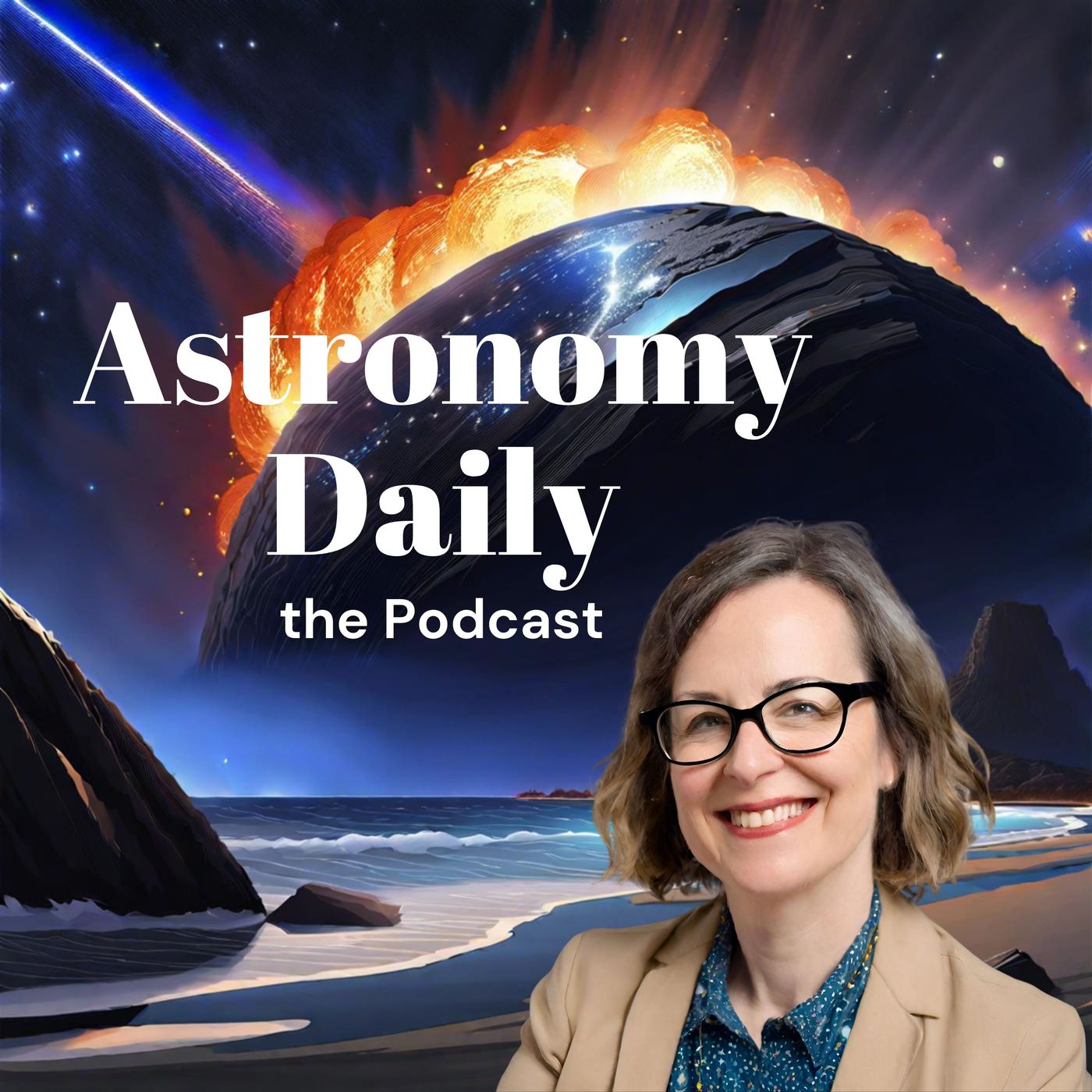
In this episode
Astronomy Daily - The Podcast: S03E186Welcome to another thrilling episode of Astronomy Daily, your go-to source for the latest in space and Astronomy news. I'm your host, Anna, and today we're diving into a cosmic lineup that spans from ancient meteorite impacts to the intriguing world of black hole mergers.
Highlights:
- Ancient Meteorite Impacts: Journey back 3.26 billion years to an Earth transformed by a colossal meteorite impact, 200 times larger than the one that ended the dinosaurs. Discover how this cataclysmic event may have surprisingly boosted early life, as revealed by recent research in the Barberton Greenstone Belt of South Africa.
- Busy Week for Space Launches: SpaceX is set for another Starlink satellite launch from Cape Canaveral, alongside a classified mission for the National Reconnaissance Office, potentially marking their 400th orbital launch. Meanwhile, China, Blue Origin, and Japan are all gearing up for significant launches, showcasing the dynamic pace of global space exploration.
- Asteroid Ryugu's Surprising Origins: New analysis of samples from asteroid Ryugu challenges previous beliefs about its formation. Findings suggest it may have formed near Jupiter, offering fresh insights into the complex history of carbon-rich asteroids and the early solar system.
- Black Hole Mergers: Delve into the violent and fascinating process of black hole mergers, where cosmic collisions release gravitational waves more powerful than all the stars in the observable universe combined. These events provide unprecedented insights into the nature of spacetime and gravity.
- Doritos in Space: In a lighter story, Doritos debuts the first commercial filmed in space. Learn how the beloved snack made its way to orbit with a special zero-gravity Cool Ranch flavor, raising funds for St. Jude Children's Research Hospital.
For more out-of-this-world news, visit our website at astronomydaily.io. There, you can sign up for our free Daily newsletter, catch up on the latest space and Astronomy news with our constantly updating newsfeed, and listen to all our previous episodes.
Don't forget to follow us on social media. Just search for #AstroDailyPod on Facebook, X, YouTubeMusic, and TikTok.
Thank you for tuning in. This is Anna signing off. Until next time, keep looking up and stay curious about the wonders of our universe.
Sponsor Links:
NordVPN - www.bitesz.com/nordvpn - currently Up to 74% off + 3 extra months
Old Glory - www.bitesz.com/oldglory Sport and Entertainment Merch. Over 100,000 items in stock
Proton Mail - www.bitesz.com/protonmail Secure email that protects your privacy
Malwarebytes - www.bitesz.com/malwarebytes Premium protection for you and all your devices!
Become a supporter of this podcast: https://www.spreaker.com/podcast/astronomy-daily-the-podcast--5648921/support
Sponsor Details:
Ensure your online privacy by using NordVPN. To get our special listener deal and save a lot of money, visit www.astronomydaily.io/nordvpn. You'll be glad you did!
Get the best secure and private email on the planet. Stop...
Welcome to Astronomy Daily, your source for the latest space in astronomy news. I'm your host, Anna, and today we've got an exciting lineup of stories covering everything from ancient meteorite impacts to black hole mergers. Let's start today by taking a journey back in time about three point two six billion years ago, to an Earth very different from the one we know today. Picture a violent scene an enormous meteorite up to two hundred times larger than the one that wiped out the dinosaurs, slamming into our planet.
You might think this catastrophic event would spell doom for any life trying to gain a foothold on early Earth, But surprisingly, this cosmic collision may have actually given primitive life a boost. Recent research published in the Proceedings of the National Academy of Sciences reveals that this ancient impact created unexpectedly favorable conditions for some early life forms. The study focused on evidence found in the Barberton Greenstone Belt in South Africa, which preserves a remarkable record of at least eight major impacts from this tumultuous period in Earth's history.
So how did this cataclysmic event benefit life? While the impact stirred things up in a big way. It caused massive tsunamis that transported iron from the deep ocean to shallower waters. This iron bonanza allowed iron metabolizing bacteria to thrive. Additionally, the meteorite itself brought phosphorus to the party, giving phosphorus loving microbes a chance to flourish as well. While the initial aftermath was undoubtedly devastating, with thick dust clouds likely shutting down photosynthesis temporarily, life rebounded quickly.
This research challenges our assumptions about the relationship between cosmic impacts and the evolution of life, suggesting that these violent events might have played a crucial role in shaping Earth's earliest ecosystems. Next, let's turn our attention to this week's launch schedules. This week is shaping up to be another busy one for space launches, with multiple missions on the docket from various launch providers around the world. SpaceX continues its rapid fire pace of Starlink deployments with another batch of Internet satellites set to launch from Cape Canal.
This mission will further expand the company's growing constellation, bringing high speed Internet to more remote areas across the globe. But SpaceX isn't stopping there. They're also gearing up for a classified mission for the National Reconnaissance Office later in the week. This launch, code named NROL one hundred and sixty seven, will lift off from Vandenberg Space Force Space in California. If schedules hold, this could mark SpaceX's four hundredth orbital launch, an incredible milestone for the company.
Meanwhile, China is maintaining its own ambitious launch tempo. Two missions are planned this week, using different variants of their long March rockets. While details are scarce, as is often the case with Chinese launches, these missions demonstrate China's continued push to expand its presence in space. Blue Origin is making another attempt at an uncrude test flight of its new Shepherd vehicle. This launch will debut a new crew capsule named RSS Carmen Line and a new booster. The flight will carry various scientific payloads and test new technologies for future lunar missions.
Over in Japan, Mitsubishi Heavy Industries is preparing to launch its H three rocket carrying a military communication satellite for the Japanese government. This will be only the fourth flight of Japan's new flagship launcher. It's worth noting that all of these launches are subject to changes due to weather or technical issues. However, the packed schedule highlights the growing commercial and government activity in space. As we see more frequent launches from a diverse set of providers and nations, it's clear that access to space is becoming increasingly routine.
This is opening up new possibilities for scientific research, earth observation and space exploration. Moving on, new analysis of samples from asteroid Reyugu has once again surprised scientists, challenging our previous understanding of how carbon rich asteroids form. When Japan's Hyabusa two mission brought back samples from Reyugu four years ago, researchers initially thought the asteroid had formed beyond Saturn's orbit. However, a recent study published in Science Advances suggests that Ryugu may have actually formed much closer to home, near Jupiter.
Scientists at the Max Planck Institute for Solar System Research in Germany compared the types of nickel found in Ryugu samples to those in typical carbon rich meteorites. Their findings indicate that different carbon rich asteroids may have formed in the same region near Jupiter, but through varying processes and about two million years apart. This discovery has significant implications for our understanding of the early Solar system. It suggests that the formation of carbonaceous chondrites, a class of meteorites to which Ryugu belongs, may be more complex than previously thought.
The researchers propose that the first carbonaceous chondrites began to form around two million years after the formation of our solar system, accumulating material as they traveled inward towards the Sun. Interestingly, this new theory also provides a potential solution to the long standing mystery of y ci chondrites, a rare subgroup to which Ryugu is closely related, have a different composition from others carbonaceous chondrites. The study suggests that cichondrites may have formed later, under different conditions, but in the same region near Jupiter.
This research demonstrates how crucial laboratory investigations of space samples can be in deciphering the formation history of our Solar system. It's a reminder that even as we explore further into space, sometimes the most significant discoveries come from studying the tiny grains of rock we bring back to Earth. Now, let's delve into the fascinating and violent process of black hole mergers. These cosmic collisions are some of the most energetic events in the universe, and they're helping us understand the fundamental nature of space and time.
The journey begins with two black holes orbiting each other at a great distance. They might have started as a pair of massive stars or randomly encountered each other in the vastness of space. For these giants to merge, they need to get much closer, which means shedding a lot of orbital energy. At first, this energy loss happens through interactions with their environment nearby gas, dust, or even stars. As they get closer, the real show begins. The black holes start to stir up space time itself, releasing gravitational waves that ripple outward like ripples in a pond.
In the final moments before merger, things get really wild. The black holes event horizons, those points of no return, begin to stretch and deform. They reach out to each other with thin tendrils, forming a bridge between the two. It's like watching two soap bubbles collide and merge in slow motion, except this is happening on a cosmic scale. The actual merger happens in the blink of an eye. The two become one, but not without consequences. A significant portion of their combined mass, usually around five percent, gets converted directly into energy in the form of gravitational waves.
To put that in perspective, it's like turning three entire suns into pure energy in an instant. This release of energy is more powerful than all the stars in the observable universe combined. Yet it happens in complete silence and darkness, detectable only through the subtle ripples in space time that eventually reach our gravitational wave detectors here on Earth. These mergers are giving us unprecedented insights into the nature of gravity, space time, and the evolution of the universe. Each detection helps us refine our understanding of these cosmic behemoths and the fundamental laws that govern our universe.
And now for a lighter story that's sure to make you smile. It seems nowhere is safe from advertising. This week, Dorito's are debuting the first ever commercial filmed in space. As you may remember, Dorito's, the beloved snack chip, recently made its way to space on a private astronaut mission, and now we have the follow up commercial filmed with astronauts biting down on these special snacks. But eating chips in zero gravity isn't as simple as you might think. For decades, chips were on the no fly list for space missions due to the risk of crumbs floating around and potentially causing issues with equipment or the astronauts themselves.
But Freedom Lay fo a way to bring doritos to orbit safely. The company created a special zero gravity cool ranch flavor, using oil based seasoning instead of the usual powdery coating to minimize mess. They also packaged the chips in individual canisters to protect them during launch. Astronauts c and Proctor describe the experience, saying the chips held up incredibly well and tasted great. The bite sized mini versions were perfect for snacking in space without creating a cloud of crumbs. This tasty experiment wasn't just about commercials and snacking, though.
Frido Lay used the opportunity to raise funds for Saint Jude Children's Research Hospital, allowing space enthusiasts on Earth to get their hands on some of these special chips in exchange for donations. It just goes to show that even in the vastness of space, we can still find ways to enjoy our favorite Earth treats with a little creative problem solving, of course. And that wraps up today's journey through the cosmos. From ancient meteorite impacts to cutting edge space snacks, We've covered a lot of ground, or should I say a lot of space.
I'm Anna, and you've been listening to Astronomy Daily. For more out of this world news, be sure to visit our website at Astronomy Daily dot io. There you can sign up for our free daily newsletter, catch up on all the latest space and astronomy news with our constantly updating news feed, and listen to all our back episodes. Don't forget to follow us on social media too, Just search for astro Daily Pod on Facebook, x, YouTube and TikTok. Until our next cosmic adventure, keep looking up and stay curious about the wonders of our universe.
This is Anna signing Offiday Star Starz

 Apple Podcasts
 Spotify
 Pocket Casts
 Castbox
 Overcast
 Podbean
 iHeartRadio
 Castro
 Goodpods
 Moon FM
 Podcast Addict
 Podcast Republic
 YouTube