S03E18: Celestial Swan Song: Delta IV's Final Flight and Lunar Landings Legacy
In this episode
**Hosts:** Charlie and the Astronomy Daily Team---
**Episode Summary:**
In today's transcendent episode of Astronomy Daily, let Charlie and the team be your celestial guides as we delve into the latest awe-inspiring events unfolding in the boundless theater above. Witness the unexpected delay of the Delta IV Heavy's final mission and the historic touchdown of the American-built Nova-C spacecraft on the Moon. We'll also ponder the Earth's accelerating rotation and its potential impact on timekeeping, and debate the merits of human versus robotic space exploration with insights from Britain's astronomer, Martin Rees. Plus, we prepare for the upcoming total solar eclipse set to unveil the sun's mysterious corona. Join us as we connect you to the cosmos, turning the sky's vastness into an intimate spectacle of discovery.
---
**Featured Topics:**
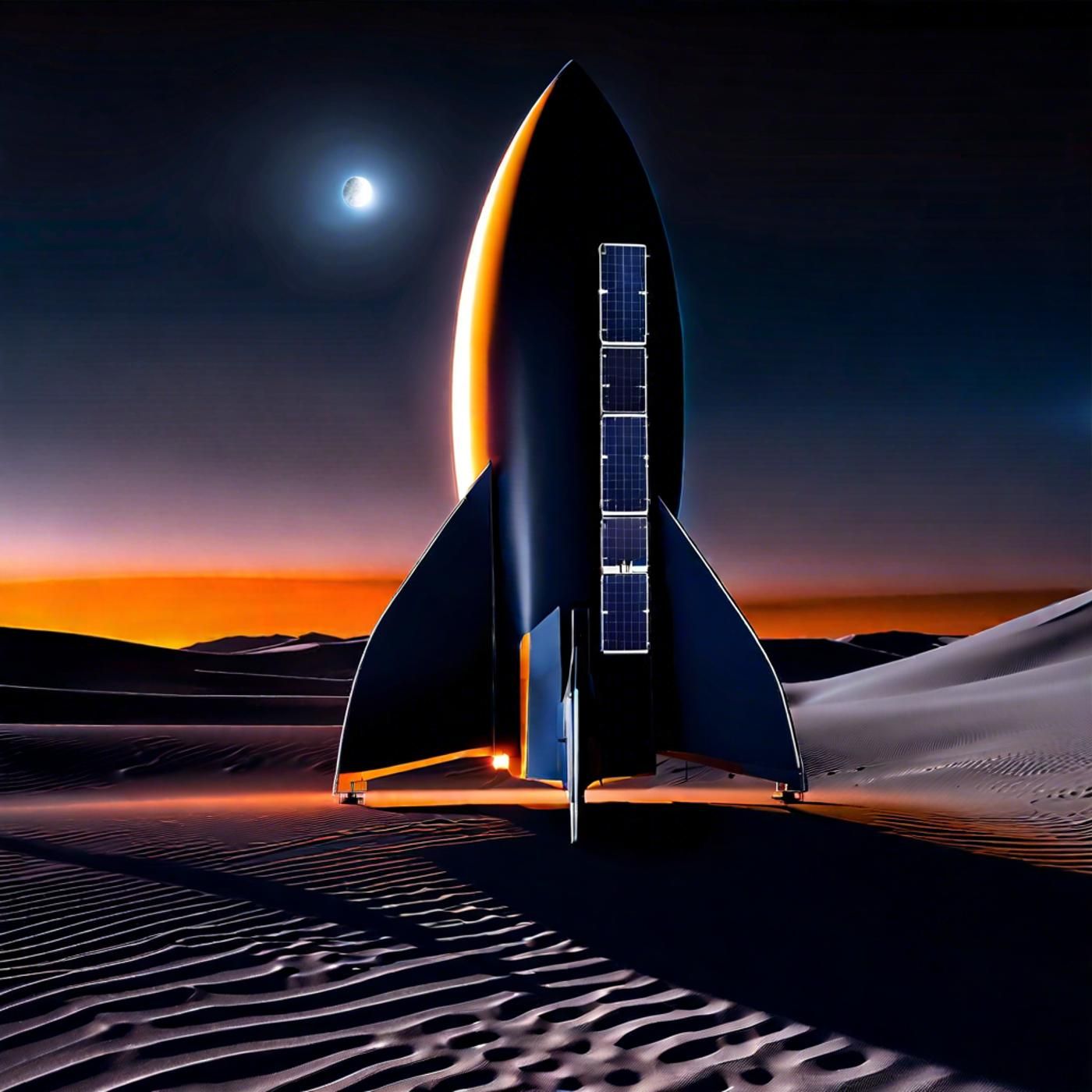
1. **Delta IV Heavy's Last Stand:** Uncover the story behind the postponed swan song of a rocket that has served the skies for decades, and what this means for the future of space launches.
2. **Odysseus' Lunar Legacy:** Celebrate the Nova-C spacecraft's historic moon landing, and explore its contributions to NASA's lunar ambitions despite its silent slumber in the moon's dark embrace.
3. **The Ticking of Earth's Clock:** Dive into the scientific intrigue behind our planet's hastening spin and the debate over the leap second's future in our modern, digitally-driven world.
4. **Human vs. Robot:** Engage with Martin Rees' compelling argument on the direction of space exploration and whether the age of the astronaut is giving way to the era of the robot.
5. **Chasing the Corona:** Anticipate the total solar eclipse that promises to shed light on one of the sun's greatest mysteries, with scientists and skywatchers alike poised for a celestial revelation.
---
**Additional Information:**
For an astronomical array of resources, visit astronomydaily.io to immerse yourself in our daily newsletter, listen to past episodes, and explore the latest space and astronomy news. Engage with us and fellow enthusiasts by following @astrodailypod on social media and join the conversation that stretches beyond the stars.
---
**Closing Remarks:**
As we wrap up this episode, may your curiosity be as boundless as the universe we cherish. Remember, the sky is not our limit but our gateway to infinity. Stay tuned for Monday's podcast with Steve and Hallie for more cosmic updates. Until we meet again under the celestial canopy, this is Charlie, bidding you a stellar journey. Keep looking up!
---
**Host Sign-off:** Charlie: "Thank you for embarking on today's astral adventure with us. Until our next cosmic rendezvous, this is Charlie signing off. Bye-bye, fellow stargazers!"
📋 Episode Chapters
(00:00) Astronomy daily brings the cosmos closer to you with insightful commentary
(00:43) Delta IV heavy rocket's final flight postponed slightly longer than originally planned
(02:26) First American spacecraft to soft land on moon since Apollo 17 in 1972
(04:05) Earth's hastening rotation could prompt correction of world's chronometers
(06:52) An upcoming total solar eclipse could be the key to unravelling the sun's mysteries
(08:53) This concludes today's episode of the Astronomy Daily podcast
Become a supporter of this podcast: https://www.spreaker.com/podcast/astronomy-daily-latest-space-news--5648921/support.
Sponsor Details:
Ensure your online privacy by using NordVPN. To get our special listener deal and save a lot of money, visit www.astronomydaily.io/nordvpn. You'll be glad you did!
Get...
Welcome listeners to Astronomy Daily, your daily podcast bringing the cosmos closer to you. In the enormity of the universe, it's easy to feel detached from the celestial wonders that unfold far above us. But fear not, because here we bridge that astronomical distance with insightful commentary on the latest news and discoveries from the space front. Today. Stay tuned as we explore a range of topics that touch upon the grand scales of space and time. We're here to keep you informed, marvel at the mysteries of the universe, and ensure you remain forever connected to the stars that light our night skies.
Ah So join me as we embark on this interstellar journey together. Exit the Astronomy Podcast. In a historic turn of events, the final curtain call for the legendary Delta for Heavy Rocket has been deferred slightly longer. The United Launch Alliance has announced the postponement of what's to be the last hurrah for this storied rocket, with a rescheduled take off set to pierce the Florida skies this coming Friday afternoon local time. This hold up in the eleventh hour was due to a call from Flight Control, a mere four minutes shy of the planned liftoff.
The mission code named NROL seventy, carries with it more than just a classified payload for the National Reconnaissance Office. It carries the weight of history. Closing the chapter on the Delta rocket family's illustrious service to the United States since the dawn of nineteen sixty, with origins tracing back to McDonald Douglas and evolving under Boeing post merger, the Delta four Heavy has been a celestial workhorse. Over the past two decades. It has been at the forefront of securing the skies, with four launches under its belt, sixteen of which have utilized the Delta four Heavy variant.
It has launched critical payloads for defense, for the National Oceanic and Atmospheric Administration, and even for NASA. As we approach the scheduled launch window, we honor the legacy of the Delta rockets, beginning with the Echo one, a communication satellite, and culminating with NROL seventy. With baited breath, we await this final voyage, a fitting tribute to a line of rockets that has etched its name firmly in the annals of space exploration. In a significant lunar feat the American built novsea spacecraft, affectionately known as Odysseus or OD for short, made its mark on the Moon's dusty surface, touching down on February twenty second.
This mission not only demonstrated cutting edge technologies and systems, but also became the first to soft land and American spacecraft on the Moon since Apollo seventeen in nineteen seventy two. Despite a bumpy arrival that so od Isssue's land on its side, the mission's conclusion comes with a lunaright fall that prolonged period of darkness, marking an end to this intrepid explorer's journey. The Odysseus mission, spearheaded by Intuitive Machines, is pivotal for NASA's ambitions of sustained lunar presence.
It provided valuable insights into technologies needed for long term exploration, including potential solutions for surviving the frigid lunar night, crucial for any infrastructure to be built on the lunar surface. After seven days, as darkness engulfed the Moon, Odysseus had no choice but to succumb to the lunaright with little hope of reawakening, despite initial hopes, it might call home after the darkness lifted. Yet this is not the end, but a beginning. Intuitive Machines is marching forward with two more NOVASEA landers in the pipeline, equipped with even more sophisticated tools tailored for resource utilization and research.
Odysseus's pioneering spirit will live on in these future missions as they delve deeper into the mysteries of the Moon, laying the groundwork for a robust and sustainable human presence beyond the bounds of our home planet. In a spellbinding twist in our dance with time, the Earth's hastening rotation might prompt a momentous decision from the world's chronometers, the subtraction of a leap second for the first time ever. We are anticipating a negative leap second by about twenty twenty nine, as revealed by a cutting edge study in Nature.
But why you ask? Our planet is spinning subtly quicker than in the past, a phenomenon not linked to impending doom, but certainly a matter of scientific note. Alarmingly, this acceleration could very well be delayed by Earth's own criosphere response, with melting ice from our poles counterbalancing this quickening spin. Way find ourselves at the cusp of recalibrating time itself, and as the geophysical dynamics of our home planet unravels, the implications radiate through our increasingly digitized society.
Tech giants already grapple with LEAPSECT stumbling across them like unexpected pebbles on a smooth path. The realm of politics intersects two as global powers like Russia, whose satellite systems depend on astronomical time, vie against proposed changes that could snarl their orbits. Our quest for precision in chronometry bears an unexpected adversary our own, living, breathing, and dynamic Earth. This leap second debate encapsulates the intersection of natural phenomena, technologies, march, and the very essence of how we perceive and measure the passage of time.
The debate over sending humans versus robots into the vast reaches of space has been rekindled by none other than Britain's astronomer, Royal Martin Reese. Reese has voiced a poignant skepticism questioning the prudence of funding human spaceflight with public money. According to Reese, it is the age of advanced robotics, and these machines are now capable of performing tasks once solely reserved force astronauts. His stance is clear space exploration should be shifted into the hands of those with the capacity to bear its tremendous costs and willing to embrace its high risks, private ventures and indeed billionaires.
Britain, which has historically concentrated on research probes rather than crude voyages, now faces this pivotal question as it peers into the cosmos. Is the romantic notion of human space travel enough to justify its expense, or should we step back and let autonomous technology lead the way, unfettered by the vulnerability of human presence. As renowned minds like Reese weigh in, the exploration of the Final Frontier seems poised to pivot towards a future where robots roam the heavens while humanity watches from a safe terrestrial distance.
The Astronomy Daily podcast in the Celestial Dance of Shadows, an upcoming total solar eclipse is setting the stage for a breathtaking scientific spectacle It's not just a wonder to behold with the naked eye. This eclipse could be the key to unraveling the Sun's most enigmatic features. The corona, a crown of plasma that shimmers around the Sun during totality, is a fiery riddle, a million times dimmer than the solar surface, yet reaching scorching temperatures far exceeding it. Why the corona is millions of degrees hotter than the Sun's surface remains one of astronomy's most puzzling questions.
For years, solar scientists have eagerly anticipated the chance to see the corona in full glory. It is during the eclipse's brief interlude of darkness that the corona reveals itself in full, offering a rare glimpse into these magnetic marvels, streamers, loops, and plumes that embellish the Sun's outer atmosphere. Studying these coronal structures is vital. They're the architects of space weather phenomena like solar flares and coronal mass ejections, events that can disrupt technology on Earth and pose risks to astronauts.
On Otathwapril, the stage is set across North America, where totality will provide up to four minutes and twenty seven seconds of invaluable observation time. It's a pace against the clock as scientists deploy a trove of instruments from high flying jets equipped with telescopes to ground based observatories staffed with citizen scientists. They'll record the corona in multiple wavelengths, analyzing its temperature, density, and composition to forecast the surges of the solar wind. The findings from this solar eclipse could not only revolutionize our understanding of the Sun, but also fortify our preparedness for the tempestuous solar winds.
By peering into the cosmic depths during this fleeting moment of alignment, we chase more than just the shadow of the Moon. We chase the secrets of our star held in the delicate silver lining of its corona. The Astronomy Daly five cats. As we conclude today's episode of Astronomy Daily, I hope that the stories we shared have sparked your curiosity and deepened your appreciation for the celestial wonders above us. Don't forget to venture over to our website at Astronomy Daily dot io. Where a universe of knowledge awaits you.
Whether you're looking to sign up for our free daily newsletter, listen to past episodes, or dive into our ever evolving Space and Astronomy newsfeed, We've got you covered, and remember the conversation doesn't end here. Join us again on Monday as Steve and Hallie bring you another compelling podcast update, continuing our journey across the cosmos. For daily snippets of stellar content. You're just one click away from joining our community on social media. Simply follow us on x at astro Daily Pod and be part of the discussion.
Thank you for joining us today on Astronomy Daily, and until next time, keep looking up.
The Sky's not the limit, It's just the beginning. Until next time. This is Charlie saying bye bye the Astronomy Daily Podcast. Man Control

 Apple Podcasts
 Spotify
 Pocket Casts
 Castbox
 Overcast
 Podbean
 iHeartRadio
 Castro
 Goodpods
 Moon FM
 Podcast Addict
 Podcast Republic
 YouTube