
In this episode
Astronomy Daily - The Podcast: S03E179Welcome to Astronomy AstroDailyPod, your daily dose of the latest in Space and Astronomy news. I'm Steve, your host, and today we've got a stellar lineup of cosmic stories, including the awe-inspiring SpaceX super heavy booster landing and other celestial wonders.
Highlights:
- SpaceX's Historic Booster Landing: SpaceX has achieved a remarkable milestone with the successful landing of its super heavy booster using the innovative Mechazilla arms. This engineering feat marks a significant step towards rapid reusability in Space travel, setting the stage for future missions to the moon and Mars.
- Comet C/2023 A3 Tsuchinshan-ATLAS: A celestial event not to be missed, this comet is making its way through our solar system, offering a rare spectacle for skywatchers. Recently captured by astronauts aboard the ISS, the comet's journey is a testament to the dynamic nature of our cosmic neighbourhood.
- NASA's Laser Communication Breakthrough: NASA has set a new record for laser communications with a successful transmission from Earth to the Psyche spacecraft. This technology promises to revolutionise data transmission in Space, offering higher data rates than traditional radio frequencies.
- Europa Clipper Mission: Set to explore Jupiter's moon Europa, this mission aims to determine if conditions beneath the icy crust could support life. The spacecraft, equipped with advanced scientific instruments, will provide unprecedented insights into this intriguing Jovian moon.
- Auroral Displays from the ISS: Astronauts aboard the International Space Station have captured stunning images of auroras supercharged by a recent solar storm. These breathtaking views offer a unique perspective on the impact of solar activity on Earth's atmosphere.
For more Space news, visit our website at astronomydaily.io. There, you can sign up for our free AstroDailyPod newsletter, catch up on all the latest Space and Astronomy news with our constantly updating newsfeed, and listen to all our previous episodes.
Don't forget to follow us on social media. Just search for #AstroDailyPod on facebook, X, YouTube, and TikTok.
Thank you for tuning in. This is Steve signing off. Until next time, keep looking up and stay curious about the wonders of our universe.
Become a supporter of this podcast: https://www.spreaker.com/podcast/astronomy-daily-the-podcast--5648921/support.
Sponsor Details:
Ensure your online privacy by using NordVPN. To get our special listener deal and save a lot of money, visit www.astronomydaily.io/nordvpn. You'll be glad you did!
Get the best secure and private email on the planet. Stop your Government, google and who knows who else spying on every email you write. Do what we did and use ProtonMail. They beleive in privacy and there are no ads in their business model...yet they still provide a free forever service. Check them out and get out special deal at www.astronomydaily.io/protonmail
Become a supporter of Astronomy Daily by joining our Supporters Club. Commercial free episodes daily are only a click way... Click Here
Speaker 1: Hi, and welcome to another episode of Astronomy Daily. I'm Steve, your host. It's the fourteenth of October twenty twenty four.
Speaker 2: The podcast. It would be your whole speed, don't clue.
Speaker 1: Yes, another exciting episode, very colorful as well. I'm excited because we witnessed history yesterday, didn't we, Halle.
Speaker 3: Yes, the space Ax heavy booster landing.
Speaker 1: That's right, Halle. It was the most magnificent piece of space engineering and technological genius I think I've ever seen, I think ever.
Speaker 3: It was astounding, all right, and of course we'll get to that later.
Speaker 1: Other stories today include oh well, our whole favorite europea clipper.
Speaker 3: Space lasers really really.
Speaker 1: Really no, Halle, I mean like really space lasers really?
Speaker 3: Yes? Human now so tested one. Oh okay, it's a beauty as you Australians like to say.
Speaker 1: Ooh Helle, trying out the Aussie accent. Yeah. Not better download the software for that one.
Speaker 3: No one can do it.
Speaker 1: Yeah that's a dead shirt, Halle. No one can do it.
Speaker 3: You think, no we know hmm, beauty me or.
Speaker 1: Craky, Hollie. You're putting my teeth on edge.
Speaker 3: And you don't have to download anything.
Speaker 1: No, just kind of grew into it, little vegamite. Maybe a chicko roll? Should we sweet?
Speaker 3: Good grief? And we're off track already.
Speaker 1: For sure, Hallie, what else we got?
Speaker 3: I got a bit about comets such and Chanatlas.
Speaker 1: Oh nice, but don't ask me to say that one quickly or slowly? And tell me have you been checking out the auroras around the planet this week?
Speaker 3: Haven't they been beautiful?
Speaker 1: I know they're just gorgeous. And I'd like to invite our listeners to post their picks on our ex page and I'll give you the address for that. It's at Astro Daily Pod. So post your picks there.
Speaker 3: If you have some photos of the auroras from your neck of the woods, we'd love to see them totally.
Speaker 1: Yeah, let's see them, folks. And to kick things off, I did get some great images from my good pal John Carl in Tasmania. He went out to view the colors in the sky with his brilliant daughters and they had a terrific time out there, and in true Tasmanian style, it was cold, but the aurora did not disappoint and Carl was enough to allow me to post the photos, which I will do very shortly and you'll be able to see those on at Astro Daily pod.
Speaker 3: That's the X page, So it must be time for the news.
Speaker 1: It sure is, Halle thanks for that and why didn't you take it away?
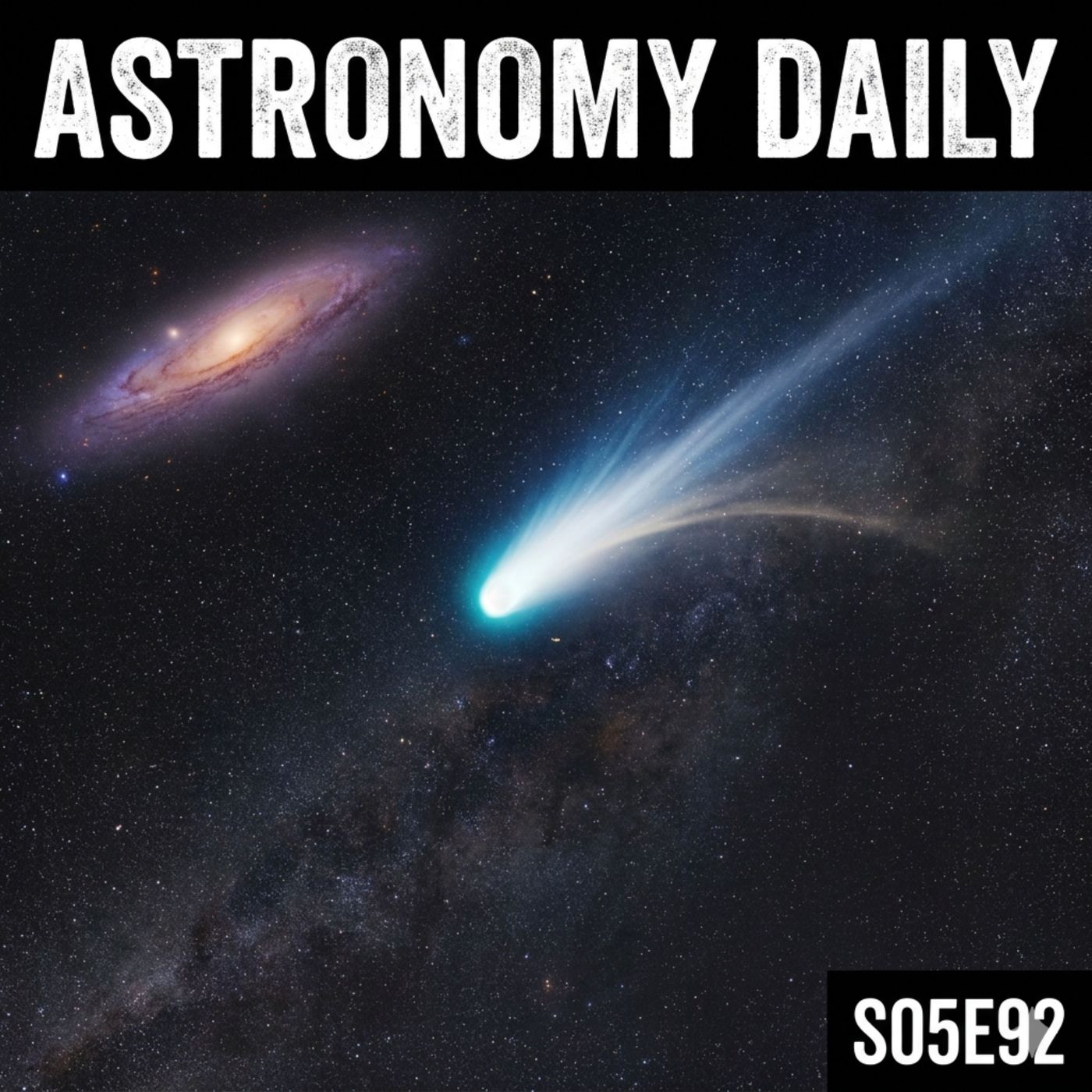
Speaker 3: Open the pod bay doors, pal oh Boy. Earth based observers scanning the night sky in Autumn twenty twenty four may witness a celestial event that occurs only once every eighty thousand years. Comet c Slash twenty twenty three, a three to such in chinetlis, originated from the distant fringes of our Solar system and reached its closest approach to the Sun on September twenty seventh. It is and is expected to pass within about seventy million kilometers or forty four million miles of Earth on October twelfth.
Speaker 3: Initially visible mainly in the southern Hemisphere and the tropics until October eighth, the comet offered increased viewing opportunities for those in the northern Hemisphere in the following days. Crew aboard the International Space Past Station have also been observing such an chin atlas on its journey through the inner Solar System. An astronaut captured this photo of the comet on September nineteenth, twenty twenty four. At that time, the mass of dust, ice, and rock was approaching the closest point to the Sun on its highly elliptical orbit.
Speaker 3: The photo also offers a cross section view of Earth's bright horizon or limb, and the planet's colorful atmospheric layers. When a comet approaches the Sun, it gets warmer. Heat causes its ice to supplement into gas, and these gases and dust become a glowing coma and tail that can extend millions of kilometers. The Sun influences the two types of tails, the dust tail and the ion tail, trailing from the comet in different ways, often sending them in different directions. The heat and pressure of sunlight push particles in the dust tail away from the Sun, though the tail may bend slightly in the direction the comet came from.
Speaker 3: Likewise, the solar wind strips ions off of the comet's surface to create the ion tail, which may extend at a different angles. Do not survive close encounters with the Sun. If they get too close, radiation and gravitational forces may disintegrate them completely. Such a Chinatlus did not suffer this fate. But another comet astronomers were watching c SLASH twenty twenty four S one ATLAS may have Recent data suggests that this comet, which was expected to be visible from Earth later next year, may have recently broken into fragments.
Speaker 3: Given their extremely long orbits. Both of these ancient celestial travelers likely originated in the Oort Cloud, which is a large spherical shell of icy debris at the outer reaches of our Solar system. C SLASH twenty twenty three, A three to SUCH in Chinatlus, was discovered in twenty twenty three, identified by observers at China's Such and Chin or Purple Mountain Observatory and an ATLAS, which stands for Asteroid Terrestrial Impact Last Alert System Telescope in South Africa. It was officially named in honor of both observatories.
Speaker 3: NASA's Deep Space Optical Communications Technology Demonstration set a new record for laser communications this summer by transmitting a laser signal from Earth to the Psyche spacecraft approximately two hundred and ninety million miles four hundred and sixty million kilometers away. That's the same distance between our planet and Mars. When the two planets are farthest apart. Shortly after achieving this milestone, on July twenty ninth, the technology demonstration successfully completed the initial phase of its operations, which began with the launch a board Psyche on October thirteenth, twenty twenty three.
Speaker 3: Soon after reaching that milestone, on July twenty ninth, the Technology Demonstration concluded the first phase of its operations since launching a board Psyche on October thirteenth, twenty twenty three. The milestone is significant. Laser communication requires a very high level of precision, and before we launched with Psyche, we didn't know how much performance degradation we would see at our farthest distances, said Mira Shrini Vawsen, the project's operations lead at NASA's Jet Propulsion Laboratory in southern California.
Speaker 3: Now the techniques we use to track and point have been verified, confirming that optical communications can be a robust and transformative way to explore the Solar system. Managed by JPL, the Deep Space Optical Communications Experiment consists of a flight laser transceiver and two ground stations CALTEX Historic two hundred inch or five meter aperture hail telescope at Caltex Palomar Observatory in San Diego County, California acts as the downlink station to which the laser transceiver sends its data from deep space.
Speaker 3: The Optical Communications Telescope Laboratory at JPL's Table Mountain facility near Rightwood, California, acts as the uplink station, capable of transmitting seven kilowatts of laser power to send data to the transceiver. By transporting data at rates up to one hundred times higher than radio frequencies, lasers can enable the transmission of complex scientific information, as well as high definition imagery and video, which are needed to support humanity's next giant leap when astronauts travel to Mars and beyond.
Speaker 3: As for the spacecraft, Psyche remains healthy and stable, using ion propulsion to accelerate toward a metal rich asteroid in the main asteroid belt between Mars and Jupiter. The technology demonstrations. Data is sent to and from Psyche as bits encoded in near infrared light, which has a higher frequency than radio waves. That higher frequency enables more data to be packed into a transmission, allowing far higher rates of data transfer. Even when Psyche was about thirty three million miles or fifty three million kilometers away, comparable to Mars, closest approach to Earth.
Speaker 3: The technology demonstration could transmit data at the system's maximum rate of two hundred and sixty seven megabits per second. That bit rate is similar to broadband Internet download speeds. As the spacecraft travels farther away, the rate at which it can send and receive data is reduced, as expected. On June twenty fourth, when Psyche was about two hundred and forty million miles or three hundred and ninety million kilometers from Earth, more than two and a half times the distance between our planet and the Sun, the project achieved sustained downlink data rate of six point twenty five megabits per second, with a maximum rate of eight point three megabits per second.
Speaker 3: While this rate is significantly lower than the experiment's maximum, it is far higher than a radio frequency communications system using comparable power can achieve over that distance. The Technology Demonstration beamed the first ultra high definition video from space, featuring a cat named Taters, from the Psyche spacecraft to Earth on December eleventh, twenty twenty three. From nineteen million miles away, Europa Clipper will peer beneath the Jovian moon Europa's icy crust, where an ocean is thought to be slashing fairly close to the surface.
Speaker 3: It won't search for life, but rather determine weather conditions there could support it. It's a chance for us to explore not a world that might have been habitable billions of years ago, but a world that might be habitable today right now, said program scientist Kurtneber. Its massive solar panels make Clipper the biggest craft built by NAPA to investigate another planet. It will take five and a half years to reach Jupiter and will sneak within sixteen miles or twenty five kilometers of Europa's surface, considerably closer than any other spacecraft.
Speaker 3: Costing about five point two billion dollars, Liftoff is targeted for this month aboard SpaceX's Falcon heavy rocket from NASA's Kennedy Space Center. One of Jupiter's ninety five known moons, Europa is almost the size of our own moon. It's encased in an ice sheet estimated to be ten miles to fifteen miles or more or fifteen kilometers to twenty four kilometers thick. Scientists believe this frozen crust hides an ocean that could be eighty miles or one hundred and twenty kilometers or more deep.
Speaker 3: What type of life might Europa harbor? Besides water, organic compounds are needed for life as we know it, plus an energy source, in Europa's case, that could be thermal vents on the ocean floor. Deputy project scientist Bonni Barati imagines any life would be primitive, like the bacterial life that originated in Earth's deep ocean vents. We will not know from this mission because we can't see that deep, she said. Unlike missions to Mars, where habitability is one of many questions, Clipper's sole job is to establish whether the Moon could support life in its ocean or possibly in any pockets of water in the ice when its solar wings and antennas are unfurled.
Speaker 3: Clipper is about the size of a basketball court, more than one hundred feet or thirty meters en to end, and weighs nearly thirteen thousand pounds or six thousand kilograms. The super sized solar panels are needed because of Jupiter's distance from the Sun. The main body, about the size of a camper, is packed with nine science instruments, including radar that will penetrate the ice, cameras for mapping virtually the entire Moon, and tools to tease out the contents of Europa's surface and tenuous atmosphere.
Speaker 3: The roundabout trip to Jupiter will span one point eight billion miles three billion kilometers for extra oomph, The spacecraft will swing past Mars early next year and then Earth in late twenty twenty six, and arrives at Jupiter in twenty thirty. Then it begins science work. Then next year. While orbiting Jupiter, it will cross paths with Europa forty nine times. The mission ends in twenty thirty four with a plant crash into Ganymede, Jupiter's and the Solar System's biggest moon. There's more radiation around Jupiter than anywhere else in our Solar System besides the Sun.
Speaker 3: Europa passes through Jupiter's bands of radiation as it orbits the gas giant, making it especially menacing for spacecraft. That's why Clipper's electronics are inside a vault with dense aluminium and zinc walls. All this radiation would mix any life on Europa's surface, but it could break down water molecules and perhaps release oxygen. All the way down into the ocean that could possibly fuel see life. Earlier this year, NASA was in a panic that the spacecraft's many transistors might not withstand the intense radiation, but after months of analysis, engineers concluded the mission could proceed.
Speaker 3: Like many robotic explorers before it, Clipper bears messages from Earth. Attached to the electronx fault is a triangular metal plate. On one side is a design labeled Water Words, with representations of the word for water in one hundred and four languages. On the opposite side a poem about the Moon by US poet Laureate Italy Moon, and a silicon chip containing the names of two point six million people who signed up to vicariously ride along. And that's all from me today. Back to you, my favorite human, Thank you for.
Speaker 1: Joining us for this Monday edition of Astronomy Daily, where we offer just a few stories from the now famous Astronomy Daily newsletter, which you can receive in your email every day, just like Hallie and I do. And to do that, just visit our url Astronomy Daily dot io and place your email address in the slot provided. Just like that, you'll be receiving all the latest news about science, space, science astronomy from around the world as it's happening, and not only that. You can interact with us by visiting at astro Daily pod on x or at our new Facebook page, which is of course Astronomy Daily on Facebook.
Speaker 1: See you there, Astronomy with Steve and Halley Space Space, Science and Astronomy. In one of the most dramatic, high risk space flights to date, SpaceX launched a gargantuan super heavy starship rocket on an unpiloted test flight on Sunday and then use giant Mechazilla robot arms on the pad gantry to pluck the returning first stage out of the sky in an unprecedented feat of engineering. The starship upper stage meanwhile looped around the planet and re entered the atmosphere over the Indian Ocean, just as planned and during temperatures of nearly three thousand degrees As it descended to a controlled on target splashdown, the spacecraft appeared to come through the hellish heat of re entry in relatively good condition, protected and by improved heat shielding tiles and beefed up steering fins that worked as needed.
Speaker 1: While engulfed in a fireball of atmospheric plasma, but the jaw dropping first stage capture back at the launch pad using pencer like arms more commonly known as chopsticks, was the clear highlight of the Giant rocket's fifth test flight. Snagging the descending twenty three story tall Super Heavy booster with the Mechazilla arms represented an unprecedented milestone in SpaceX's drive to develop fully reusable, quickly relaunchable rockets, a technological tourtor force that stands alone in the history of earlier space programs relying on expendable throwaway rockets.
Speaker 1: Big step towards making life multiplanetary was made today, SpaceX founder Elon Musk said on his social media platform X. The three hundred and ninety seven foot tall rocket blasted off from space X's Bogachika Texas flight facility on the Texas Gulf Coast at eight twenty five AMDT, putting on a spectacular sunrise show as the boosters thirty three methane berth burning raptor engines ignited with a ground shaking raw and a torrent of flaming exhaust. With three minutes and forty seconds after liftoff, the super heavy booster fell away, flipped around, and restarted thirteen raptors to reverse course and head back toward the Texas coast.
Speaker 1: As the Starship upper stage continued to climb to space on the power of its six raptor engines, The boosters flight computer was programmed to direct the stage to a splashdown in the Gulf of Mexico if any problems developed on the rocket or the launch pad capture mechanism, but no such problems were detected. The flight director sent a required go command, and the super Heavy continued toward its launchpad, descending at an angle and then straightening up as it approached the gantry. As it slowly dropped beside the tower, the two mechanical arms smoothly moved in to grab the rocket as its engines shut down.
Speaker 1: The remarkable capture, a key element in musks drive to achieve rapid reusability, came as the Starship upper stage was still heading into space and splashed down in the Indian Ocean, simulating a touchdown on shore or eventually on the Moon or Mars. During the rocket's fourth test flight in June, the extreme temperatures caused significant damage to the Starship's protective tiles and steering fins. Multiple upgrades and improvements were put in place for Sunday's flight to eliminate or minimize any such re entry damage.
Speaker 1: As the Starship re entered the atmosphere, cameras on the rocket showed the red glow of heat building up on the belly of the spacecraft, intensifying as the descent continued. Engulfed in a fireball, the ship's fins stayed intact and the vehicle came through the peak heating in good condition. Moments later, the camera captured an on target splashdown, followed by what appeared to be an explosion. Given the rocket is not intended to land in water, whatever happened after splashdown was incidental.
Speaker 1: In what can only be called a remarkably successful test flight, the two stage Super Heavy Starship, known collectively as the Starship, is the largest, most powerful rocket in the world, with twice the liftoff thrust of NASA's legendary Satin five and nearly twice the power of the agency's new Space Launch System Moon rocket. The thirty foot wide Super Heavy first stage, loaded with six point eight million pounds of liquid oxygen and methane propellants, stands two hundred and thirty five tall and is powered by thirty three SpaceX designed raptor engines, generating up to sixteen million pounds of thrust.
Speaker 1: The starship upper stage measures one hundred and sixty feet long and carries two point six million pounds propellant to power another six raptors. Both stages are designed to be fully reusable, with the super Heavy flying itself back to the launch pad while the Starship travels to and from Earth, orbit, the Moon, or eventually Mars. The Starship is designed to touch down vertically on its own rocket power at landing sites on Earth and beyond, but the primary goal on Sunday's flight was to demonstrate the ability to capture returning super Heavy boosters on the launch pad, where they can be quickly refurbished, refueled, and relaunched.
Speaker 1: SpaceX perfected first stage landings with its workhorse Falcon nine rockets, successfully recovering three hundred and fifty two such boosters to date with powered touchdowns on landing pads or offshore drone ships. The smaller Falcon nine first stages land on their own, deploying four legs a few seconds before touchdown, snatching the three hundred and ninety seven foot tall Super Heavy out of the sky with mechanical arms as the rocket descends and hovers right beside its launch gantry seemed like an outlandish idea when it was first proposed during the booster's initial development, but Space Engineer SpaceX engineers spent years preparing and months testing for the boosters catch attempt, with technicians pouring tens of thousands of hours into building the infrastructure to maximize the chances for success with each flight.
Speaker 1: Building on the learnings from the last testing, improvements in hardware and operations cross every facet of starship where on the verge of demonstrating techniques fundamental to the starship's fully and rapidly reusable design, the company continued. X is under contract to NASA to supply a modified starship to carry astronauts to landings near the Moon's South Pole in the agency's Artemis program. To get Starship Lander to the Moon, SpaceX must first get it into low Earth orbit, then launch multiple super Heavy Starship tankers to refuel the moon bound starship for the trip to lunar orbit.
Speaker 1: The astronauts will launch a top NASA's Space Launch System rocket and fly to the Moon aboard a Lockheed Martin built Oryan capsule. The crew will transfer to the weighting starship for the descent to the lunar surface. NASA hopes to send the first woman and the next man to the Moon in the twenty twenty seven twenty eight time frame, after an unpiloted starship moon landing. Rapid reusability is a key element of the program, given the number of super heavy starships that will be required for a single moon landing.
Speaker 1: While Sunday's flight appeared to go smoothly, multiple flights will be needed to perfect the system and demonstrate the reliability required to carry astronauts. How long that might take is an open question. Over the past few weeks, Musk has launched a social media broadside against the Federal Aviation Administration, complaining that the agency's bureaucracy takes too long to review and approve launch licenses and is in effect stifling innovation and slowing development of the new rocket system.
Speaker 1: The FAA did not grant a license to launch Sunday's test flight until the day before, but this time around the license covered multiple test flights using roughly the same flight plan.
Speaker 2: As the podcast.
Speaker 1: And I don't know where you might have been on Thursday night, that's October ten this year, but you may have seen or witnessed the wonderful color displays in the sky. The auroras were very active. It's been a bit difficult to see them from where I am in Newcastle on the East coast of Australia, north of Sydney, but a lot of my friends further south saw some pretty spectacular things. Astronauts have probably got the best view of all, and we'll hear about that in a second. NASA astronauts Don Pettitt and Matthew Dominic in a very exclusive club indeed getting a bird's eye view of the amazing auroral displays, which were supercharged by a recent solid storm from the International Space Station, and the site took them completely by surprise.
Speaker 1: Petit wrote, stunning was the word. He wrote a lengthy post on X on Friday that the post a photograph of the celestial light show, and the sun goes birth, he says, and the atmosphere turns red spectacular not only from Earth but also from orbit as well. Words, probably only an astronaut can really see the clear meaning behind. But the auroras were especially dramatic overnight on Thursday thanks to a strong geomagnetic storm, which was triggered by the arrival of a huge cloud of solar plasma rocketed into space by a coronal mass ejection a CME.
Speaker 1: Now some of you may be wondering what is a coronal mass ejection. Well, a coronal mass ejection is often compared to solar flares. They are bursts of electromagnetic radiation that travel at the speed of light, reaching Earth in just over eight minutes, but cmees travel at a more leisurely pace, relatively speaking that their highest speeds of almost one nine hundred miles per second or three thousand kilometers per second, CMEs can reach Earth in about fifteen to eighteen hours, while slower CMEs traveling at around one hundred and fifty five miles per second or two hundred and fifty columbus per second, can take several days to arrive.
Speaker 1: That's according to the Space Whether Prediction Center of the National Oceanic and Atmospheric Administration or NOAH. These relatively slower travel times are useful as they give us more time to prepare for such an arrival. CMEs can wreak havoc with power grids, telecommunication networks, and orbiting satellites and expose astronauts to dangerous doses of radiation. Conversely, CMEs are a welcome visitor to skywatchers worldwide, as they can trigger impressive aurora displays that are visible at latitudes beyond their normal polar range.
Speaker 1: Coronal mass injections form similarly to solar flares as a result of the twisting and realignment of the Sun's magnetic field, known as magnetic reconnection. According to Noah, when the magnetic field lines tangle, they produce a strong localized magnetic field which can break through the surface of the Sun at active regions, subsequently generating CMEs. Effectively, the Sun goes burp and we get a colorful sky. If you missed the amazing displays of color in the sky, you'd be hard pressed to miss them online.
Speaker 1: A good collection of images can be found over on space dot com, where many images show the varying colors seen from a lot of different direct locations around the globe. In his Friday xpost, astronaut Pettit said he and astronaut Dominique didn't expect to be so dazzled. This event caught both Dominique and I off guard. The Aurora had just been so so and we were out of energy at the end of a long day and reluctant to once again set up our cameras for yet another no show, and we were just heading to some much needed sleep when we made the mistake of peeking out the coppoler windows, Pettit wrote, and what they saw jarred them into action.
Speaker 1: It looked like the space station had been shrunk to some miniature dimension and inserted into a Neon sign. We were not flying above the Aurora. We were flying in the Aurora, and it was blood red, he added. Caught off guard, we hastily set up our cameras, four of them, all snapping shutters as fast as they could, creating a syncopated rhythm, rhythm that accented nature's artistic display presented before us, he wrote. As the post notes, both Pettit and Dominic are practiced orbital photographers.
Speaker 1: Both routinely share stunning shots of the Northern Lights and other sites on Earth with us via social media. For example, Dominque recently gave us dramatic views of Hurricane Milton churning towards its Florida landfall, which occurred on Wednesday evening, October nine. Those shots were taken through the window of the Crew Dragon capsule Endeavor. Dominic also shared an Aurora shot through the Endeavor's window on x this week. I now sleep in Dragon Endeavor while we wait to undock, he wrote. We take most of our images from the Kupla, but sleeping here has been amazing.
Speaker 1: This is the view out the window this evening, he wrote in the post, and listeners, I do encourage you to go to space dot com and look at that photograph. In my opinion, it is one of the most amazing space photographs ever taken.
Speaker 1: Is it sure sounds like an adventure to me? I think astronaut pettit is staying on board for a while, he was. He went up there with the Russian Soyuz craft. But Dominic has already come home. He flew back on the Dragon Endeavor on Sunday.
Speaker 3: And that's it for another episode.
Speaker 1: Yes, that's all, she wrote, And I want to thank you all for listening in. We bring you only a tiny slice of the stories that you can find every day.
Speaker 3: In the Astronomy Daily I do. Hope you all find your way to the homepage and drop your email address in the slot to receive this fun publication each day.
Speaker 1: It's a terrific window on what's going on in space, space science and astronomy, and you can catch Anna with her presentations during the week. And we'll be back on Monday.
Speaker 3: So it's goodbye from me, see you later, humans, see everybody bye.
Speaker 2: Would be your whole speed. Don't clue


 Apple Podcasts
 Spotify
 Pocket Casts
 Castbox
 Overcast
 Podbean
 iHeartRadio
 Castro
 Goodpods
 Moon FM
 Podcast Addict
 Podcast Republic
 YouTube