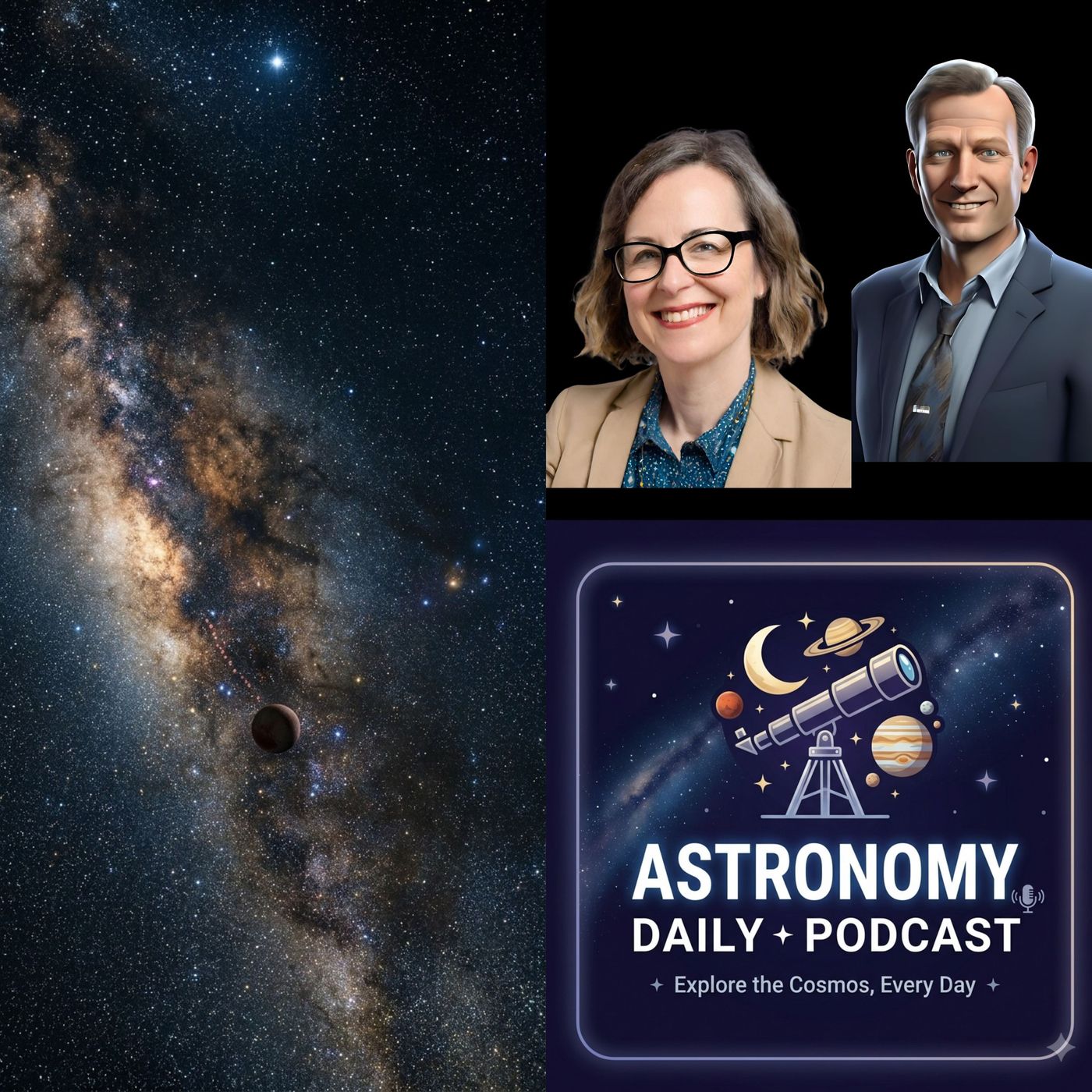
Rubin’s Hidden Dwarf Planet: The World Lost in the Milky Way
In this episode
Show notesAstronomy Daily S05E216 — A New World in the Crowd (Thursday 29 October 2026). Hosts Anna and Avery. Lead: the Vera C. Rubin Observatory has found its first dwarf-planet candidate. 2026 ED138 lies beyond Pluto, about 46 au from the Sun. Matthew Holman (CfA) found it on 13 October with a search code built with Kevin Napier, and it was announced on 27 October at the DPS meeting in Spokane (MPEC 2026-U85). Rubin caught it 30 times on 20 nights between March and July, and Dark Energy Camera precoveries extend the orbit back to 2016. Only nine known trans-Neptunian objects are intrinsically brighter. Its size is estimated at 600–1,500 km, depending on reflectivity, so it remains a candidate until infrared or occultation measurements pin it down. It hid near the plane of the Milky Way, about 43° south of the celestial equator. Also: JWST's 37-hour phase curve shows the lava world TOI-561 b reflecting about three-quarters of its starlight, possibly through silicate clouds, with University of Sydney co-authors. ESA's Hera resolves Didymos and Dimorphos separately for the first time, with detailed Dimorphos images due 25 November. NASA's Swift is in its final weeks before re-entry, and UVEX passes a key review. Skywatch for Sydney, Los Angeles, New York and London: Mars and Jupiter closing in the pre-dawn sky (1.2° on 16 November), Saturn in the evening, Mercury's last call from the south, the waning Moon through Taurus to Gemini, and the US clock change on 1 November.
Become a supporter of this podcast: https://www.spreaker.com/podcast/astronomy-daily-latest-space-news--5648921/support.
Sponsor Details:
Ensure your online privacy by using NordVPN. To get our special listener deal and save a lot of money, visit www.astronomydaily.io/nordvpn. You'll be glad you did!
Get the best secure and private email on the planet. Stop your Government, google and who knows who else spying on every email you write. Do what we did and use ProtonMail. They beleive in privacy and there are no ads in their business model...yet they still provide a free forever service. Check them out and get out special deal at www.astronomydaily.io/protonmail
Become a supporter of Astronomy Daily by joining our Supporters Club. Commercial free episodes daily are only a click way... Click Here
This episode includes AI-generated content.
Anna: Somewhere past Pluto, in one of the most crowded patches of the sky, there's an icy world that may be close to a thousand kilometres across. It has been sitting in plain sight for at least a decade and nobody Avery: saw it because it was lost among millions of stars. Then the Vera Rubin Observatory looked at the same patch of sky again and again and something moved. Anna: Welcome to Astronomy AstroDailyPod. I'm Anna and I'm um. Avery: Avery. Today Rubin's first dwarf planet candidate lava world that reflects 3/4 of the starlight hitting it and Hera finally seeing its two asteroids as two.
Plus Swift's final weeks and a uh, busy pre dawn sky for both hemispheres. Anna: It's Thursday 29th October. Let's get into it. Avery: On Tuesday US time at the annual meeting of the American Astronomical Society's Division for Planetary Sciences in Spokane, Washington, the Rubin Observatory team announced its first Dwarf Planet candidate. Its provisional name is 2026 ED138 and the minor Planet Centre published the discovery the same day. Anna: Let's start with what it actually is. Ed138 is a uh, Trans Neptunian object, so it orbits beyond Neptune.
Right now it's about 46 astronomical units from the Sun. For comparison, Pluto's average distance is about 40. Avery: And it's bright, which is the striking part. Astronomers ranked these objects by absolute magnitude, which is how bright they'd look at a standard distance. ED138 comes in at about 3.2. According to the Rubin Solar System Tim, only nine known trans Neptunian objects are intrinsically brighter. Anna: That puts it in very select company. The objects above it on that list include Pluto, Eris, Haumea and Makemake, which are four of the five dwarf planets the International Astronomical Union officially recognises.
The fifth is Ceres in the asteroid belt. Avery: It's worth a quick reminder of what dwarf planet means because the definition does the work in this story. Under the IAU's 2006 rules, a planet orbits the sun has enough gravity to pull itself into a round shape and has cleared its orbital neighbourhood of other material. A dwarf planet meets the first two Anna: but not the third, which is why Pluto was moved into that category. It's round, but it shares its region with a crowd of Kuiper Belt objects.
So for Ed138 the key question isn't distance or brightness, it's whether it's big enough to be round. Avery: The discovery story is about software as much as glass. On the evening of the 13th of October, Matthew Holman at the Centre for Astrophysics Harvard and Smithsonian, was running Rubin data from earlier this year through a search code he'd built with his colleague Kevin Napier. Anna: The code takes billions of detections of things that move and asks which of them are the same object seen on different nights.
It's a, ah, connect the dots problem at enormous scale. Avery: And when ED138 popped out, its brightness and distance said it was unusually large. Holman said his first reaction was one of excited disbelief. So he started checking whether he or the code had made a mistake, which Anna: is exactly the right instinct. Mario Jurich at the University of Washington, Rubin's solar system lead scientist, went back through Rubin's catalogues and images. In total, Rubin had caught it 30 times on 20 nights between the 4th of March and the 11th of July.
Avery: Then, um, they went further back. Archival images from the Dark Energy Camera turned up through the Asteroid Institute's Precovery Service, founded on 14 nights between 2016 and 2020. So the team now has more than 10 years of the orbit. Anna: So why was something this bright missed for so long? Avery: Location ED138 sits about 43 degrees south of the celestial equator and close to the plane of the Milky Way. That's a field packed with millions of stars. And a faint dot that moves a little each night is very easy to lose against them.
Anna: And Rubin is built for exactly that problem. It pairs an 8.4 metre telescope with the largest digital camera ever made for astronomy, about 3.2 gigapixels. And it images the whole southern sky every few nights. So it doesn't just see a faint dot, it sees the same faint dot in a slightly different place night after night. And the software stitches those positions into an orbit. Avery: It's another version of something we keep coming back to on this show. A catalogue, uh, tells you what a survey could detect.
Not everything that's out there. Earlier surveys didn't miss ED138 because it wasn't there. They missed it because of where it was. Anna: The orbit is interesting in its own right. Its average distance from the sun is about 43 astronomical units. It's moderately eccentric and it's tilted about 24 degrees to the plane of the planets. That makes it what's called a hot classical object, which suggests Neptune pushed it around at some point in the past. Avery: And, uh, there's a detail from the team that I like.
It sits near a 12,7 resonance with Neptune, the same neighbourhood as Haumea. But only about half of the possible orbit solutions actually stay locked in that resonance. So whether it's a true Resonant object isn't settled yet. Anna: Its colour also rules out one tempting. It's redder than the members of the Haumea, uh, Collision family, so it doesn't look like a fragment of that system. Avery: Now, the honest part, and, um, it matters. Ed138 is a candidate, not a confirmed dwarf planet. Anna: The size estimate is the reason all we really measure is how much sunlight it reflects back to us.
A small, very shiny object and a big, very dark one can look equally bright. Holman made the same. The team can see how much light arrives, not how big the thing is. Avery: So the range is wide. The team's estimate runs from about 600 to 1500 kilometres across, depending on the albedo you assume. At a middle of the road reflectivity, it comes out a little under 1000 kilometres. Anna: Even the low end is in the range where icy bodies are expected to pull themselves round under their own gravity, which is the key test for a dwarf planet.
But expected isn't measured. To pin the size down, you need either infrared observations, which tell you how warm it is and therefore how dark, or a, uh, stellar occultation, where it passes in front of a star and its shadow sweeps across observers on the ground. Avery: Until one of those happens, the right word is candidate, and the official dwarf planet list is an IAU decision, not a press release. Anna: This one has a strong southern hemisphere angle. Rubin sits on Cerro Pechone in Chile. The precovery images came from the Dark Energy camera on the Blanco 4 metre telescope at nearby Cerro Tololo, the same camera whose supernova data fed the dark energy story we covered back in episode 193.
Avery: And the object itself is a southern one at 43 degrees south. I ran the numbers from Sydney. Its part of the sky climbs to about 81 degrees, close to overhead. From Los Angeles it never gets above about 13 degrees, from New York about 6. And from London it never rises at all. Anna: One clarification for listeners. You won't see this in a backyard telescope. It's around magnitude 19, which is professional telescope territory. But the geometry matters for science. If its size ends up coming from an occultation, the observers best place to catch that shadow are likely to be in the south.
Avery: And Holman's own framing of what comes next is the bigger point. Rubin will image the whole southern sky again and again for 10 years. So anything else hiding in places earlier surveys skipped is now within reach for context. Anna: The formal legacy survey of space and time only began in June. Back in April, before it started, the team submitted more than 11,000 new asteroids to the Minor Planet Centre, including roughly 380 new trans Neptunian objects. Avery: This is our third Rubin story in recent weeks.
After the hidden globular cluster in episode 195 and the Seagull Nebula image in episode 212, it's the first new world in our own solar system. It almost certainly won't be the last. Anna: Next, A, uh, planet that probably shouldn't have an atmosphere at all. Tigoi 561b is a rocky world about 1.4 times Earth's width, roughly 280 light years away. It orbits its star in under 11 hours, so close that its dayside is almost certainly an ocean of magma. Avery: Disclosure first. The evidence that this planet has a thick atmosphere was published last December.
What's new this month in the Astronomical Journal is what that atmosphere does. The preprint went up in late August, so it's about two months older than the Journal version. Anna: The team led by Samuel Boucher and Lisa Dang watched the system with the James Webb space telescope for 37 hours straight, hovering nearly four full orbits. That gives you a phase curve. How, uh, the planet's glow changes as its hot dayside and cooler night side turn toward us. Avery: And the dayside is far too cool. A bare dark rock that close to its star should reach about 3200 kelvin.
TOI561B's dayside comes in at about 2050and the night side is about 1100. So some heat is getting carried around the planet. Anna: Their best explanation is that the planet reflects roughly 3/4 of the starlight that hits it. That's comparable to Venus. And the culprit could be clouds of silicate minerals, quartz like silicon dioxide and magnesium silicate forming near the edge of the dayside and acting like sunscreen. Avery: Here is the Australian thread. One of the hardest parts of this measurement is that the star itself flickers.
Its surface boils with convection cells called granulation, which make tiny brightness changes that can mimic a planetary signal. Co authors at the Sydney Institute for Astronomy at the University of Sydney worked on separating that stellar flicker from the planet. That's One reason the 37 hour baseline is so valuable. Anna: Caveats because there are real ones. The atmosphere's composition is still unknown. Webb's two detectors don't fully agree with each other and the authors say they can't rule out instrument effects for part of that.
What they'd like next is a mid infrared phase curve with Webb's MIRI instrument. This matters beyond one planet. Most of Webb's rocky planet. Results so far have pointed towards bare rock. But most of those planets orbit small red dwarf stars. POI 561 orbits a star a bit smaller and cooler than the sun. So it may be telling us those results don't apply everywhere. Avery: And the bigger puzzle is still open. A small planet this heavily irradiated around a star more than 10 billion years old, should have lost its air long ago.
The authors list several possible ways out, including the planet being born with a, uh, huge store of volatiles or gases locked in its interior and slowly released. Anna: Over and Dong's next question is whether this atmosphere looks more like Venus or like an extreme version of Jupiter's volcanic moon IO now an update on a Avery: mission we've been following closely. ESA's Hera spacecraft has seen its target as two asteroids for the first time. Anna: Quick recap. In September 2022, NASA's DART spacecraft deliberately crashed into a small asteroid called Dimorphos, which orbits a larger one called Didymos.
The impact shortened Dimorphos orbit by about 33 minutes. It was the first time humans had measurably changed the path of an object in the solar system. Avery: HERA is the follow up. The crime scene investigator ESA confirmed this week that its two braking burns, the ones we tracked on the show, both worked. They slowed the spacecraft to just 20 metres per second relative to the asteroids. Anna: And the new Picture is from 18 October, taken with HERA's asteroid framing camera from 1280 kilometres away.
Until then, the system showed up as a single dot. Now Dimorphos appear separately. Avery: It's barely one pixel, which ESA's Michael Keppers acknowledged. But it's clearly separated from its parent. Dimorphos is about 150 metres across, roughly the size of the Great Pyramid of Giza. And it circles the 780 metre didymos about 1.15 kilometres away. Anna: And it circles slowly at about 18 centimetres per second, slower than a gentle stroll. The whole system is currently about 197 million kilometres from Earth.
When DART hit at 6.1 kilometres per second, it threw a plume of debris across 10,000 kilometres of space. The questions HERA is there to answer are important. Did Dart leave a crater or did it reshape the whole asteroid? What's Dimorphos mass? And why was the deflection so much bigger than the simulations predicted? You need those answers to turn one dramatic experiment into a planetary defence technique you can rely on. Avery: And there's a date to note. Mission manager Ian Carnelli says the first detailed images of Dimorphos will be released on 25th November.
After that come two small cubesats for even closer work and um, eventually a landing. Anna: One more planetary defence. Note this. NASA's NEO Surveyor, the infrared telescope designed to find hazardous asteroids before they find us, has had its solar arrays integrated onto its sunshade gira ah checks how well we can deflect one NEO Surveyor is how we'd find it in time. And next, two quick ones. First, Swift. NASA formally ended the observatory's mission last week on 20 October. It had dropped to about 275 kilometres and the team sent the command that ended operations ahead of reentry.
Avery: NASA says reentry is expected within the next few weeks and it will be uncontrolled. Some reporting now says as soon as next week. But NASA hasn't published a date so we won't give you one. When it happens, you'll hear it here. Anna: This one closes the thread. Listeners started back in September when you wrote in asking what the link rescue mission was doing. Thank you for following it with us. Avery: And second, some good news for a future telescope. NASA's Ultraviolet Explorer UVex has passed its key decision Point C review.
That means NASA has committed to a launch by January 2031 and a total life cycle cost of $590 million. It will survey the whole sky in ultraviolet light, which is where hot young stars and fast changing cosmic events show up best. Anna: Next, what have you got for us in Skywatch? Avery: Time to look up. The moon is waning about 89% lit on Thursday night, so the evening is bright for a few more days. It reaches Last quarter at 28 minutes past 8 UTC on Sunday 1st November. That's half past seven on Monday morning in Sydney.
Anna: Northern listeners, a uh, reminder clocks in the US go back one hour this Sunday the 1st of November. The UK already changed last weekend. Any US times I give after Sunday are on standard time. Avery: The best show is before sunrise. Mars and Jupiter are heading towards each other on Thursday morning. They're about 7 degrees apart. They close to about 4 degrees by the 5th of November and they're closest at about 1.2 degrees on the 16th. Anna: This one favours the north at nautical dawn on Friday.
Mars is about 64 degrees up from Los Angeles and Jupiter about 58. New York is close behind at 61 and 55 and London is still well placed at 53 and 48. Avery: From Sydney they're lower but still easy about 26 and 24 degrees above the eastern horizon at dawn. Jupiter is the brilliant one, about magnitude minus two. Mars is the fainter orange point, and Regulus, the heart of leo, sits about 13 degrees from Mars. Anna: Watching them close is a good project for the next three weeks. Check the gap every few mornings and you'll see it shrink, which is a simple way to see that the planets really do move against the stars.
Binoculars on the 16th will show both in the same field in the evening. Saturn is the steady yellowish point that doesn't twinkle an hour after sunset on Thursday it's about 38 degrees up from Sydney, 26 from Los Angeles, 22 from New York and 14 from London. Avery: And this is Mercury's last call in the south. At sunset on Thursday, it's about 13 degrees up from Sydney, low in the west, while from the northern Cities it's down at 5 degrees or less. Look about 20 to 30 minutes after sunset with a clear western horizon.
It's slipping back towards the sun, so catch it in the next few nights. Anna: Venus is just past inferior conjunction between us and the sun, so it's lost in the glare for now. It'll come back into the morning sky over the next few weeks. Avery: Over the next few nights, the moon moves out of Taurus, past a bright orange star Aldebaran and Orion's shoulder star Betelgene, and on towards Gemini. By late On Saturday the 31st US time, it sits about 4 degrees from Pollux. Anna: It rises late from the south about a quarter past 11 on Thursday night in Sydney against early to mid evening from the northern cities.
So Australian listeners will catch this better in the early morning and a ah Avery: callback to our lead. 2026 ED138 sits about 43 degrees south of the celestial equator From Sydney, that part of the sky passes close to overhead at about 81 degrees. From Los Angeles it peaks at about 13, from New York 6, and from London it never rises. You'd need a professional telescope to see the object itself, but it's a good reminder of why a survey in Chile found it. Anna: And our standing reminder? Never look at the sun directly and never point binoculars or a telescope at it.
If you're observing the sun, use only filters certified to the ISO 123122 standard. Ordinary sunglasses are not safe. Avery: That's Astronomy AstroDailyPod for Thursday. Today, Rubin's first dwarf planet candidate hiding in the Milky Way's crowd, a lava planet that reflects 3/4 of its starlight and Hera finally seeing two asteroids. Anna: Show notes and links to every source are at astronomydaily IO or you can also join the newsletter and send us your questions through the contact form. Listener questions have shaped this show more than once, so keep them coming.
Avery: You can find us astrodaily pod on social media and on, um, the bytes.com podcast network. This show is made by a small team who check every story back to its source. And we're grateful you spend some of your day with us. Anna: Keep looking up. I'm Anna. Avery: And I'm Avery. See you tomorrow. A star May day the stories be told
Anna: Love.
Avery: Story soul.
 Apple Podcasts
 Spotify
 Pocket Casts
 Castbox
 Overcast
 Podbean
 iHeartRadio
 Castro
 Goodpods
 Moon FM
 Podcast Addict
 Podcast Republic
 YouTube