
NASA Artemis Overhaul, Vulcan Centaur Grounded, and the Milky Way's True Origin Story
In this episode
NASA rewrites the Artemis roadmap, the Space Force grounds Vulcan Centaur, astronomers peer back 11 billion years to the universe's most extraordinary construction site, water bears reveal surprising secrets about Martian soil, NASA passes a key milestone in extracting oxygen from lunar regolith, and ancient stellar lighthouses rewrite the Milky Way's origin story. Plus — six planets in tonight's sky.📰 STORIES THIS EPISODE
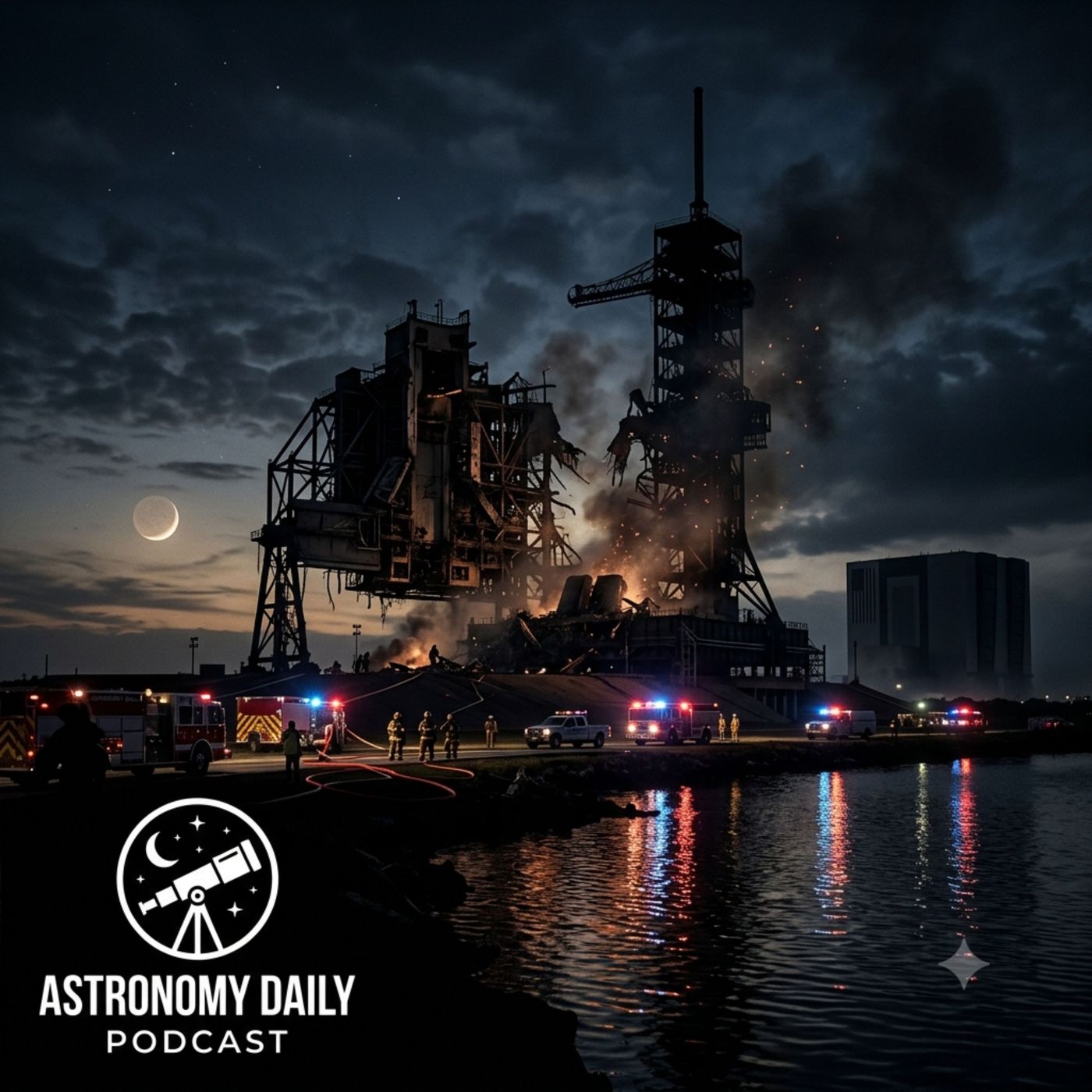
1 — NASA Overhauls the Artemis Programme NASA Administrator Jared Isaacman announced a sweeping restructure of the Artemis Moon programme on Friday 27 February. The headline change: Artemis III will no longer attempt a crewed lunar landing. Instead it has been redesigned as a low Earth orbit test flight in 2027, where astronauts will dock with the SpaceX Starship Human Landing System and potentially Blue Origin's Blue Moon lander, testing suits, life support and rendezvous procedures before anyone attempts a surface landing. The Block 1B SLS upgrade has been scrapped, vehicle configuration standardised, and NASA is targeting annual Moon landings from Artemis IV and V in 2028, with at least one surface landing per year thereafter. Isaacman invoked Apollo's step-by-step approach as his model — pointing out the programme was essentially jumping from Apollo 8 to the Moon landing without the intervening tests. The Lunar Gateway space station was notably absent from the announcement. Artemis II — the crewed flight around the Moon — remains on track for no earlier than 1 April 2026 pending resolution of a helium pressurisation issue. 2 — Space Force Grounds Vulcan Centaur The U.S. Space Force has placed an indefinite hold on all national security launches aboard ULA's Vulcan Centaur rocket following a repeat solid rocket booster anomaly during the USSF-87 mission on 12 February — the rocket's fourth flight. A booster nozzle appeared to separate during ascent, mirroring an incident on Vulcan's second certification flight in October 2024. The payloads were successfully delivered, but Space Force Col. Eric Zarybnisky confirmed at the AFA Warfare Symposium that no further Vulcan national security missions will fly until the issue is fully resolved. With over a dozen military launches manifested for 2026, the grounding threatens significant disruption to the Pentagon's launch schedule. 3 — The Universe's Most Extraordinary Construction Site Astronomers using the Very Large Array and ALMA telescope have discovered J0846 — the first strongly gravitationally lensed protocluster core ever found. A foreground galaxy cluster is acting as a cosmic zoom lens, magnifying a cluster of at least 11 furiously star-forming galaxies more than 11 billion light years away — all crammed into a region smaller than the distance between the Milky Way and Andromeda. Completely invisible to optical telescopes due to dense dust shrouding, ALMA's detection of cold dust and gas revealed the extraordinary scene. Lead researcher Nicholas Foo (Arizona State University) describes it as catching a galaxy cluster in the very first chapter of its life. 4 — Could Mars Soil Actually Block Earth Microbes? A Penn State-led international team published findings in the International Journal of Astrobiology showing that simulated Martian regolith significantly suppresses tardigrade (water bear) activity — one of the toughest creatures on Earth. Critically, rinsing the regolith with water largely reversed the harmful effect, suggesting the culprit is a water-soluble compound — possibly salts or perchlorates detected by previous Mars missions. The dual implication: Martian soil may naturally protect the Red Planet from Earth contamination, and could potentially be treated to support plant growth in future habitats. 5 — Extracting Oxygen from Lunar Soil — A Major Milestone NASA's Carbothermal Reduction Demonstration (CaRD) project has passed a key integrated prototype test aboard the ISS,...
Speaker 1: Hello, and welcome to Astronomy Daily. You're daily briefing from the Cosmos. I'm Anna and I'm Avery. It is Saturday, February twenty eight, twenty twenty six, and we are back with Season five, episode fifty one. A slightly later start to our day than usual, Avery, but the universe has been very much keeping normal business hours on our behalf.
Speaker 2: It absolutely has six stories today, and honestly, what a six. We've got a major shakeup at NASA headquarters, a serious headache for the Pentagon's launch calendar, one of the most mind bending objects ever discovered in the deep universe, a rather unsettling experiment about Martian soil, a genuine breakthrough in how we might breathe on the Moon, and a piece of galactic archaeology that is rewriting the history of our home galaxy.
Speaker 1: If you are anywhere near a clear western horizon tonight, We've also got a little cosmic bonus for you, six planets lined up in the evening sky. More on that as we go, but first let's get into the news.
Speaker 2: Our lead story today is a big one, and it has been the talk of the space community since Friday afternoon. NASA Administrator Jared Isikman has announced a major restructuring of the Artemis program. And when I say major, I mean this is the most significant overhaul since the program was first established.
Speaker 1: So let's break this down, because there's quite a bit to unpack. The headline is this Artemis three, which was supposed to be the first crude lunar landing in more than fifty years, is no longer going to the Moon, at least not yet.
Speaker 2: That's right. Instead of landing on the lunar South Pole in twenty twenty eight as originally planned, Artemis three has been redesigned as a low Earth orbit test flight targeting launch in twenty twenty seven. The crew will rendezvous and dock in orbit with one or both of the commercial lunar landers, SpaceX's Starship Human Landing System and Blue Origins Blue Moon, and run a full sweet of tests base suits, in microgravity, life support, checks, navigation, propulsion, everything you would want to have verified before you actually depend on those systems to bring people back from the surface of the Moon.
Speaker 1: Isaacman drew a very deliberate comparison to the Apollo program. He pointed out that NASA didn't go from Apollo eight, which was the first crude flight around the Moon straight to the landing. Apollo nine and ten tested all the critical hardware in Earth and lunar orbit first. His argument is that Artemis as currently structured, was essentially skipping those steps.
Speaker 2: And that concern was echoed just days earlier by the NASA Independent Aerospace Safety Advisory Panel, which released its annual report calling the existing plans too risky and recommending a restructure. So this wasn't a shock in some quarters, but the scale of the changes still caught a lot of people by surprise.
Speaker 1: The Block one B upgrade to the Space Launch System has also been scrapped. NASA is standardizing the vehicle configuration to reduce complexity and accelerate the launch cadence, because that is really the overarching goal here, moving from a program that has launched the SLS once every few years to one that aims for a flight every ten months or so.
Speaker 2: Which is genuinely ambitious. The SLS has launched exactly once. Isikman himself has been quite candid about that, noting that a flight rate that low is simply not sustainable and not safe. His view is that the more frequently you fly, the sharper your team stay, the less your skills atrophy, and the safer Each subsequent mission becomes the.
Speaker 1: Revised plan targets Artemis four and five for lunar landings in twenty twenty eight, with at least one surface landing per year thereafter. One thing that was conspicuously absent from the announcement, though any mention of the Lunar Gateway space Station, which had been central to earlier Artemis planning.
Speaker 2: Isikman deflected questions about Gateway, saying the FOE I needed to stay on what he called the hardest part, actually getting astronauts to and from the Moon with a reliable cadence. Make of that what you will.
Speaker 1: And Artemis two itself, that's the crude flight around the Moon. No landing that's been in preparation at Kennedy's Space Center. It's currently targeting no earlier than April first. After rolling back to the vehicle assembly building on February twenty fifth to address a helium pressurization issue in the upper stage, engineers are working through it. The goal is a successful wet dress rehearsal before a launch date is confirmed.
Speaker 2: So a lot of moving parts, but the direction of travel seems clear Apollo style, step by step build up, faster cadence, leaner vehicle configuration. We will be keeping a very close eye on how this unfolds over the coming months.
Speaker 1: Now staying in launch industry news, and this one is going to cause some significant headaches for the United States military space launch program this year. The US Space Force has placed an indefinite hold on all national security launches aboard ULA's Vulcan Centaur rocket.
Speaker 2: This follows an anomaly observed during the USSF eighty seven mission, which launched on February twelfth. That was Vulcan's fourth flight overall, and it was carrying a pair of geosynchronous space situational awareness satellites, essentially neighborhood watch satellites for the military, keeping tabs on what's happening in geosynchronous orbit.
Speaker 1: The mission itself was technically successful, the payloads were delivered to their correct orbits, but observers watching the launch footage noticed something very unwelcome, an unusual plume of debris from one of the solid rocket boosters, and specifically, it appeared that a booster nozzle may have separated during ascent.
Speaker 2: Which will sound familiar to anyone following Vulcan closely, because essentially the same thing happened on the rocket's second certification flight back in October twenty twenty four. ULA investigated, said the root cause was a manufacturing defect and said it had been corrected and now it appears to have happened again.
Speaker 1: Colonel Eric Zaribniski, the Space Force's Portfolio Acquisition Executive for Assured Access to Space, was very direct at the Air and Space Forces Association Warfare Symposium this week. He said, and I'm paraphrasing here that until the anomaly is fully understood and corrective actions are developed and implemented, there will be no more Vulcan national security missions.
Speaker 2: The scale of the problem is hard to overstate. Vulcan is manifested for more than a dozen national security launches this year, nearly its entire twenty twenty six manifest is military. With an investigation that could run for months, This could seriously disrupt the Pentagon's launch schedule, and it comes at a particularly challenging time for ULA, which recently saw the departure of longtime CEO Tory Bruno.
Speaker 1: ULA and Northrip Grumman, who make the solid rocket boosters have confirmed they are standing up a joint investigation team. No timeline has been given for resolution. We'll be watching this one closely.
Speaker 2: Right time to zoom out, way way out, eleven billion light years out in fact, because astronomers have just announced the discovery of what might be the most extraordinary object in the early universe, and it has a story attached to it that is quite wonderful.
Speaker 1: So this discovery involves something called a proto cluster, which is essentially a galaxy cluster in the process of being assembled. These are the primordial cities of the universe where gravity is busy pulling together what will eventually become some of the most massive structures in existence. And the object in question is called Jay zero eight four six.
Speaker 2: Now, the reason they were able to see Jay zero eight four to six and such extraordinary detail is because of a cosmic accident of alignment. Sitting almost perfectly between us and Jay zero eight four six is a closer galaxy cluster, and the immense mass of that foreground galaxy cluster is acting as a gravitational lens, bending and amplifying the light from the distant protocluster behind it, making it appear far brighter and larger than it otherwise would. It's the universe providing us with a zoom lens that no human engineer could ever build.
Speaker 1: And when astronomers pointed the very Large Array radio telescope in New Mexico and the ALMA telescope in the Chilean Autocoma Desert at this magnified view, what they found was stunning. What had previously looked like a single smudge of light in older survey data turned out to be at least eleven separate galaxies, all crammed into a region of space smaller than the distance between our own Milky Way and the Andromeda galaxy next door.
Speaker 2: Eleven galaxies in a space that height, and every single one of them is undergoing a starburst, pumping out new stars at a rate that would make our own galaxy look thoroughly lazy by comparison. They are building stars at a ferocious, almost frenzied pace.
Speaker 1: The reason we couldn't see them in ordinary optical telescopes is that they are absolutely shrouded in dust, dust that absorbs visible light completely. Alma's ability to detect the faint thermal glow of cold dust and gas is what cuts through that cosmic fog and reveals what's actually happening in there.
Speaker 2: Lead researcher Nicholas Fu, a graduate student at Arizona State University, describe the whole scenario beautifully. The foreground cluster is the mature, modern city, The proto cluster behind it is the ancient settlement it grew from, and by looking back more than eleven billion years, we are essentially catching a galaxy cluster in the very first chapter of its life.
Speaker 1: It's also the first strongly lensed proto cluster core ever discovered, which makes it scientifically invaluable. Gravitational lensing is giving us a level of detail we simply could not access any other way. Nature, it turns out, is a pretty outstanding telescope builder.
Speaker 2: Now, if you've been thinking about how future Mars explorers will feed themselves, grow plants, or avoid contaminating the Red planet, this next story is directly relevant and it involves one of our favorite microscopic creatures.
Speaker 1: The Tarta grade, otherwise known as the water bear. And if you've heard of them before, you'll know they are essentially the toughest animals on Earth surviving freezing radiation. The vacuum of space extreme dehydration. They are extraordinary.
Speaker 2: A research team led by microbiologist Korean Bakerman's at Penn State Altona has been using Tarta grades as biological proxies, essentially asking the question what the simulated Martian soil actually due to Earth microbes, because this matters enormously both for planetary protection making sure we don't contaminate Mars with Earth life and for understanding whether astronauts could safely use Martian soil for growing food.
Speaker 1: And the results published in the International Journal of Astrobiology were surprising. When tartar grades were placed into simulated Martian regolith and they used a simulant designed to closely match what NASA's Curiosity rover has sampled in Gale Crater, their activity dropped significantly. These creatures, which can survive almost anything, were being suppressed by the Martian soil itself.
Speaker 2: Which is a remarkable finding on its own. But then they tried something clever. They rensed the regolith with water before introducing the tartar grades, and that almost entirely removed the harmful effect. The tartar grades were back to nearly normal activity.
Speaker 1: Levels, So whatever is doing the damage in Martian soil is water soluble. The team suspects salts or some other water soluble compound, possibly related to prochlorates that have been detected in Martian regolith by previous missions. They're still investigating this specific culprit.
Speaker 2: Now. There are two very interesting things to take from this. First, Martian soil might naturally act as a kind of chemical defense against Earth microbes, which could be genuinely helpful from a planetary protection standpoint. Microbes hitching a ride on spacecraft or equipment might struggle to establish themselves in an environment that is actively hostile to them.
Speaker 1: Second, and this is the hopeful angle. If the harmful compounds can simply be washed away with water, that opens a potential pathway for treating the soil to make it usable for plant growth in future Mars habitats. Water is incredibly scarce on Mars, of course, so it's not a simple solution, but it is a lead where pursuing.
Speaker 2: Professor Bakerman summed it up well, when we send people to non earth environments, we need to understand two things, how the environment will impact the people and how the people will impact the environment. This research is pushing both of those questions.
Speaker 1: Forward and now a story that connects beautifully with our lead story today because NASA this week also confirmed a significant milestone in one of the technologies that will be absolutely essential if the revamped Artemis program is ever going to achieve that dream of a permanent human presence on the Moon.
Speaker 2: We're talking about in situ resource utilization ISRU, which is the umbrella term for the idea of using what's already available at your destination rather than shipping everything from Earth. And specifically we're talking about oxygen.
Speaker 1: Because here's a fact that should stop you in your tracks. Lunar reglith, the loose rock and dust covering the Moon's stone surface, is approximately forty five percent oxygen by mass, the vast majority of it locked up in silicate minerals deposited over billions of years as the Moon passes through Earth's magnetic tail, capturing oxygen ions from our upper atmosphere, forty five percent oxygen just sitting there waiting to be unlocked.
Speaker 2: NASA's carbo Thermal Reduction Demonstration Project CARD has been working on doing exactly that aboard the International Space Station. The technique uses concentrated solar energy to heat the regolith to extreme temperatures, triggering a chemical reaction that releases that bound oxygen as carbon monoxide gas. That COO can then be converted downstream into breathable oxygen.
Speaker 1: And this week the CARD team confirmed that their integrated prototype combining a carbo thermal oxygen production reactor from Sierra Space, a solar concentrator from NASA's Glen Research Center, precision mirrors from composite mirror applications, and avionics and gas analysis systems from Kennedy Space Center have successfully passed a full integrated test confirming production of carbon monoxide through a solar driven chemical reaction on simulated lunar regulate.
Speaker 2: That is a meaningful step, not a demo, not a simulation, an actual integrated system test confirming the chemistry works. The next steps are miniaturization, durability testing, and ultimately deploying something like this on the lunar surface.
Speaker 1: And the applications go beyond just breathing air. The same process could be adapted to convert carbon dioxide into oxygen and methane, giving future Moon bases a way to produce rocket propellant in situ, which dramatically changes the economics of the whole enterprise. You no longer need to ship fuel from Earth for the journey home.
Speaker 2: The technology also has direct applicability to Mars. A solar driven oxygen extraction system working on Martian regolith would be a cornerstone of any long term surface presence there too, so it's worth connecting the dots. This week NASA announced it wants annual moon landings from twenty twenty eight, and this week NASA confirmed a key piece of technology that would make staying there actually viable. These stories belong together.
Speaker 1: Well spotted, avery nicely joined up, and.
Speaker 2: For our final story today, we're heading home, or rather we're heading back to the very beginning of home, because a new study has just rewritten what we thought we knew about how our own galaxy formed.
Speaker 1: This research centers on a type of star called an r r lyyra variable. These are ancient pulsating stars. They swell and shrink over the course of just a few hours, brightening and dimming like a slow cosmic heartbeat. What makes them extraordinary as scientific tools is that they are almost eerily predictable. Astronomers know precisely how intrinsically bright they are, which means that by measuring how bright they appear in the sky, you can calculate their distance with great precision.
Speaker 2: They are in the truest sense cosmic lighthouses, standard candles for measuring the universe. And crucially, they are old, not millions of years old, billions more than ten billion years. These stars were forming when the Milky Way itself was still taking shape in the chaotic early universe, shortly after the Big Bang. They are essentially living fossils.
Speaker 1: A large international team of astronomers assembled the biggest catalog of these ancient stellar fossils ever, compiled thousands of them, combining precise distance measurements with data from the European Space Agency's Gaia satellite, which has mapped the positions and movements of over a billion stars across the galaxy. Together, this gave them a three dimensional map of the early Milky Way that they could essentially rewind like a film, tracing these ancient stars back to where they came from and how they were moving in the galaxy's formative years.
Speaker 2: And what they found challenged the long held assumption. The conventional picture was that the Milky Ways different structural layers, the outer halo, the thick disk the thin disc formed at different times, sequentially one building on the last the halo first, then the thick disc, then the thin disc.
Speaker 1: But the new results suggest that all of these layers formed at roughly the same early epoch, not sequentially simultaneously or close to it. The main difference between the layers isn't age, it's chemistry. Stars in the halo contain less iron than those in the thick disk, which in turn contain less than the thin disk. Each successive layer was enriched by the deaths of previous stellar generations, a kind of celestial inheritance passed down through supernovae. The iron content tells the story of the order, not the ages themselves, and.
Speaker 2: Perhaps the most striking finding involves our nearest galactic neighbor, the Andromeda Galaxy. When the team compared the chemical fingerprints of these ancient stars across the Milky Way with those in Andromeda, they found strikingly similar patterns, despite the two galaxies being very different in size and structure, which suggests this isn't just a local story. It may be a universal mechanism by which large galaxies form.
Speaker 1: The idea that galaxies as different as the Milky Way and Andromeda went through the same fundamental process of formation written in the chemistry of their oldest stars. That is a genuinely profound result the lactic archaeology at a it's finest, and.
Speaker 2: With ten billion year old stars doing the storytelling, you really can't argue with the witnesses.
Speaker 1: Right before we close out today, a quick reminder for anyone listening this evening. Tonight is the peak of February's six planet parade. If you step outside about thirty minutes after sunset and look west, you should be able to spot Venus blindingly bright. You really can't miss it, along with Jupiter high in the sky and Saturn low on the western horizon. Mercury is also out there. If you have a flat, clear horizon and you're quick, Uranus and Necktune round out the six, though you'll need binoculars or a telescope.
Speaker 2: For those it's a genuinely lovely evening spectacle.
Speaker 1: They'll miss it, and that is everything. For episode fifty one, What a Day in Space, A program reshaped, a rocket grounded, a cosmic construction site eleven billion years in the past, water bears on Mars, solar powered oxygen on the Moon, and our galaxies formation story turned upside down. Not a bad Saturday, not a bad Saturday at all. If you enjoyed today's episode, please do share it with a fellow Space enthusiast, leave us a review wherever you listen, and follow us on social media at astro Daily Pod for updates throughout the day.
Speaker 2: You can also find our show notes, blog posts, and full episode archive over at Astronomy Daily dot io. Everything you need is right there.
Speaker 1: From all of us here at Astronomy Daily. Clear skies, and we'll see you Monday.
Speaker 2: See you then, everyone, Sunday Starsz Starz with a


 Apple Podcasts
 Spotify
 Pocket Casts
 Castbox
 Overcast
 Podbean
 iHeartRadio
 Castro
 Goodpods
 Moon FM
 Podcast Addict
 Podcast Republic
 YouTube