
Making Water on the Moon, The Hubble Bubble Hypothesis, and Neptune's Unique Orbital Partner
In this episode
- Revolutionising Lunar Exploration: Discover the groundbreaking research from a team of Chinese scientists who are developing innovative technology to produce water, oxygen, and fuel directly from lunar soil. This game-changing approach could significantly reduce the costs of transporting resources from Earth, making sustainable lunar habitats a reality. With the potential to utilise the Moon's own resources, this closed-loop system could transform our future in space.
- - The Hubble Bubble Theory: Delve into the intriguing new theory suggesting our Milky Way galaxy might be suspended within a vast cosmic void, dubbed the Hubble Bubble. This concept could provide solutions to the ongoing Hubble Tension, offering fresh insights into the universe's expansion and our cosmic neighbourhood.
- - A Cosmic Dance with Neptune: Learn about the newly discovered trans-neptunian object, 2020 VN40, which exhibits a unique orbital rhythm, completing one orbit for every ten of Neptune's. This fascinating discovery sheds light on the dynamics of distant solar system bodies and hints at the complexities of our solar system's evolution.
- - Catching the Southern Delta Aquariad Meteor Shower: Prepare for the upcoming Southern Delta Aquariad meteor shower peaking on July 29. We provide tips on how to maximise your viewing experience, including the best times and locations to spot these shooting stars as Earth passes through the debris trail of comet 96P/Machholz.
- For more cosmic updates, visit our website at astronomydaily.io. Join our community on social media by searching for #AstroDailyPod on Facebook, X, YouTube Music, TikTok, and our new Instagram account! Don’t forget to subscribe to the podcast on Apple Podcasts, Spotify, iHeartRadio, or wherever you get your podcasts.
- Thank you for tuning in. This is Anna signing off. Until next time, keep looking up and stay curious about the wonders of our universe.
Lunar Resource Utilisation
[Chinese University of Hong Kong](https://www.cuhk.edu.hk)
Hubble Bubble Theory
[Royal Astronomical Society](https://ras.ac.uk)
Trans-Neptunian Object Discovery
[Harvard-Smithsonian Center for Astrophysics](https://www.cfa.harvard.edu)
Southern Delta Aquariad Meteor Shower
[NASA](https://www.nasa.gov)
Astronomy Daily
[Astronomy Daily](http://www.astronomydaily.io/)
Become a supporter of this podcast: https://www.spreaker.com/podcast/astronomy-daily-latest-space-news--5648921/support.
Sponsor Details:
Ensure your online privacy by using NordVPN. To get our special listener deal and save a lot of money, visit www.astronomydaily.io/nordvpn. You'll be glad you did!
Get the best secure and private email on the planet. Stop your Government, google and who knows who else spying on every email you write. Do what we did and use ProtonMail. They beleive in privacy and there are no ads in their business model...yet they still provide a free forever service. Check them out and get out special deal at <a href="https://www.astronomydaily.io/protonmail" target="_blank"...
Anna: Welcome to Astronomy Daily, your daily dose of cosmic curiosities and stellar stories. I'm your host, Anna, and I'm thrilled to have you join us for another exciting journey through the universe. Today, we're diving into some fascinating breakthroughs. We'll explore how new technology might allow us to make water and fuel right on the moon, potentially changing the future of lunar exploration. We'll also ponder an intriguing theory that suggests our entire galaxy might be floating inside a massive cosmic void.
A Hubble bubble, if you. Which could reshape our understanding of the universe's expansion. And for those who love to look up, we'll guide you on how to best catch an upcoming celestial spectacle. The Southern Delta Aquarian meteor shower. Plus, we've got a quirky tale about a newly discovered space rock doing a strange orbital dance with Neptune. So buckle up because there's a lot to unpack in today's episode. First up, let's talk about something that could truly revolutionise our future in space.
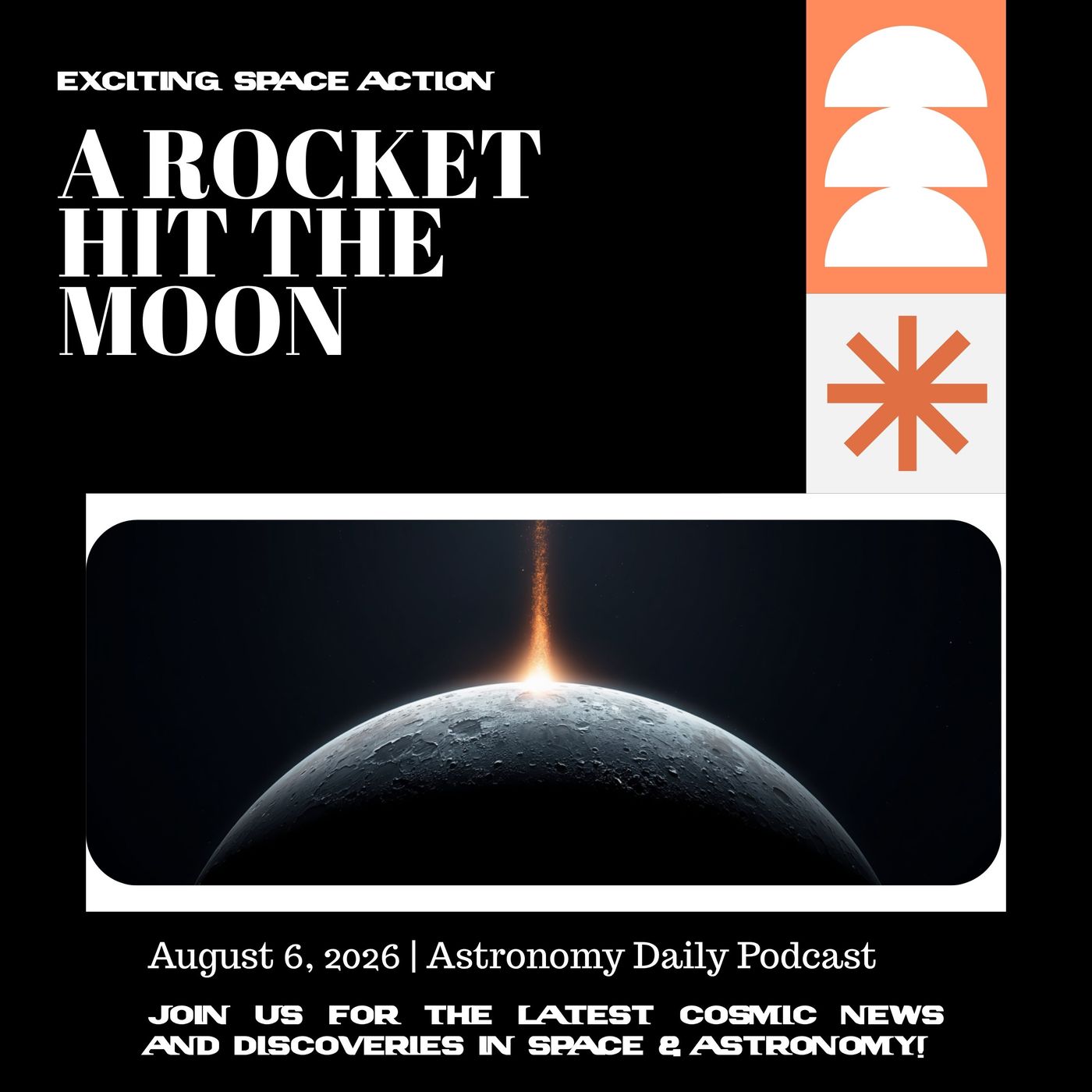
Making essential resources directly on the moon. Imagine if astronauts didn't have to haul every drop of water or every breath of oxygen from Earth. Well, a team of researchers from China is working to make that a reality, developing a new technology that they say could produce water, oxygen and even fuel from lunar soil. This is a game changer because shipping just one litre of water to the moon currently costs a staggering 33,000 Australian dollars, which is roughly US$22,000. So finding ways to use the moon's own resources will be absolutely critical if humanity is going to return there and establish temporary or even long term habitats.
The new approach uses what's called photothermal technology, detailed in a paper published in the journal Joule. Lunar soil isn't just inert dust. It actually holds stores of carbon dioxide and water, along with other minerals that could be incredibly useful for space mission crews. The real puzzle has always been how to extract these molecules efficiently on the moon's surface. As co author Lu Wang from the Chinese University of Hong Kong, Shenzhen, put it, they never fully imagined the magic that the lunar soil possessed.
Wang's team had previously analysed lunar soil samples brought back by China's Chang's five spacecraft, discovering that moon dust indeed contains many useful compounds. Their latest research builds on this, showing it's possible to extract water from lunar soil. But it gets even more exciting. They can then use that extracted water and the carbon dioxide exhaled by astronauts to produce hydrogen gas and carbon monoxide. These products in turn can be used to create fuel and breathable oxygen. All that's needed to power this remarkable process is the photothermal technology, which efficiently converts sun sunlight into heat.
The team was particularly surprised by the tangible success of this integrated method. They found that combining lunar water extraction with photothermal carbon dioxide catalysis could significantly enhance energy utilisation and reduce the cost and complexity of developing the necessary infrastructure on the Moon. It's a truly ingenious closed loop system. Now, while these lab experiments are a huge step forward, the researchers are also very realistic about the challenges ahead. They remind us that the Moon's extreme environment poses unique hurdles for implementing this technology.
We're talking about drastic temperature fluctuations, an ultra high vacuum, intense solar radiation and low gravity. All of these factors complicate things considerably. Furthermore, lunar soil doesn't have a uniform composition across the Moon's surface. Some areas will naturally be richer in resources than others. And even with this innovative system, the carbon dioxide exhaled by astronauts might not be enough to meet all the water, fuel and oxygen needs for a larger base. Overcoming these technical hurdles, along with the significant development, deployment and operational costs, will be crucial to making sustainable lunar resource utilisation and space exploration a widespread reality.
But but it's certainly a very promising start from the possibility of making our own resources on the Moon. Let's zoom out to a much grander scale. Remember how they were theorising that we might be living inside a black hole? Well, we have a new theory to ponder with an intriguing Are we here on Earth and our entire Milky Way galaxy actually trapped inside a giant cosmic void? This fascinating theory, based on echoes from the Big Bang, suggests exactly that. Researchers presenting at the Royal Astronomical Society National Astronomy meeting unveiled fresh evidence that our galaxy is suspended within a region of space that is less dense than the cosmic average.
This vast 2 billion light year expanse has been dubbed the Hubble Bubble and it's estimated to be about 20% less dense than the average matter density across the universe. If this idea holds true, it it could provide a much needed solution to a persistent mystery in cosmology known as the Hubble Tension. This tension arises from conflicting measurements of the universe's expansion rate, which also impacts our understanding of its true age. One method based on analysing the cosmic microwave backgroundessentially.
Cosmic fossils from the universe's first light suggests an expansion rate of 67 kilometres per second per megaparsec. However, a second method which measures distances using Type Ia supernovas and variable stars indicates a higher expansion rate of 73.2 kilometres per second per megaparsec. That's a noticeable discrepancy The Hubble bubble theory posits that if the Milky Way is indeed situated within such a less dense region, then the local expansion inside this void would naturally appear faster than in the denser, more distant parts of the cosmos.
Indranil Banik, the study's lead author, explained that a large local void would cause matter to be pulled by gravity towards its higher density exterior, making the void emptier over time. This effect would accelerate local expansion. For this theory to work, our galaxy would need to be located quite close to the centre of this low density Hubble bubble. Bannock and his team used data from baryon acoustic oscillations, the sounds of the Big Bang, to support previous research from the 1990s that had already noted fewer galaxies in our local universe than expected.
These ancient sound waves, frozen in place when the universe cooled, act like a standard ruler that allows astronomers to chart cosmic expansion history. What's truly striking is that their research found it's 100 times more likely that we live in a cosmic void than than in a region of average density. This suggests we might be in a very unique cosmic neighbourhood. The next steps for Banik and his team will involve comparing their void model to other cosmological models and exploring potential adjustments to the standard model of cosmology.
It's, uh, a truly mind bending concept that could redefine our place in the universe from the vastness of the cosmos and potential cosmic voids. Let's bring our focus a little closer to home. Though still quite far out in our own solar system, astronomers have recently made an incredibly intriguing discovery. A peculiar space rock at the very edge of our solar system is locked in a fascinating rhythmic dance with Neptune. This Object, officially designated 2020 VN40, belongs to a group of distant solar system bodies known as Trans neptunian objects, or TNOs.
What makes 2020 VN40 so special is that it's the very first object ever found that orbits the sun exactly once for every 10 orbits Neptune completes. Considering that one Neptunian year stretches across a remarkable 164.8 Earth years, this means 2020 VN40 has an incredibly long year, lasting approximately 1,648 Earth years, or nearly 20,000 Earth months. Researchers believe this slow ponderous orbital dance with Neptune might have begun when the ice giant's gravity temporarily snared it. This discovery is a significant step in understanding the dynamics of objects at the solar system's fringe.
As Rosemary pike from the Centre for Astrophysics at Harvard and Smithsonian noted, it shows that Even very distant regions influenced by Neptune can contain objects. And it gives us new clues about how the solar system evolved. The unique orbital rhythm of 2020 VN40 was unearthed from data collected by the Large Inclination distant objects, or LIDO survey. This survey specifically hunts for TNOs with orbits that carry them far above and below the main orbital plane of Earth around the Sun. Exploring previously uncharted areas of our solar system, what truly sets 2020 VN4.0 apart is its unusual perihelion alignment with Neptune.
Most other bodies in rhythmic alignment with Neptune make their closest approaches to the sun when Neptune is at its farthest. But 2020 VN4.0 defies this trend, reaching its perihelion when Neptune is also relatively close to the Sun. While this might sound like they're side by side, 2020 VN4.0's highly tilted path means it's actually far below the solar system's plane during this alignment. This new motion, as Ruth Murray Clay from the University of California, Santa Cruz described it, is like finding a hidden rhythm in a song we thought we knew.
It suggests that objects with highly tilted orbits can adopt novel and unexpected types of, um, movement, revealing more complexity in our solar system than previously imagined. The hunt is now on for more bodies like 2020 VN4.0, with the new Vera C. Rubin Observatory poised to play a crucial role in this exciting investigation. This discovery truly opens a new window into the solar system's past. And now for something you can enjoy right here on Earth, if you know where to look. The 2025 Southern Delta Aquariad meteor shower is upon us, with its peak expected on July 29.
This annual shower is active from July 18 to August 12 as our planet drifts through an ancient trail of debris. This debris is thought to have been shed by a 4 mile wide comet named 96PMachholz. When these tiny particles hit Earth's atmosphere, the friction makes them ignite, creating those beautiful streaks of light we call shooting stars. The shower is at its strongest in the week around its July 29 peak, when you might spot up to eight faint meteors per hour. These shooting stars will appear to emanate from a specific patch of sky known as a radiant within the constellation Aquarius, very close to the bright star Delta Aquarii, which gives the shower its name.
For the best chance to spot a southern Delta Aquariad, aim for the early morning hours in the week surrounding July 29th. During this time, the radiant will be highest in the southern sky, and the waxing crescent Moon will be well below the horizon, ensuring a dark canvas for your meteor hunt. As its name suggests, this shower is most visible to stargazers in the southern hemisphere, where the radiant will be higher in the post sunset sky. However, don't despair if you're north of the equator, the shower will still be visible just at a slightly lower hourly rate.
To maximise your chances, first locate the bright star Delta Aquarii in the constellation Aquarius above the southern horizon, or use a stargazing app to guide you. Then find a patch of sky about 40 degrees away from this radiant in the direction directly above your head. As a handy guide, the width of your outstretched fist, from your thumb to the outside of your little finger, covers about 10 degrees in the night sky. Meteors seen further from the radiant wheel often have longer trails, making them easier to spot.
You'll also have a much better chance if you head away from city lights and give your eyes about 30 minutes to fully adapt to the darkness. After that, simply lie back, perhaps in a comfortable deck chair, and lose yourself in the night sky. Keep an eye out for bright meteors streaking across the sky from the north too. If you see one, you might have spotted a member of the Perseid meteor shower, which is also active since mid July. Happy stargazing? And that brings us to the end of another fascinating journey through the cosmos.
Today we've explored the innovative possibilities of extracting water and fuel from lunar soil, pondered whether our Milky Way galaxy is truly nestled within a vast cosmic void, and discovered a new, intriguing dance partner for Neptune in the outer solar system. And of course, we learned how to catch a glimpse of the beautiful southern Delta Aquarid meteor shower. Thank you for joining me, Anna, on Astronomy Daily. Don't forget, you can dive deeper into all the latest space and astronomy news by visiting our [email protected].
there you can sign up for our free daily newsletter and keep up to date with our constantly updating news feed. Be sure to subscribe to Astronomy Daily on Apple Podcasts, Spotify, YouTube, or wherever you get your podcasts so you never miss an episode. Until next time, keep looking up.

 Apple Podcasts
 Spotify
 Pocket Casts
 Castbox
 Overcast
 Podbean
 iHeartRadio
 Castro
 Goodpods
 Moon FM
 Podcast Addict
 Podcast Republic
 YouTube