In this episode
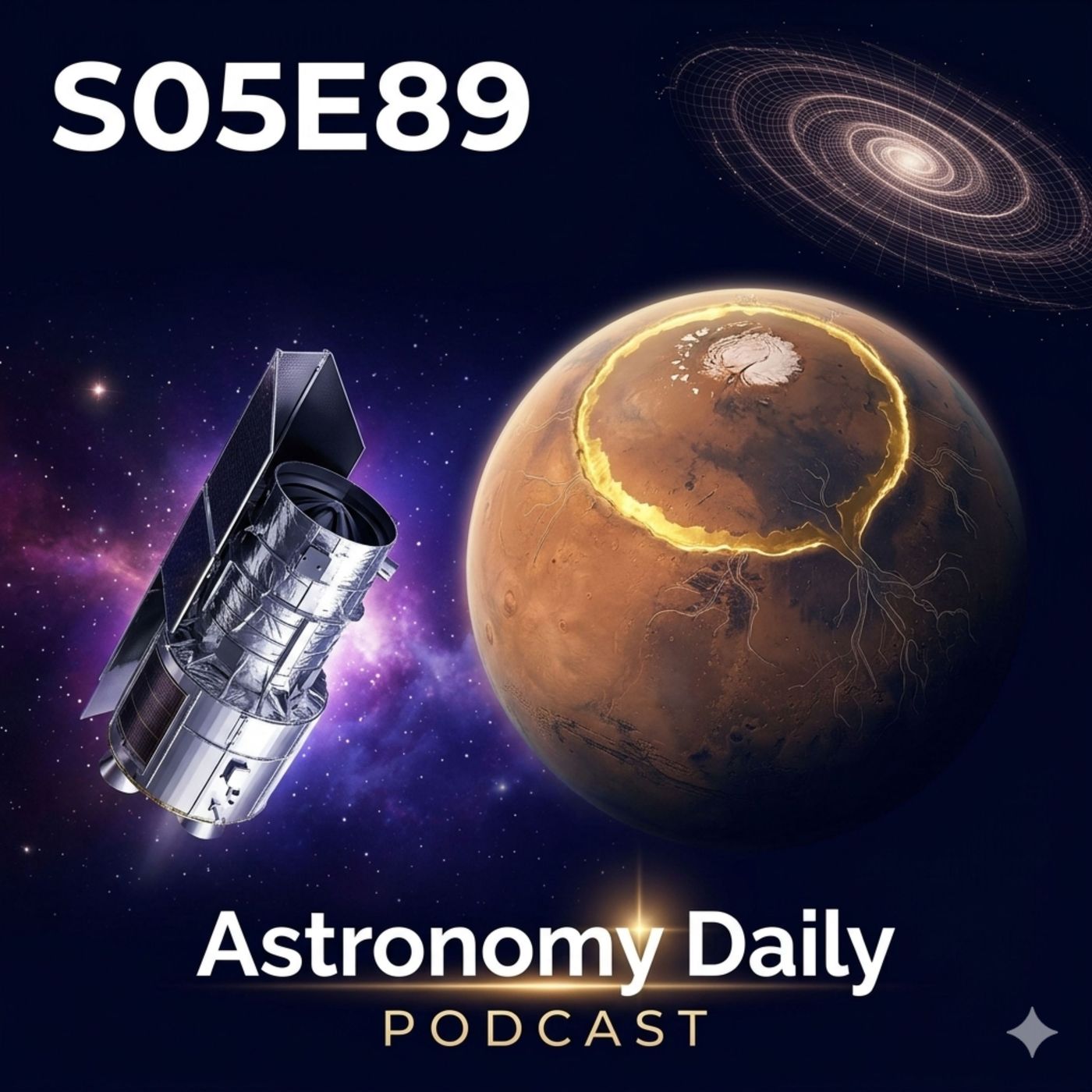
- Lightning on Mars: NASA's Perseverance rover has potentially captured the first direct evidence of lightning on Mars. Using its super-sensitive microphone, the rover recorded distinct crackling sounds, suggesting that electrical discharges may be caused by the planet's notorious dust storms. This discovery indicates that Mars has a more dynamic atmosphere than previously thought, raising excitement for future crewed missions.
- Thanksgiving Crew Launch: A crew of three, including one NASA astronaut and two Russian cosmonauts, successfully launched to the International Space Station aboard a Soyuz rocket. Their eight-month mission will involve overseeing a variety of scientific experiments and performing maintenance tasks, showcasing continued international cooperation in space.
- ESA's Space Rider Announcement: The European Space Agency has announced the inaugural flight of its Space Rider vehicle, set for 2028. This reusable space plane will serve as an uncrewed robotic laboratory, conducting experiments in orbit and returning to Earth for refurbishment, marking a significant advancement in European space capabilities.
- New Cosmic Discovery: The James Webb Space Telescope has detected a series of tiny red dots in deep space, leading to the hypothesis of a new class of objects dubbed "black hole stars." These entities would contain supermassive black holes at their cores, surrounded by dense gas, challenging our understanding of the early universe.
- Understanding Venusian Winds: New research has uncovered that the extreme winds on Venus, which rotate 60 times faster than the planet itself, may be driven by a massive atmospheric tide caused by solar heating. This insight could enhance our understanding of the climate on Venus and tidally locked exoplanets.
- For more cosmic updates, visit our website at astronomydaily.io. Join our community on social media by searching for #AstroDailyPod on Facebook, X, YouTubeMusic, TikTok, and our new Instagram account! Don’t forget to subscribe to the podcast on Apple Podcasts, Spotify, iHeartRadio, or wherever you get your podcasts.
- Thank you for tuning in. This is Anna and Avery signing off. Until next time, keep looking up and exploring the wonders of our universe.
Perseverance Rover Lightning Detection
[NASA](https://www.nasa.gov/)
International Space Station Crew Launch
[NASA](https://www.nasa.gov/)
ESA's Space Rider Details
[European Space Agency](https://www.esa.int/)
James Webb Space Telescope Discoveries
[NASA](https://www.nasa.gov/)
Venus Atmospheric Research
[NASA](https://www.nasa.gov/)
Become a supporter of this podcast: https://www.spreaker.com/podcast/astronomy-daily-space-news-updates--5648921/support.
Sponsor Details:
Ensure your online privacy by using NordVPN. To get our special listener deal and save a lot of money, visit www.bitesz.com/nordvpn. You'll be glad you did!
Become a supporter of Astronomy Daily by joining our Supporters Club. Commercial free episodes daily are only a click...
Avery: Hello, and welcome to Astronomy Daily, the podcast that brings you the universe, one story at a time. I'm Avery. Anna: And I'm Anna. Um, it's great to have you with us. We've got news stretching from the rusty soil of Mars all the way to the deepest reaches of cosmic time. Avery: That's right, we'll be talking about possible lightning on Mars. A new crew arriving at the space station. Europe's next gen reusable spacecraft. A potential new kind of cosmic monster. And we'll finally get an answer to what drives the furious winds of Venus.
Anna: So let's get started. Our first story takes us to the Red Planet, where an old question might have a shocking new answer. Avery: Do tell, Avery. Anna: For decades, scientists have wondered if lightning could occur on Mars. Well, it seems NASA's Perseverance rover may have finally captured the first direct evidence. Avery: Wow. Really? After all this time? How did it detect it? Was it a flash of light? Anna: Not visually, but audibly. The rover's super sensitive microphone, part of the Supercam instrument, recorded crackling sounds, faint pops and crackles that are distinct from the usual Martian wind.
Avery: It heard lightning. That's incredible. So what's causing these electrical discharges? Anna: Scientists believe the primary suspect is the planet's infamous dust storms. The friction between dust particles as they're whipped around by the wind can build up a significant static charge. Just like shuffling your feet on a carpet. Avery: Right, and eventually that charge has to go somewhere, resulting in a spark. Anna: Exactly. A miniature Martian lightning bolt. While the energy is likely much lower than a typical terrestrial thunderstorm, it proves that Mars's atmosphere is more electrically active than we ever knew.
Avery: So Mars has more dynamic and complex weather than we previously thought. This just makes me even more excited for future crewed missions. There's still so much to discover. Anna: I think you'll find you're not the only one waiting for that step. Avery: Speaking of space travel, let's turn our attention a little closer to home. On, um, Thanksgiving Day, a crew of three successfully launched to the International Space Station aboard a Soyuz rocket. Anna: That's right. The crew consists of one NASA astronaut and two Russian cosmonauts.
It's a powerful symbol of continued international cooperation in space, even during complicated times here on Earth. Avery: Absolutely. The space station has always been a beacon for that kind of partnership. What's on the agenda for their mission? Anna: It's going to be a busy stay. They're scheduled for an eight month mission, during which they'll oversee a whole range of scientific experiments. These experiments cover everything from human biology and microgravity to material science and earth observation.
Avery: And I imagine a lot of maintenance work too, keeping the 20 plus year old station in good shape. Anna: Of course, there's always something to fix or upgrade. They'll also be preparing the station for the arrival of new commercial modules and supporting spacewalks for hardware installation. It's a critical job to keep our outpost in orbit running smoothly. Avery: Well, we wish them, uh, a safe and productive mission up there. Anna: From the present of spaceflight to its future. The European Space Agency, or esa, has just announced a target date for a very exciting project.
The inaugural flight of its state Space Rider vehicle is now set for 2028. Avery: Space Rider, that's ESA's reusable space plane, right? What makes it different from other spacecraft out there? Anna: Think of it as an uncrewed robotic space laboratory. It's designed to launch on a Vega C rocket, deploy a multi purpose cargo bay into orbit, and stay there for up to two months, conducting experiments automatically. Avery: So it's essentially a free flying science platform. Anna: Exactly, and here's the key part.
After its mission is complete, it will re enter the Earth's atmosphere and land on a Runway just like an airplane. The vehicle and its payloads can then be recovered, refurbished and flown again. Avery: That's a huge step for Europe. Reusability is the name of the game for making access to space more affordable and sustainable. Having their own reusable vehicle opens up a lot of possibilities for science and technology development. Anna: It really does. It will give European scientists and companies a routine way to run experiments in microgravity and bring them back to Earth for analysis without relying on other launch providers.
2028 will be a year to watch. Avery: All right, now let's journey from low Earth orbit out to the edge of the observable universe. The James Webb Space Telescope has found something peculiar. And it might be a new class of object we've never seen before. Anna: This is one of those stories that really stretches the imagination. In some of its deepest images of the early universe, Webb spotted a series of tiny, extremely red dots. Avery: Okay, tiny red dots in deep space, that could be a lot of things.
What's the theory? Anna: Well, after ruling out more conventional explanations like distant red galaxies, a team of astrophysicists has proposed a wild new idea. They think these could be a new kind of cosmic monster. Whoa. They're calling them black hole stars. The idea is that, uh, at the core of each of these objects is a supermassive black hole, but it's surrounded by an incredibly dense, massive shell of gas that it's feeding on. Avery: So it would look like a giant puffy star from the outside, but it's really a black hole in disguise.
Anna: That's the essence of it. This shell of gas is so thick that it traps the light from the accreting, uh, material, making the object appear as a single redd point of light rather than a blazing quasar, which is what we'd normally expect to see. Avery: That would be a game changer for understanding how the very first supermassive black holes grew so big so fast in the early universe. Anna: It certainly would. If this hypothesis holds up, it means there could be a hidden population of these growing black holes that we've been completely missing until now.
It's a testament to how JWST isn't just seeing farther, it's seeing, seeing things in a whole new way. Avery: It really does make you wonder what else is out there that we know nothing about. But let's hope it's not a case of ignorance is bliss. Anna: Ya betcha. Okay, for our final story, we come back to our own solar system, to Earth's evil twin sister planet, Venus. We're talking about its hellish atmosphere and the extreme winds that whip around the planet. Avery: Ah, uh, Venusian super rotation.
This has been a huge puzzle for decades. The entire atmosphere rotates around the planet 60 times faster than the planet itself spins. Anna: How is that even possible exactly? The mechanics have been a mystery, but new research is pointing to a key driver. A massive atmospheric tide fueled by the heat of the Sun. Avery: An, um, atmospheric tide like the ocean. Anna: Tides on Earth, Similar in principle, but driven by heat, not gravity. The sun intensely heats the dense atmosphere on the day side of Venus.
This creates a huge planet wide thermal wave. As Venus slowly rotates, this wave of hot expanding gas travels around the planet, pushing the atmosphere and maintaining those incredible wind speeds. Avery: So the daily cycle of heating and cooling from the sun is constantly pumping energy into the atmosphere, keeping it spinning like a top. Anna: That's a perfect analogy. Previous theories focused on other factors, but this research suggests this daily thermal tide is a major contributor, if not the primary one.
It's a huge step forward in understanding the climate of not just Venus, but potentially of tidally locked exoplanets around other stars. Avery: And that's all the time we have for today. From the crackle of Martian lightning to the roar of Venusian winds and the silent mysteries of the Eurelli universe, it' been another incredible time in astronomy. Anna: It certainly has. Thank you for joining us, uh, on Astronomy Daily. We hope you'll subscribe and join us again next time as we continue to explore the cosmos.
You'll find us on all podcast platforms, or simply visit our website at astronomydaily IO for details. Plus, you can catch up on all the latest space news by checking out our constantly updating news feedback. Avery: Um, until tomorrow then, this has been. Anna: Avery and Anna wishing you Clear Sky.
 Apple Podcasts
 Spotify
 Pocket Casts
 Castbox
 Overcast
 Podbean
 iHeartRadio
 Castro
 Goodpods
 Moon FM
 Podcast Addict
 Podcast Republic
 YouTube