
In this episode
In this episode, we delve into a thrilling array of space news and discoveries that are shaping our understanding of the cosmos. We start with a sobering update on Europa, one of Jupiter's moons, where new research suggests its vast subsurface ocean may lack the necessary energy to support life as we know it. Despite its potential, the study highlights the importance of geological activity for habitability, leaving us with more questions than answers.Shifting gears, we turn our attention to the upcoming Artemis 2 mission, set to mark the first crewed flight around the Moon in over 50 years. With a launch date tentatively scheduled for February 6, 2026, the excitement builds as NASA prepares for this historic journey, testing life support systems and navigation in deep space.Next, we explore a surprising discovery made by the James Webb Space Telescope in the dwarf galaxy Sextans A, which has revealed unexpected dust content, challenging previous assumptions about early galaxies. This finding could have significant implications for our understanding of star formation and planet-building materials in the early universe.On Mars, the Curiosity rover continues to impress with stunning new panoramas from Mount Sharp, showcasing the planet's geological history and ongoing exploration efforts. The rover's advanced autonomy allows it to multitask while analyzing the Martian landscape, providing invaluable insights into the planet's past.For sky watchers, we discuss an intriguing upcoming astronomical event: a rare predicted double exoplanet transit set for April 1, 2026. However, due to scheduling constraints at major telescopes, real-time observations may be elusive, reminding us of the challenges in capturing such fleeting cosmic moments.Finally, we reflect on NASA's bittersweet decision to demolish three historic test facilities at the Marshall Space Flight Center, marking the end of an era in space exploration. While progress is essential, it comes with the acknowledgment of our rich history and the legacy of past achievements.Join us as we unpack these captivating stories and more in this episode of Astronomy Daily!00:00 – **Welcome to Astronomy Daily, your daily dose of space and astronomy news00:52 – **New research suggests Europa's vast subsurface ocean might not support life
02:38 – **NASA is eyeing February 6, 2026 for launch of historic Artemis 2 mission
03:50 – **James Webb Space Telescope finds dwarf galaxy with super low metallicity
06:36 – **Astronomers predict rare double exoplanet transit in 2026### Sources & Further Reading1. NASA2. James Webb Space Telescope3. European Space Agency4. Jet Propulsion Laboratory### Follow & ContactX/Twitter: @AstroDailyPod
Instagram: @astrodailypod
Email: [email protected]
Website: astronomydaily.io
Clear skies and see you next time! 🌟
Become a supporter of this podcast: https://www.spreaker.com/podcast/astronomy-daily-latest-space-news--5648921/support.
Sponsor Details:
Ensure your online privacy by using NordVPN. To get our special listener deal and save a lot of money, visit www.astronomydaily.io/nordvpn. You'll be glad you did!
Get the best secure and private email on the planet. Stop your Government, google and who knows who else...
Anna: Hello and welcome to Astronomy Daily, your daily dose of space and astronomy news. I'm Anna, and sitting across from me virtually of course, is my co host, Avery. Hey, Avery. Happy January 7th. We are already a week into 2026 and the stories just keep coming. Avery: Hey, Anna. And hi everyone out there gazing at the stars with us. Absolutely. It's been a whirlwind start to the year. Today we've got a mix of sobering science about one of Jupiter' moons. Exciting updates on the next human trip to the moon, a surprising JWST discovery, gorgeous views from Mars, a sky watching heads up, and some bittersweet news from NASA History.
Six great stories. Anna: Let's dive into it, starting with a bit of a downer for astrobiology fans. New research suggests that Europa's vast subsurface ocean might be too quiet to support life as we know it today. Avery: Yeah, this comes from a study just published in Nature Communications. Europa, that cracked ice moon of Jupiter, has this global ocean deeper than anything on Earth. Maybe 100 kilometers deep under a 15 to 25 kilometer thick ice shell. More water than all our oceans combined. But the key question is energy.
Life needs not just water and organics, but a source of chemical energy. Anna: Exactly. On Earth, a lot of that comes from hydrothermal vents on the seafloor. Hot mineral rich fluids fueling ecosystems. But the models here, based on Europa's size, composition and tidal heating from Jupiter, show the seafloor is likely inactive. No tectonic plates moving, no fresh fractures, no active volcanoes or hot plumes. The rocky core cooled billions of years ago. And tidal forces aren't strong enough to keep things churn like they do on IO.
Avery: Lead researcher Paul Byrne put it bluntly, the energy just doesn't seem to be there to support life. At least today. If we sent a submersible down there, we'd probably see a still, quiet bottom. Nothing geologically exciting. It's a reminder that habitability needs that dynamic interplay, not just the big ocean. Anna: Still, it's today. Maybe early Europa was more active. And missions like Europa, uh, Clipper launching soon will give us better data on plan plumes and surface chemistry. Fingers crossed for some surprises.
Avery: Definitely. Europa keeps us hooked. Anna: Shifting to human exploration, the historic Artemis 2 mission, the first crewed flight around the moon in over 50 years, could be just a month away now. Avery: As of early January, NASA is eyeing February 6, 2026 for launch, though nothing's locked in yet. The SLS rocket and Orion capsule are stacked in the vehicle assembly building at Kennedy Space center with rollout to the pad expected in the next couple weeks. Then comes final checks, integration and the wet dress rehearsal.
Anna: The crew is awesome. NASA astronauts Reid Wiseman as commander Victor Glover, pilot Christina Koch, mission specialist and Jeremy Hansen from Canada. They'll do a free return trajectory around the moon, testing life support, navigation, everything from deep space with humans aboard. Since Apollo 17, delays came from heat. Avery: Shield issues on Artemis 1, but NASA's fixed staff for crew safety. It's thrilling. We're so close to seeing humans back in lunar space. And it sets up the whole Artemis program for landings and bases.
Anna: I can't wait to watch that launch livestream. Goosebumps. Already thinking about it next. Avery: The James Webb Space Telescope has spotted something unexpected in a galaxy that's like a window into the early universe. Anna: This is Sextance A a dwarf galaxy with super low metallicity. Just 3 to 7% of the sun's heavy elements. It's an analog for galaxies shortly after the Big Bang when everything was mostly hydrogen and helium. Avery: Normally we'd expect almost no dust there. Dust needs those heavier elements like silicon or magnesium to form silicates.
But JWST found two rare types metallic iron dust grains and silicon carbide. Stars, especially aging asymptotic giant branch ones, are forging peas via alternative chemistry pathways, even with scarce ingredients. Anna: They also detected polycyclic aromatic hydrocarbons, complex carbon molecules in tiny dense pockets. That's the lowest metallicity place we've seen. Pahs it means early galaxies were dustier and more inventive than models predicted. Building planet forming materials way sooner. Avery: Huge implications.
Dust helps cool gas for star formation, absorbs light and seeds rocky planets. This reshapes how we think high redshift galaxies evolved, maybe more building blocks for world like ours earlier than thought. Anna: JWST just keeps rewriting the textbooks. Avery: From deep space to Mars, Curiosity rover has sent back a stunning new panorama from high up on Mount Sharp. Anna: This composite was taken in November 2025 from a ridge in Gale Crater, combining shots from afternoon and morning. Mars. Time to capture changing light.
It looks north across this intricate boxwork formation. Networks of mineral ridges hardened by ancient groundwater billions of years ago. Now exposed by wind. Avery: You can see the rover's wheel track snaking behind a drill site called Valley de la Luna. The slopes dropping to the crater floor and the rim 25 miles away. On the horizon, Mount Sharp itself towers three miles high. Curiosity's been climbing it since 2012, layer by layer, reading Mars's climate history. Anna: These veins and sediments tell of wetter times, possible habitability, then drying out.
Recent drills, like at Nevado Sahama are analyzing chemistry to piece together water flow. Plus, the rover's using Smarter Autonomy now for multitasking. Thirteen years in and still going strong. Avery: Those views never get old. Makes you feel like you're there on the red dust. Anna: For sky watchers, there's some intriguing buzz about a truly rare astronomical event coming up in 2026, though unfortunately, it's highly likely astronomers won't be able to watch it in real time, even though they know it's coming.
Avery: Yeah, this one's a bit different from the usual planetary parades in our solar system. The story is about a predicted exosity that's a syzygy, or alignment of three bodies. But in an extrasolar system specifically, two known exoplanets in a distant system are expected to simultaneously transit across the face of their host star as seen from Earth. Anna: The event is forecasted for around April 1, 2026, based on orbital models refined from past data. It's only the second such double exoplanet transit ever predicted.
The first One, back in 2010, was actually discovered retrospectively in archival data NASA's Kepler mission. That one was missed in real time, and sadly, this 2026 event might suffer. Avery: The same fate Exactly. Lead researcher Teriyuki Hirano has noted that while calculations suggest a good chance it'll happen, it depends on factors like the planet's exact masses, gravitational interactions, and whether there's an unseen outer planet tugging on the system. But the bigger issue is observation time.
Major telescopes and space missions have tightly scheduled queues, and without pre allocated slots, astronomers likely won't get the continuous coverage needed to watch the transits unfold live. Anna: As Hirano put it, I hope to observe, but I am not sure that I can get an observing time with an appropriate telescope for the whole event. Real time data would be gold. It could reveal transit timing variations showing how the planets gravitationally influence each other, or even hint at additional unseen worlds.
Avery: Scientifically, these rare double transits are huge for understanding multiplanet systems, refining orbits, measuring masses more precisely, and probing dynamics similar to how Jupiter and Saturn interact here. But since the host star is faint and far away, it's strictly professional telescope territory, no naked eye or amateur viewing possible. Anna: So while it's an exciting milestone for exoplanet science, it's a reminder of how telescope time is one of the most precious resources in astronomy.
We'll have to wait for the data analysis afterward to learn what happened. In the meantime, there are plenty of visible solar system alignments to enjoy throughout 2026. Like that tight trio of Mercury, Mars and Saturn on April 20th in the morning sky, or the brighter conjunctions with Venus and Jupiter later in the year. Avery: Definitely keep an eye on those for some great naked eye or binocular views. The universe has events for every level of observer. Finally, a, uh, touch of nostalgia. NASA's preparing to demolish three historic test facilities at Marshall Space Flight center in Alabama.
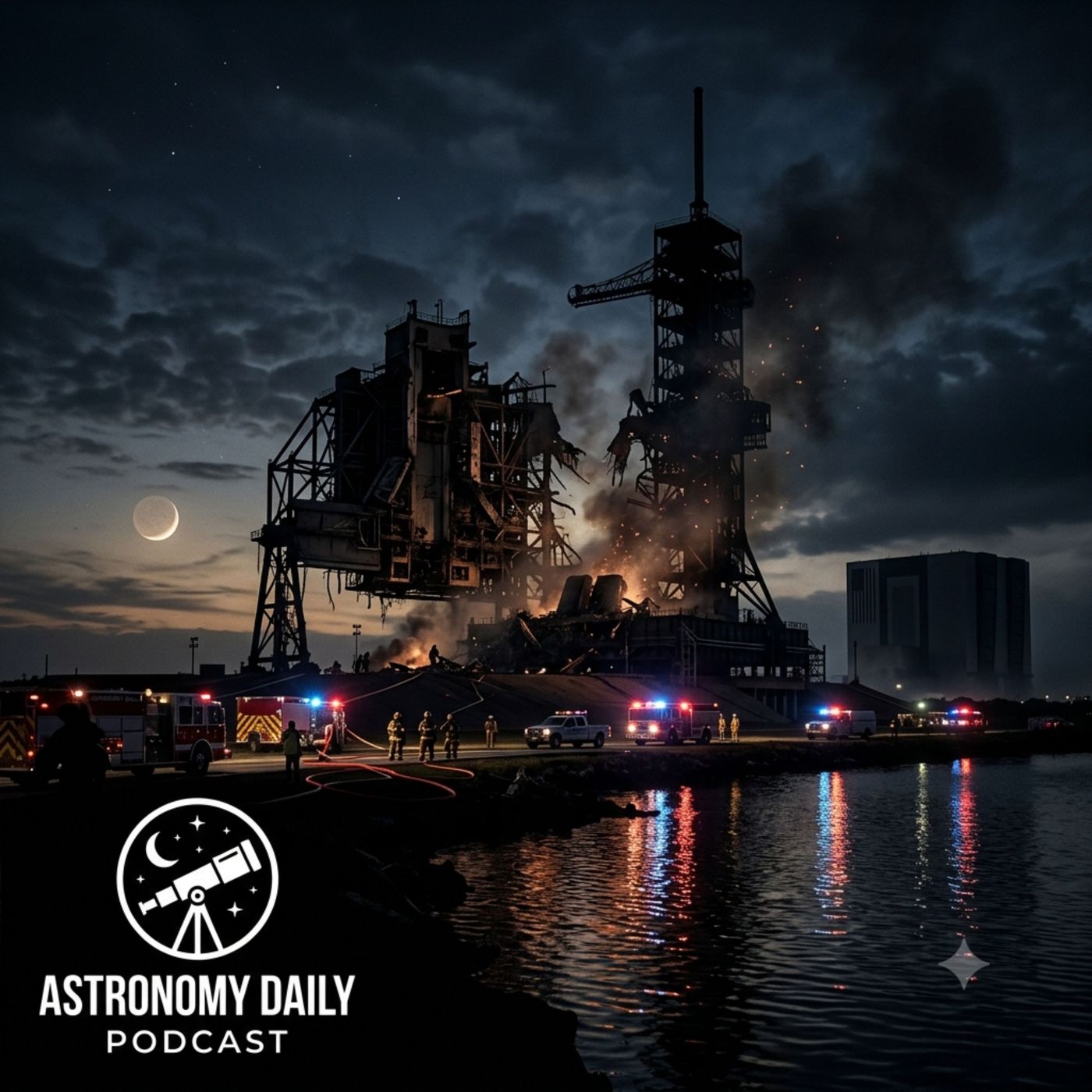
Anna: These are real icons. The Neutral Buoyancy Simulator, a massive pool from the 1960s for weightless training used for Hubble repairs and shuttle hardware. The Propulsion and Structural Test Facility, or t Tower from 1957 tested Redstone, Saturn and shuttle boosters. And the Dynamic Test Facility, tallest in north Alabama when built in 1964 shook. Avery: Saturn V and shuttle elements, all national landmarks since 1985. Key to Apollo, Skylab and Shuttle, but they're inactive, unsafe and costly to maintain.
Demolition starts with implosions, possibly as soon as January 10th. Part of clearing 25 old structures to modernize for Artemis. Anna: Bittersweet, but NASA's preserving the legacy. High res digital models, artifacts to museums, virtual tours. End of an era making way for the next. Avery: Yeah, progress often means saying goodbye to the past. Anna: What a thoughtful mix today. Quiet oceans, upcoming moonshots, dusty early galaxies, Martian vistas, sky events. Avery: And honoring history, the cosmos and our exploration of it.
Always evolving. Thanks for spending your time with us on Astronomy Daily. Anna: We love bringing these stories to you. Subscribe if you haven't, share with a friend and we'll be back tomorrow. Avery: Until then, keep wondering and looking up. Anna: Clear skies, everyone.

 Apple Podcasts
 Spotify
 Pocket Casts
 Castbox
 Overcast
 Podbean
 iHeartRadio
 Castro
 Goodpods
 Moon FM
 Podcast Addict
 Podcast Republic
 YouTube