
In this episode
- SpaceX's Starship Soars Again: SpaceX has successfully completed another test flight of its Starship, marking a significant milestone in its ambitious plans for Mars exploration. We discuss the impressive specifications of the current version and what to expect from the upcoming iterations, including orbital refueling capabilities that will pave the way for interplanetary travel.
- New Theories on Dark Energy: A groundbreaking theory proposes that dark energy may have once pulled the universe together before switching to its current role of expansion. This intriguing idea could potentially resolve two major cosmological tensions, showcasing the ongoing quest to understand the universe's fabric.
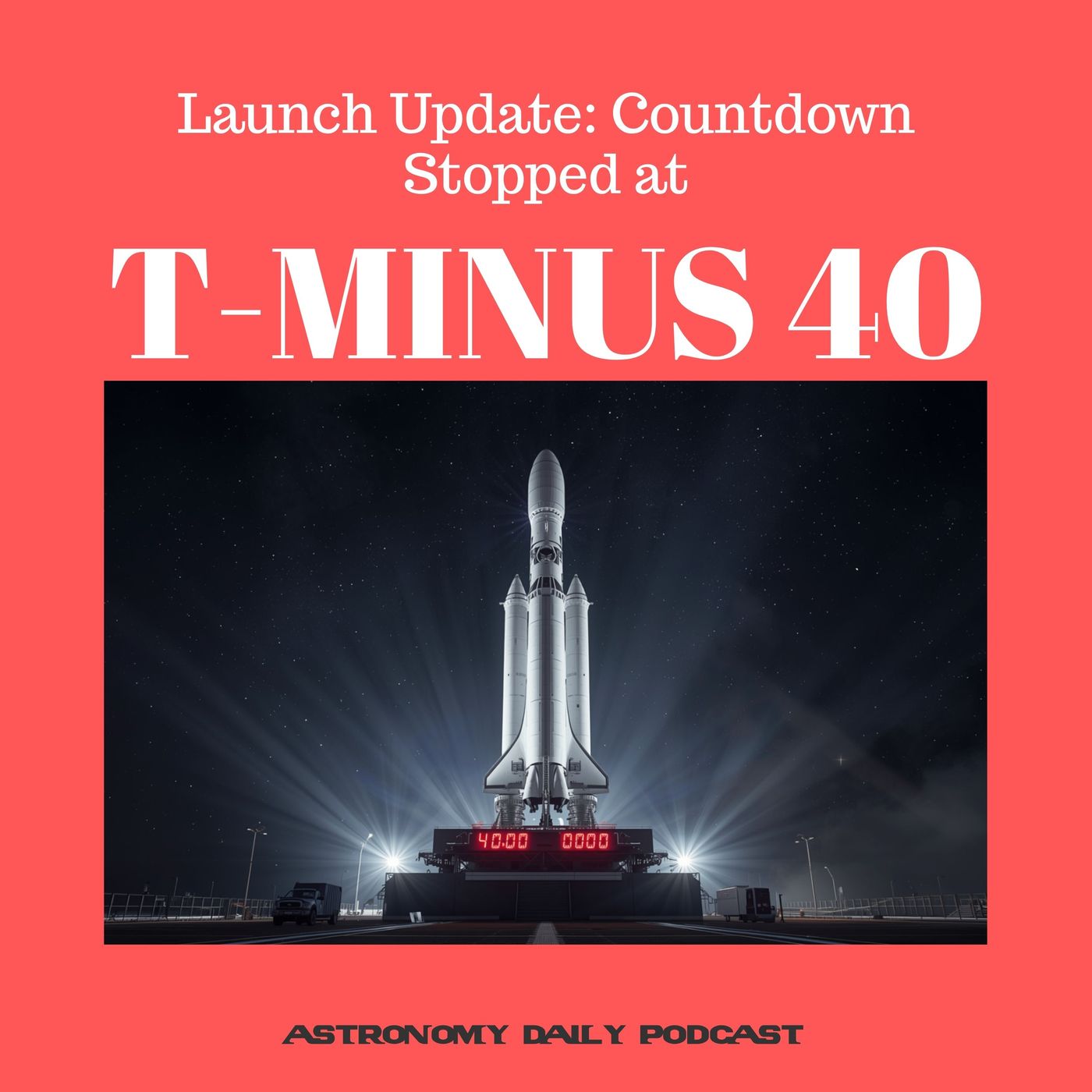
- Falcon 9's 400th Booster Landing: SpaceX's Falcon 9 rocket has achieved a remarkable feat by completing its 400th successful landing of a booster on a drone ship. We reflect on the evolution of their reusability efforts and how this milestone underscores the company's relentless focus on efficiency.
- China's Lunar Ambitions: China's space program is rapidly advancing towards a crewed lunar landing by 2030. We delve into their recent engine tests and the development of new spacecraft and technology that are bringing them closer to this monumental goal.
- For more cosmic updates, visit our website at astronomydaily.io. Join our community on social media by searching for #AstroDailyPod on Facebook, X, YouTubeMusic Music, TikTok, and our new Instagram account! Don’t forget to subscribe to the podcast on Apple Podcasts, Spotify, iHeartRadio, or wherever you get your podcasts.
- Thank you for tuning in. This is Anna and Avery signing off. Until next time, keep looking up and stay curious about the wonders of our universe.
SpaceX Updates
[SpaceX](https://www.spacex.com/)
Dark Energy Research
[NASA](https://www.nasa.gov/)
Falcon 9 Milestones
[SpaceX](https://www.spacex.com/)
China's Lunar Program
[CNSA](http://www.cnsa.gov.cn/)
Astronomy Daily
[Astronomy Daily](http://www.astronomydaily.io/)
Become a supporter of this podcast: https://www.spreaker.com/podcast/astronomy-daily-space-news-updates--5648921/support.
Sponsor Details:
Ensure your online privacy by using NordVPN. To get our special listener deal and save a lot of money, visit www.bitesz.com/nordvpn. You'll be glad you did!
Sponsor Details:
Ensure your online privacy by using NordVPN. To get our special listener deal and save a lot of money, visit www.astronomydaily.io/nordvpn. You'll be glad you did!
Get the best secure and private email on the planet. Stop your Government, google and who knows who else spying on every email you write. Do what we did and use ProtonMail. They beleive in privacy and there are no ads in their business model...yet they still provide a free forever service. Check them out and get out special deal at <a...
Avery: Hello, and welcome to Astronomy Daily, the podcast that brings you the universe one story at a time. I'm your host, Avery. Anna: And I'm Anna. It's great to have you with us. We've got an information rich show for you today covering everything from record breaking rocket landings to new theories about the very fabric of the cosmos. Avery: That's right, Anna. Uh, we'll also be diving into the future of SpaceX's colossal Starship, exploring how a simple sign switch in dark energy might solve some of cosmology's biggest puzzles.
And we'll also look at the incredible progress China's making in its race to the moon. Anna: So let's get right to it. Our first story takes us to Boca chica, Texas, where SpaceX just completed another successful test flight of its Starship Mars rocket. Avery, Flight 10 was a success, but SpaceX is already looking past this vehicle, isn't it? Avery: They absolutely are. The flight on August 27 was flawless, checking all the box. But in true SpaceX fashion, they're not resting on their laurels. This current version, version two, is essentially a stepping stone.
The whole program is about rapid iteration to build the vehicle capable of getting humanity to Mars. Anna: And the next versions are going to be even more impressive. The current starship stands at about 121 meters tall, which is already staggering. But the next iteration, version three, is expected to be over 124 meters and beyond that. Version four is planned to fly in 2027 with a mind boggling 42 engines. Avery: That is some, um, serious thrust. Version three is a massive upgrade and is expected to be in testing by the end of this year, with a heavy flight schedule planned next year.
This is all building towards a very ambitious timeline. SpaceX is targeting 2026 for its first uncrewed missions to the Red planet. Anna: A critical piece of that puzzle is orbital refueling. To get to Mars, Starship will need to be refueled in Earth orbit by other starship tankers. It's a complex maneuver that's never been done on this scale. And SpaceX aims to demonstrate that capability next year. It's the key that unlocks the whole interplanetary vision. Avery: And it's not just about Mars. This massive lift capacity is going to revolutionize other areas too.
Think about the next generation of StarLink satellites, Star V3. They're so large that they can only be launched by starship. It's a step change in capability. Anna: That's a great point. And there's also the long term vision of point to point travel on Earth. Imagine Traveling from New York to London in under an hour. It sounds like science fiction, but Starship is the vehicle designed to make that a reality. The infrastructure build out at their Starbase facility in Texas is staggering, with a new launch tower and production facilities working around the clock to support this incredible pace.
Avery: Absolutely, Anna. Uh, and that rapid pace is key. The philosophy of build, fly, test, repeat is what sets this program apart. They accept that some tests will fail, but each failure provides invaluable data that feeds into the next iteration. It's a high risk, high reward strategy that is clearly paying off, pushing the boundaries of what's possible in rocket engineering. It's an incredible pace. Now, from engineering the future of spaceflight, let's turn to the fundamental nature of the universe itself.
Anna? Uh, there's a fascinating new theory that might shake up our understanding of dark energy. Anna: That's right. For decades, our standard model of cosmology, known as lambda cold dark matter, has been our best guide to the universe. But it's not perfect. It has a couple of persistent problems. The Hubble tension and the Sigma 8 tension. Essentially, our measurements of the universe's expansion rate and its clumpiness don't quite match what the model predicts. Avery: So what's the new idea? It sounds like something straight out of science fiction.
A new study is proposing that dark energy, the mysterious force driving the universe's accelerated expansion, didn't always push things apart. It may have once pulled things inward. Anna: Exactly. The theory suggests the universe may have undergone a phase transition, shifting from what's called an anti de sitter phase, where vacuum energy caused contraction, to the de sitter phase we see today, where it causes expansion. If this sign switch happened in the early universe, it could elegantly resolve both the Hubble and Sigma 8 tensions at the same time.
Wow. Avery: So a simple flip from a, uh, minus to a plus sign in the nature of dark energy could fix two of the biggest nagging problems in cosmology. It's a powerful reminder that there's still so much we have to learn about the cosmos. Anna: We certainly do. Now let's come back down to Earth orbit for another major achievement from SpaceX. While Starship represents the future, the their workhorse Falcon 9 rocket just hit an incredible milestone for reusability. Avery: Absolutely historic one. On a recent Starlink mission, SpaceX completed its 400th successful landing of a Falcon booster on a drone ship.
The first stage, designated B1095, touched down perfectly on the drone ship. Just read the Instructions. After launching 28 more Starlink satellites, 400. Anna: That number is just amazing. When you think about where we were less than a decade ago, it's easy to forget that the first successful recovery of a Falcon 9 booster was on land back in December 2015. Landing on a tiny drone ship at sea was an even bigger challenge, which they first cracked in April 2016. Avery: And now it's routine. Those drone ships are the key to their high flight rate.
By catching the boosters at sea, they can fly more efficient trajectories and recover boosters from almost any mission. It's a testament to the relentless focus on reusability. Anna: Speaking of ambitious national space programs, SpaceX isn't the only player making big moves. Our final story today focuses on China's accelerating effort to land its own astronauts on the moon. Avery: That's right, Anna. Uh, they are making serious, visible progress towards their goal of a crewed lunar landing by 2030.
A major piece of evidence was a ground Test on August 15 for the first stage of their new rocket, the Long March 10th. Anna: And this wasn't just any test. They clustered seven of their powerful YF100K engines together and fired them, reaching a thrust of nearly 1,000 tons. That's a new record for China's space program and a clear demonstration of the power they're developing for their lunar ambitions. Avery: And it's not happening in a vacuum. This engine test follows a string of other successful milestones.
They've performed a pad outboard test for their Mengzhou crew spacecraft, simulated a takeoff and landing with their Langyue lunar lander, and even unveiled their new lunar spacesuits. Anna: All the pieces are coming together. It's clear that China is methodically and successfully building the hardware and expertise needed to create a new chapter in human lunar exploration. The race back to the moon is definitely heating up. Avery: And that's a wrap for this episode of Astronomy Daily. From the next generation starship and China lunar rocket to a 400th booster landing and a new twist in cosmic history, it's been a busy day in space news.
Anna: Thank you all so much for tuning in. If you enjoyed the show, please subscribe wherever you get your podcasts and feel free to leave us a review. It helps others discover the wonders of the universe with us. Avery: We'll be back soon with more of the latest news from across the cosmos. Until then, on behalf of Anna and myself, keep looking up.
Anna: The story.

 Apple Podcasts
 Spotify
 Pocket Casts
 Castbox
 Overcast
 Podbean
 iHeartRadio
 Castro
 Goodpods
 Moon FM
 Podcast Addict
 Podcast Republic
 YouTube