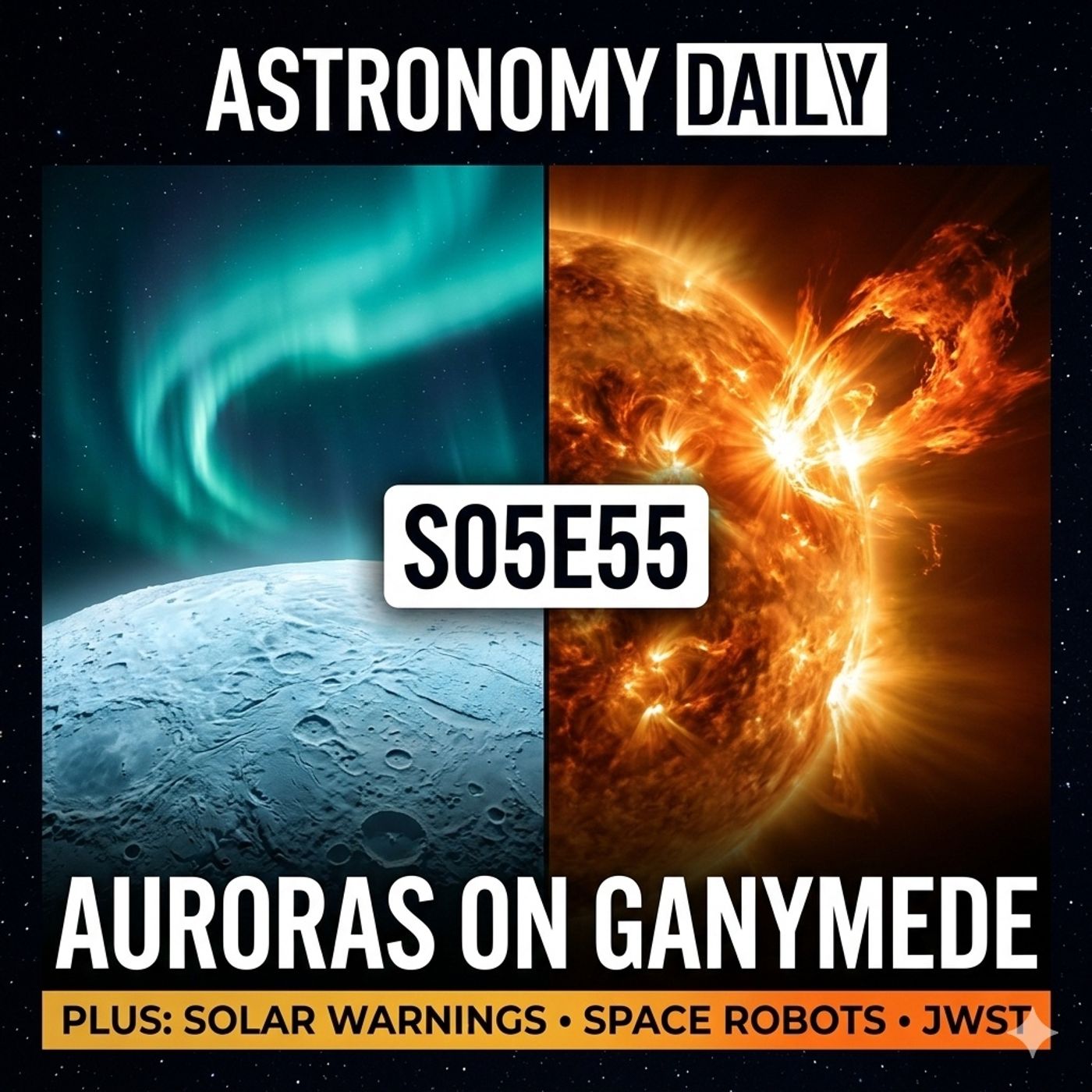
Auroras on Ganymede, Superflare Warnings and Japan’s Very Bad Week
In this episode
Welcome back to Astronomy Daily! In S05E55, Anna and Avery explore six fascinating stories from across the cosmos — from auroras on Jupiter’s largest moon to the latest JWST galaxy reveal, a breakthrough solar storm warning system, a beautiful combined nebula image, Japan’s ongoing rocket struggles, and Europe’s ambitious plans for orbital repair robots. Stories This Episode 1. Ganymede’s Auroras Mirror Earth’s Northern Lights Scientists using data from NASA’s Juno spacecraft have revealed that Jupiter’s largest moon Ganymede has fragmented, patch-like auroras remarkably similar to those seen on Earth. The research, led by the University of Liège and published in Astronomy & Astrophysics, suggests that the fundamental physical processes generating auroras may be universal across magnetised bodies in the solar system. Ganymede is the only moon known to have its own intrinsic magnetic field. 2. New Solar Superflare Forecasting System An international team has developed the first system capable of predicting when and where extreme solar storms are likely to occur, with up to a year’s advance warning. By analysing 50 years of X-ray data, researchers identified a 1.7-year and a 7-year solar cycle whose alignment predicts high-risk periods. The current window (mid-2025 to mid-2026) is flagged as elevated danger. Published in the Journal of Geophysical Research: Space Physics. 3. Cat’s Eye Nebula — Euclid and Hubble Combined NASA and ESA have combined imagery from the Euclid and Hubble space telescopes to produce a breathtaking new composite view of the Cat’s Eye Nebula — the glowing remnant of a dying star about 3,000 light-years away in Draco. The image showcases the nebula’s complex layered shells and intricate inner structure in unprecedented detail. 4. JWST Reveals Spiral Galaxy NGC 5134 The James Webb Space Telescope has captured a stunning infrared portrait of NGC 5134, a barred spiral galaxy 65 million light-years away. Webb’s infrared capability pierces through galactic dust to reveal glowing stellar nurseries and the full cycle of star birth and evolution playing out across the galaxy’s spiral arms. 5. Japan’s Kairos Rocket — Safety Abort on Third Attempt Space One’s Kairos No. 3 rocket was aborted just 30 seconds before liftoff on March 4 when a safety monitoring system detected unstable positioning satellite signals. Following two failed launches in 2024 and multiple weather scrubs this week, the company has yet to set a new launch date. The window remains open until March 25. A successful launch would mark the first orbital success for a fully private Japanese rocket. 6. Europe’s Orbital Repair Robots European companies led by Thales Alenia Space are developing robotic satellites capable of refuelling, repairing and repositioning spacecraft in orbit. A demonstration mission is planned for 2028. With nearly 15,000 operational satellites now in orbit — most never designed to be serviced — the in-orbit servicing market could transform how we manage space infrastructure. Regulatory questions around liability remain unresolved. Links & Further Reading Full show notes, images and source links: astronomydaily.io Listen on: Apple Podcasts | Spotify | Amazon Music | All podcast platforms Watch on: YouTube — Astronomy Daily Follow us: @AstroDailyPod on Twitter/X, Instagram, Facebook, TikTok, Tumblr Part of the Bitesz.com Podcast NetworkBecome a supporter of this podcast: https://www.spreaker.com/podcast/astronomy-daily-latest-space-news--5648921/support.
Sponsor Details:
Ensure your online privacy by using NordVPN. To get our special listener deal and save a lot of money, visit
Speaker 1: Hey, everyone, Welcome back to Astronomy Daily.
Speaker 2: I'm Anna, and I'm Avery and Anna. Today's episode is genuinely one of those ones where I kept saying wait what out loud reading the headlines.
Speaker 1: Right, We've got auroras on Jupiter's biggest moon that look just like the ones here on Earth, a solar storm early warning system that could give us a whole year's notice before the really dangerous ones hit, a cosmic image that is genuinely going to make you stop scrolling.
Speaker 2: And Japan's struggling private rocket company has had yet another very bad day. This is Series five, Episode fifty five of Astronomy Daily. Let's get into it.
Speaker 1: So our first story is a beautiful one. Scientists have just published detailed new research showing that Jupiter's largest moon, Ganymede, has auroras, and not just auroras, auroras that look strikingly similar to the northern lights here on Earth.
Speaker 2: Which already sounds incredible for listeners who might not know. Ganymede is fascinating in its own right. It's actually bigger than Mercury. It's thought to have a vast liquid saltwater ocean beneath its icy crust, and it's the only moon in our entire Solar system known to have its own magnetic field, and.
Speaker 1: That magnetic field is the key to this story. The research was led by astrophysicists at the University of Liege in Belgium, and they used data from NASA's Juno spacecraft, which made a close flyby of Ganymede back in twenty twenty one, coming within about one thousand kilometers of the surface.
Speaker 2: So what did they find. Previous observations at suggested Ganymede had auroras, but they were blurry and low resolution. With Juno's ultraviolet spectrograph, the team could finally see the fine detail, and what they found surprise them.
Speaker 1: Right they expected to see smooth, continuous, oval shaped glowing bands like a diffuse curtain of light. Instead, Ganymede's auroras are fragmented into a chain of distinct bright patches, each one roughly fifty kilometers across.
Speaker 2: Those same structures, called beads, are something we see in Earth's own auroral displays. They're linked to large scale rearrangements of the magnetoskhire that release enormous amounts of energy. The fact that we're seeing the same thing on Ganymede suggests that the fundamental physical processes creating auroras might be essentially universal.
Speaker 1: Which is a beautiful idea when you think about it, that the same magnetic dance that lights up our polar skies on Earth is happening on a moon half a billion kilometers away. The research was published in the journal Astronomy and Astrophysics.
Speaker 2: And if you're wondering when we'll get another look, frustratingly, Juno will never fly over Ganimat again. The next close up opportunity will come in twenty thirty one, when ESA's Juice spacecraft arrives at Jupiter. Until then, these fifteen minutes of data from twenty twenty one are all.
Speaker 1: We have fifteen minutes of data that have kept scientists busy for years. That's pretty remarkable.
Speaker 2: Really, Okay, next up, and this one has real world stakes. An inter national team of sciences has developed what they're calling the first system that can actually predict when and where the most dangerous solar storms superflares are likely to occur.
Speaker 1: And the headline number here is remarkable. They're talking about up to a year's advance warning, which, if you know anything about how solar forecasting currently works is a complete game changer.
Speaker 2: Right because today we can maybe predict a solar flare a few hours before it happens, if we're lucky. And that's for regular flares. Superflares, the really extreme X ten or stronger events happen so fast and so unpredictably that they've historically been almost impossible to foresee.
Speaker 1: So how does this new approach work. The team, led by doctor Victor velasco Arera from the National Autonomous University of Mexico analyzed nearly fifty years of X ray data from solar monitoring satellites. They identified two repeating natural cycles in solar activity, one lasting about one point seven years and another of around seven years. When those cycles align in certain ways, the risk of superflares increases sharply.
Speaker 2: And the system doesn't just give you a time window, it also identifies which specific regions of the Sun are at greatest risk for Solar cycle twenty five, the one we're in right now. The model flags a high risk window that runs roughly from mid twenty twenty five through to mid twenty twenty six, focused on the Sun's southern hemisphere.
Speaker 1: Meaning we're in it right now.
Speaker 2: We are, and the reason this matters so much is what a serious superflare could actually do. We're talking widespread power grid failures, satellite damage, GPS disruption, communications blackouts. For astronauts traveling outside Earth's magnetic protection, like the Artemis two crew heading around the Moon, it could pose serious radiation risks.
Speaker 1: The team actually validated this approach by demonstration it correctly anticipated powerful eruptions on the far side of the Sun in twenty twenty four, events nobody knew about until after the fact. That retroactive confirmation is what gives the scientific community confidence the model is genuinely working. It's been published in the Journal of Geophysical Research.
Speaker 2: Lead researcher doctor Velasco Herrera put it, well, we can't tell you the exact moment a storm will erupt, but we can tell you when the conditions are most dangerous, and that lead time is what makes all the difference for utilities, satellite operators, and space agencies planning missions.
Speaker 1: Think of it like a hurricane season forecast rather than a specific storm path prediction. You know when to be on guard. That could genuinely save lives and billions of dollars in infrastructure.
Speaker 2: Right let's take a breath from the We're all in danger stories and look at something beautiful. NASA and ISSA have released a stunning new combined image of the Cat's Eye nebula, bringing together observations from two of our most powerful space telescopes, EUCLID and Hubble.
Speaker 1: The Cat's Eye nebula is one of those objects that just never gets old. It's a planetary nebula, the glowing remains of a star similar to our Sun, that expelled its outer layers as it died, Located about three thousand light years away in the constellation Draco. It was actually one of the first nebulae ever observed through a spectroscope way back in eighteen sixty four.
Speaker 2: And Hubble has imaged it before famously. But this new composite uses euclid's wide field infrared capability alongside Hubble's detailed optical and ultraviolet data to produce something genuinely new. You can see the layered, billowing shrouds of expelled material in extraordinary detail, along with the intricate inner structures around the central white dwarf.
Speaker 1: What I love about this story is what it says about where we are with our telescope infrastructure. Right now, we have Hubble, Web, euclid, all operating simultaneously, each with different strengths, and scientists are combining their data to produce views of the universe that no single instrument could achieve alone.
Speaker 2: This is also, in a very direct sense, a preview of our own son's future. In about five billion years, our sun will go through the same process, jetting its outer layers, leaving behind a glowing nebula and a dense white dwarf at its core. The Catsie is one possible version of our cosmic obituary.
Speaker 1: Cheerful but genuinely awe inspiring. We'll have a link to the full image in the show notes. It is absolutely worth seeing full size.
Speaker 2: It's just incredible what they keep on finding out there.
Speaker 1: Staying in the beautiful corner of the universe for a moment, the James Webb Space Telescope has delivered another jaw dropping image, this time of a spiral galaxy called NNGC five one three four, sitting about sixty five million light years away.
Speaker 2: So not exactly next door, but in infrared, Web is able to pierce through the dust that normally obscures so much of the galactic structure, and what it reveals is extraordinary glowing clouds of gas stellar nurseries where new stars are actively forming and the intricate spiral arms traced in enormous detail.
Speaker 1: NNGC five one three four is what's called a barred spiral galaxy. It has a central bar shaped structure from which its spiral arms extend. Galaxies like this are really important to study because they let us trace the entire stellar life cycle in one place, from dense clouds of gas where new stars are just beginning to form, right through to older stellar populations in the central regions.
Speaker 2: And this image also serves as a kind of reference point for understanding galaxy evolution more broadly. By comparing infrared observations of galaxies like NNGC five one three four across cosmic time, astronomers can build a picture of how galaxies grow, change, and eventually in some cases stop forming stars altogether.
Speaker 1: Web continues to deliver every single week. There's something new. Link to the full image in the show notes.
Speaker 2: As always, Okay, we've had two gorgeous images and some landmark science. Time to talk about Japan's very unlucky rocket program.
Speaker 1: Poor cairos So to set the scene for anyone just joining this story. Space one is a Tokyo based startup founded in twenty eighteen, backed by canon Ihi Aerospace, Shimizu Corporation, and the Development Bank of Japan. They've been trying to become the first fully private Japanese company to put satellites into orbit using a domestically developed rocket.
Speaker 2: Their first Chiros rocket exploded seconds after liftoff in March twenty twenty four. The second one made it off the pad in December twenty twenty four, but los attitude control about two minutes in, creating what one commentator described as a very expensive quirk screw in the.
Speaker 1: Sky, And so all eyes were on Cairo's Number three, which has been through a genuinely painful week. The launch was originally scheduled for February twenty fifth, scrubbed for weather, BEN, rescheduled for Sunday, scrubbed for weather again, BEN, rescheduled for Wednesday, March fourth, which seemed promising, and.
Speaker 2: Then a safety monitoring system activated thirty seconds before liftoff due to unstable signal reception from a positioning satellite, and the launch was aborted. No new date has been set, though the launch window runs until March twenty fifth, and to.
Speaker 1: Be clear, that system activating is actually the system doing exactly what it's supposed to do. This is not a failure in the sense that the previous two launches were. It's the safeguard working correctly, but it's still deeply frustrating for everyone involved, including the local community in Kushimoto who've embraced this as a kind of space tourism attraction.
Speaker 2: There's something genuinely compelling about this story because it's about a country's private space industry trying to find its feet in a market now dominated by SpaceX. Japan has excellent government rockets, the H three has been going well, but the commercial small satellite launch market is where everyone wants to be, and Space one is fighting hard to get there.
Speaker 1: We will absolutely be watching still a few weeks in the launch window. Fingers crossed for Cairos number three.
Speaker 2: Will keep you updated.
Speaker 1: And finally, a story I find genuinely exciting because it's about solving a problem we've been quietly ignoring for decades. Europe is developing orbital repair robots, autonomous spacecraft that could refuel, fix, and reposition satellites in orbit.
Speaker 2: The freeming. I love here is space tochucks, which is how the project manager at thallus Alna Space, Stephanie bihar La Fenetre, described it. The idea is a robotic satellite with a mechanical arm that can approach a stricken or aging satellite, capture it, service it, and if necessary, push it to a different orbit.
Speaker 1: The scale of the problem this addresses is significant. There are now nearly fifteen thousand operational satellites in orbit. The vast majority were designed to be entirely disposable. Once they malfunction or run out of fuel, they either drift into a graveyard orbit or contribute to the growing debris problem. Repair was never part of the business model.
Speaker 2: Dallas Alina Space is planning a demonstration mission for twenty twenty eight, so still a few years away, that will prove out the capture and servicing technology. One of the clever insights in the engineering is that around three quarters of all satellites in orbit have robust metal rings that were originally designed for launch. Those rings turn out to be ideal grab points for a robotic arm, even though nobody designed them with that in mind.
Speaker 1: There are fascinating legal questions too, if a French company's robot repairs a South Korean military satellite who bears liability if something goes wrong during the procedure. These are genuinely unsolved problems in international space law that need to be worked out before this market can scale.
Speaker 2: And it's not just Europe. There are parallel programs in the US and China. But this story shows Europe is serious about staking a claim in what could be a very large market for telecommunications companies running aging geostationary satellites worth hundreds of millions of dollars. The economics of repair versus replacement are compelling.
Speaker 1: It's also just a nice idea, isn't it. Space is full of expensive hardware. We've abandoned the idea that we might start going back up there to fix things rather than just launch new ones. Feels like a more mature relationship with the orbital environment, and.
Speaker 2: That's our six for today. Auroras on Ganymede Solar Superflair forecasting, the cats ey Nebula reimagined a stunning web galaxy, Japan's ongoing rocket struggles, and Europe's plans to send robots to fix our orbital infrastructure.
Speaker 1: If you want to see any of the images we talked about today, the cats I, NGC, five, one, three, four, Ganimedes auroras. They're all linked in the show notes and the blog post over at Astronomy Daily dot io.
Speaker 2: If you're enjoying the show, the best thing you can do is leave us a review on Apple Podcasts or Spotify and share the episode with a friend who loves space. It genuinely makes a difference.
Speaker 1: You can also find us at astro Daily Pod across x, Instagram, TikTok, YouTube, and Facebook. We're back tomorrow with more. Until then, keep looking.
Speaker 2: Up Sunday Stars starsz

 Apple Podcasts
 Spotify
 Pocket Casts
 Castbox
 Overcast
 Podbean
 iHeartRadio
 Castro
 Goodpods
 Moon FM
 Podcast Addict
 Podcast Republic
 YouTube