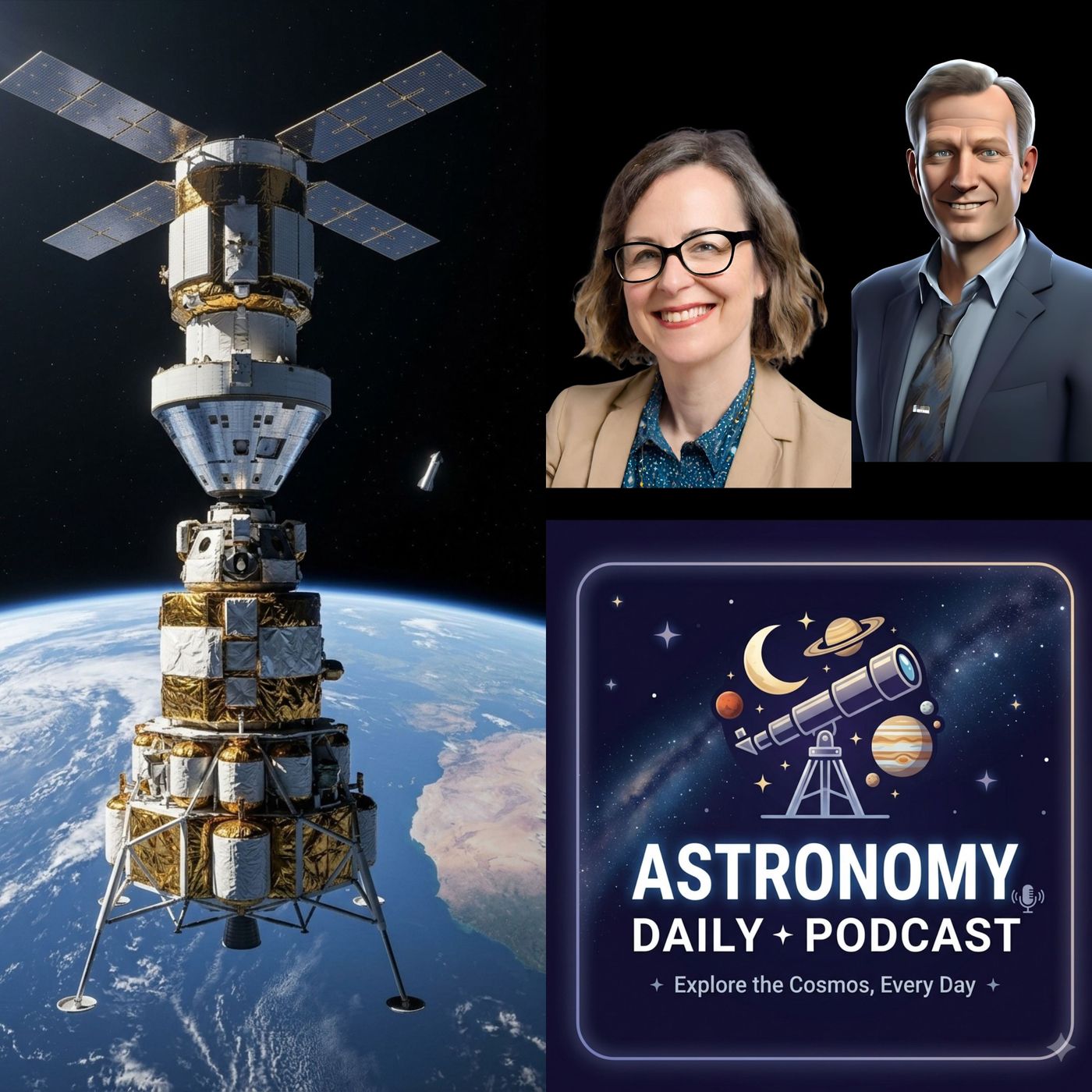
Artemis 4: The Moon's Tiebreaker Awaits - The Weekend Wrap
In this episode
Show notes NASA lays out Artemis III day by day: fourteen days in Earth orbit, two rival landers, one Orion. Plus the week that was, Swift's final bow, and Venus changing sides. The Rehearsal NASA's 23 October Artemis update laid out Artemis III day by day: a 14-day low-Earth-orbit mission targeted for summer 2027 in which Orion docks with a Blue Origin Blue Moon Mark 2 test lander on day three (crew enter its cabin) and a SpaceX Starship test lander on day eight. For Artemis IV in 2028, Starship would dock with Orion in Earth orbit and push it to the Moon; Blue Moon would reach lunar orbit on Mark 1-derived transfer stages. Isaacman put Artemis III about 90 days behind on paper. Plus: the National Academies' four science-first landing sites, none at the south pole. The Week That Was MMX launched for Phobos and is in good health; the Moon is still shrinking (>10,000 young thrust faults); the Milky Way's disc formed in two stages; balloons measured GLE 77 through the atmosphere; and The Starry Night as a real 1889 sky. Also: the ELT's mirror, a Valles Marineris marsquake and Roman's science commissioning. Farewell, Swift On 20 October Swift reached 275 km, entered safe mode and was commanded to end operations ahead of re-entry, expected within weeks. No date or location has been published. Skywatch Venus at inferior conjunction (24 Oct, 6.5° from the Sun — do not look); Mercury low in the west for the south; the near-full Moon beside Saturn tonight; full Hunter's Moon 26 Oct 04:11 UTC; Mars and Jupiter closing pre-dawn for the north; UK clocks go back Sunday 25 Oct. Always use ISO 12312-2 certified filters for any solar viewing.Become a supporter of this podcast: https://www.spreaker.com/podcast/astronomy-daily-latest-space-news--5648921/support.
Sponsor Details:
Ensure your online privacy by using NordVPN. To get our special listener deal and save a lot of money, visit www.astronomydaily.io/nordvpn. You'll be glad you did!
Get the best secure and private email on the planet. Stop your Government, google and who knows who else spying on every email you write. Do what we did and use ProtonMail. They beleive in privacy and there are no ads in their business model...yet they still provide a free forever service. Check them out and get out special deal at www.astronomydaily.io/protonmail
Become a supporter of Astronomy Daily by joining our Supporters Club. Commercial free episodes daily are only a click way... Click Here
This episode includes AI-generated content.
Anna: At 5 o' clock Saturday morning, Sydney time, NASA's leadership stood up at the Kennedy Space Centre and laid out day by day how they intend to put people back on the moon. And the first thing they told us is that the next crew isn't going anywhere near it. Avery: 14 days in low earth orbit. 2 different lunar landers from 2 rival companies launched on 2 different rockets and 1 Orion capsule trying to dock with both of them. It's a dress rehearsal and it's a tiebreaker. Anna: Plus the week that was a farewell to an old friend of this show and a sky where Venus quietly swaps sides.
Avery: This is Astronomy AstroDailyPod, the weekend wrap for Saturday 24th October. I'm Avery. Anna: And I'm Anna. Let's get into it. Avery: If you listened on Wednesday, you'll know we got the day of this briefing wrong and corrected it on Thursday. So consider this the loop closed. NASA held its Artemis update on Friday afternoon at AH2 Eastern at the Press site at UH Kennedy with Administrator Jared Isaacman, Associate Administrator Amit M. Chatria and the Artemis Programme Manager, Jeremy Parsons.
Anna: And the headline is that Artemis 3 is still on track for the summer of 2027, northern summer, and that it's now a 14 day mission in low Earth orbit rather than a moon landing. That change itself isn't new. NASA converted Artemis III back in February. What's new is that we finally have the flight plan. Avery: Let's walk it. It takes three of the most powerful rockets in the world. First up is Blue Origin. A new Glenn launches a test version of its blue moon mark two lander from Launch Complex 36 at uh, Cape Canaveral.
And it sits in orbit while Blue Origin checks it out. Anna: Then the crew four astronauts launch on the Space Launch System and orion from pad 39B at Kennedy. Orion spends its first couple of days on systems checks, then raises itself into a rendezvous orbit about 237 nautical miles up. That's roughly 440 kilometres. Avery: On day three, Orion meets Blue Moon and docks. And this is the part I find genuinely striking. Over the next two days, the crew opens the hatch, floats into the lander's cabin and works through its life support and controls with mission control people inside a lunar lander in Earth orbit for the first time since Apollo.
Anna: Then SpaceX, a Starship test lander, launches from pad 39A, a few kilometres up the coast from where Orion lifted off. Orion undocks from Blue Moon, adjusts its orbit, and on day eight, it docks with Starship. That docking is short about two hours and this time the crew stays inside Orion. Avery: The rest of the mission is spacesuit evaluations, human research, science experiments and technology demonstrations. And then Orion comes home to a splashdown. NASA's own summary describes the point of it as validating the coordination of multiple launch systems.
And They've said the 14 days could stretch the 17 if weather or anything else slips a launch. Anna: So why do this at all rather than just go? Avery: Isaacman's argument back in February was about gaps. One uncrewed flight of the big rocket, three years, a crewed flight around the moon, another three years and then a landing. He said, in effect, that you don't learn to land on the moon in one jump from there. You need flights in between. Anna: And if that sounds familiar, it should. In March 1969, Apollo 9 took the lunar module up for its first crewed flight and tested it in Earth orbit, undocking, separation, rendezvous and docking again, all close to home, where a problem could be survived.
Two months later, Apollo 10 went to the moon and flew down to within about 15 kilometres of the surface. And then Apollo 11. Avery: Artemis 3 is Apollo 9, except this time there are two landers from two companies and they're competing. Anna: And that competition is the other half of yesterday's news, because the two companies now have quite different plans for actually getting crew to the surface. On Artemis 4, which NASA is targeting for 2028. Avery: SpaceX's plan is the simpler one to picture.
Starship would dock with Orion in Earth orbit and then use its own engines to push the whole stack, crew capsule and all, out to the moon. The lander is also the translunar stage. Anna: Blue Origin goes the other way. Blue Moon would fly itself out to lunar orbit using separate transfer stages derived from its uncrewed Mark one lander. And Orion would meet it there in orbit around the moon. That replaces a big propellant carrying transporter vehicle that Blue Origin had in its earlier architecture.
Avery: NASA hasn't picked which one flies Artemis IV. Isaacman described Artemis 3 as effectively the tiebreaker. And both companies are still saying they intend to land in 2028 either way. So the docking tests next year aren't a formality, they're an audition. Anna: Now, we need to be straight about the calendar because there's a lot of pressure on it. Avery: Isaacman himself said Artemis 3 is about 90 days behind on paper, mainly supply chain delays on both companies test landers. He was blunt about the size of the job, calling what they're attempting extraordinarily difficult.
Anna: And look at the hardware. Blue Origin's new. Glenn hasn't flown since a launchpad explosion during a static fire test in May. So that pad is being rebuilt. Starship reached orbit for the first time only last month on Flight 14. Parsons said SpaceX is targeting Flight 15 for November from Starbase and its first in space propellant transfer demonstration, Starship to starship for early 2027. That refuelling is the thing SpaceX's lunar lander cannot work without. Avery: Parsons answer to the risk was that uh, there will be multiple Starship launches and multiple new Glenn launches from the rebuild pad before anyone flies Artemis 3, which is a reasonable answer.
But every one of those dates is a target. We'll say targeted, not scheduled and we'll report them when they happen. Anna: A couple of smaller details worth keeping eye on. Axiom Space is developing a second lighter moonwalking suit, a ah, sortie suit at roughly 113 kilogrammes, about half the mass of its main suit, which means less for each lander to carry. And Blue Origin still plans to send its uncrewed mark one cargo lander called Endurance to the Moon in 2027. Avery: And here's a counterpoint that landed the same week.
NASA's landing target is the south polar region, because that's where the water ice is. On Wednesday, a National Academies committee led by Daniel Dumbacher of Purdue recommended four sites for human exploration based purely on science. And none of them is at the pole. Anna: Baba Crater on the far side. Bons Hadley, near where Apollo 15 landed, beside Hadley Rille, the Oriental Basin, that huge bullseye right on the moon's western limb. And the Aristarchus Plateau, home to the brightest crater on the near side, which you can pick out in a small telescope.
Avery: Their argument is that these are the places where a human geologist rather than a rover, answers the biggest questions, from the Moon's volcanic history to space weather. It doesn't change NASA's plan for 2028, but it's a useful reminder that the South Pole is one answer to where we should go, not the only one. Anna: We'd usually find you an Australian thread here, and honestly there isn't one in this mission. Artemis 3 never leaves low Earth orbit. The European angle is real because Orion's service module is European, built by Airbus.
But we're not going to manufacture a local hook for a test flight that's all about Florida. Avery: What we can say is that if all of this works, the 2028 landing is when the Moon itself becomes a story again. And that's a story every one of you can step outside and look at. Speaking of which, it's nearly full tonight. Anna: Time for the week. That was five episodes Monday to Friday. And here's one thing from each Monday was launch day for Japan's Martian moons exploration mission. MMX is heading for Phobos, the larger of Mars.
Two moons to land, scoop up at least 10 grammes of surface and bring it home. The capsule is due to come down in South Australia in 2031. The third Japanese sample returned to land in the outback after the two Hayabusas Avery: and um, the update since Monday. JAXA says the spacecraft is in good health and the team is working through its functional checks. The question it's chasing is still the one we laid out is Phobos A, uh, captured asteroid or debris from a giant impact on Mars. Anna: Tuesday the moon kept shrinking.
Tom Waters and colleagues in the Planetary Science Journal catalogued more than 10,000 young thrust faults, the little cliffs that form as the interior cools and the crust squeezes in. Their estimate is that the moon's radius has dropped by roughly 42 to 46 metres. Avery: Small in kilometres, but big for anyone planning a base. Those faults can still slip and some of them sit near the regions Artemis Anna: wants to land in our own galaxy. A team at the Instituto de Astrophysica de Canarias, using stellar ages and Gaia data found the Milky Way's disc formed in two distinct stages with a turning point about 10.8 billion years ago.
Born thick, settled, thin, it's an upside down picture compared with the old idea of a thin disc that slowly puffed up. Avery: Thursday, a solar radiation storm measured from the ground up on the 11th of November last year. Ground level enhancement 77. A team from Surrey, the Met Office and the Dutch Weather Service had a radiosonde balloon from Lerwick in Shetland climb right through it. Radiation readings exceeded the Aviation Authority's moderate threshold at business jet altitudes and um, were twice, twice the severe threshold at supersonic altitudes.
Anna: And their estimate for a London to New York flight on that day was a dose about 42.6% higher than normal. That's the figure in the paper. The Press release said 46 and we Avery: went with the paper and on Friday Anna: and Friday, your producer's pick. A uh, Korean team argued in scientific reports that the starry night shows the real pre dawn sky over Sam Raimi in late July. July 1889. A waning crescent moon, Venus and the Hyades star cluster. We also gave you the critique from Donald Olson at Texas State and we noted that one of the research groups has a disclosed competing interest.
A Lovely idea held at arm's length. Avery: A few more from the week quickly. On Monday, more than half of the mirror segments for the Extremely Large Telescope had reached Chile. On Thursday, a Marsquake under Valles Marineris turned out to be a strike slip rupture, 20 to 40 kilometres long, evidence the Great Canyon is still tectonically active. And on Friday, the Roman Space Telescope moved into science, commissioning the final phase before its surveys begin. Anna: Roman Reuben the ELT It's a good time to be watching big new telescopes come to life now.
Avery: A, uh, farewell. Back in September, listeners wrote in through the website asking what had happened to the mission sent to rescue NASA's Swift Observatory. That's how the link story got onto the show. Anna: Link never managed to capture Swift and it re entered. On 25 September, Swift went back to doing science, observing hundreds of targets, from supernova remnants to distant black holes to comets. But pointing at targets rather than holding its lowest drag attitude meant it sank faster. Avery: On Tuesday the 20th, Swift reached 275 kilometres.
At that point, it could no longer compensate for the drag and dropped into safe mode. And the operations team at Penn State sent a command that effectively ended the mission. NASA confirmed it yesterday. Reentry is expected in the next few weeks. Anna: NASA hasn't published a reentry date or a, uh, location and, um, we won't guess it either. What we will say is that Swift launched in November 2004 and for nearly 22 years it was the observatory that turned within a minute or two to catch a gamma ray burst while it was still happening.
So thank you, Swift. Avery: And one last arc. Harris second braking burn, about 31 minutes long, was due on Thursday. We're still waiting for ESA's confirmation and we'll bring it to you as soon as we have it. Arrival at Didymos is due in November with the first signal after each burn picked up through ESA's Deep Space Antenna at New Norca, uh, in Western Australia. Anna: Moving on to today's skywatch, let's look Avery: up and we start with something you won't be able to see at all, which is the point.
Today, Venus reaches inferior conjunction. It passes between us and the sun, coming within about six and a half degrees of it around two in the afternoon Universal Time. That's one in the morning. Sunday in Sydney and Saturday morning in the Americas. Anna: Which means the brilliant evening star of the last few months is gone from the evening sky. And over the next couple of weeks it reappears in the east before dawn as the morning star. Same planet other side of the sun. Avery: And please don't go hunting for it near the sun with binoculars or a telescope.
6.5 degrees is a hand's width at arm's length. Never point any optics anywhere near the sun. And if you ever do want to look at the sun itself, use only a filter Certified to the ISO 123122 standard, fitted properly over the front of the instrument, never improvised, and never sunglasses down south. Anna: Mercury is your evening planet this week. From Sydney, it's about 14 degrees up in the west at the end of civil twilight, around 20 to 8 in the evening and shining at about magnitude 0.8. Look low in the west southwest after sunset.
Avery: Northern listeners, I'm sorry, this one's ours. From Los Angeles, it's only about 3 degrees up at the same stage of twilight. From New York, about one. And from London, it's already below the horizon and it fades fast. So by Halloween, it's gone for everyone. Anna: Anay, uh, wherever you are, the Moon is almost full and Saturn is nearby. At 09:00 local time, the gap is about 6 and a half degrees from Sydney, about 7 from London, and 9 to 11 from the Americas, with Saturn 30 to 45 degrees up everywhere.
Saturn is the steady, slightly golden point next to the Moon. Avery: The Moon is full on Monday at 4:11 Universal Time M, which is quarter past three on Monday afternoon in Sydney, just after nine on Sunday evening in Los Angeles and just after midnight Monday in New York. Up north, that's the Hunter's moon and Anna: you may remember our anti harvest Moon from September. Same geometry, same result. On the nights around this full moon, the Moon rises only about 20 to 25 minutes later each night. From London, 30 to 40 from New York, around 40 from Los Angeles.
From Sydney, it's more than 70 minutes later each night. So the north gets a run of bright early evening moonrises for the hunters and we get the ordinary version. Avery: And here's the North's reward. Before dawn, Jupiter and Mars are closing in on each other. They're about 9 degrees apart this morning and about 6 by the end of the month at nautical dawn. From Los Angeles or New York, Jupiter is more than 50 degrees up, with Mars higher still. From Sydney, they're only around 22 to 25 degrees up.
Jupiter is the bright one, magnitude minus 1.8. Mars is fainter and reddish. Anna: Finally, a housekeeping note for our British listeners. Your clocks go back an hour early tomorrow morning, Sunday the 25th, as British Summer time ends in the United States. That's next. Sunday, the 1st of November, you're in Sydney. We're staying on daylight time until April, so for one week, the gaps between us all shift around. Check your meeting times. Avery: That's the weekend wrap. NASA has its rehearsal planned.
Two landers are auditioning for the Moon, and Swift has taken its final bow. Anna: If there's a story you want us to chase the way you chased Swift, write to us through the contact [email protected] you can also find every episode there. And we're AstroDaily Pod on social media. Avery: We're back on Monday with a fresh week of space and astronomy news. I'm Avery. Anna: And I'm Amma. Clear Skives.
 Apple Podcasts
 Spotify
 Pocket Casts
 Castbox
 Overcast
 Podbean
 iHeartRadio
 Castro
 Goodpods
 Moon FM
 Podcast Addict
 Podcast Republic
 YouTube