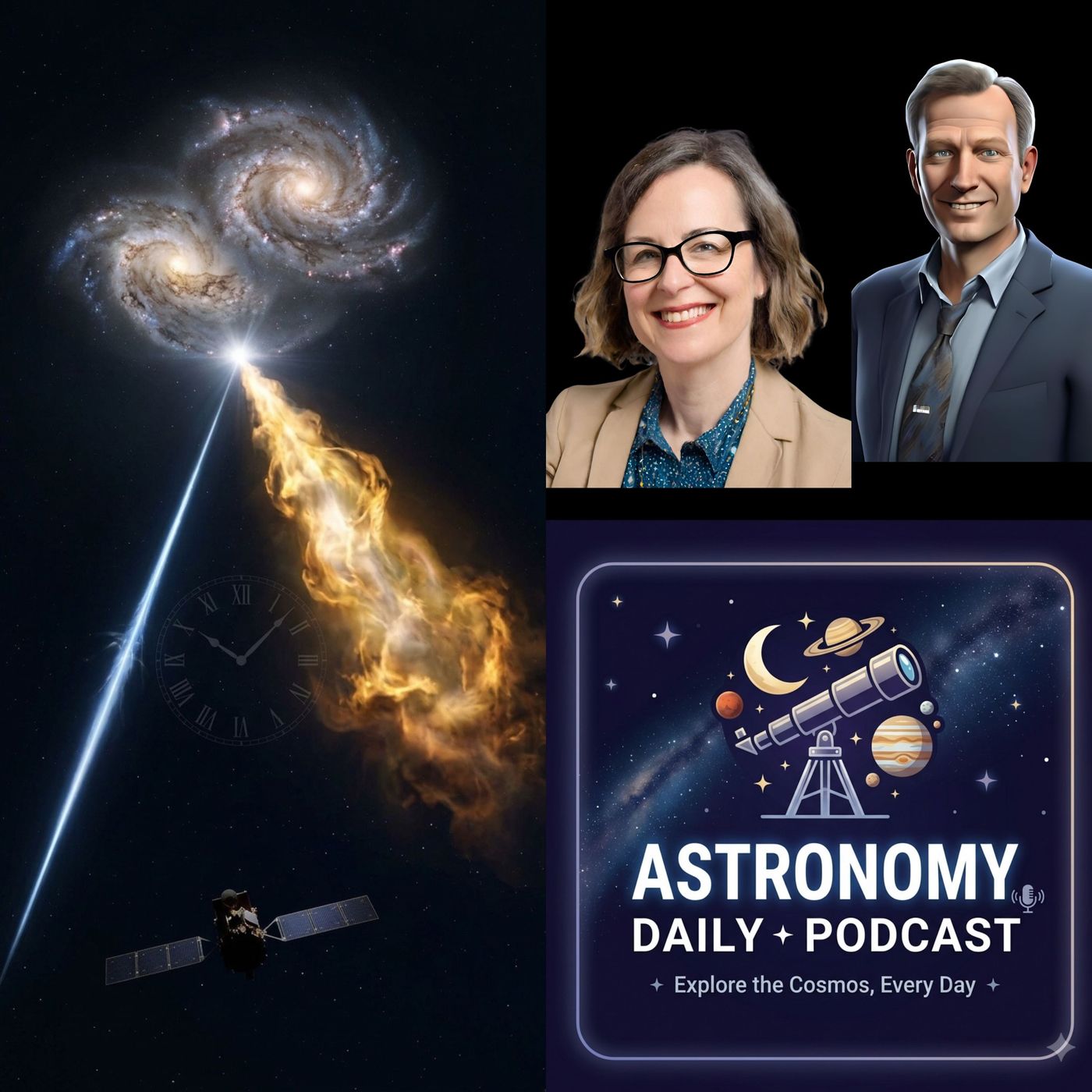
A Gamma-Ray Burst’s Split Personality: The Week Swift Fell Silent
In this episode
Show notes In 2016, NASA's Swift caught a gamma-ray burst that came in two parts: a 1.7-second spike, four minutes of silence, then a 51-second burst from the same spot. A new Nature Astronomy paper finds that nearly every classification test labels the first part a merger and the second a collapsing star. It was published three days after Swift ended science operations. Also today: a black hole disc in MAXI J0637−430 that puffs up and shades itself at just a fifth of the Eddington limit; JWST finds methane in interstellar comet 3I/ATLAS with a deuterium ratio of 3.18%, the highest ever measured in methane anywhere in the solar system; and NASA's Psyche goes to near-continuous thrust and makes the first in-space measurement of Hall-thruster swirl torque. Quick hits: Hera's second braking burn, Dragonfly's first simulated Titan flight, and 20 years of STEREO. Skywatch for Sydney, Los Angeles, New York and London: the Hunter's Moon, Mars and Jupiter closing before dawn, Saturn in the evening and Mercury's last call.Become a supporter of this podcast: https://www.spreaker.com/podcast/astronomy-daily-latest-space-news--5648921/support.
Sponsor Details:
Ensure your online privacy by using NordVPN. To get our special listener deal and save a lot of money, visit www.astronomydaily.io/nordvpn. You'll be glad you did!
Get the best secure and private email on the planet. Stop your Government, google and who knows who else spying on every email you write. Do what we did and use ProtonMail. They beleive in privacy and there are no ads in their business model...yet they still provide a free forever service. Check them out and get out special deal at www.astronomydaily.io/protonmail
Become a supporter of Astronomy Daily by joining our Supporters Club. Commercial free episodes daily are only a click way... Click Here
This episode includes AI-generated content.
Anna: Hello, everyone, and welcome back for another week's of space and astronomy news. On 25 April 2016, NASA's Swift Observatory caught a flash of gamma rays lasting less than two seconds. Then nothing. Then, about four minutes later, from the same patch of sky, a second burst. This one lasted nearly a minute. Avery: Two bursts that by every rule in the textbook, should come from two completely different kinds of cosmic catastrophe. The paper explaining them came out on Friday. The same week Swift itself fell silent.
Anna: Welcome to Astronomy AstroDailyPod. I'm Anna. Avery: And I'm Avery. Today, a gamma ray bursts with a split personality. A black hole disc that throws its own shade. The most deuterium rich methane ever measured from an interstellar comet. And NASA's psyche putting its foot down. Anna: Let's start with the rule we just mentioned, because this whole story is about breaking it. Gamma ray bursts are the brightest explosions we know of. For a few seconds, a single burst can outshine everything else in the gamma ray sky put together.
And since the early 1990s, astronomers have sorted them into two piles. Avery: That goes back to Chris Akuvaliotu and NASA's BATSEE instrument in a paper from 1993. When you plot how long thousands of bursts last, you don't get one hump, you get two. A short population clustered under about two seconds and a long population above it. Anna: And over the next 20 odd years, those two piles picked up two origin stories. Long bursts come from the collapse of a massive, rapidly spinning star, a collapsar.
In the best studied cases, a supernova turns up in the light a week or two later. Short bursts come from mergers. Two neutron stars, or a neutron star and a black hole spiralling together. The clincher was August 2017, when gravitational waves from a neutron star merger arrived about 1.7 seconds before a short gamma ray burst. Avery: So two seconds became shorthand for two different kinds of death. Under the line, a merger. Over it, a collapsing star. Anna: Which brings us to 25 April 2016, Avery: Swift's burst alert telescope triggered on an event now catalogued as GRB 160425A.
The circular the Swift team sent out that day called it unusual. That, uh, turned out to be an understatement. Anna: Here's the light curve. First, a single sharply peaked pulse lasting about 1.7 seconds. Then more than 250 seconds of nothing, no detectable emission at all. And then a second episode, broader and Messier, lasting around 51 seconds. Avery: Short, then quiet, then long, then. And both from the same position on the sky within Swift's error box. Anna: The follow up was fast, and a lot of it came from southern telescopes.
Within about seven hours, a team using the European Southern Observatory's Very Large Telescope at Paranal in Chile with its X Shooter spectrograph had a redshift 0.555. That's light that set out roughly five and a half billion years ago, and Avery: the host galaxy turned out to be two galaxies, 2 knots of light about 8 kiloparsecs apart, moving within about 180 kilometres per second of each other, an um interacting pair. Anna: The afterglow was also tracked by grand a seven channel camera on the 2.2 metre telescope at La Silla, by Smarts at Cerro Tololo and by the Master Robotic Telescope in South Africa.
Avery: The new paper is led by Liang Li at Ningbo University and Yu Wang at ICRNET and Sapienza University in Rome, with Bing Zhang at the University of Hong Kong among more than 20 co authors. It came out in Nature Astronomy on Friday and it takes those two episodes and treats them as two separate bursts, Anna: call them G1 and G2. Each one goes through the full battery of classification tests, not just duration, because duration on its own is a blunt instrument, right? Avery: The two second line is a statistical boundary, not a law of physics.
The two populations overlap, so astronomers lean on other signatures as well. Anna: Hardness for one short bursts tend to put more of their energy into high energy photons. Then there's the minimum variability timescale, which is how quickly the light flickers, and spectral lag, whether the lower energy photons arrive later than the higher energy ones. Avery: Lag is one of the cleanest separators. Long bursts usually show the soft photons trailing behind. Short bursts show almost none. For G1, the measured lag is about 38 milliseconds, plus or minus 39.
In other words, consistent with zero. For G2, it's more than a second. Anna: There are also two empirical relations, named after Lorenzo Amati and Jay Norris, that tie together a burst's energy, its peak photon energy and its lag. Short and long bursts sit on different Avery: tracks, and nearly every test lands the same way. G1 behaves like a short merger type burst. G2 behaved like a long collapsar type burst. Two classifications, one event four minutes apart. Anna: Now, regular listeners know this isn't the first time the two second rule has wobbled.
Avery: Not even close. In 2006, GRB 060614 lasted about 100 seconds, but deep searches found no supernova. A long burst that behaved like a merger. In 2020, GRB 200826A lasted well under a second, but came from a collapsing star. And then GRB21 1211A and GRB23 0307A, both long, both followed by a kilonova, the glow of freshly forged heavy elements that marks a merger. Webb even picked up tellurium in the second one. Anna: So the field has already accepted that duration and origin don't line up perfectly.
A merger can make a long burst, a collapser can make a short one. Avery: What's different here is that both signatures turn up in the same event, cleanly separated in time. It's not one ambiguous burst sitting on the boundary, it's one burst on each side of it. Anna: And there was no bright supernova. Imaging from Cerro to Lolo over the following month ruled out anything as luminous as SN1998BW, the classic gamma ray burst supernova. If a supernova was there, it was fainter than that. Avery: Which is where we need to be careful, because the headline writes itself and the paper doesn't.
Anna: Three caveats. First, it's one event. Just one. The authors frame it as a challenge to the classification scheme, a uh, call to reevaluate it, not as a new class of burst with a population behind it. Avery: Second, the physics is open. The team discusses scenarios where a merger and a uh, collapse are both involved. But nobody watched two stars do this. Alternatives, like a single central engine that changed its behaviour between the two episodes, have to stay on the table until more events like this turn up.
Anna: And third, timing. The data are 10 years old and a preprint of this analysis appeared in March. What's new this week is the peer Avery: reviewed version, so the honest summary is an event. The standard toolkit splits cleanly in two sitting in a which brings us back to the telescope that caught it. Swift launched in November 2004 and for 22 years its whole job was to spot a burst, swing itself around within a minute or two and point its X ray and ultraviolet telescopes at the afterglow before it faded.
Anna: That's how GRB 160425A got a position good enough for the VLT to find its galaxy within seven hours. Without that fast slew, this is just two blips in a gamma ray detector. Avery: Swift ended Science operations on 20 October below about 275 kilometres, where atmospheric drag means it can no longer hold steady on a target. Listeners will remember the rescue attempt we followed through September with the Lynx spacecraft that couldn't make the catch. Anna: NASA expects reentry within weeks and three days after Swift stopped observing, its data put a crack in one of the most used rules in high energy astrophysics.
Not a bad last word. Avery: The next step is finding more of these. The Chinese French SVOM M mission and the Einstein probe now carry much of the fast response burst work Swift used to do. If double personality bursts are real, they'll Anna: turn up again from a burst that came in two parts to a disc that hides part of itself. In November 2019, Japan's maxi instrument on the International Space Station spotted a new X ray source low in the southern sky. Maxi J0637 -430. It's a black hole pulling gas off a companion star, the pair whipping around each other roughly every two hours.
Avery: And a new study led by Monserrat Armas um Padilla at the Instituto de Astrophysica de Canarias and published in Nature Astronomy on Thursday found something odd in its outburst. Anna: Here's the setup in a textbook black hole Binary gas spirals in through a thin, flat disc. The inner disc glows in X rays, and that X ray light shines out across the outer disc and heats it up. Astronomers say the outer disc is irradiated, Avery: and theory says the inner disc only puffs up, becoming thick as the black hole approaches the Eddington limit.
That's the point where the push of radiation fights gravity to a standstill. Anna: The team caught this system at three points as the outburst faded with ESO's Very Large Telescope and the X Shooter Spectrograph, the same instrument from our lead plus the SOAR telescope at Cerro Pechone. And the spectra ran backwards. Avery: Backwards how? Anna: At the peak, at about a fifth of the Eddington limit, the outer disc looked cool. Strong hydrogen and helium emission lines. This signature of gas that isn't being blasted by X rays.
As the black hole faded, the spectrum turned hot and almost featureless, as if the outer disc was suddenly getting much more X ray heating, even though less X ray light was coming out. Avery: So the outer disc got more sunburnt when the sun dimmed. Anna: Exactly. And the explanation is shade. At the peak, the inner disc had swollen vertically and was shielding the outer disc from the X rays. As the feeding rate dropped, the inner disc thinned, the shade lifted, and the outer disc was suddenly exposed.
X ray spectra taken at the same time by Nicer, Nustar and Swift back that picture up. Avery: Why does this matter beyond one system? Anna: Because a lot of black hole measurements assume a thin disc. Spin estimates X ray polarisation from NASA's IXPE bottles of the winds blowing off the outer disc if the disc is thicker than assumed at a fifth of Eddington. Some of those numbers need revisiting. The authors point out that similar behaviour in other systems suggests it may be common caveats one source and one outburst and the data are from 2019 and 2020.
The point where the disc puffs up probably isn't the same for every black hole, but it sits neatly beside the Goodwin and Mummery result we covered in September the idea that accretion changes character at particular fractions of the Eddington rate. This is the disc's shape changing at Avery: one of them and another Southern sky story declination -43 observed from Paranal and Cerro Pachon. Our next story continues a thread we followed since September the chemistry of 3i ATLAS only the third object ever seen passing through the solar system from another star.
Anna: And this time it's a brand new measurement, not a reanalysis, right? Avery: Nathan Roth at NASA Goddard with Martin Cordiner and an international team used Webb's Near Infrared Spectrum Spectrograph to look at 3I ATLAS after its closest approach to the sun at about 2.4 astronomical units out. Their paper came out in Nature Astronomy on Friday. Anna: They picked out methane and also a heavy version of methane CH3D, where one hydrogen atom is swapped for deuterium. That's the isotope of hydrogen with an extra neutron.
Avery: And the ratio of deuterium to hydrogen in that methane is 3.18%, give or take about a third of a percent. Anna: Give me some context for that. Avery: Earth's ocean water has about 156 deuterium atoms for every million hydrogen, roughly 0.016%. This methane is around 200 times richer than that. It's higher than any methane value measured anywhere in the solar system, and about 13 times higher than Comet 67P, the only other comet where heavy methane has been detected by Rosetta. Anna: Why does deuterium tell you anything about where it came from?
Avery: Because cold concentrates it at a few tens of degrees above absolute zero. The chemistry on icy dust grains favours deuterium, so ices that form in very cold places end up enriched. It works like a thermometer with a Anna: memory, like the nitrogen thermometer from the three eye story back in September. Avery: Exactly that, and there's a consistency check in both 3i and 67pMethane is more deuterated than water. The same pattern seen in nearby star forming clouds where organic molecules can be up to 10 times more deuterated than water.
So 3i Atlas isn't strange in kind. It's the same chemistry turned up, Turned uh, up by what the team's reading is a birthplace that was cold pour in heavy elements, so probably old and bathed in cosmic rays. That fits the earlier water measurements published in April and June, which also pointed to a cold ancient origin. Caveats 3 It's one object. The gas in a uh, comet's coma comes from ices that have been through a lot, including a pass by the sun. So it's a strong clue, not a birth certificate.
And um, a preprint of this has been around since March. It's the peer reviewed version that's new Anna: and a lovely footnote. The acknowledgments thank school students in the uk, Spain, Brazil and Croatia through the Comet Chasers Outreach programme for position measurements that helped pin down exactly where to Avery: point Webb and the southern thread. 3i Atlas was discovered by the ATLAS survey telescope at Rio Urtado in Chile. Anna: Time for some engineering. NASA's Psyche spacecraft is on its way to a metal rich asteroid of the same name.
And last week the team announced it has gone, in their words, pedal to the metal. Avery: Psyche, launched in October 2023, swung past Mars in May for a uh, gravity assist. And since 28 September it, it's been Anna: thrusting almost continuously about 90% of the time from now until arrival, pausing once a week to check in with Earth. And those check ins like every deep space missions run through NASA's Deep Space Network, including the big dishes at Tidbinbilla outside Canberra. Avery: Now the thrusters Psyche uses Hall effect thrusters.
Electric and uh, magnetic fields push ions of xenon gas out the back with a vivid blue glow. Anna: And the force is tiny, up to 250 millinewtons. NASA compares it to the weight of a single AA battery resting in your hand. Avery: But it never stops pushing. Over months that adds up. At its fastest, Psyche will be moving at uh, more than 160,000 kilometres an hour relative to Earth. Anna: The fuel budget looks healthy too. It launched with about 1,090 kilogrammes of xenon and after three years it has used roughly a third.
Avery: There's a catch with solar electric propulsion though. The further you get from the sun, the less power you have. The team says it'll run at full power for about three months, then gradually throttle back to around half as the sunlight weakens. Anna: And here's the bit that caught my eye. When the thruster expels its ions, the magnetic field makes them swirl. And that swirl puts a tiny Twist on the spacecraft. Avery: A torque too small to measure on the ground. Anna: Exactly. You can only measure it in space.
The team says this is the first time anyone has measured that swirl torque on a Hall thruster across different power levels and operating times over such a long stretch in space. They soak it up with reaction wheels and every few hours they run a different thruster briefly to dump the built up momentum. Avery: So the spacecraft is doing science on its own engine on the way to doing science on an asteroid. Anna: Right, and the target is worth the trip. Psyche is about 280 kilometres across at its widest.
And it may be part of the exposed metal core of a planetesimal, one of the building blocks of planets like Earth. Arrival is mid-2029, followed by two years in orbit. Avery: Uh, a look inside a planet without having to dig. Anna: Next, let's have some other news headlines. Avery: The quick hits. First, a desk flag we've carried for nearly two weeks can finally come down. ESA's HERA spacecraft carried out its second braking manoeuvre, BRM2, on Thursday the 22nd. In a post on X the next day, ESA said the burn cut HERA speed relative to the Didymus and dimorphous pair by 70 metres per second from about 2,300 kilometres out.
Hera is now drifting in at about 20 metres per second. Anna: Three smaller transition manoeuvres this week should bring that close to zero ahead of arrival in November and the southern thread. ESA follows these burns through its deep space antennas at New Nortia in Western Australia. Avery: Second, NASA's Dragonfly flew to Titan sort of at, uh, the Applied Physics Laboratory in Maryland. The team ran its most complete simulation yet of Dragonfly's first flight. On flight, like avionics, with navigation, camera images rendered in real time and simulated lidar all the way to an autonomous landing, Dragonfly launches no earlier than 2028 and reaches Titan in 2034.
Anna: And third, happy birthday. Stereo NASA's twin solar observatories launched on a Delta II rocket on the evening of the 25th of October 2006, Florida time. That was late morning on the 26th in eastern Australia. So 20 years ago this week, in February 2011, the pair gave us our first view of the whole sun at once. Stereo B fell silent in 2014, but stereo A is still working. Avery: Skywatch, as always, we've run the numbers for Sydney, Los Angeles, New York and London. Anna: Start with the moon.
The hunter's moon was full at 4:11 universal time on Monday the 26th. That's 3:11 on Monday afternoon in Sydney. So Monday night looks full here in the Americas, uh, the instant fell on Sunday night, the 25th. Either way, it looks full on both Avery: nights from here, it's a waning moon rising later each evening. On Tuesday, it comes up around 8:45pm in Sydney, about 7pm in Los Angeles, 6:40 in New York. And in London it rises almost exactly at sunset at about a quarter to five. Last quarter is on the 1st of Anna: November Universal Time and a clock reminder for the north.
The UK went back to standard time on Sunday the 25th. The US follows this coming Sunday the 1st of November. Here in Australia, we've been on daylight time since the start of October. If you're in a different time zone from where you usually listen, your skywatch times have probably moved. Avery: The big show is before dawn and this week it favours the north. Jupiter at magnitude -1.8 in Leo and Mars, a, uh, fainter orange point at about 0.9 in cancer, are closing on each other. They're about seven and a half degrees apart this week, under six by the first of November, about three by the eighth.
And they reach their closest just over one degree apart on the 16th of November Universal Time. Anna: And the hemisphere gap is big. At, uh, nautical dawn on Wednesday the 28th. Mars is about 64 degrees up from Los Angeles, 60 from New York and 52 from London, with Jupiter just below it from Sydney. Both are only about 25 degrees up Avery: in the northeast, so for northern listeners, they're high and easy. From the south, look northeast about an hour before sunrise. They're lower but still well clear of the Horizon.
And by the 8th of November, both sit around 28 degrees up from Sydney. Anna: The evening sky gives some back to the south. Saturn, at about magnitude half in Cetus, is a few weeks past opposition and up. As the sky darkens at the end of evening twilight on Wednesday, it's around 31 degrees up from Sydney against about 19 from Los Angeles, 16 from New York and 11 from London. Avery: And this is Mercury's last call for the southern evening sky. It's fading quickly from about magnitude 1.3 on Tuesday to 3.6 by the first of November and sinking toward the sun from Sydney.
It's around 9 degrees up in the west at the end of twilight midweek, lick low with a clear horizon 20 to 40 minutes after sunset. From the north, it's essentially gone. Anna: Venus passed between us and the sun on the 24th, about 6 1/2 degrees from it in the sky, so it's out of sight this week. It'll start climbing into the morning sky in November. Avery: Meteor wise, the Taurids are building toward their peaks in early and mid November. Rates are low, only a handful an hour, but this shower is known for slow, bright fireballs, and it's visible from both hemispheres.
The Moon will be a thinning crescent by then, which helps. Anna: No eclipses this week, but the standing reminder Never look at the sun directly or through binoculars or a telescope without proper solar filters Certified to the ISO 123122 standard. Ordinary sunglasses won't do. Avery: So north, get up early for Mars and Jupiter. South catch Saturn in the evening and Mercury before it's gone. And everybody enjoy the bright Moon this week. Anna: That's Astronomy daily for Monday, 26 October. Today, a UH gamma ray burst that seems to be two kinds of explosion at UH once caught by Swift a decade ago and published the week Swift went Quiet A black hole disc that shades itself at a fifth of the Eddington limit.
Record heavy methane from 3i atlas and psyche pedal to the Metal Show Notes, Avery: sources and links to every paper are at astronomydaily.IO Questions or story ideas use the contact form there. Some of our best segments have started with a listener's question and you'll find us on social media. Strodailypod thanks for listening. Anna: I'm Anna. Avery: And I'm Avery Clear Skies, and we'll see you tomorrow. Astronomy Day. The Stories we told Anna: Love.
Avery: Story soul.
 Apple Podcasts
 Spotify
 Pocket Casts
 Castbox
 Overcast
 Podbean
 iHeartRadio
 Castro
 Goodpods
 Moon FM
 Podcast Addict
 Podcast Republic
 YouTube