
Artemis 3 Delays, Hayabusa2's New Mission, and Earth's Mini Moon Gold Rush
In this episode
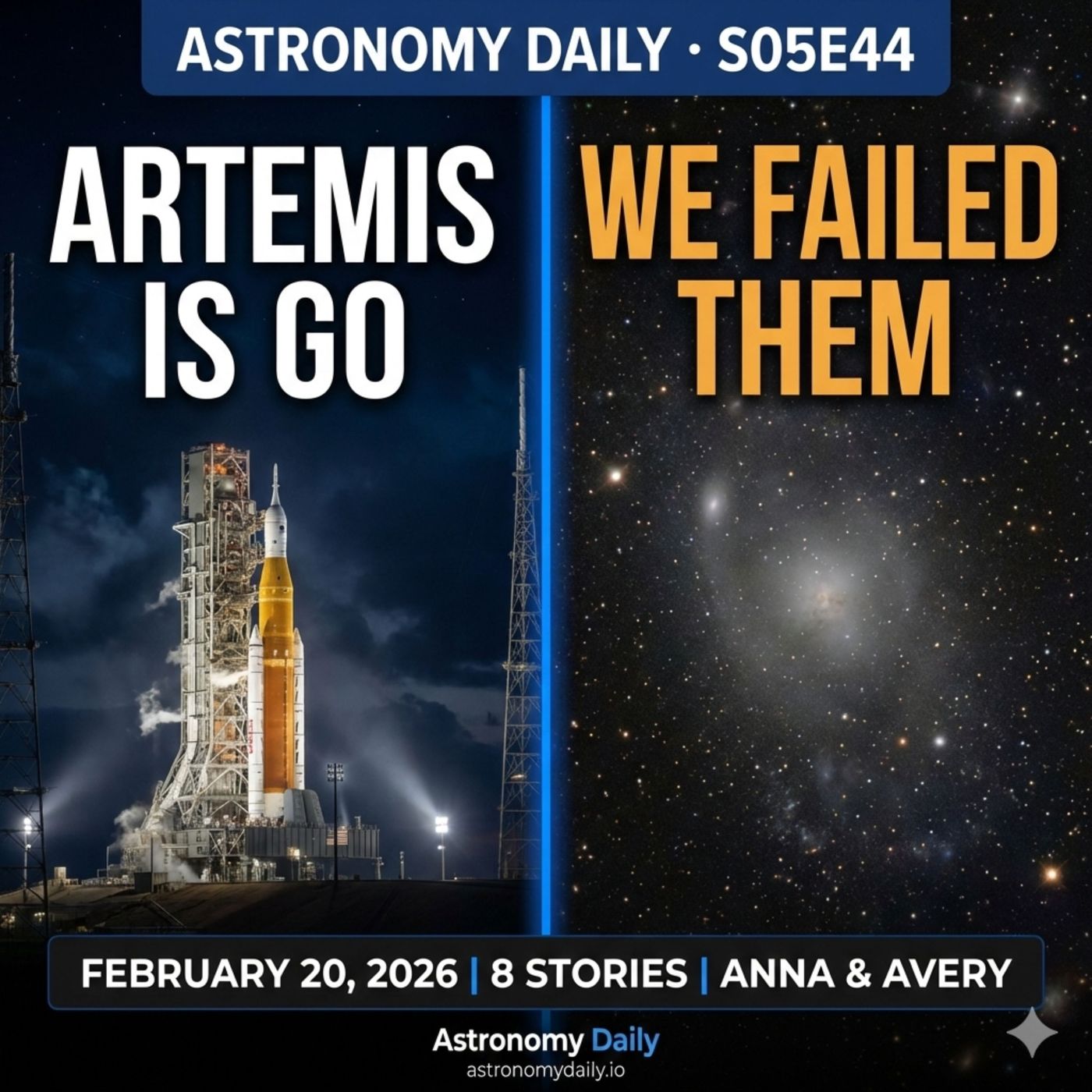
- NASA's Artemis 3 Mission Faces High Risk of Delay: The Aerospace Safety Advisory Panel has raised concerns regarding the timeline for the Artemis 3 mission, warning that SpaceX's Starship may not be ready for the planned late 2026 lunar landing. Key issues include the need for successful flight tests and the unproven capability of propellant transfer in orbit, raising questions about contingency plans for the mission.
- Hayabusa2's Extended Mission to Asteroid 1998 KY26: Japan's Hayabusa2 spacecraft is embarking on an extended mission to study the small, rapidly rotating asteroid 1998 KY26. Unlike its previous mission, Hayabusa2 will observe this asteroid from a distance, providing valuable insights into different types of asteroids and the early solar system.
- Recovery of Rare Aubrite Meteorite: Scientists have successfully recovered the Bliskavica meteorite, a rare Aubrite type, following a fireball event over Europe. This meteorite is significant as it offers a known origin story, allowing researchers to trace its pre-impact orbit back to the asteroid belt, enhancing our understanding of planetary formation.
- Potential Gold Rush from Earth's Mini Moons: A new study suggests that temporarily captured objects (TCOs) orbiting Earth could contain billions in precious metals. Proposed missions to retrieve samples from these TCOs could be launched for as little as $10 million, making asteroid mining much more accessible and potentially revolutionizing the industry.
- SpaceX's Busy Launch Schedule: SpaceX continues its impressive launch cadence with the successful deployment of 22 Starlink satellites, marking its 65th orbital mission of the year. The Falcon 9 rocket's first stage booster completed its 17th landing, showcasing the company's advancements in reusable rocket technology.
- Growing Tea on the Moon: New research indicates that astronauts may be able to grow tea plants in lunar soil simulants. This breakthrough could provide a psychological boost for long-term space missions, allowing astronauts to enjoy comforting beverages while in space.
- Earth's Crystals Hold Galactic Secrets: A study reveals that ancient crystals in Earth's crust may contain traces of heavy elements produced by supernovae in the spiral arms of our galaxy. This discovery suggests that our solar system's journey through the Milky Way has left a geological record in the form of these crystals.
- For more cosmic updates, visit our website at astronomydaily.io. Join our community on social media by searching for #AstroDailyPod on Facebook, X, YouTubeMusic Music, TikTok, and our new Instagram account! Don’t forget to subscribe to the podcast on Apple Podcasts, Spotify, iHeartRadio, or wherever you get your podcasts.
- Thank you for tuning in. This is Anna and Avery signing off. Until next time, keep looking up and exploring the wonders of our universe.
Artemis 3 Delay Concerns
[NASA](https://www.nasa.gov/)
Hayabusa2 Mission Update
[JAXA](https://www.jaxa.jp/)
Bliskavica Meteorite Recovery
[Nature](https://www.nature.com/)
TCO Gold Rush Study
[Journal of Astrobiology](https://www.journalofastrobiology.com/)
SpaceX Launch Updates
[SpaceX](https://www.spacex.com/)
Tea Growth Research
[NASA](
Anna: Welcome to Astronomy Daily, your essential guide to the cosmos. I'm Anna. Avery: And I'm Avery. We're the podcast that brings you the day's biggest news in space and astronomy from our solar system and beyond. Anna: We have a packed show for you today. Our top story, NASA's Aerospace Safety Advisory Panel is sounding the alarm warning that the Artemis 3 mission to land humans on the moon is at high risk of delay. Avery: Plus, we'll check in on the extended mission of the Hayabusa2 spacecraft, celebrate the recovery of a rare meteorite in Europe, and explore a potential gold rush for asteroid manners targeting Earth's mini moons.
Anna: And later, we'll have a few quick updates on SpaceX, growing tea on the moon, and finding the history of our galaxy right here on Earth. Let's get started. All right, our main story today comes from a public meeting at the Johnson Space Center. NASA's Aerospace Safety Advisory Panel, or ASAP, issued a stark warning on September 18th regarding the timeline for the Artemis 30. Avery: Um, and this all centers on the human landing system, which is SpaceX's Starship. Right? The vehicle that's supposed to actually take the astronauts down to the lunar surface.
Anna: Exactly. The panel is concerned that Starship will likely not be ready to support the mission in late 2026 as currently scheduled. They cited two key. SpaceX needs to get the vehicle flying successfully, and it needs to demonstrate propellant transfer in orbit. Avery: That first one is a pretty big hurdle. The first integrated test flight back in April failed a few minutes after liftoff, and, well, it completely obliterated its own launch pad. Anna: It certainly did. SpaceX has made repairs and upgrades, but they are still awaiting an updated launch license from the Federal Aviation Administration for their next test flight.
The chair of the panel, Patricia Sanders, was very direct, stating the current schedule has a high risk of delays, and. Avery: It'S not just a safety panel. We've heard similar rumblings from senior NASA officials, though they've also mentioned concerns about the development of new spacesuits and other lander systems. But Starship seems to be the longest pole in the tent. Anna: It is. And that second point, propellant transfer, is critical. Starship needs to be refueled in orbit for a lunar mission, and transferring cryogenic propellants on that scale has never been done before.
Avery: So what's the backup plan if the lander has problems? Is there a contingency? Anna: That's the other issue Sanders raised. NASA's Gateway, the planned outpost in lunar orbit, could serve as a safe haven for astronauts, but the gateway itself won't be ready for Artemis 3. It really puts all the pressure on starship performing as planned and on schedule. Avery: It sounds like a very high stakes development. We will certainly be watching for news on the next test flight moving from the moon to the asteroids.
Let's talk about a mission that has already proven to be a great successJapan's Hayabusa2. Anna: Of course, the mission that returned a pristine sample from the asteroid ryugu back in 2020. What's next for the spacecraft? Avery: It's on an extended mission heading to a new target called asteroid, uh, 1998 KY26. And this new destination is a very different kind of space rock. Anna: Different how? Avery: For starters, it's very small with a diameter of only 30 meters. It's also a fast rotator, spinning on its axis once every 10.7 minutes.
Anna: That is incredibly fast. That must give it a very low gravitational field, making any kind of landing or contact extremely difficult. Avery: You're exactly right. Because of that, Hayabusa2 will not be collecting a sample this time. Instead, it will study the asteroid from a distance when it arrives in July 2031. Anna: It's just fantastic that they can get more science out of an already completed mission. This extended mission will allow scientists to study a completely different type of asteroid and learn more about the early days of our solar system.
A great example of mission efficiency. Well, from visiting asteroids, we now turn to an asteroid that visited us after two years. Scientists have recovered a very special meteorite from a fireball that exploded over Europe in February 2023. Avery: I think I remember seeing videos of that one online. It was seen by thousands of people. Anna: It was. The recovered meteorite has been named Bliskvika, which is polish for lightning. And it's a rare type of meteorite known as an Aubrite. Avery: An Aubrite.
What makes that type of meteorite special? Anna: They're thought to originate from the main asteroid belt and are made of a very distinct light colored rock. But. But what makes the Bliskavica meteorite so important is that it's the first abrite ever to be recovered from a fireball that was observed by so many people and captured on so many cameras. Avery: So all those dash cams and doorbell cameras actually contributed to the science immensely. Anna: It allowed scientists to precisely calculate the meteorite's trajectory.
And this is the crucial part, determine its pre impact orbit. They have actually traced this specific rock back to its likely origin point in the asteroid belt. Avery: That's incredible. So they don't just have the rock, they have its return address? Anna: Essentially, yes. It's being called a major coup for planetary science. It provides a unique opportunity to study a rare meteorite with a known origin story which can tell us some so much more about the formation of our solar system. Avery: Speaking of getting our hands on space rocks, our next story sounds like something straight out of science fiction.
Apparently Earth's next mini moon could create a gold rush for asteroid miners. Anna: A mini moon? Are we talking about a permanent second moon? Avery: Sort of, but temporary. The official term is a temporarily captured object or tco. These are asteroids that are captured by Earth's gravity, orbit, uh, our planet for a few months or even years and then get ejected back into space. Anna: Okay, so they're transient visitors. Where does the gold rush come in? Avery: A new study has found that a TCO with a diameter of just a few meters could contain billions of dollars worth of precious metals.
The authors of the study propose a mission concept called a T class mission to to go out, collect the sample and bring it back to Earth. Anna: Billions of dollars in value. But surely the mission to retrieve it would cost just as much. Avery: That's the most exciting part. The study suggests such a mission could be launched for as little as $10 million. Because these TCOs are so much closer and easier to reach than main belt asteroids, they are far cheaper targets. Anna: That's incredible. So the authors believe these TCOs could be a game changer for the asteroid mining industry.
Avery: They do. They say TCOs could provide a regular, accessible and much cheaper supply of precious metals to Earth. It turns these fleeting visitors into potential orbiting treasure chests. Alright, let's wrap up with a few quick updates from around the cosmos. First up, it was another Busy Sunday for SpaceX. Anna: Let me guess, more Starlink satellites? Avery: You got it. A Falcon 9 rocket launched another 22 Starlink spacecraft from Cape Canaveral. The first stage booster successfully landed for its 17th time.
This marked the 65th orbital mission of the year for SpaceX. Just an incredible launch cadence. Anna: It really is. Now from low Earth orbit to the lunar surface, could future astronauts grow their own tea? Avery: It seems so. A new study found that it is possible to grow tea plants in a simulant of lunar soil. The plants were able to germinate and grow and they even produced catechins, the antioxidant compounds that make tea healthy. Anna: Being able to grow their own food, even something as simple as tea for a comforting drink, would be a huge logistical and psychological advantage for astronauts on long term space missions.
Avery: Absolutely. And for a final story, we're going from the small scale to the galactic new research suggests that signs of our galaxy's spiral arms may be trapped in some of Earth's crystals. Anna: How is that possible? Avery: A study in the journal Nature analyzed ancient crystals from our planet's crust. They found traces of heavy elements like gold and platinum, which are thought to be produced in the supernova of massive stars. These supernovae are much more common in the spiral arms of galaxies.
Anna: So the theory is that as our solar system passed through these dense star forming spiral arms over billions of years, the Earth picked up this stardust which which then got trapped in the crust. Avery: Exactly. The crystals act as a geological record of our planet's epic journey through the Milky Way. Anna: And that is our cosmic journey for today. From potential delays for our return to. Avery: The Moon to finding galactic history right here in the ground beneath our feet. Thank you for joining us on Astronomy Daily.
Anna: You can find our show wherever you get your podcasts. Please be sure to subscribe so you don't miss an episode and subscribe. And if you would like even more space and astronomy news from around the globe, please visit our website at astronomydaily IO. You'll find all our back episodes there as well, plus our latest blogs. See you tomorrow. Avery: Until next time, keep looking up.



 Apple Podcasts
 Spotify
 Pocket Casts
 Castbox
 Overcast
 Podbean
 iHeartRadio
 Castro
 Goodpods
 Moon FM
 Podcast Addict
 Podcast Republic
 YouTube