The Weekend Wrap: Roman's Countdown Begins
Related Episode
The Weekend Wrap, August 29: Roman's Countdown BeginsThis week’s Weekend Wrap centres on a telescope that’s spent the last seven days quietly becoming the biggest story in space news without ever getting its own segment — plus a moon mission whose delay just got a lot more complicated, a star with a genuinely strange bubbling face, a two-decade physics argument finally put to rest, and a fight brewing over how bright space is allowed to get. Here’s the full rundown, with links to everything referenced.
One day out: the Nancy Grace Roman Space Telescope
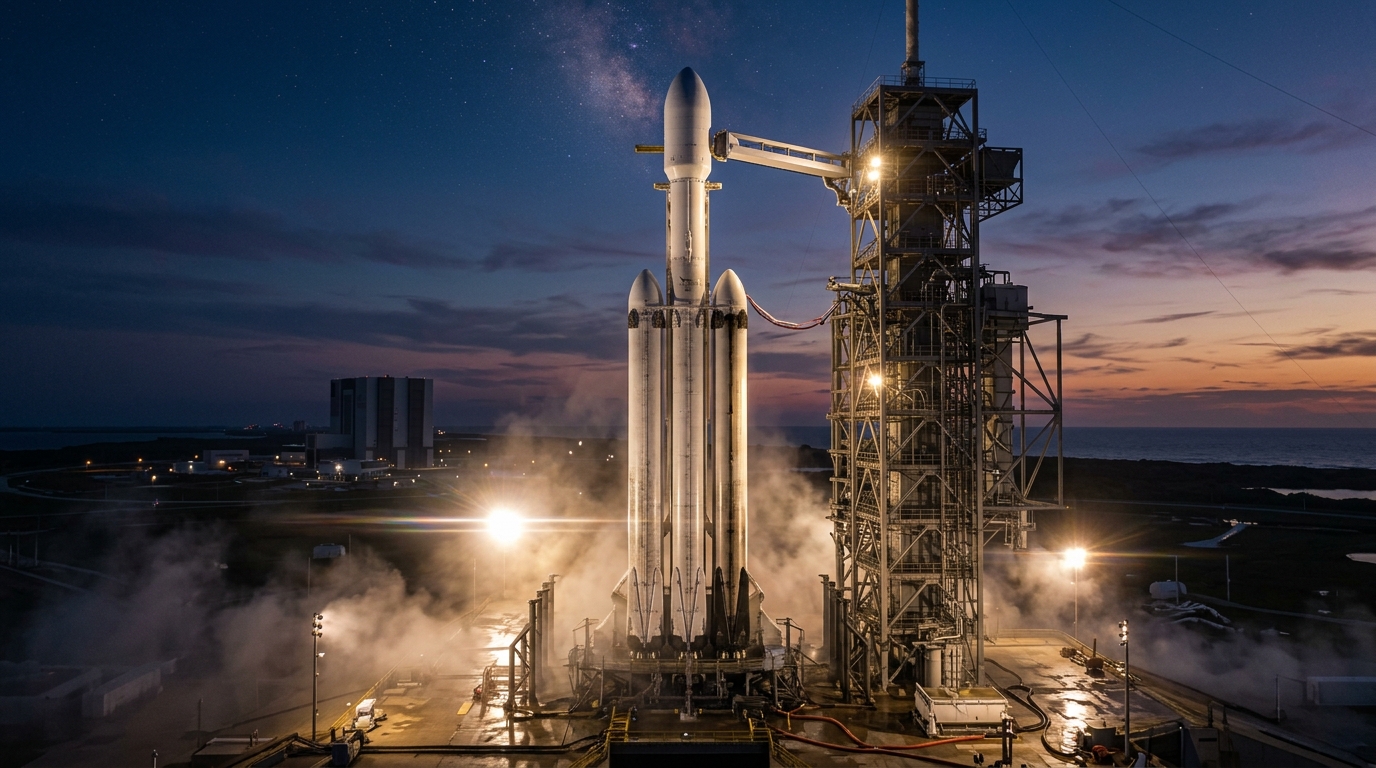
Tomorrow, Sunday August 30, NASA’s Nancy Grace Roman Space Telescope launches on a SpaceX Falcon Heavy from Kennedy Space Center’s Launch Complex 39A. The primary window opens at 7:26am Eastern (11:26 UTC — 9:26pm Sunday night for anyone in Sydney), with a backup window the following morning if needed. The ascent to spacecraft deployment takes about 31 minutes 31 seconds, with Falcon Heavy’s two side boosters flying themselves back to landing zones at Cape Canaveral roughly seven and a half minutes after liftoff.
Named for Nancy Grace Roman, NASA’s first chief astronomer and the woman often credited as the driving force behind Hubble’s existence, the telescope shares Hubble’s 2.4-metre primary mirror but pairs it with a Wide Field Instrument whose 300-megapixel camera captures a field of view roughly 100 times larger at similar sharpness. That scale is the whole point: Roman’s flagship project, the High Latitude Wide Area Survey, will image around two billion galaxies to probe dark matter and dark energy, backed by a companion supernova survey chasing the same question. A separate Galactic Bulge Time Domain Survey will hunt exoplanets via gravitational microlensing — a technique sensitive to worlds transit surveys like Kepler and TESS can’t easily catch, including free-floating rogue planets — with scientists expecting on the order of 100,000 new detections. A Coronagraph Instrument rounds out the payload as a technology demonstration for directly imaging exoplanets rather than just inferring them.
After deployment, Roman heads for the Sun-Earth L2 point, about 1.5 million kilometres out, a month-long cruise followed by months of commissioning before science data starts flowing. Tomorrow’s launch closes out three threads we’ve built across the week: Roman’s clearance for launch nine months ahead of schedule, its unlikely Cold War origins as repurposed spy-satellite hardware, and the budget fight that nearly cancelled it outright last year before its team responded by launching eight months early instead of late.
Chang’e-7’s delay: murkier than we first reported
Monday’s episode reported China’s Chang’e-7 lunar south pole mission scrubbing its August 24 launch due to Tropical Storm Narra, with the best information available at the time putting the next window about a month out. That picture has gotten less clear since, not more. Chang’e-7 targets Shackleton Crater at the lunar south pole, a landing site whose sunlight geometry only cooperates for roughly 100 days a year, split into short recurring windows — a constraint China’s own state broadcaster CGTN detailed in an explainer this week. Some reporting still holds to a mid-September window; other outlets, citing the same orbital constraints, now put the next real opportunity at February or March 2027. China’s Manned Space Agency hasn’t issued a firm new date to settle it either way, so we’re reporting the uncertainty honestly rather than picking whichever figure sounds more confident.
Betelgeuse’s bubbling surface, decoded
ALMA has delivered the most detailed picture yet of Betelgeuse’s actual surface — not a smooth stellar disk, but a corrugated, bubbling texture dotted with hot spots, one of which has persisted in roughly the same spot for over seven years. The leading explanation is a newly confirmed companion star, close enough to keep stirring the same patch of the red supergiant’s extended outer layers.
A 20-year diamond-rain argument, settled
Researchers at Lawrence Livermore recreated the crushing pressures found deep inside ice giants like Neptune and Uranus, resolving a two-decade dispute over exactly where carbon turns to diamond under those conditions. Beyond settling a planetary-science argument, the same compression physics feeds into fusion reactor target design — the newly resolved data points toward roughly triple the energy gain in certain fusion configurations compared to older, less certain models.
The space-mirror fight
US startup Reflect Orbital wants to eventually put more than 50,000 large mirrors into orbit, reflecting sunlight down to chosen spots on the ground on demand, even at night. The FCC approved its first demonstration satellite, Eärendil-1, in July. A new peer-reviewed study led by Miroslav Kocifaj and Princeton’s Gáspár Bakos calculates that the planned full-scale, 174-foot operational mirrors would appear roughly 40 times brighter than the full Moon to anyone standing in their beam — “worse than big cities like London,” in Bakos’s words — with measurable sky-glow extending 20 to 34 kilometres further still. It’s a different complaint to the streaking-satellite concerns raised about megaconstellations: this is hardware built specifically to be as bright as possible, aimed deliberately at the ground.
Starship’s Ship 40 is actually heading home
Hours after Friday’s episode aired, Ship 40 — the Starship upper stage that survived an intact splashdown after Flight 13 back on July 24 — was loaded onto the heavy-lift vessel Forte and departed Christmas Island on the roughly 20,000-kilometre voyage back to Starbase, Texas, expected to take several weeks. Flight 14 remains on track for no-earlier-than September 15, with Booster 21’s static-fire testing now complete.
No episode tomorrow — we’re back Monday with our regular weekday format, and hopefully some very good news about a certain telescope.
Follow us: @AstroDailyPod