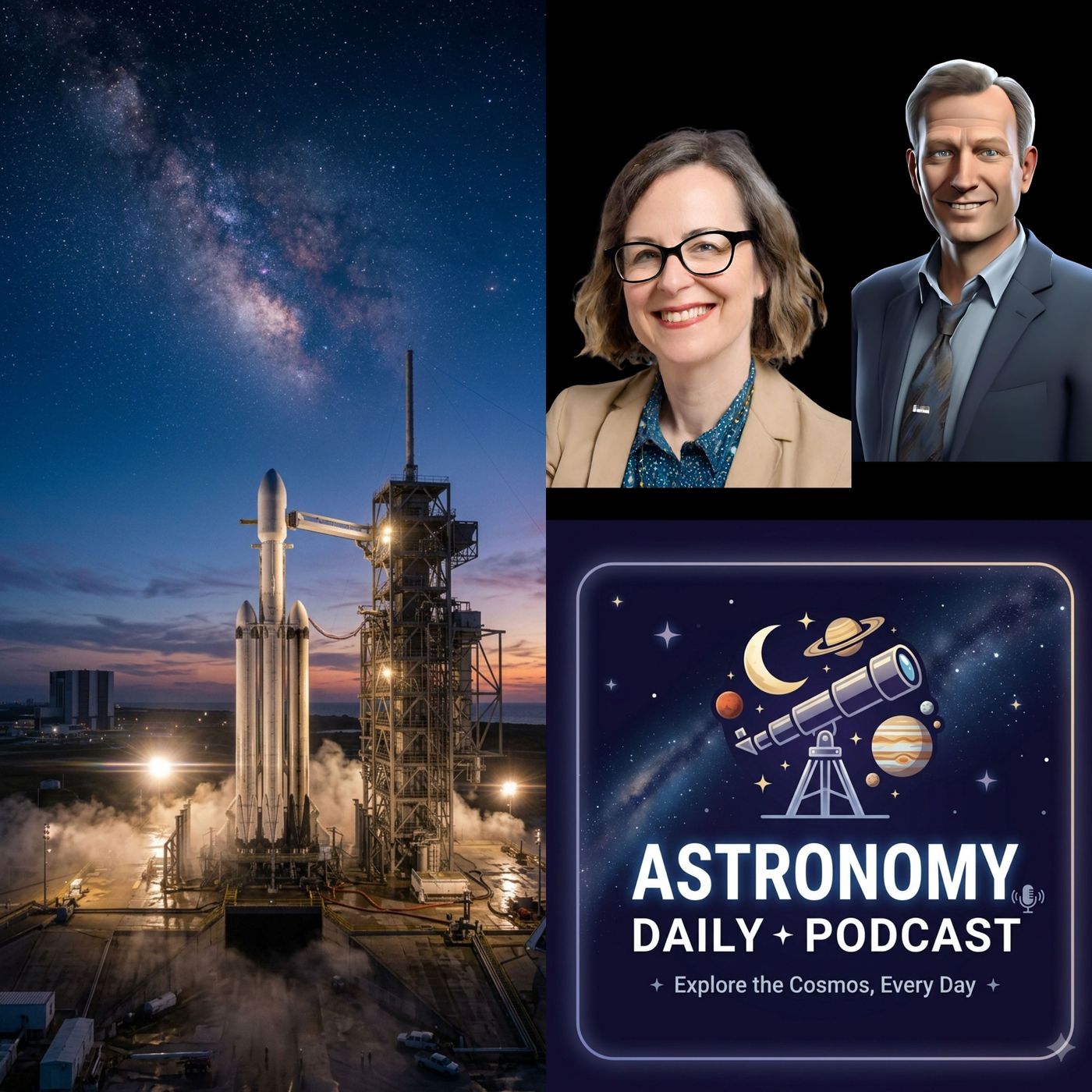
The Weekend Wrap, August 29: Roman's Countdown Begins
In this episode
Today's episode — S05E180, Saturday August 29, 2026, The Weekend Wrap: Main story: The Nancy Grace Roman Space Telescope launches tomorrow, Sunday August 30, with a primary window opening 7:26am EDT (11:26 UTC / 9:26pm AEST Sunday night in Sydney) on a SpaceX Falcon Heavy from LC-39A, Kennedy Space Center; backup window Monday August 31 at 7:22am EDT. Total ascent to spacecraft deployment is about 31 minutes 31 seconds, with Falcon Heavy's side boosters landing back at Cape Canaveral roughly 7 minutes 40 seconds after liftoff. Named for NASA's first chief astronomer Nancy Grace Roman (the "mother of Hubble"), the telescope shares Hubble's 2.4-metre primary mirror but pairs it with a Wide Field Instrument boasting a field of view roughly 100 times larger at similar resolution. Its major science campaigns: the High Latitude Wide Area Survey, mapping ~2 billion galaxies to probe dark matter and dark energy; a companion supernova time-domain survey; and the Galactic Bulge Time Domain Survey, a gravitational-microlensing exoplanet hunt expected to find on the order of 100,000 new worlds, including free-floating rogue planets. A Coronagraph Instrument will demonstrate direct exoplanet imaging technology. After deployment, Roman heads for the Sun-Earth L2 point (~1.5 million km out), a month-long cruise followed by months of commissioning. The mission closes out three threads covered this week: its clearance for launch nine months early (S05E176), its Cold War spy-satellite origin story (S05E178), and its narrow escape from budget cancellation (S05E179). The week in review: ● Chang'e-7's delay, revisited: Monday's episode (S05E175) reported China's Chang'e-7 lunar south pole mission scrubbing on August 24 due to Tropical Storm Narra, with the next window estimated at about a month out. Since then, reporting has split — some outlets still cite a mid-September window, while others report a slip to February or March 2027, citing the mission's roughly 100-days-per-year favorable lighting geometry at Shackleton Crater. China's Manned Space Agency has not issued a firm new date as of this recording; we're flagging the uncertainty rather than picking a side. ● Betelgeuse's bubbling surface: ALMA's most detailed image yet of the red supergiant's actual surface shows a corrugated, hot-spotted texture, with one hot spot persisting for over seven years — possibly stirred by a newly confirmed companion star (S05E177). ● Diamond rain, decoded: A Lawrence Livermore experiment recreated Neptune- and Uranus-like interior pressures, settling a 20-year dispute over diamond's melting point and pointing toward roughly triple the energy gain in certain fusion reactor configurations (S05E178). ● The space-mirror fight: US startup Reflect Orbital has FCC approval for its first demonstration mirror satellite; a new peer-reviewed study (Kocifaj, Bakos & Kundracik) finds the planned full-scale mirrors would appear roughly 40 times brighter than the full Moon to anyone in their beam — "worse than big cities like London," per Princeton's Gáspár Bakos (S05E179). ● Starship's Ship 40 is actually heading home: hours after Friday's episode aired, Ship 40 was loaded onto the heavy-lift vessel Forte and departed Christmas Island on the ~20,000km voyage back to Starbase, Texas, expected to take several weeks. Flight 14 remains targeted no-earlier-than September 15, with Booster 21's static-fire testing now complete. Links & sources: ● Space.com — What time will SpaceX launch NASA's Roman Space Telescope on Aug. 30? (Full mission timeline) ● NASA Science — Roman Launch Countdown ● Engadget — How to watch the Nancy Grace Roman Space Telescope's launch ● Scientific American — China delays ambitious Chang'e 7 moon mission until 2027 ● SpaceNews — China delays Chang'e-7 lunar south pole landing mission launch ● CGTN — Explainer: Why Chang'e-7 can't simply launch a...Anna: Hey everyone, welcome back to Astronomy AstroDailyPod. And it's Saturday, so you know what that means. Avery: The weekend wrap one brand new storey. Then we run back through the week's biggest news. In case you missed any of it, Anna: it's Saturday, August 29th. Series five episode 180. And today's fresh storey is a big one. Literally the biggest NASA mission of the year is on the pad right now. Less than a day from launch. Avery: The Nancy Grace Roman Space Telescope. We've been building up to this one all week without ever quite telling the whole storey.
Anna: So today we finally do full launch profile, what it's actually going to do out there and exactly when to watch wherever you are. Avery: Okay, then, a moon mission that slipped from a month to maybe next year. A star with a bubbling face, a couple of scientists finally settling an argument about diamonds, a fight over how bright space is allowed to get, and a very well travelled rocket finally heading home. Anna: It's a big one today. Let's get into it. Avery: Okay, we've mentioned Roman three times this week without ever actually sitting down with it properly.
Fix that for me. Anna: Happy to. The Nancy Grace Roman Space Telescope launches tomorrow, Sunday, August 30th. And by the time most of you are hearing this, it's inside its final day of preparation. Avery: Give me the vitals. When, how? From where? Anna: Liftoff window opens at 7:26am M Eastern. That's 11:26 UTC on a SpaceX Falcon Heavy from Launch Complex 39A at Kennedy Space Centre. The same pad the Apollo missions and more recently Artemis One flew from. There's a backup window the next morning, Monday the 31st at 7:22am Eastern.
If anything pushes it a day, um, Avery: and for anyone listening in our part Anna: of the world, this is the rare one where Southern Hemisphere listeners actually get the good time slot. 11:26 UTC on Sunday is 9:26pm Sunday night here in Sydney. Prime time. Not a 3am alarm. Our, uh, North American listeners get it at breakfast. We get it with our Sunday night cup of tea. Avery: I'll take it. What actually happens once it goes, It's a fast ride. Anna: The whole ascent to spacecraft separation is about 31 1/2 minutes and Falcon Heavy's two side boosters peel away 2 1/2 minutes in and fly themselves back to landing zones at Cape Canaveral.
And Roman itself separates from the upper stage right at the 31 minute 31 second mark. Avery: So of Falcon Heavy, that's the same rocket family that launched ship 40's return voyage on flight 13. Anyone can watch this live. Anna: NASA's coverage starts at 6:20am Eastern on NASA. Their social channels Twitch, Discovery, Apple Prime prime and YouTube. SpaceX runs its own stream on X starting about an hour before launch. If you'd rather watch it from that side of the pad. Avery: Okay, so who is this telescope actually for?
Remind people why we've spent all week circling it. Anna: It's named after Nancy Grace Roman, NASA's very first chief astronomer, who's often called the mother of Hubble because she was the one who pushed a space telescope into existence back in the 1960s. And it feels right that this one carries her name because it's genuinely a spiritual sibling to Hubble. Same size primary mirror, 2.4 metres, but pointed at a completely different problem. Avery: Different how? Anna: Hubble and Webb are both brilliant at staring very closely at one small patch of sky.
Roman's whole design philosophy is the opposite. Its wide field instrument carries a 300 megapixel camera with a field of view roughly a hundred times larger than Hubble's at basically the same sharp where Hubble gives you a postage stamp, Roman gives you a poster at the same resolution. Avery: What's the point of that much sky at once? Anna: Statistics, mostly. Some of the biggest open questions in cosmology need you to look at billions of things, not dozens. Roman's headline project is the High Latitude Wide Area survey.
Imaging roughly 2 billion galaxies to map how dark matter is distributed and how dark energy is pushing the universe apart over cosmic time using weak gravitational lensing and the large scale clustering of galaxies. Avery: That's the why does a universe's expansion keep accelerating Question. Anna: Exactly that one. Arguably the biggest unanswered question in cosmology right now. There's a companion time domain survey, hunting supernovae for the same dark energy work. And then there's the survey I think is actually the most fun.
The Galactic Bulge Time Domain Survey. A dedicated exoplanet hunt using gravitational microlensing. Avery: Different from how Kepler and Tess found planets. Anna: Completely different technique. Instead of watching a planet cross in front of its star, microlensing watches for a foreground star's gravity, briefly magnifying the light of a background star with a planet adding its own little blip to that signal. It's sensitive to planets transiting missions can't easily see, including ones on wide orbits.
And even rogue free floating planets with no star at all. Scientists are expecting on the order of 100,000 new exoplanet detections out of this one survey alone. Avery: Hundred thousand from one instrument. Anna: From one instrument. And there's a fourth piece Riding along. The coronagraph instrument. A technology demonstration for blocking out a star's glare well enough to directly image the planets around it, rather than just inferring them. If that works as hoped, it's a genuine stepping stone toward the kind of direct exoplanet imaging NASA wants for future flagship missions.
Avery: Okay, so where does it actually go after that 31 minute ride? Anna: It heads not into orbit around Earth, it heads for the sun. Earth. Lagrange point two. About one and a half million kilometres out. The same gravitationally stable parking spot Webb uses. That's roughly a month's cruise, then months more of commissioning before real science data, uh, starts flowing. Avery: Right, so nothing dramatic happens tomorrow night beyond the launch and a very long drive. Anna: Correct, and worth saying plainly, so nobody's disappointed.
Tomorrow is liftoff deployment and the start of the journey. Not first light. But it's still a huge moment because of everything that had to go right just to get here. If you've been with us this week, you know the shape of it. Tuesday we covered Roman being cleared for launch nine months ahead of its original schedule. Thursday we told the strange Cold War storey of the surplus spy satellite hardware this whole mission was actually built around. And yesterday we told you the part nobody had. That this telescope was one leaked budget draught away from being cancelled outright.
Last. And the team that saved it responded by launching eight months early instead of late. Avery: Three different storeys, one mission. Anna: And tomorrow all three of those threads either pay off or they don't in real time on a pad in Florida. That's why we wanted this to be its own proper segment, rather than another line in Friday's recap. Avery: No episode tomorrow. So this is genuinely the last word before it flies. Anna: It is. We're back Monday with our regular weekday format. And if all goes to plan, that'll be a very satisfying episode to record.
Avery: Rockets on. The pad window opens tomorrow night, our time. We'll be watching. Anna: All right, on to the recap. And it was a genuinely full week. Five storeys roughly in the order they broke. Avery: Storey one. And it's actually a correction to something we told you ourselves. Monday's episode reported China's Chang' E7 launch scrubbing on the 24th because of Tropical Storm Nar, with our best information at the time, putting the next window about a month out, sometime in mid to late September.
Anna: That's what the trajectory analysis available Monday pointed to. And we stand by reporting it that way with the information we had. But the picture's gotten murkier since, not clearer. Tonga 7 targets the rim of Shackleton Crater at the lunar South Pole. And that landing site only gets the right sunlight geometry for something like a hundred days total across an entire year, split into short windows. China's own state broadcaster, cgtn, ran an explainer on exactly this point. Avery: So it's not as simple as wait a month and, um, try again.
Anna: Not necessarily. And here's the part that's genuinely unresolved as we're recording this. Some regional reporting is still holding the line at a matter of weeks. But several other outlets, citing the same orbital mechanics constraints, are now reporting the next real opportunity isn't until February or March of next year, 2020. Avery: That's a completely different storey than about Anna: a month it is. And China's Manned Space Agency hasn't put out a firm new date to settle it. Either way.
Officially, it's just a comprehensive assessment, finding the mission no longer met the conditions required for launch, with no specifics beyond the weather. We're not going to pretend we have a cleaner answer than the primary source does. What we can tell you is that the spacecraft was already vertical on the pad when this happened, which several outlets flagged as an unusual, usually late point in the campaign for that kind of call. Avery: So watch this space more literally than usual. Anna: Exactly.
We'll give you the real number the moment China's space agency actually commits to one, rather than repeating whichever guess sounds most confident. Avery: Storey two from Wednesday. The closest look anyone's ever gotten to the actual surface of a star most people only know as that big red one that might explode. Anna: Betelgeuse. Using alma, the big radio telescope array in Chile. What he captured isn't a smooth stellar disc. It's a corrugated, genuinely bubbling surface dotted with hot spots that come and go.
Except for one that's been sitting in more or less the same place for over seven years. Avery: Seven years is a long time for a hotspot to just stay put long Anna: enough that it's not obviously random convective churn. The leading explanation on the table now is a previously unconfirmed companion star tucked in close enough that its gravity or its passage through Betelgeuse's extended outer layers keeps stirring the same patch. Avery: A star with its own tiny stirring spoon. Anna: That's more or less the picture.
It doesn't change the is Betelgeuse about to explode? Question either way. Still no, not on any human timescale we can predict. But it's a genuinely new piece of the puzzle of how these enormous instable red supergiants actually behave right at the end of their lives. Avery: Storey3 Thursday and this is the one I've been waiting to talk about. Diamond rain. Anna: This is genuinely satisfying. Scientists at Lawrence Livermore recreated the crushing pressure and temperature conditions found deep inside ice giants like Neptune and Uranus.
We're talking millions of atmospheres to settle an argument about exactly where carbon turns to diamond under those conditions. That's been running for 20 years. Avery: 20 years is a long running scientific argument. Anna: Different experiments over the years kept disagreeing on diamond's precise melting point at those extreme pressures. Which matters more than it sounds. It changes models of what's actually happening inside those planets all the way down to whether it's literally raining diamonds in their deep interiors.
Which is the popular framing. But the real prize is what it means for us here, which is the same pressure temperature physics that governs diamond formation inside Neptune also governs some of the compression physics inside fusion reactor targets. The new Resolved data points toward roughly triple the energy gain achievable in certain fusion configurations compared to what older less certain diamond behaviour models assume. Avery: So a ah, 20 year argument about ice giants just quietly helped fusion energy research.
Anna: That's genuinely one of the nicer side effects of planetary science. The physics doesn't know it's supposed to stay in its own subfield. Avery: Storey4 Friday and um, this is the one people are still arguing about. Space mirrors. Anna: A US startup Reflect Orbital wants to eventually put more than 50,000 large mirrors into low Earth orbit, reflecting sunlight down to chosen spots on the ground on demand, even at night. Back in July the FCC approved their first demonstration satellite, a 60 foot mirror called Earendel 1.
Avery: And the pushback is about brightness. Anna: Specifically a new peer reviewed study Kossify, Bacchus and Kundrassic accepted at the Astrophysical Journal Letters modelled what the planned full scale 174 foot operational mirrors would actually look like from the ground. Their number roughly 40 times brighter than the full moon to anyone standing inside the beam with measurable sky glow extending another 20 to 34 kilometres beyond its edge. Avery: Princeton's Gaspar Bacchus had a pretty blunt line about that.
Anna: Worse than big cities like London was his framing. You would not see any stars if you were in the beam. And if several mirrors ever end up overlapping their beams at once, which is a real possibility at full constellation scale. The the combined brightness in those overlap zones could reach something like 10,000 times the full moon. Avery: That's a genuinely different complaint to the starlink streaking satellite arguments we've covered before. Anna: It is this is hardware built specifically to be as bright as physically possible, aimed deliberately at the ground, rather than an incidental side effect of a communications constellation.
Reflect Orbital's position is that beams stay contained to defined target areas, can be shut off instant, and will steer clear of observatories and sensitive habitats. Whether that promise holds at a constellation of tens of thousands of mirrors is exactly the fight regulators and astronomers are now gearing up to have. Avery: And um, Storey five An um update to an update to an update at this point ship 40's journey genuinely this Anna: saga just keeps getting new chapters Quick recap for Anyone just joining ship 40 survived Starship's first ever intact splashdown after Flight 13 back on July 24, then spent over three weeks adrift before finally getting towed to sheltered waters off Christmas island in mid August, where it sat with no announced plan home.
Avery: That's where Friday's episode left it. Anna: Uh, right. But just hours after Friday's episode went out, it actually got moving. Jip 40 was loaded onto a heavy lift transport vessel called the Forte, which departed Christmas island on Friday afternoon and is now genuinely underway on the roughly 20,000 thousand kilometre voyage back to Starbase Texas. Expected to take several weeks, not the year plus a slow tow would have needed. Avery: And Flight 14? The next launch still on track for that mid September target from Friday's episode?
Anna: Still tracking that way as of our recording. Booster 21 completed its static fire testing this week, which was the pacing item holding things up so no earlier than September 15 still stands for now, when Flight 14 does go, it's slated to attempt Starship's first ever full orbital flight. Avery: So the old ship is finally actually definitely coming home. And the next one Static fire tested and waiting its turn. Anna: That's about as clean a status as this particular saga has offered us in weeks.
We'll take it. Avery: Okay, that's the weekend wrap for this week. The Nancy Grace Roman Space Telescope on the pad and set to launch tomorrow night. Our time plus a full week catching up on Chang' E7's delay turning out to be a lot murkier than about a month Beetlejuice's bubbling long lived hotspot, a 20 year diamond rain argument finally settled, the fight brewing over reflect orbital space mirrors and Starship ship 40 genuinely on its way home at last a Anna: big one to wrap up and hopefully a useful way to catch up if you missed any of it live through the week.
Avery: If you enjoyed today's episode, the best thing you can do for us is leave a rating or review wherever you're listening and share it with a fellow space nerd. Full show notes, sources and links for every storey we cover today are @astronomydaily IO and you can find us on social media. We're AstroDaily Pod pretty much everywhere. Anna: We'll be back Monday with our regular weekday format and hopefully some very good news about a certain telescope. Fingers crossed. Until then, keep looking up.
Avery: See you then. Clear skies, everyone.
 Apple Podcasts
 Spotify
 Pocket Casts
 Castbox
 Overcast
 Podbean
 iHeartRadio
 Castro
 Goodpods
 Moon FM
 Podcast Addict
 Podcast Republic
 YouTube