The Long Way Home
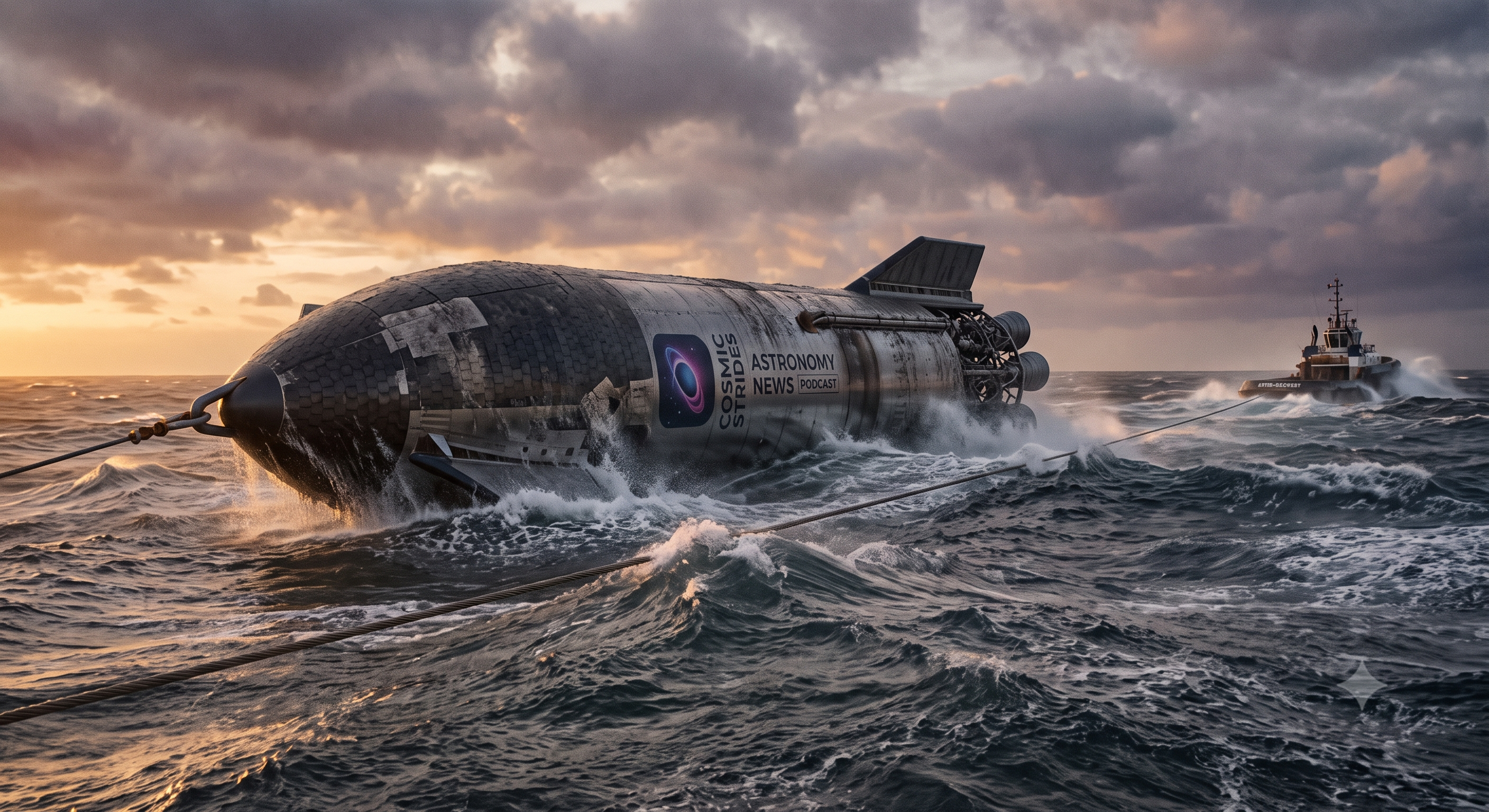
Somewhere in the Indian Ocean, more than thirteen hundred kilometres off the coast of Western Australia, a rope runs from a tugboat to the nose of a rocket. On the other end of that rope is the top half of a SpaceX Starship — fifty-two metres of stainless steel that, for two weeks now, has stubbornly refused to sink. It is the strangest sea story spaceflight has produced in years, and this week it drifted, almost literally, onto an Australian shore.
The saga began on 24 July, when Starship flew its thirteenth full test flight from Starbase in Texas. The upper stage — “Ship,” this one designated Ship 40 — came down for a splashdown off Western Australia and did something none of its predecessors had managed: it made the softest Starship water landing yet, toppled onto the waves, and stayed in one piece. Airtight and buoyant, it simply floated there, its six Raptor engines showing no obvious damage. A SpaceX spokesperson called it, live on air, “a dream scenario.”
That was never the plan. The flight’s real prize was the heat shield — the tiles that protect Ship on its scorching return through the atmosphere, and the problem Elon Musk has long called the biggest obstacle to making Starship fully reusable. On this flight, the shield held. On the company’s first quarterly earnings call on 4 August, Musk went so far as to say he’d consider the heat-shield problem solved. So when a fully intact Ship bobbed up in the ocean, it became a floating laboratory too good to ignore.
On 28 July, Musk posted three words: “We’re sending a ship out to recover Starship.” The recovery vessel Go Australis, which had shadowed Ship 40 since splashdown, was joined by two Norwegian tugs, the Normand Ranger and the Skimmer Tide. Satellite images soon showed all three at work, a tow line fixed to the nose, the convoy inching toward a Western Australian port — Dampier and Port Hedland both floated as destinations.
Then, on 7 August, the mood changed. “Unfortunately, ship recovery is not looking good right now,” Musk wrote, citing increasingly rough seas. But he added the crucial caveat: the team had already captured close-up photos of the heat shield and engines for future upgrades. And that is the quiet truth of this story — a Ship soaked in saltwater for a fortnight was never going to fly again. The prize was never the hardware; it was the look at the hardware. SpaceX has, in all likelihood, already won, whatever the ocean decides.
Reusability is the thread that ties today’s stories together, because SpaceX is no longer the only one chasing it. Tonight, the Chinese company Landspace attempts to land the first stage of its methane-fuelled Zhuque-3 rocket — a propulsive, legs-down landing in the Falcon 9 mould, touching down on a pad in Gansu Province. It is worth being precise: this is China’s fourth orbital-class recovery attempt, and one already worked, when a Long March 10B was net-caught on 10 July. But Landspace is going for the harder, Falcon-style move, and its December debut fell agonisingly short, the booster crashing after its landing burn faltered. A second company flying rockets back to the pad is how a one-company trick becomes an industry.
From the ocean to the outer Solar System: a lovely result this week shows that Uranus’s bow shock — the boundary where the solar wind piles up against the planet’s magnetic field — “breathes,” swelling and shrinking over a single seventeen-hour Uranian day. Because Uranus rolls on its side with a wildly tilted, off-centre magnetic field, its own rotation, not the Sun, drives the rhythm. The model that revealed it leans on data from Voyager 2’s 1986 flyby — still the only measurements ever taken inside the Uranian system, and the same spacecraft whose team recently coaxed new life from its ageing power supply. Forty-year-old data, still doing frontline science.
And then there is the sky itself. Three days from now, on 12 August, the Moon’s shadow arcs over the top of the world for the only total solar eclipse of 2026 — across Arctic Siberia, Greenland, Iceland and northern Spain, with just two minutes and eighteen seconds of totality at its peak off Iceland’s coast. North America catches a partial across its northern tier, deepest in Alaska, with NASA streaming totality live from 1:15 p.m. Eastern. Australia misses this one entirely — but the same night brings the Perseids at their peak under a new Moon, dark and unspoiled for northern watchers, while southern skywatchers turn instead to a pre-dawn parade of planets and brilliant evening Venus.
Four stories, one shared gravity: a Starship under tow, a booster flying itself home, ancient data still arriving from Uranus, and eclipse-chasers travelling to the ends of the Earth for two minutes of dark. Everything, this week, is taking the long way home. Clear skies.