The Colour of Empty Space
Related Episode
The Colour of Empty SpaceA dead star, an Australian dish, and the week the vacuum showed its grain.
Ask a physicist to describe truly empty space and you will not get silence. You will get a story about a place that is anything but empty — a restless froth where pairs of particles and their antimatter twins blink into existence and vanish again before any instrument can catch them. It sounds like a metaphor. This week, thanks to a dead star and a radio dish in the New South Wales countryside, it started to look like a measurement.
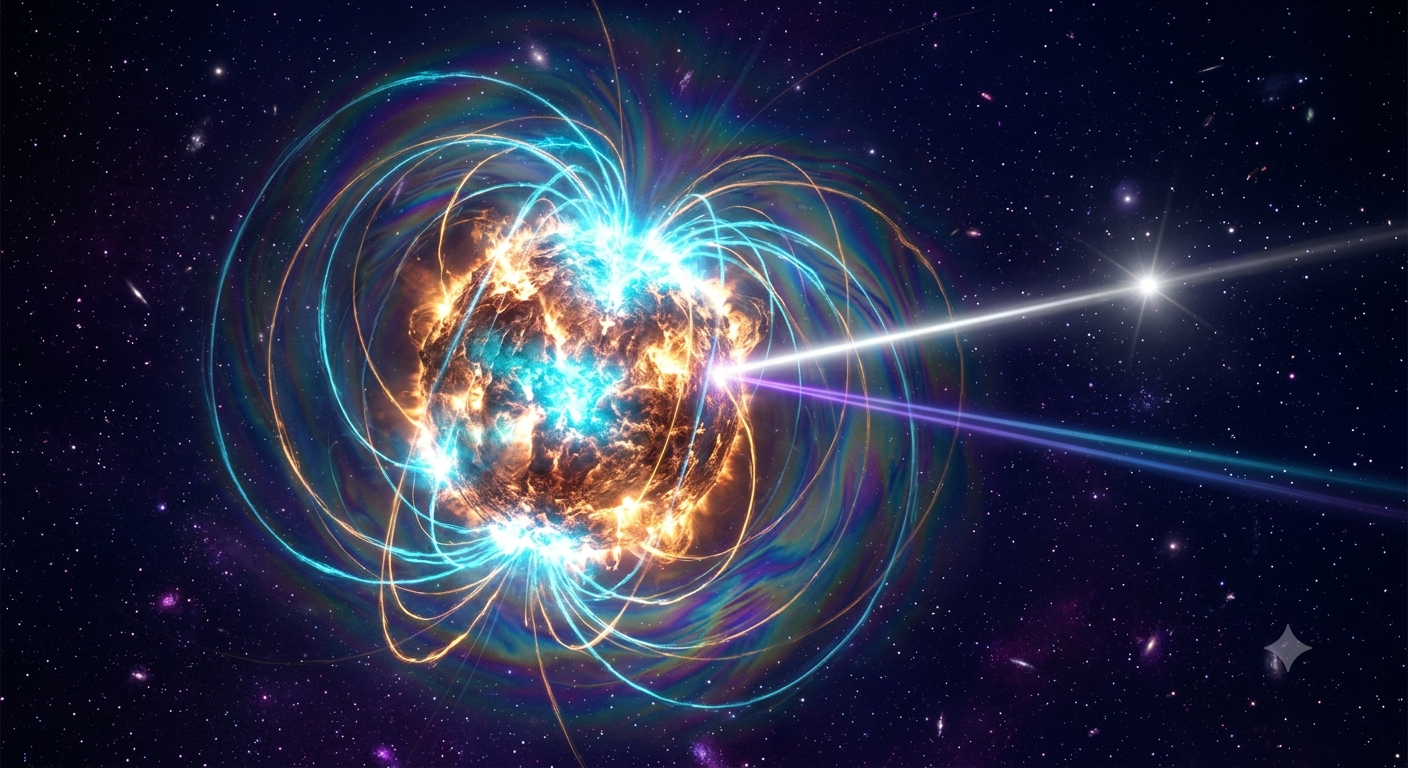
The star is a magnetar called 1E 1547.0−5408. Magnetars are the show-offs of the neutron-star family: the crushed cores of massive stars, a Sun’s worth of matter packed into something the size of a city, wrapped in the strongest magnetic field known anywhere in the universe. That field is roughly a trillion times mightier than the best magnet ever built on Earth, and it is precisely what makes this experiment possible.
In 1936, one of the founders of quantum mechanics, Werner Heisenberg, and his colleagues predicted that a sufficiently violent magnetic field would change the character of the vacuum itself. Those flickering virtual particles would line up, and empty space would gain a grain — behaving like a crystal that bends light one way for one orientation and another way for another. Physicists call the effect vacuum birefringence. The trouble is that no laboratory on Earth can generate a field strong enough to see it. You need a magnetar. You need the universe to build the apparatus for you.
Enter NASA’s Imaging X-ray Polarimetry Explorer, or IXPE, which specialises in measuring the polarisation of X-rays — the direction in which the light waves wriggle, and exactly the fingerprint you need to catch birefringence in the act. In a paper published in Nature this week, a team led by Rachael Stewart combined IXPE with NASA’s NICER instrument and, crucially, with the Parkes radio telescope — Murriyang — in central New South Wales. Australian science, done from a paddock, helping to test the fabric of the vacuum.
What they found was startling. In the soft X-rays that come from the magnetar’s glowing surface, the light was polarised at around sixty-five per cent, climbing to nearly eighty per cent at certain points in the star’s rotation. According to the team, you simply cannot reproduce that pattern — the X-rays and the radio behaviour together — unless the vacuum around the star is bending the light. The signal, they argue, requires vacuum birefringence to be present.
It is worth being careful here, and the researchers are. They describe their result as the most definitive signal to date, not a confirmed detection. There is even a live disagreement: earlier this year, an independent group modelled the same data with a different geometry and concluded the evidence was not yet compelling. Both readings are honest. Confirming the effect for good will take a sharper signature, a whole family of magnetars showing the same thing, or — the real prize — a laboratory result on Earth. None of that is in hand. But the direction of travel is thrilling.
The rest of the week kept its feet closer to the ground. NASA and Northrop Grumman revealed that the hardware from the paused Lunar Gateway — the power and avionics built for its HALO crew module — will be repurposed into three robotic missions to test the technology a Moon base needs to survive the fortnight-long lunar night. Blue Origin, meanwhile, finally named the culprit behind May’s dramatic New Glenn explosion: a single oxygen valve on one of seven engines, now getting a retrofittable fix.
And in the most nail-biting story of the day, a commercial robot named LINK continued its fight to rescue NASA’s ageing Swift observatory from a fiery re-entry. Knocked into a tumble when two of its three reaction wheels failed, LINK’s team improvised, using its gentle ion thrusters to wrestle the spin down from nine degrees a second to under one and a half — on less than a hundred grams of fuel. A software transplant comes next.
It made for a fitting bookend. Our headline was about reading the extremes of physics with an X-ray telescope; our closing drama was about saving one. Look up next Wednesday — carefully, through certified glasses — for the total solar eclipse and the moonless Perseids. And remember that even the empty patches between the stars are quietly, gloriously full.