Starship's Ship 40 Makes It Home
Related Episode
Starship's Ship 40 Makes It HomeSpaceX closes out a three-week ocean saga, plus a dead star previews our Sun’s distant future, new evidence of an ancient collision that built the Milky Way, and China’s fast recovery from a rocket failure”. Episode: “S05E170”
Starship’s Ship 40 Makes It Home
Three weeks ago, SpaceX’s Starship Flight 13 upper stage did something no Starship upper stage had ever done before — it survived a soft, controlled splashdown in the Indian Ocean, fully intact. What followed was a genuine ocean saga: a slow tow toward shore, deteriorating seas, an “it’s not looking good” update from Elon Musk, and prediction markets giving it roughly an 18% chance of ever making it back. This week, it did. Here’s the rundown, along with three more stories — a dead star previewing our own Sun’s distant fate, fresh evidence of an ancient galactic collision that helped build the Milky Way, and China’s rapid recovery from a rocket failure — with links to everything we referenced.
Starship’s Ship 40 makes it home
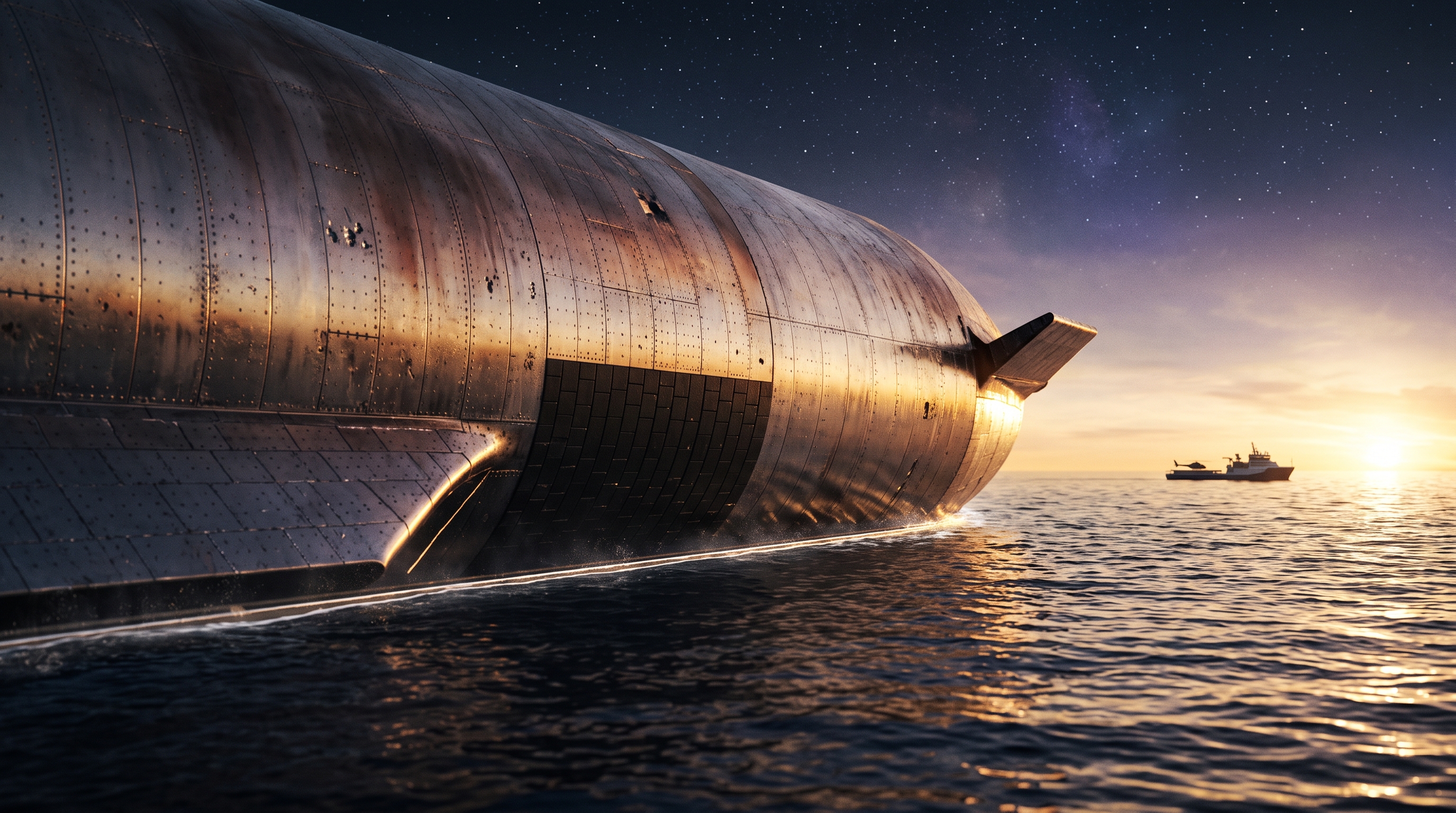
SpaceX has successfully recovered Ship 40, the Starship upper stage that survived an unprecedented soft splashdown in the Indian Ocean off Western Australia on July 24 following Flight 13. Rather than let the intact vehicle sink or scuttling it, SpaceX dispatched recovery vessels — including the Normand Ranger, GO Australis and Skimmer Tide — to retrieve it. The tow proved difficult: the ship drifted more than 400 kilometers, rough seas slowed the convoy to 1–3 knots, and on August 7 Elon Musk warned that “ship recovery is not looking good right now.” Over the following days, the recovery team secured the vehicle and towed it in toward Dampier, Western Australia, completing the recovery this week.
SpaceX had already extracted the mission’s core value before the tow even began, having captured close-up satellite and drone imagery of the heat shield and engine sections while Ship 40 was still floating — inspection showed the thermal protection system largely held up despite elevated aerodynamic pressure during ascent, with some tile loss and damage near the aft rim. Having the physical hardware back now allows engineers to do direct, hands-on inspection. The program has moved on regardless: Ship 41 has completed cryogenic testing and engine installation ahead of static-fire testing, Booster 21 is receiving engines after its own cryo campaign, and Flight 14 is currently targeting around August 20 — just days away.
A dead star previews our Sun’s distant future
Astronomers have captured the clearest direct evidence yet of a dying star’s outer layers dispersing back into the galaxy — a preview of what will happen to our own Sun in roughly five billion years. A team led by Pieter van Dokkum (Yale University), with Roberto Abraham (University of Toronto) and Imad Pasha (Dragonfly Focused Research Organisation), studied the outer halo of the Helix Nebula, a planetary nebula 650 light-years away containing a white dwarf — the dense remnant core of a Sun-like star that has shed its outer layers after exhausting its fuel.
The team identified 22 distinct arc-shaped “bow shock” structures in the nebula’s 5.7-light-year-wide outer ring — wakes left as clumps of the star’s ejected material plow through the surrounding interstellar gas. It’s the first direct observation of stellar debris being broken apart and absorbed back into the interstellar medium in real time; the researchers estimate the clumps survive roughly 10,000 years before fully dispersing. “We are seeing material shed near the end of a star’s life being broken apart and returned to the galaxy,” van Dokkum said. The findings were published August 12 in Nature.
The collision that built the Milky Way
New research combining Hubble Space Telescope observations with data from ESA’s Gaia mission has identified a previously unrecognized ancient collision that helped shape the Milky Way almost 12 billion years ago. A team led by Davide Massari (Bologna’s Astrophysics and Space Science Observatory), with key analysis from Chiara Zerbinati (University of Bologna), found a distinct third population of globular clusters — dense, ancient star clusters orbiting the galaxy — that traces back to a previously unidentified dwarf galaxy the team calls LKH (Low-energy Kraken-Heracles).
LKH, with a mass of roughly 500 million suns, merged with the Milky Way about 11.8 billion years ago, just 2 billion years after the Big Bang — predating the well-known Gaia-Sausage-Enceladus merger by roughly 1.8 billion years. The collision likely triggered bursts of star formation and shaped the Milky Way’s early chemical evolution. “Our home is the Milky Way galaxy, but we do not know how our house was built,” Massari said. The results were published August 17 in Nature Astronomy.
China bounces back with back-to-back launches
Following an August 10 failure in which a Long March 7A rocket broke apart roughly 85 seconds after liftoff — destroying the rocket and its Zhongxing-4B communications satellite payload, with the cause still under investigation — China’s space program returned to flight quickly. On August 16, it launched twice within about 23 hours: a Long March 12 from the Wenchang Commercial Space Launch Site carrying 24 internet satellites (its seventh consecutive successful mission since debuting in 2024), followed roughly a day later by a Long March 2C — a rocket design flying since 1982 — from the Taiyuan Satellite Launch Center, carrying a satellite for the United Arab Emirates. Two different rockets, two different launch sites, back to back, inside a week of the failure.
Tonight’s sky
If skies are clear this evening, look low in the western sky about 45 minutes after sunset: the waxing crescent Moon is keeping company with a blazing Venus, shining at magnitude -4.1.
Links & sources:
NASASpaceFlight.com — While SpaceX recovers Ship 40, Ship 41 prepares for testing ahead of Flight 14
MarineRadar — SpaceX recovers Starship from Indian Ocean after three-week tow
CNN — Satellite imagery captures race to recover 170-foot SpaceX Starship in the Indian Ocean
Space.com — Scientists find dead star that predicts our Sun’s future
Space.com — How an ancient collision with another galaxy transformed the Milky Way
Space.com — China bounces back from Long March rocket explosion with back-to-back launches
Space.com — Night sky August 2026: what you can see tonight
Follow us: @AstroDailyPod