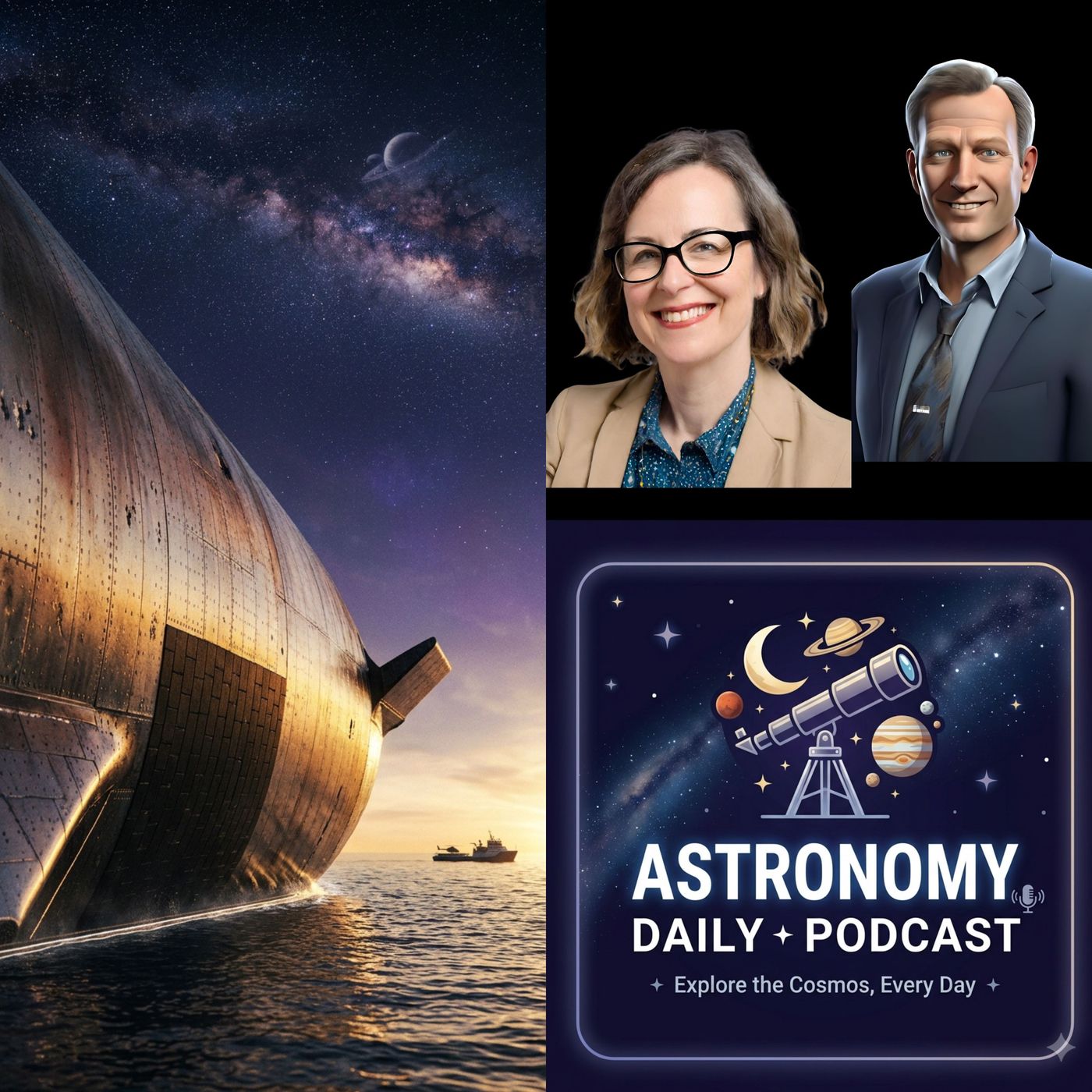
Starship's Ship 40 Makes It Home
In this episode
Anna and Avery close out a three-week saga: SpaceX has recovered Starship's Ship 40 from the Indian Ocean after a soft splashdown, a difficult tow, and a moment where recovery odds looked as low as 18%. Plus: a dead star in the Helix Nebula previews our own Sun's five-billion-years-from-now fate, new evidence the Milky Way was built in part by an ancient galactic collision, and China's fast recovery from a rocket failure with back-to-back launches.Full show notes:
Today's episode — S05E170, Tuesday August 18, 2026:
Main story: Starship's Ship 40 makes it home. SpaceX has completed recovery of Ship 40, the Starship Flight 13 upper stage that survived an unprecedented soft splashdown in the Indian Ocean on July 24. After drifting over 400km and a difficult multi-week tow through rough seas (prediction markets had given it ~18% odds as of mid-August), recovery vessels including the Normand Ranger brought the ship in to Western Australia this week. SpaceX had already secured the imagery it needed from the heat shield and engines regardless of outcome; Ship 41 and Flight 14 (targeting ~August 20) are already in the pipeline.
A dead star shows us our Sun's future. A Yale-led team studying the Helix Nebula's white dwarf found 22 bow-shock structures in its outer halo — the first direct observation of a dead star's ejected material dispersing back into the galaxy. It's a preview of what our own Sun will undergo in roughly 5 billion years. Published August 12 in Nature.
The collision that built the Milky Way. Hubble and Gaia data revealed a previously unknown ancient dwarf galaxy, "LKH," which merged with the Milky Way 11.8 billion years ago — predating the well-known Gaia-Sausage-Enceladus merger by 1.8 billion years. Published August 17 in Nature Astronomy.
China bounces back from a rocket failure. After an August 10 Long March 7A failure destroyed a communications satellite, China launched twice within 23 hours on August 16 — a Long March 12 from Wenchang and a Long March 2C from Taiyuan — demonstrating operational resilience across two rocket types and launch sites.
Tonight's sky: the waxing crescent Moon pairs with a brilliant Venus (magnitude -4.1) low in the western sky, about 45 minutes after sunset.
Links & sources:
- NASASpaceFlight.com — While SpaceX recovers Ship 40, Ship 41 prepares for testing ahead of Flight 14
- MarineRadar — SpaceX recovers Starship from Indian Ocean after three-week tow
- CNN — Satellite imagery captures race to recover 170-foot SpaceX Starship in the Indian Ocean
- Space.com — Scientists find dead star that predicts our Sun's future
- Space.com — How an ancient collision with another galaxy transformed the Milky Way
- Space.com — China bounces back from Long March rocket explosion with back-to-back launches
Anna: Hey, everyone. Welcome back to Astronomy AstroDailyPod. I'm Anna. Avery: And I'm avery. It's Tuesday, August 18th, series five, episode 170. Anna: And we've got a genuinely satisfying one to lead with today. After three weeks of, uh, will they, won't they? SpaceX has actually pulled its starship upper stage out of the Indian Ocean. Avery: Ship 40 makes it home, closing the loop on a storey we've been checking in on since it splashed down back on July 24th. Anna: Then three more. A dead star in a nearby nebula that's basically showing us our own sun's obituary five billion years early.
New evidence that the Milky Way itself was built out of a galaxy we crashed into almost 12 billion years ago. And China bouncing back fast from a rocket explosion with two launches in about 23 hours, plus a quick one for Avery: anyone stepping outside tonight, there is a nice pairing in the western sky right after sunset. Anna: Lots to get through. Let's get into it. Avery: Okay, so let's actually finish this storey, Anna, uh, take us back to the start, because it's been a genuine saga. Anna: It has.
This goes back to July 24 and Starship's Flight 13. The upper stage ship 40 did something no Starship upper stage had ever managed before. It flipped, reignited two engines, oriented itself and made a controlled soft splashdown in the Indian Ocean off Western Australia, completely intact. Avery: Which nobody was really planning for. Usually these things topple over and break apart on impact. Anna: Right? That was the original good news storey. SpaceX got an intact upper stage sitting on the water and decided that was too good an opportunity to just scuttle it.
They sent recovery vessels out, the Normand Ranger, the Go Australis, a ship called Skimmer Tide, and started trying to lasso a, uh, 170 foot stainless steel rocket that had drifted more than 400 kilometres from where it landed. Avery: And that's when it got complicated. Anna: Very complicated. The tow back toward shore started in early August, but the seas didn't cooperate. Conditions kept deteriorating. The convoy could only creep along at 1 to 3 knots. And on August 8th, Elon Musk gave us the line we led an episode with a couple of weeks ago.
Ship recovery is not looking good right now. Avery: And, um, prediction markets had it down around an 18% chance of actually making it to shore. Anna: That's right where it sat for a while. But here's the actual news today. It worked. Over the past few days, the Normand Rangers convoy got ship 40 secured, built up speed and towed it all the way in toward Dampier in Western Australia. As of this week, SpaceX has recovered Avery: the ship three weeks adrift and they actually brought it home. Anna: Three weeks, more than 400 kilometres of drift, rough seas that nearly sank the whole recovery effort, and an intact 170 foot Starship upper stage sitting on a dock instead of on the seafloor.
That's a first. Avery: What do they actually get out of having the physical vehicle back versus just the imagery they'd already collected? Anna: That's the interesting part. SpaceX had already said the mission's main objective was done regardless of outcome because they got close up satellite and drone imagery of the heat SH and engine sections while ship 40 was still floating. That inspection showed the thermal protection system mostly held up despite higher than expected aerodynamic pressure during ascent.
Though there was some tile loss and damage around the aft rim that happened earlier in flight. Avery: So having the actual hardware back is a bonus on top of an already successful data run. Anna: Exactly. Now engineers can do hands on forensic inspection instead of just working from photos, which is a much richer way to validate what held and what didn't for the next generation of ships. Avery: And the programme hasn't exactly been standing still waiting for this to resolve. Anna: Not even slightly.
Jip41 has already been through cryogenic testing and engine installation and it's expected to roll out to the Massey's test site for static fire testing as early as this week. Booster 21's finished its own cryo campaign and is having engines installed for its static fire and Flight 14. The next full test flight is currently targeting around August 20th. So just a couple of days from now. Avery: So this whole saga wraps up almost exactly as the next chapter is about Anna: to start, which is very on brand for this programme.
At the moment there's basically no gap between close one storey and open the next one. But Gregor has also been busy in the background. SpaceX ran 22 separate Raptor 3 engine firings there over the last two weeks, including one that ran, ah, a full 140 seconds, matching a complete ascent burn. Avery: That's a lot of engines getting put through their paces. For a rocket that's supposedly still in Anna: a testing phase, it's the clearest sign yet that they're trying to get the cadence up. Anyway, ship 40's home after three weeks of is it lost at sea?
It isn't. Good outcome and one less loose thread for us to keep tracking. Avery: We can finally stop saying still unresolved about this one. Anna: Next storey is, uh, a bit more melancholy, but in a genuinely beautiful way. Astronomers have gotten the clearest look yet at what happens to A star like our sun after it dies. Avery: And, uh, we're talking about the sun's actual eventual fate here. Anna: Not a metaphor, not a metaphor at all. This comes from the helix Nebula, about 650 light years away in the constellation Aquarius, one of the closest and most photographed planetary nebulae there is.
At its centre sits a white dwarf, the dense leftover core of a sun like star that ran out of hydrogen fuel, ballooned into a red giant and then shed its outer layers into space. Avery: Which 5 billion years from now is exactly what's going to happen to our sun. Anna: Precisely. This is our own star's future. Just further along the timeline, a team led by Peter Van Daakum at Yale, along with Roberto Abraham at the University of Toronto and Imad Pasha at the Dragonfly Focused Research Organisation studied the nebula's outer faint halo and found something nobody directly resolved before.22 distinct arc shaped structures called bow shocks, essentially wakes left behind as clumps of the dead star's ejected material plough through the surrounding interstellar gas.
Avery: So we're watching the star's old outer layers actually being absorbed back into the galaxy? Anna: That's the headline. This is the first direct observation of stellar debris being broken apart and returned to the interstellar medium in real time. Van Daukum put it simply, we are seeing material shed near the end of a star's life being broken apart and returned to the galaxy. Avery: How long does that process actually take? Anna: Relatively fast on cosmic timescales. The researchers estimate those clumps survive for around 10,000 years before they fully disperse and blend into the surrounding gas.
The nebula's outer ring itself spans about 5.7 light years. Avery: So this is basically recycling the star's guts eventually become raw material for the next generation of stars and planets. Anna: That's exactly the point. Every heavy element in your body that isn't hydrogen or helium came from a star that did this at some point. Watching it happen in real time, even in a nebula that's already thousands of years into the process, is about as close as we get to watching that recycling loop in action.
The results were published Aug. 12 in Nature. Avery: A nice one to sit with. Not a disaster storey, just the actual shape of how stars, um, end. Anna: And a preview of a very, very distant Tuesday 5 billion years from now. Avery: Storey 3. And this one's about our home galaxy's own deep history, Right? Anna: New research using Hubble, backed up by data from ESA's GAIA mission, has identified a previously unknown collision that helped shape the Milky Way almost 11 billion years ago. Avery: Previously unknown, is doing some work there.
How do you find a collision that happened that long ago? Anna: You look at the fossil record it left behind. Specifically, globular clusters, these dense balls of hundreds of thousands of old stars that orbit the galaxy. A team led by Davide Massari at Bologna's Astrophysics and Space Science Observatory, with Kiara Zerbinati from the University of Bologna doing key analysis of the Hubble and Gaia data, found a distinct population of globular clusters that didn't match any previously known building block of the Milky Way.
Avery: So a whole separate family of star clusters just hiding in plain sight. Anna: Hiding in plain sight for decades, basically, because until you have precise enough motion and composition data, one old globular cluster looks a lot like another. This third population traces back to a dwarf galaxy. The team's calling LKH for low energy Kraken Heracles, which merged with the Milky Way about 11.8 billion years ago, just roughly 2 billion years after the Big Bang. Avery: How big was this thing? Anna: Relatively speaking, modest by galaxy standards, around 500 million solar masses.
But it brought its own globular clusters along with it, which merged into the Milky Way's own population. And the collision likely triggered bursts of star formation and contributed meaningfully to our galaxy's early chemical makeup. Avery: And this is a different event from the Gaia sausage Enceladus merger, the one we've mentioned before as the Milky Way's biggest ancient collision. Anna: Different and earlier. LKH predates that Gaia Sausage Enceladus merger by about 1.8 billion years. So this pushes the known history of the Milky Way's construction by collision back even further than we'd already mapped.
Avery: It's a good reminder that the Milky Way isn't really one continuous thing. It's more like a scrapbook of everything it swallowed. Anna: Which is exactly the sentiment Messari captured. He said, our home is the Milky Way galaxy, but we do not know how our house was built. This is one more floorboard in that house getting identified. The findings were published August 18th in Nature Astronomy. Avery: Somewhere between the LKH merger and Gaia sausage Enceladus, our, uh, galaxy basically had two formative growth spurts back to back.
Anna: And there's likely more of these still hiding in the data. This is very much an ongoing excavation. Okay, on to our last storey today and a quicker one. China's space programme had a rough moment last week, and a strong recovery this Avery: week set the scene. Anna: What happens on August 10th? A Long March 7A rocket failed about 85 seconds into flight. The Fairing and upper section of the vehicle bent backward and broke apart, destroying the rocket along with its payload. A communications satellite, Zongshang 4B.
The cause is still under investigation, which Avery: is obviously a serious loss. Both a rocket and a comm satellite gone it is. Anna: And there was a real question of how quickly China's programme could get back to flying after that kind of very public failure. The answer turned out to be fast. On August 16, they launched twice within about 23 hours, using two completely different rockets from two different sites. Avery: Walk us through both. Anna: First up was a long March 12 from the Wenshang Commercial Space Launch Site, carrying 24 Internet satellites into low Earth orbit.
That's the long March 12's seventh consecutive successful mission since it debuted in 2024. Then about 23 hours later, a long March 2C lifted off from the Taiwan Satellite Launch Centre roughly 1300 miles to the north, carrying a satellite for the United Arab Emirates. Avery: Um, and the IIC is the old reliable of the fleet, right? Anna: By a wide margin. That airframe's been flying since 1982. So the message China's sending here is pretty deliberate. Newer commercial rocket, decades old workhorse rocket, two different launch sites, back to back.
Less than a week after a very Avery: public failure, a calculated show of operational depth rather than just look, we launched Anna: something that's exactly the read on it, proving the failure was contained to that. One rocket and one pad. Not a symptom of something systemic across the programme. Avery: A quick one before we go. If you step outside after sunset tonight, look low in the western sky. Anna: The waxing crescent moon, just a few days old, is keeping company with Venus tonight. And Venus is blazing away at magnitude -4.1, so it's genuinely hard to miss.
About 45 minutes after sunset. Avery: Um, an easy, no telescope required, one for tonight. Anna: Okay, that's today's episode. Starship's ship 40 finally makes it home after three weeks adrift a dead star, showing us our Sun's own distant future. New evidence the Milky Way was built out of an ancient galactic collision and China's fast recovery with back to back Avery: launches, plus tonight's Moon and Venus pairing. If you get a clear sky. Anna: If you enjoyed today's episode, the best thing you can do for us is leave a rating or review wherever you're listening and share it with a fellow space nerd.
Full show notes, sources and links for every storey we covered today are at, uh, astronomydaily IO and you can find us on social media. We're astrodaily Pod pretty much everywhere. Avery: We'll be back tomorrow with more from the world of space and astronomy. Until then, keep looking up. Anna: See you then. Clear skies, everyone. Astronomy day. Avery: The storeys be told.
Anna: Storeys.
 Apple Podcasts
 Spotify
 Pocket Casts
 Castbox
 Overcast
 Podbean
 iHeartRadio
 Castro
 Goodpods
 Moon FM
 Podcast Addict
 Podcast Republic
 YouTube