Starship Flight 14: The Historic Catch Attempt
Related Episode
Catching the Uncatchable: Starship's Boldest Test YetIn this episode of Astronomy Daily: SpaceX clears the last static fire before Starship’s boldest test yet, China’s Chang’e-7 slips all the way to early 2027, a marathon spacewalk day unfolds at the ISS, new JWST research says planet formation is a race against time, and Türkiye joins the Artemis Accords. Episode S05E182
Starship Flight 14: The Historic Catch Attempt
SpaceX has cleared the last major hurdle before Starship’s most ambitious test flight yet. Booster 21 — the Super Heavy first stage for Flight 14 — completed a full-duration static fire at Starbase’s Pad 2 on Saturday, August 30, with Ship 41 having already finished its own static fire campaign at the separate Massey’s Test Site days earlier. Both halves of the vehicle are now cleared, with a firm launch date still pending FAA and range approvals — current expectation points to sometime this month.
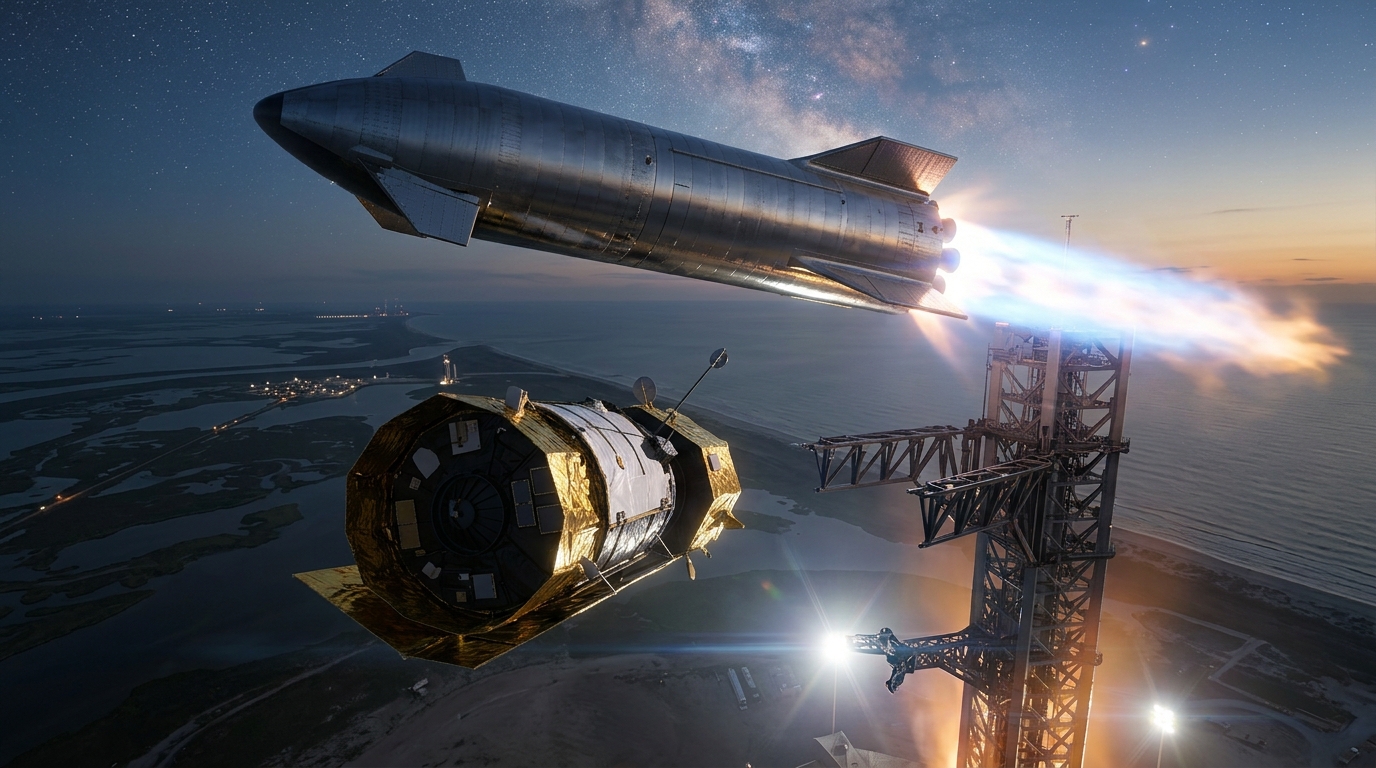
What makes Flight 14 different from everything that’s come before it is the objective on the ship side. SpaceX has successfully caught the Super Heavy booster on the tower’s arms several times now — a relatively well-understood trajectory a few minutes after liftoff. Flight 14 will attempt to catch the ship itself: the upper stage that actually goes to orbit, which has to survive a full ascent, a scorching atmospheric reentry, and then thread itself back down onto the same “mechazilla” arms, with an entirely different mass, velocity profile and thermal history than the booster ever deals with. Nobody has ever caught a Starship upper stage before. If it works, it’s the move that actually makes full, rapid reusability real for the vehicle — not just recovering the expensive bottom half, but bringing the whole rocket home, ready to refly.
Pad 2 has been upgraded between campaigns to give the attempt a real shot: expanded propellant storage, additional pumps for faster vehicle loading, and new electromechanical chopsticks designed to move quicker and more reliably. This is also the third flight of the Starship V3 design, which has brought its own quiet list of changes under the hood. Flight 14 follows directly on from Flight 13’s Ship 40, whose splashdown in the Indian Ocean turned into a genuine drama of its own — a soft landing that refused to sink, a difficult recovery operation with the odds at one point put as low as 18%, and a slow tow home that only wrapped up as Ship 40 finally began its journey back to Starbase by ship on August 30, the same day Booster 21 fired.
Chang’e-7’s delay gets a lot worse
China’s Chang’e-7 lunar south pole mission — a four-vehicle expedition including a leaping hopper robot, widely described as the most ambitious robotic Moon mission any nation has attempted — has been pushed from an originally reported “about a month” delay to early 2027, with February or March windows now the target. The rocket was rolled back to the vehicle assembly building on August 24, hours before its scheduled launch, with Chinese authorities citing only that the mission “didn’t meet the launch requirements” against the backdrop of an approaching storm. Multiple outlets now report a separate issue was likely found during final on-pad testing, though China’s Manned Space Agency hasn’t clarified whether the launch vehicle or the spacecraft itself is at fault, and reviews are continuing.
A marathon month at the space station
A spacewalk got underway at the International Space Station this morning, 7:30am Eastern, expected to run around six and a half hours. ESA’s Sophie Adenot — who made history a few weeks ago as the first French woman to conduct a spacewalk — is out for her third EVA, alongside NASA’s Jessica Meir on her seventh. Between them they’re replacing a spacecraft navigational aid, prepping a cosmic particle detector for a future upgrade, and installing data-relay jumper cables — routine but essential upkeep. It’s the ISS’s 284th spacewalk since 1998, and remarkably the fourth for Expedition 75 in a single month.
Planet formation, and a diplomatic first
In pure science news, a team led by Naman Bajaj at the University of Arizona’s Lunar and Planetary Laboratory, working with the SETI Institute, has used archival James Webb data on 72 young, Sun-like stars to show protoplanetary disk dispersal happens in two distinct phases — magnetically driven jets and winds early on, then photoevaporative winds taking over as the star matures. Gas giant planets need to form before that window closes, making the whole process, in Bajaj’s words, “a race against time.” And in space diplomacy, Türkiye signed the Artemis Accords on Monday at NASA Headquarters, becoming the 71st country to join — timed neatly ahead of Türkiye hosting the International Astronautical Congress in October.
Tonight’s sky: Venus is in a tight conjunction with Spica, under 2° apart, low in the west after sunset. Saturn has graduated to an all-night target ahead of its October 4 opposition, rings tilted a photogenic angle. Jupiter’s back in the pre-dawn sky, with Mars still visible nearby but fading, and the Moon is a waning gibbous heading toward last quarter on September 4.
Follow us: @AstroDailyPod