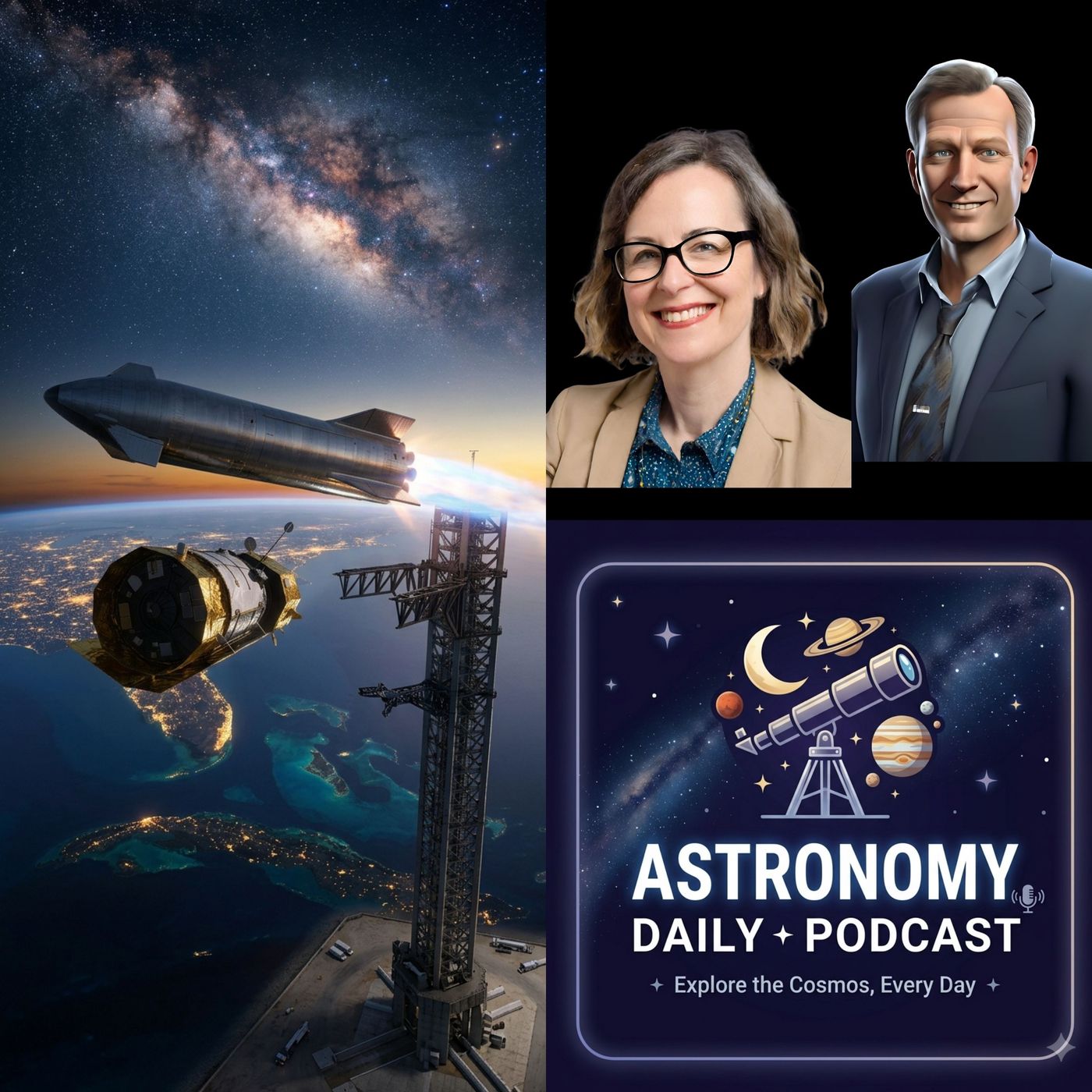
Catching the Uncatchable: Starship's Boldest Test Yet
In this episode
Today's episode — S05E182, Tuesday September 1, 2026: Main story: SpaceX cleared Booster 21's static fire at Starbase's Pad 2 on August 30, the last major milestone before Starship Flight 14 — the third flight of the Starship V3 design. Ship 41 had already completed its own static fire campaign at Massey's Test Site. Flight 14 will attempt something no Starship flight has done before: catching the ship itself, not just the Super Heavy booster, with the launch tower's upgraded "chopstick" arms. Pad 2 received expanded propellant storage, additional pumps and faster-moving catch hardware ahead of the attempt. The flight follows directly on from Flight 13's Ship 40, which survived a dramatic, unplanned float in the Indian Ocean after splashdown before finally beginning its journey home to Starbase on August 30. A firm Flight 14 launch date is still pending FAA and range approvals, with current expectation pointing to sometime in September. Chang'e-7 slips to early 2027. China's four-vehicle lunar south pole mission — rolled back to the vehicle assembly building on August 24, hours before its scheduled launch — has now been retargeted to early 2027 (February–March windows), a far bigger delay than the "about a month" first reported. Chinese authorities have not disclosed a technical cause beyond an approaching storm; multiple outlets report a separate issue was likely found during final on-pad testing, with reviews continuing into whether the launch vehicle or the spacecraft itself is at fault. A very busy month at the space station. NASA's Jessica Meir (her 7th spacewalk) and ESA's Sophie Adenot (her 3rd, following her historic first-French-woman EVA a few weeks ago) began a roughly six-and-a-half-hour spacewalk at 7:30am EDT on September 1 — the ISS's 284th since 1998, and Expedition 75's fourth in a single month. Tasks include replacing a spacecraft navigational aid, prepping a cosmic particle detector for a future upgrade, and installing data-relay jumper cables. NASA's Anil Menon supported from inside on Canadarm2, with Jack Hathaway on safety watch. Planet formation is a "race against time." A team led by Naman Bajaj (University of Arizona Lunar and Planetary Laboratory, with the SETI Institute) published in The Astronomical Journal on August 27, using archival JWST MIRI data on 72 young, Sun-like stars to show protoplanetary disk dispersal happens in two distinct phases — magnetically driven jets and winds early on (roughly the first 1–10 million years), then photoevaporative winds taking over as the star matures. Gas giant planets must form before that gas is gone. Türkiye joins the Artemis Accords. Turkish Minister of Industry and Technology Mehmet Fatih Kacır signed on August 31 at NASA Headquarters, hosted by NASA Administrator Jared Isaacman — Türkiye is the 71st country to sign. Türkiye sent its first astronaut to the ISS in 2024 and is preparing its first lunar mission, AYAP-1; it hosts the International Astronautical Congress in October. Tonight's sky: Venus is in a tight conjunction with Spica, under 2° apart, low in the west/west-southwest about 45 minutes after sunset (Sydney sunset ≈ 5:33pm AEST), setting roughly 90 minutes later. Saturn now rises near sunset and is up most of the night in Aquarius, building toward an October 4 opposition with rings tilted a photogenic angle. Jupiter has returned to the pre-dawn sky (best 4–6am), with Mars still visible nearby but fading. The Moon is a waning gibbous heading to last quarter on September 4. The weak Aurigid meteor shower peaked overnight but is Northern Hemisphere-favoured and moonlight-affected — not worth chasing from the Southern Hemisphere. Links & sources: KeepTrack — SpaceX Brief, Aug 30 2026: Super Heavy Static Fire Clears Starship Flight 14 Basenor — Starship Flight 14: 5 Details That Matter Right Now Space.com — SpaceX test-fires Starship Super Heavy booster ahead of critical Flight 14 Tesla Oracle — Starship 40 begins its journey from the...Anna: Hey everyone. Welcome back to Astronomy daily. It's Tuesday, September 1st. Series 5 episode 182 and can we Avery: just acknowledge that it's the first day of September, which in Sydney means nearly spring. Anna: Equinox is still a few weeks off, but I'll take any excuse. Avery: Fair enough. Today's a big one though. SpaceX just cleared the last major hurdle before Starship's most ambitious flight yet, Flight 14. Anna: And this time they're not just trying to catch the booster. Avery: Then Changi 7's about a month delay turns out to have been wildly optimistic.
There's a spacewalk happening at the iss literally as we record this new JWST research says planet formation really is a race against the clock. And a quick one. Turkey just became the newest member of the Artemis Accords Club. Anna: Big lineup. Let's get into it. Avery: Okay, start with the news. What actually happened over the last few days? Anna: Booster 21, that's the super heavy first stage for Flight 14, completed its static fire at Pad 2 on Saturday, August 30th. Full duration, all engines, no scrubs.
That's the last big box to tick before this thing can fly. Avery: And um, the ship side of it? Anna: Already done. Actually, ship 41 finished its own static fire campaign a few days earlier over at Massey's Test site, which SpaceX uses specifically so they can validate the upper stage separately away from the orbital launch Avery: pad, so both halves are cleared. Remind me why this particular flight has had people paying closer attention than usual? Anna: Because Flight 14 isn't just trying to repeat what's already been done.
Every catch attempt so far, and there have been several successful ones, has been the booster super heavy, coming back down onto the tower's arms. This time they're attempting to catch the ship itself. Avery: The actual upper stage. The part that goes to orbit. Anna: Exactly. Which is a completely different problem. The booster comes back on a relatively gentle, well understood trajectory just a few minutes after liftoff. The ship has to survive a full run towards space, then a uh, scorching re entry through the atmosphere, then thread itself back down onto those same Mechazilla arms with a totally different mass, velocity, profile and thermal history than the booster ever deals with.
Avery: So it's the harder catch. By a wide margin. Anna: By a wide margin. And it's the move that if it works reliably, is what actually makes full and rapid reusability for Starship Real. Not just we got the expensive bottom half back, but we got the entire vehicle back on the same day ready to refly. Avery: What's changed that the pad to give them a shot at it. Anna: Pad two got a proper upgrade between campaigns. More propellant, storage capacity, extra pumps so they can load the vehicle faster.
And new electromechanical chopsticks, which is what people actually call the catch. Arms designed m to move quicker and more reliably than the previous hardware. Avery: And this is Starship V3 we're talking about, not the earlier version. Anna: Right. This is the third flight of the V3 design. Bigger, more powerful, more heat shield changes under the hood than people realise. A lot of these early V3 flights have really been about proving out the new vehicle as much as anything else. Avery: Okay, now walk me back, because I don't think we've properly closed a loop on the last flight.
Ship 40. That was Flight 13's vehicle, wasn't it? Anna: It was. And that turned into a much bigger storey than anyone expected. Ship 40 came down for what looked like a clean, soft splashdown in the Indian Ocean back at the end of July. But then it just didn't sink. It sat there floating intact for days. Avery: I remember we said the recovery odds were being put as low as 18% at one point. Anna: They were genuinely dicey for a while, a, uh, difficult tow operation, bad weather in the mix. But by the end of August they'd got it moving and by the 30th, it was properly on its way home to Starbase by ship closing out basically a full month of Is this thing coming back or not?
Avery: So Flight 14 is picking up right Anna: where that left off pretty much immediately. Booster cleared, ship cleared, pad upgraded. And now it's just a matter of nailing down the actual launch date. FAA paperwork, final range approvals, that kind of thing. Current expectation is sometime this month. September Though SpaceX being SpaceX, uh, treat any specific date as provisional until it's within about 48 hours of launch. Avery: What should people actually watch for when it does go? What tells you it's gone well versus badly?
Anna: Booster catch first. That one's become almost routine at this point, though. Almost routine for something this hard is still remarkable. Then the ship needs to make it through ascent complete. Whatever its specific test objectives are for this flight, that detail hasn't been fully confirmed yet. Survive reentry and then attempt the catch back at the tower. If that last part works, it's a genuine first. Nobody's ever caught a starship upper stage before. Avery: No pressure then. Anna: None at all.
We'll obviously be tracking it closely once a firm launch window drops. This is very much a, uh, watch this space situation pun fully intended. Avery: I was Going to let that one go, but you clearly weren't. Can we back up for a second on why the catch itself is even the goal, rather than just say, a, uh, parachute splashdown or a Runway landing like some other reusable designs use? Anna: Fair question. SpaceX's whole argument is that catching the vehicle on the tower skips a huge amount of hardware you'd otherwise need.
No landing legs to carry all the way to orbit and back, which is dead weight on every single flight. And no separate landing site to build and maintain away from the launch pad. The tower's already there. It's already got a crane's worth of structure. So if you can make the catch reliable, you've effectively turned your launch pad into your landing pad too. Avery: Which is why Falcon 9 doesn't do this. It lands itself on legs instead. Anna: Right. Different scale, different trade off. Starship is simply too big and too heavy for landing legs to make sense the way they do on Falcon 9 boosters.
The catch is a very SpaceX solution. Remove the extra hardware entirely and let the tower do the hard part. Avery: And this connects to more than just SpaceX's own programme too, doesn't it? Starship's also NASA's ride to the lunar surface for Artemis 3. Anna: It is a modified starship is the human landing system for Artemis 3 and beyond. So every one of these test flights is also indirectly a data point on whether that timeline holds. NASA is watching Flight 14 as closely as SpaceX is, even though this particular flight has nothing to do with a, uh, moon landing directly.
Avery: So a, uh, clean ship catch here matters well beyond just SpaceX's own scorecard. Anna: It genuinely does. It's one of the clearest public signals we get of whether the vehicle's maturing fast enough to support everything that's riding on it. Avery: Storey 2. And it's a bit of a gut punch update on something we've been tracking for weeks. Anna: Chang' E7, China's four vehicle lunar South Pole mission. Quick recap. The rocket got rolled back to the assembly building on August 24, just hours before it was due to launch.
And at the time, Chinese authorities said only that the mission didn't meet the launch requirements, with a tropical storm bearing down on the launch site as the obvious culprit. Avery: And, uh, in the weekend wrap, we said the storey was murkier than that original about a month delay suggested. Anna: Turns out we were right to be suspicious as of the 31st. Reporting now puts the new target at early 2027. We're talking February or March. Windows not the few weeks originally floated. Avery: That's a big jump from one month to next year.
Anna: It really is. And nobody's officially said why the storm was real, but multiple outlets are now reporting a separate issue was likely found during final on pad testing. Something with the rocket or the spacecraft itself. And China's manned space agency hasn't clarified which. Avery: Radio silence, basically. Anna: Total radio silence. Beyond that original vague statement. The rockets still sitting in the vehicle assembly building, the spacecrafts in storage at the launch site, and reviews are apparently ongoing.
Avery: Does this actually change anything for the broader moon race? Or is it just an awkward few months for China? Anna: Boastly the latter. One space security strategist put it well, the same kind of thing that just happened to Chang' e 7 has happened to American lunar missions, too. It might ease the political pressure on NASA for a stretch, since there's no rival headline to react to, but it doesn't change the shape of the competition. China's still going for the South Pole just five or six months later than anyone expected a week ago.
Avery: We'll keep half an eye on it and flag it properly once there's an actual firm date. Anna: That's the plan. No more about a month promises from us until China itself commits to something solid. Avery: Does a delay like this ripple out anything else on China's lunar calendar? Or is Chang' E7 fairly self contained? Anna: Mostly self contained for now. It's the precursor mission, scouting landing sites and ice deposits ahead of China's crewed lunar ambitions later this decade. Though a, uh, slip here doesn't directly reschedule anything else that's already flown or is separately booked.
It just means the water ice data everyone's waiting on arrives that much later too. Avery: Storey 3 is happening basically as we speak, which is always a fun one to record. Anna: It is. There's a spacewalk underway at the International Space Station right now. It started 7:30 this morning, Eastern time, and it's expected to run about six and a half hours. Avery: Who's out there? Anna: Sophie Adenote from the European Space Agency. Regulars will remember her from a few weeks back, when she became the first French woman to ever conduct a spacewalk.
This is her third EVA now, and alongside her, NASA's Jessica Mair on her seventh. Avery: What are they actually out there? Anna: Doing a proper maintenance list, replacing a spacecraft navigational aid, prepping a cosmic particle detector for a future upgrade, and installing jumper cables to boost the station's data relay systems. Not the most glamorous sounding tasks individually, but exactly the kind of unglamorous upkeep that keeps a 25 year old space station running. Avery: And there's a milestone number attached to this one too, isn't there?
Anna: There is. This is the 284th spacewalk at the ISS since 1998. And for context on just how busy this particular stretch has been, it's the fourth spacewalk in a single month for the current crew. Expedition 7, 5, 4 in a month is a lot. It's genuinely a, uh, heavy cadence. Spacewalks aren't undertaken lightly, so four in a row like this tells you there's been a real backlog of maintenance items to work through inside. NASA's Anil Menon is running the Canadarm2 robotic arm to support them. And Jack Hathaway's on safety watch keeping an eye on suit systems and choreography Avery: and anything to watch for as it wraps up?
Anna: Just the standard closeout procedures. Repressurize the airlock, stow the suits and NASA will confirm. Once everyone's back in safely, we'll have a clean wrap on it by tomorrow's episode. If anything noteworthy happens in the final stretch. Avery: Four EVAs in a month feels like a lot of wear and tear on both the crew and the suits themselves. Anna: It is a heavy load and it's exactly why NASA schedules these in clusters when they can. Once you've got a crew suited up, trained on a task list and the robotic arm support lined up, you it's more efficient to knock out several jobs back to back than to space them out and rerun all that setup each time.
Avery: Storey4 and um, this one's pure science. No launches, no spacewalks. Just a really nice piece of research. Anna: I like this one a lot. A team led by Naman Bajaj out of the University of Arizona's Lunar and Planetary laboratory with the SETI Institute, published in the Astronomical Journal on the 27th. They used archival James Webb data, specifically the Mrii instrument, to study 72 young sun like stars. Avery: 72 is a decent sample size. Anna: It is, and it let them piece together something that's mostly been theoretical until now.
Exactly how a protoplanetary disc, the swirling ring of gas and dust around a young star that planets are built from, actually gets cleared away. And on what timeline? Avery: And the answer? Anna: It happens in two distinct phases early on. Call it the first one to 10 million years of a star's life. Magnetically driven jets and winds do most of the clearing work. Later, as the star matures and the material falling onto it slows down, photo evaporative winds take over as the dominant mechanism instead.
Avery: So the disc doesn't just fade away evenly. It's cleared by two completely different processes at two different stages. Anna: Exactly. And that timeline really matters because gas giant planets, the Jupiters and Saturns of a system, need huge amounts of gas to build their atmospheres, and that gas has to come from the disc before it's gone. Fajaj's own line for it was that planet formation is, quote, a race against time. Avery: Nice turn of phrase for what's otherwise a pretty technical result.
Anna: It is, and it's a good one to remember because it's basically the missing piece connecting the theory people have had for years to what Webb's now actually happening around 72 real stars. Avery: So next time we talk about why some systems end up with big gas giants and others don't. This is probably part of the answer. Anna: A big part of it, yeah. How fast a star clears out its own nursery. Avery: Quick one. Before we get to the sky, a bit of space diplomacy. Anna: Turkey A signed the Artemis Accords on Monday at a ceremony at NASA headquarters in Washington.
Turkish Minister of Industry and Technology Mehmet Fatih Kachir signed on behalf of the country alongside Turkish Space Agency President Yousef Karach, hosted by NASA administrator Jared Isaacman. Avery: Where does that put the total count? Anna: 71 countries now signed on. Turkey A's got a bit of form here too. They sent their first astronaut to the ISS back in 2024 and they're prepping their own first lunar mission called IAP1. Avery: And signing the Accords actually gets them something concrete, not just a nice photo op.
Anna: It does. It opens the door to contributing actual hardware payloads, tech demos, even cubesats to future Artemis missions, rather than just watching from the sidelines. Nice bit of timing too. Turkey as hosting the International Astronautical Congress in October. So expect a lot of the Accords countries to be in the same room again pretty soon. Avery: All right, let's get everyone sorted for tonight. Anna: Venus is the one to catch, and there's a real reason to look tonight. Specifically, it's in a tight conjunction with Spica, the brightest star in Virgo.
They'll be under 2 degrees apart, with Spica sitting just to Venus's upper right. Avery: Where and when do people need to look? Anna: Low in the west. West southwest starting about 45 minutes after sunset for Sydney. That's sunset around 5:33pm so you're looking from roughly a quarter past six. Venus won't hang around long. It's following the sun down fairly quickly at the moment, so you've probably got about 90 minutes before it sets if you've got binoculars, both objects should sit comfortably in the same field of view.
Avery: And that's visible from everywhere. Not just us, uh, everywhere with a Anna: clear western horizon after sunset, it's a genuinely global event tonight. Just adjust for your own local sunset time. Avery: What about Saturn? Feels like it's been the reliable one for weeks now. Anna: Saturn's graduated to an even better slot. It's rising close to sunset these days and staying up for the most of the night, sitting in Aquarius, easily the brightest thing in that part of the sky. It's building toward opposition on October 4 and the rings are tilted a photogenic angle at the moment.
So if you've got any kind of telescope, now's a good window to actually look at them properly. Morning sky Jupiter's back. After being lost in the sun's glare for a stretch, it's returned as a pre dawn target. Low in the east, best window roughly 4 to 6 in the morning. Mars is still knocking around out there too. Fading a bit, but findable if you know where to look. Avery: Anything for the meteor crowd? Anna: Not really tonight. The rigids peaked overnight, but it's a weak shower at the best of times.
Only around six meteors an hour, made worse by the moon's brightness, washing things out. Mostly a Northern hemisphere event too, so don't go out of your way for it from down here. Avery: And the moon itself waning gibbous, still Anna: nice and bright heading toward last quarter on the fourth. Avery: One quick standing reminder before we wrap, since we're talking about bright things low near the horizon again, always worth repeating Anna: whenever you're pointing anything at all near the sun's position in the sky, whether that's sunrise, sunset or any direct solar viewing.
Make sure any filter you're using is Certified to the ISO 123122. Standard sunglasses are not eclipse glasses, no matter how dark they look. Avery: Good habit to keep sharp. And that's the show for today. Starship Flight 14 cleared for its historic first ship catch attempt. Chang' E7 pushed all the way to early 2027, a busy day of maintenance at the space station, new research on planet formation as a race against time turkey, joining the Artemis Accords and Venus cozying up to Spica tonight. Anna: If you enjoyed today's episode, the best thing you can do for us is leave a rating or review wherever you're listening and share it with a fellow space nerd.
Full Show Notes, sources and links for every storey we covered today are up at astronomydaily IO. Avery: We'll be back tomorrow with more space and astronomy news. Until then, keep looking up, do you? Anna: Then clear skies, everyone.
 Apple Podcasts
 Spotify
 Pocket Casts
 Castbox
 Overcast
 Podbean
 iHeartRadio
 Castro
 Goodpods
 Moon FM
 Podcast Addict
 Podcast Republic
 YouTube