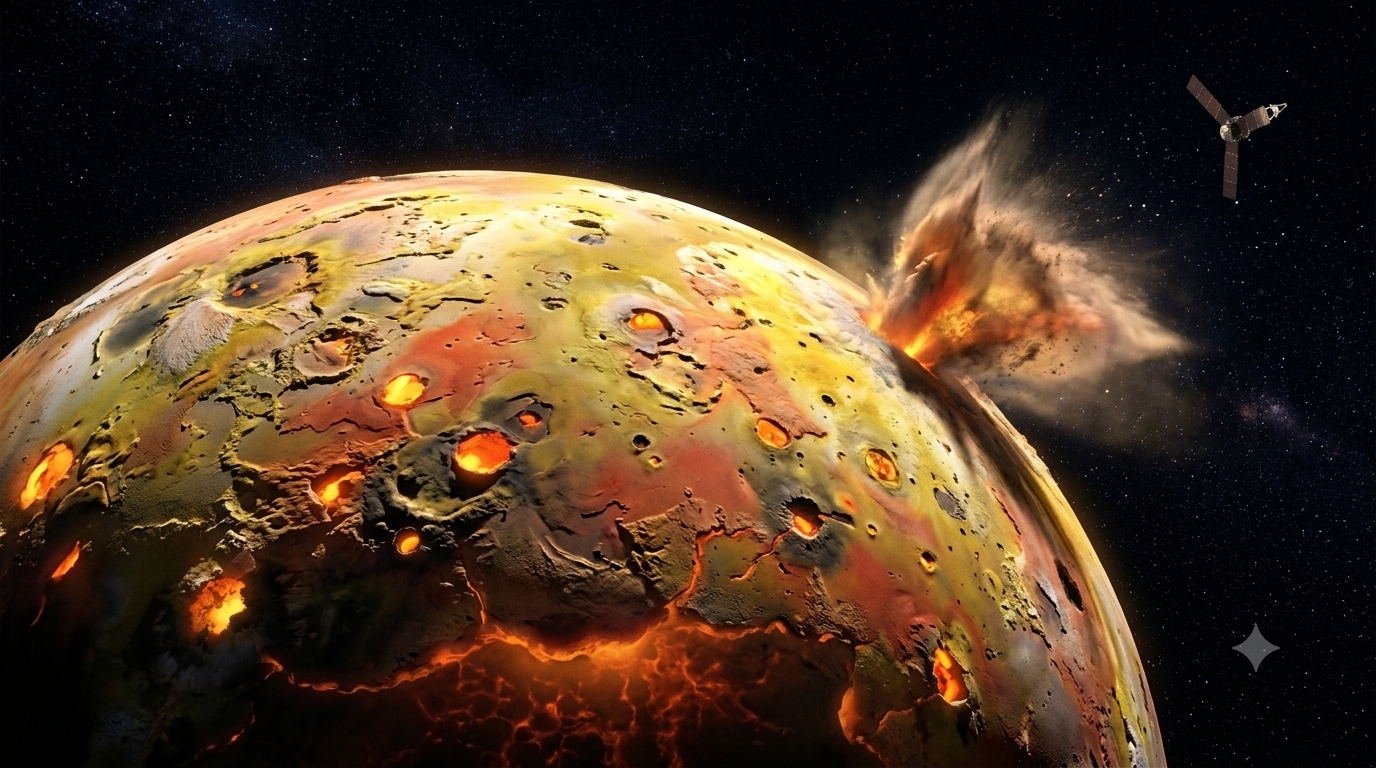
“Reading the Heat: Juno Takes Io’s Temperature from the Inside”
There is a particular kind of discovery that has nothing to do with going somewhere new, and everything to do with looking at somewhere familiar in a way no one has looked before. This week delivered a lovely example — at Io, Jupiter’s innermost large moon, and the most volcanically active world in the solar system.
Io is a place of superlatives. More than four hundred active volcanoes. Lava lakes. Plumes that climb hundreds of kilometres above the surface. Its garish yellows and sulphur reds come from being resurfaced, endlessly, by its own eruptions. All of that fury is driven by tidal heating: as Io travels its slightly elliptical orbit, Jupiter’s immense gravity stretches and squeezes it, and that ceaseless flexing warms the interior — the way a paperclip heats up when you bend it back and forth, only on a planetary scale and without pause.
For decades, though, almost everything we knew about that heat came from the surface. Infrared instruments read the temperature of the top skin of a world and no deeper. What no one had ever done — for any rocky body beyond Earth — was measure the temperature below the ground. That is the line NASA’s Juno mission has now crossed, in a study led by Shannon Brown of the Jet Propulsion Laboratory and published in the Journal of Geophysical Research: Planets.
The tool for the job was never meant for it. Juno’s Microwave Radiometer, or MWR, was designed to peer down through Jupiter’s thick clouds and read the giant planet’s atmosphere at a range of depths. It carries six antennas, each tuned to a different wavelength — and that is the quiet genius of what happened next. Microwaves of different wavelengths escape from different depths. Point the instrument at solid ground instead of cloud, and each channel becomes a reading of the temperature at a slightly different depth beneath the surface. A multi-depth thermometer, working from orbit, using only the natural heat the crust already radiates.
During two close flybys — in late December 2023 and early February 2024, each sweeping within about 1,500 kilometres of the surface — the MWR found that Io’s temperature climbs by more than 20 degrees Celsius within just the first few metres of crust. On a world whose surface sits near minus 143 Celsius, a rise that steep and that shallow points to serious heat rising from below: a heat flow estimated at one to three watts per square metre, up to thirty times Earth’s global average. The same data also revealed that most of Io’s surface is remarkably smooth and made of low-density material — exactly what you would expect of a world forever burying itself under fresh volcanic deposits.
Striking as the Io result is, the most consequential part of this story may be the method. This is the first subsurface temperature profile ever taken of a rocky world from orbit, and the technique is indifferent to whether a world is fiery or frozen. Turn it toward an icy ocean moon — Europa, Enceladus — and in principle it could sense the warmth of the ocean beneath the ice, or reveal how thick that ice shell really is. With Europa Clipper already en route to the Jupiter system, that is not an abstract prospect.
And the idea reaches all the way back home. Juno’s principal investigator, Scott Bolton, has noted that flying an MWR-type instrument over a volcano on Earth could read the same kind of subsurface temperature gradient — opening a genuinely new way to study our own volcanoes from the air. An instrument built for Jupiter’s clouds, quietly handing us a new capability for the ground beneath our feet.
That is the shape of the best exploration stories: you build a tool for one purpose, aim it somewhere unplanned, and it returns something no one designed it to find. Io gave up the first reading of its hidden heat this week — and in the process, we picked up a new way to take the temperature of worlds, ours among them.
One last note, with a wink. We spent the episode at a moon of Jupiter — and yet Jupiter itself is, right now, the one bright planet you cannot see. It reaches solar conjunction on 29 July, lined up behind the Sun, and won’t return to the morning sky until late August. The moon we can study up close; the planet, briefly, out of sight.