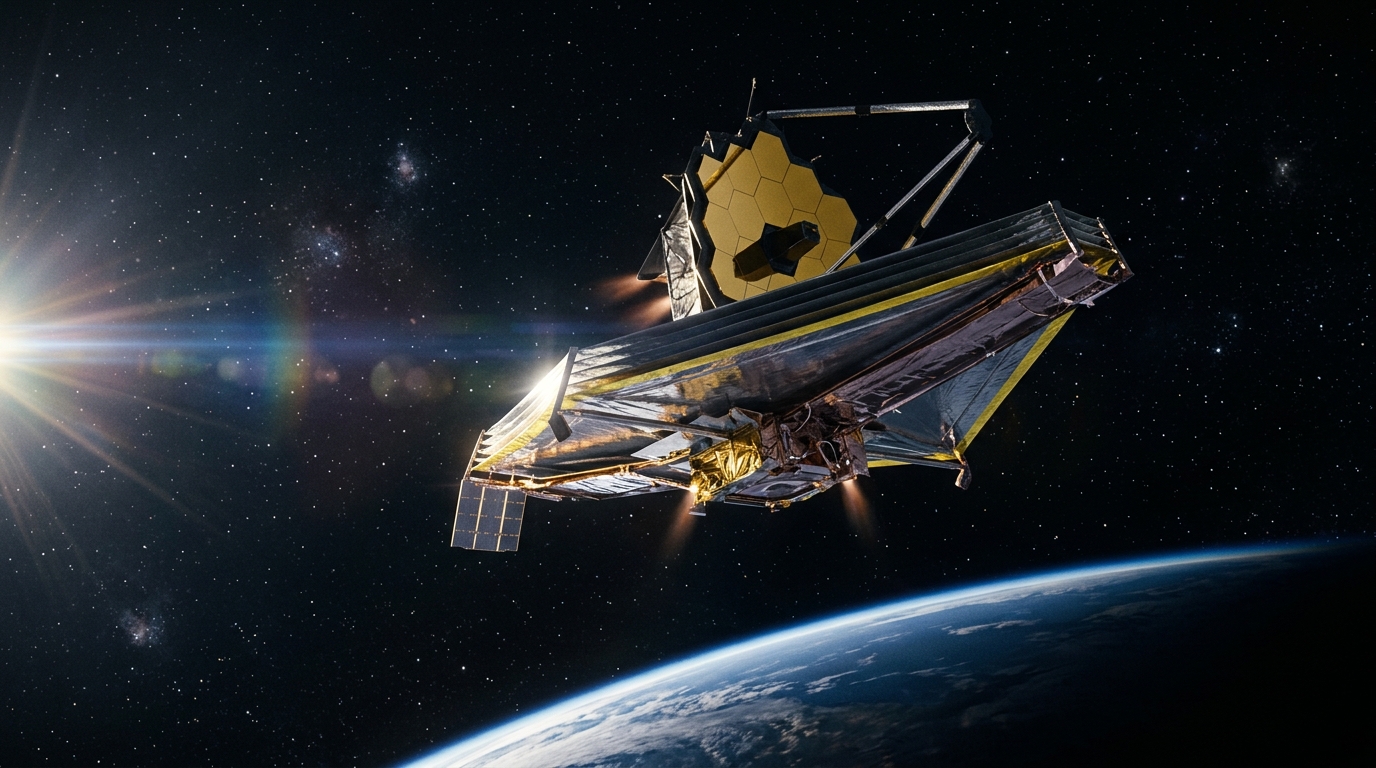
NASA's Roman Space Telescope Is Ready to Fly — Nine Months Early
Related Episode
NASA's Roman Space Telescope Is Ready to Fly — Nine Months EarlyRoman launches this Sunday to hunt dark energy and exoplanets, plus a third ISS spacewalk in a month, a 12-billion-year-old scar at the Milky Way’s core, a possible 2028 Perseid outburst, and a near-total lunar eclipse this week - S05E176
NASA’s Roman Space Telescope Is Ready to Fly — Nine Months Early
Today’s episode covers a flagship telescope that’s arriving ahead of schedule for once, a spacewalk happening as we speak, a 12-billion-year-old scar at the heart of our galaxy, a meteor shower forecast worth watching over the next two years, and an eclipse most of our listeners won’t actually get to see. Here’s the rundown, with links to everything we referenced.
NASA’s Roman Space Telescope is cleared for launch, nine months ahead of schedule
The Nancy Grace Roman Space Telescope is now fully encapsulated inside the fairing of the SpaceX Falcon Heavy rocket that will carry it to orbit, following encapsulation at Kennedy Space Center’s Payload Hazardous Servicing Facility on August 21. Liftoff is targeted for no earlier than 7:26 a.m. Eastern time this Sunday, August 30. Roman is heading roughly 1.6 million kilometers out to Sun-Earth Lagrange Point 2 — the same gravitationally stable region James Webb calls home — for a planned five-year primary mission.
What stood out to us most is the timeline: Roman is launching about nine months ahead of its original schedule, a rarity for a NASA flagship observatory given how often missions like this slip the other way. The $4 billion telescope carries two headline science goals — mapping dark matter and dark energy through wide-field galaxy surveys, and hunting exoplanets with a coronagraph instrument built to cancel out starlight and reveal the much fainter planets nearby. NASA senior project scientist Julie McEnery calls the coronagraph technique “doing magic with physics.”
Roman’s mirror is comparable in size and sharpness to Hubble’s, but its camera’s field of view is roughly a hundred times wider — NASA’s own comparison is that one month of Roman surveying the Milky Way would take Hubble about a century to match. Over its main survey Roman is expected to image around two billion galaxies and generate more than 500 terabytes of data annually, versus roughly 400 terabytes from Hubble across its entire 35-year mission. Against Webb, the comparison is depth versus breadth: Webb’s extreme infrared sensitivity finds fainter, more distant single objects, while Roman’s images cover about fifty times more sky area per shot — useful for building statistics on puzzles like JWST’s unexplained “Little Red Dots.”
The telescope is named for Nancy Grace Roman, NASA’s first chief astronomer and the person widely credited with securing funding and support for the Hubble Space Telescope — hence her nickname, “mother of Hubble.” The mission began life under the clunkier name WFIRST (Wide Field Infrared Survey Telescope) before being renamed in her honor. ESA is a formal partner on the mission, supplying coronagraph detector hardware, star trackers, and batteries — and, in a nice local touch, some of Roman’s data will come down through a new 35-metre ESA antenna at New Norcia, Western Australia.
A third ISS spacewalk in a month, happening today
NASA’s Anil Menon and ESA’s Sophie Adenot head back outside the International Space Station today for Spacewalk 98 — Menon’s third career EVA and Adenot’s second. It follows Spacewalk 96 on August 6 (power channel upgrades ahead of a future solar array install) and Spacewalk 97 on August 18, when Adenot became the first French woman to conduct a spacewalk while the pair replaced a Space-to-Ground communications antenna. Today’s walk is billed as finishing that antenna work and, time permitting, installing a new retroreflector for spacecraft docking navigation. Standard hatch-open time is around 8:35 a.m. Eastern, running roughly six and a half hours.
Astronomers find a 12-billion-year-old scar at the Milky Way’s core
A team led by Davide Massari (Italian Institute for Astrophysics), working on the ARMA project, has identified evidence the Milky Way absorbed a dwarf galaxy roughly 12 billion years ago — pushing our galaxy’s known merger history back about 1.8 billion years further than previously documented. Using Hubble to precisely date and chemically fingerprint globular clusters at the galactic core, the team found a third cluster population that didn’t match any known merger — evidence of a previously undiscovered dwarf galaxy, dubbed Low-energy-Kraken-Heracles (LKH), estimated at around 500 million solar masses and comparable in scale to the previously best-known ancient merger, Gaia-Enceladus. “This work tells us what happened to the Milky Way in its infancy,” says team member Chiara Zerbinati.
Could Jupiter supercharge the Perseids in 2028?
Robert Lunsford of the American Meteor Society is modeling whether Jupiter’s roughly twelve-year approach to part of Comet 109P/Swift-Tuttle’s debris stream — the source of the Perseid meteor shower — could nudge material into orbits closer to Earth in 2028, potentially producing an outburst of 200–300 meteors per hour if 2027 already shows elevated rates. Lunsford is upfront that the models are “educated guesses” given uncertain debris density data. The 2028 peak is expected under favorable third-quarter moon conditions.
Tonight’s Sky: a near-total lunar eclipse — but not for the Southern Hemisphere
A partial lunar eclipse the night of August 27–28 will cover 96% of the Moon’s disk, among the deepest partial eclipses possible without going total, with peak coverage around 12:12 a.m. US Eastern (4:12 UTC) on the 28th. It’s visible across the Americas and, low near the horizon, parts of Europe and Africa — but for Australia and the rest of Asia-Pacific, the Moon will be firmly on the daylight side of Earth when it happens, so there’s nothing to see from here this time. Closer to home, Venus remains a bright, easy target in the evening western sky, and Saturn is well placed rising in the east after dark.
Links & sources
NASA Science — Roman Launch Countdown
NASA Roman Blog — Roman Telescope Enclosed in SpaceX Falcon Heavy Rocket Fairing
Space.com — “It’s going to do things that currently are impossible”: the Roman Space Telescope is ready to launch Aug. 30
NASA/JPL — NASA Telescope Named for “Mother of Hubble” Nancy Grace Roman
ESA — Roman factsheet
NASA — NASA to Cover Three US Spacewalks, Host Preview News Conference
Space.com — The earliest galaxy ‘swallowed’ by the cannibal Milky Way left a scar at its heart
Space.com — Is the Perseid meteor shower going to get even more spectacular? Jupiter could send more ‘shooting stars’ towards Earth in 2028
Space.com — What to expect from each stage of the partial lunar eclipse on Aug. 27-28
Space.com — Partial lunar eclipse August 2026 — Where will it be visible from?
The Planetary Society — What’s up in the night sky: August 2026