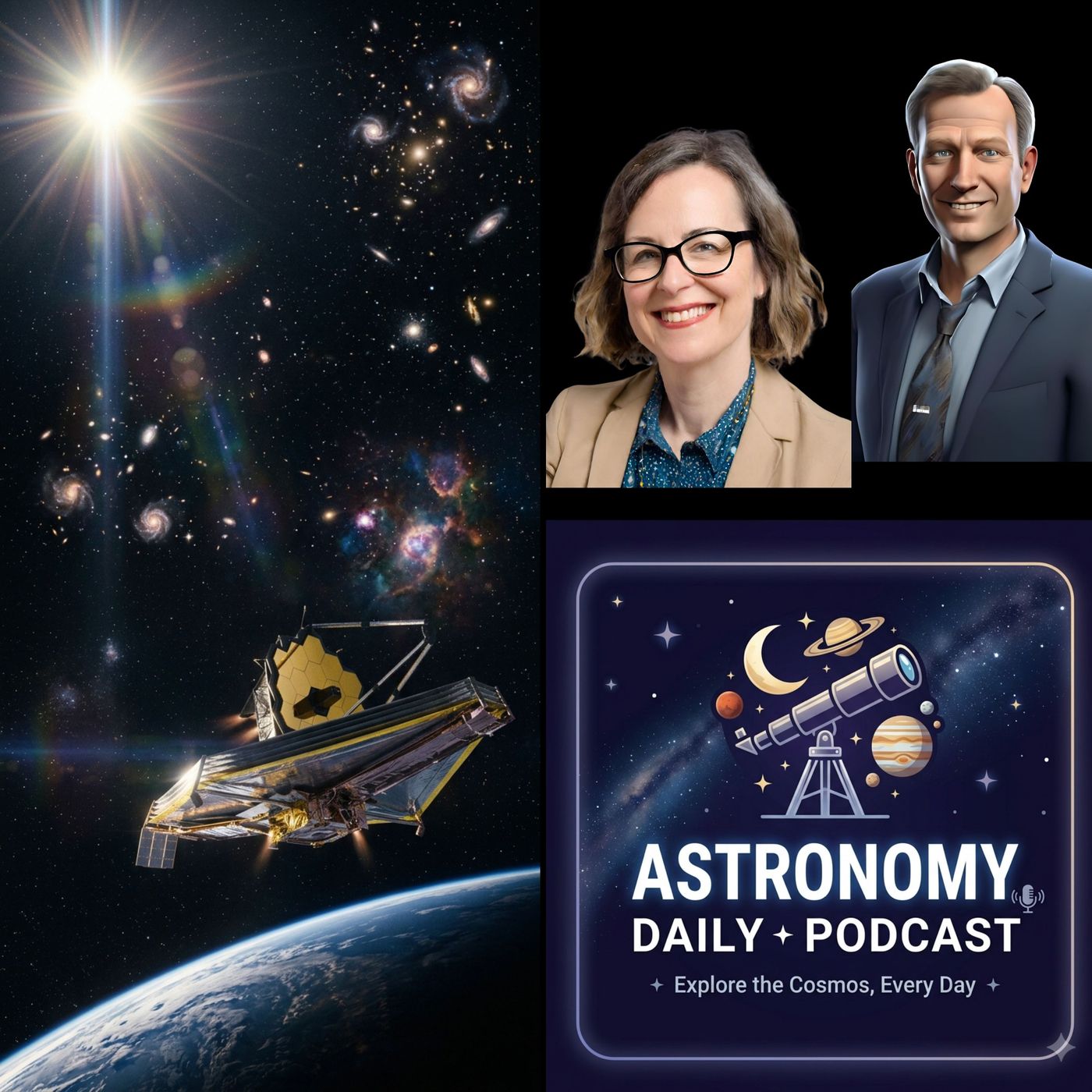
NASA's Roman Space Telescope Is Ready to Fly — Nine Months Early
In this episode
Today's episode — S05E176, Tuesday August 25, 2026:Feature story: NASA's Roman Space Telescope is fully encapsulated inside its Falcon Heavy fairing and cleared to launch no earlier than 7:26 a.m. ET this Sunday, August 30 — about nine months ahead of its original schedule, a rarity for a NASA flagship mission. Roman is headed to Sun-Earth L2 for a five-year mission mapping dark energy and dark matter and hunting exoplanets with a starlight-cancelling coronagraph. Its wide-field camera surveys roughly a hundred times faster than Hubble at comparable image sharpness. Named for NASA's first chief astronomer, Nancy Grace Roman — the "mother of Hubble" — the mission is a formal ESA partnership; some of its data will come down through a new ESA antenna at New Norcia, Western Australia.
The rest of the news:
- ISS Spacewalk 98: NASA's Anil Menon and ESA's Sophie Adenot are outside the station today finishing a Space-to-Ground antenna replacement and, time permitting, installing a new docking retroreflector — their third spacewalk together in under a month.
- Milky Way merger scar: A Hubble-based study (the ARMA project, led by Davide Massari) has found evidence of a ~500-million-solar-mass dwarf galaxy, dubbed Low-energy-Kraken-Heracles, absorbed by the Milky Way roughly 12 billion years ago — the earliest documented merger in our galaxy's history.
- Perseids 2028 watch: Jupiter's gravity may nudge Perseid debris closer to Earth's path in 2028, potentially producing an outburst of 200-300 meteors/hour under favorable dark-sky conditions — though modelers caution the forecast is an "educated guess."
- Tonight's Sky: A 96%-partial lunar eclipse falls the night of August 27-28 — spectacular from the Americas and parts of Europe/Africa, but invisible from Australia and the rest of Asia-Pacific, where it happens in broad daylight. Venus and Saturn remain good evening targets locally in the meantime.
Links & sources:
- NASA Science — Roman Launch Countdown
- NASA Roman Blog — Roman Telescope Enclosed in Falcon Heavy Fairing
- Space.com — The Roman Space Telescope is ready to launch Aug. 30
- JPL — NASA Telescope Named for "Mother of Hubble" Nancy Grace Roman
- ESA — Roman factsheet
- NASA — NASA to Cover Three US Spacewalks
- Space.com — The earliest galaxy "swallowed" by the cannibal Milky Way left a scar at its heart
- Space.com — Could Jupiter supercharge the Perseids in 2028?
- Space.com — Partial lunar eclipse Aug. 27-28: stages and visibility
Follow us: @AstronomyDailyPod
Become a supporter of this podcast: https://www.spreaker.com/podcast/astronomy-daily-latest-space-news--5648921/support.
Sponsor Details:
Ensure your online privacy by using NordVPN. To get our special listener deal and save a lot of money, visit www.astronomydaily.io/nordvpn. You'll be glad you did!
Get the best secure and private email on the planet. Stop your Government, google and who knows who else spying on every email you write. Do what we did and use ProtonMail. They beleive in privacy and there are no ads in their business model...yet they still provide a free forever service. Check them out and get out special deal at www.astronomydaily.io/protonmail
Become a supporter of Astronomy Daily by joining our Supporters Club. Commercial free episodes daily are only a click way... <a...
Anna: Hey everyone. Welcome back to Astronomy AstroDailyPod. I'm Anna. Avery: And I'm, uh, avery. It's Tuesday, August 25th, series five, episode 176. Anna: Quick programming note before we get into it, no firm new launch date yet on China's Chang' E7, the storey we spent most of yesterday's episode on. Still pointing at that mid to late September window we talked about. Nothing more specific from CNSA as of this morning. We'll flag it the moment that changes. Avery: So instead, today belongs to a telescope.
A, uh, very big, very expensive, very ready to fly telescope. Anna: NASA's Nancy Grace Roman Space Telescope is sitting inside its rocket fairing right now. Cleared for launch this Sunday, and it's getting there the better part of a year earlier than anyone expected. We'll spend some real time on why that matters. Avery: Astronauts are heading back outside the space station today for the third spacewalk in a month. Astronomers have found a scar at the centre of the Milky Way from a collision 12 billion years ago.
Jupiter might be about to supercharge the Perseids in 2028. And there's a near total lunar eclipse this week though we've gotta manage expectations on that last one. For anyone listening from down under, let's get into it. Okay, so this is the big one today. Talk me through where things actually stand. Anna: As of Monday, the Nancy Grace Roman Space Telescope is fully encapsulated inside the fairing of the Falcon Heavy rocket that's going to launch it. That happened at Kennedy Space Centre's Payload Hazardous Servicing facility.
Teams will move the encapsulated payload over to SpaceX's hangar at pad 39A, made it to the rocket and roll the whole stack out to the pad later this week. Liftoff is targeted for no earlier than 7:26am Eastern time this Sunday, August 30th. Avery: That's in Florida time. So for anyone doing the math from Australia, that lines up with Sunday night here. Somewhere around 9:30pm Sydney time. Anna: Exactly. We'll pin down the precise local time closer to launch day. But here's the headline that actually got our attention.
Roman is launching about nine months ahead of its original schedule. Avery: Nine months early for a NASA flagship mission. That basically never happens. Anna: It basically never happens, which is exactly why it's worth pausing on. Big space telescopes have a well earned reputation for slipping. Right. Webb famously blew out its schedule and budget by years. Roman going the other direction, arriving early and as far as the reporting shows, without dramatic cost blowouts, is genuinely unus. And it says something about how NASA and its contractors have run this build.
Avery: What actually happens once it's up there? What is Roman for? Anna: 2 big jobs plus a bonus one. Job 1 map Dark Energy and dark matter by surveying huge swaths of the sky and watching how galaxies are distributed and how their light is bent by gravity. Job 2 Hunt for exoplanets using a coronagraph instrument that's specifically built to block out a star's glare so the much fainter planets around it become visible. NASA's senior project scientist on this, Julie McInerney, put it nicely. She called it doing magic with physics, using the wave properties of light itself to cancel out starlight and reveal what's hiding next to it.
Avery: And, um, the bonus job? Anna: The bonus job is speed. Roman's mirror is roughly the same size and sharpness as Hubble's, so similar image quality, but its camera has a field of view about 100 times wider. NASA's own comparison is the one that stuck with us. One month of Roman surveying the Milky Way would take Hubble something like a Avery: century to match a century of Hubble time in a month. Anna: That's the number over its main survey. Roman is expected to image something like 2 billion galaxies.
And it'll generate more than 500 terabytes of data a year. For comparison, Hubble has produced around 400 terabytes total across its entire 35 year mission. Roman matches that in well under 12 months every year for years M. How Avery: does it stack up against James Webb since that's the telescope everyone's already got a mental picture of different job. Anna: Basically, Webb is built for depth, extreme sensitivity in the infrared, staring at one small patch of sky for a long time to see extremely faint, extremely distant objects in exquisite detail.
Roman is built for breath, a wide field survey machine covering roughly 50 times the area Webb can. In a single image, one finds needles, the other maps the whole haystack. And Roman's actually expected to help with a puzzle. Webb turned up the little red dots, these compact, surprisingly luminous objects from the early universe nobody's fully explained yet. More sky coverage means more of those objects to study statistically instead of one at a time. Avery: Where does it actually go once it launches?
Anna: Not low Earth orbit like Hubble or the space station Roman is headed to. Sun Earth, Lagrange Point 2, about 1.6 million kilometres out. The same gravitationally stable neighbourhood Webb calls home. It's carrying enough hydrazine fuel on board for course corrections on the way out and for station keeping across a planned five year prim mission. Avery: Any sense of what happens right after launch? Like day One week one. Anna: Jeremy Perkins, one of the integration and test scientists on the project, described it about as plainly as you can.
Roughly 30 days out from an early August update, he said, we're going to be launching Roman, testing it out, opening the deployable aperture cover, looking at the sky and sending data down to the ground for the first time. So the sequence is launch, commissioning, first light, and then the real survey work begins. Avery: And the project managers basically just declared it done and ready. Anna: Jacqui Townsend's line was short. Roman is ready for launch after nine months of schedule margin. They clearly feel confident saying that.
Avery: Worth asking. Who actually is Nancy Grace Roman? The name gets used a lot without the backstory. Anna: She was NASA's first chief astronomer back in the 1960s and she's usually credited as the person who did more than anyone to get the Hubble Space Telescope funded and built in the first place, which is where the nickname Mother of Hubble comes from. This mission actually started life under a much clunkier name, Wide Field Infrared Survey Telescope, before NASA renamed it in her honour a few years back.
Given what Roman's actually built to do, a fast wide field survey machine following on from Hubble's legacy. It's a genuinely fitting name. Avery: And, um, this isn't a NASA only build, Right. I feel like I've seen ESA and other partners mentioned, right? Anna: There's meaningful international contribution. ESA is flying as a formal partner, supplying detector hardware for that coronagraph we just talked about, plus star trackers and batteries. And here's a nice local angle. Some of Roman's data is going to come down through a new 35 metre ESA antenna at New Norcia out in Western Australia.
Avery: Wait, this telescope's data's going to physically land in Australia? Anna: Some of it, yes. New Norcia already hosts one ESA dish, and this new one was built partly with missions like Roman in mind. So next time someone tells you space is happening somewhere else, you can point out there's a dish out west quietly catching signals from a telescope parked a million miles from Earth. Avery: And, um, remind me on cost, because flagship telescopes have a reputation for blowing budgets as well as schedules, anon's been Anna: reported at roughly $4 billion across its development.
That's real money, but it's a fraction of Webb's final cost. And going back to where we started, it's arriving early rather than late, which on recent NASA flagship history is close to a genuine surprise. Avery: So to sum up the why this Matters, a $4 billion flagship observatory, arriving early instead of late, headed out to join Webb at L2 built to survey the sky roughly a hundred times faster than Hubble, hunting dark energy and thousands of new exoplanets at the same time. Anna: That's the mission Sunday morning.
US time. We'll be watching. Avery: Sticking with things happening literally this week, there is a spacewalk today. Anna: There is, and it's the third one in less than a month for the same two astronauts. NASA's Anil Menon and ESA's Sophie AdNote are heading back outside the International space station today. US time for what Mission Control is calling Spacewalk 98, Menon's third career EVA, AD notes. Avery: Second, remind me what the first two were about. Anna: Spacewalk 96 back on August 6th had Menon out with veteran astronaut Jessica Mair, installing hardware to modify the station's power channels, prepping for a future solar Array upgrade.
Spacewalk 97 on the 18th is the one that actually made headlines. Menon and Adano went out to replace a space to ground communications antenna. And Adno became the first French woman ever to conduct a spacewalk. Avery: And today's picks up where that one left off. Anna: Right. Today's walk is billed as finishing the antenna replacement and if time and consumables allow, swapping in a new retroreflector, which is a passive device used to help visiting spacecraft navigate and dock precisely. Standard EVA suit up puts the actual hatch open time at around 8:35am M. Eastern, running roughly six and a half hours.
So by the time most of you are hearing this, it's either just getting underway or already wrapped up. Avery: US side Three spacewalks, two astronauts, one month. That's a heavy cadence. Anna: It is though. It's also just what station maintenance looks like when several jobs queue up at once. Power upgrades, comms, hardware, docking aids. Nothing about today's walk is flagged as urgent or off normal. It's scheduled methodical work. We'll confirm how it went and note anything unexpected once NASA posts the wrap up.
Avery: Now, for something that happened a lot longer ago than this morning, try 12 billion years. Anna: This is a genuinely nice piece of galactic archaeology. A team led by Daveed Massari at the Italian Institute for Astrophysics, working on something called the ARMA Project, has identified evidence that that the Milky Way swallowed a dwarf galaxy roughly 12 billion years ago. Which pushes the known start of our galaxy's merger history back about 1.8 billion years earlier than anything previously documented.
Avery: How do you even find evidence of Anna: something that old globular clusters, these dense ancient balls of stars that orbit the galactic core. The team used Hubble to measure the ages and chemical makeup the metallicity of clusters right at the Milky Way centre with real precision. And they found three distinct groups. Two matched patterns astronomers already understood. The third didn't fit anything on record. Different age, different chemistry, which is the signature of material that came from somewhere else entirely.
Avery: Somewhere else being this dwarf galaxy. Anna: Right, They've given it the name low energy Kraken Hercules or LKH for short, and estimate its mass at around 500 million times that of the Sun. That's genuinely comparable in scale to Gaia Enceladus, the previously best known ancient merger in the Milky Way's history. Most of what LKH contributed ended up concentrated within about 20,000 light years of the galactic centre, which is exactly why it left a scar right at the core, rather than out in the disc somewhere else.
Avery: What does finding this actually tell us? Beyond just there was another one. Anna: It fills in the very earliest chapter of the Storey. One of the team members, Chiara Zerbinati, put it simply. This work tells us what happened to the Milky Way in its infancy. A merger that early and that massive would have shaped how the galaxy's core assembled and how everything since has built on top of it. She called it a piece of the answer to where we ultimately came from. Avery: 12 billion years, and we're only just now finding the scar tissue.
Anna: That's galactic archaeology for you. The wounds heal into structure. And it takes instruments like Hubble and a lot of careful work on stellar ages to read the scar. Avery: Okay, moving on and sticking with things written a long way in advance. This one's a forecast rather than a discovery. Meteor watchers are starting to talk about Anna: 2028, specifically whether Jupiter is about to give the Perseid meteor shower a serious boost. Robert Lunsford from the American Meteor Society has been modelling this.
Jupiter's gravity passes close to part of the debris stream left behind by Comet 109p Swift Tuttle, the comet responsible for the perseids. Roughly every 12 years, the next close pass lines up with 2028. Avery: And the effect is what exactly? Anna: Jupiter's pull can nudge some of that debris into orbits that bring it closer to Earth's path. Which means more material for our atmosphere to potentially run into, and potentially a real outburst rather than a typical year's Perseid rate. Avery: How much more are we talking?
Anna: Lunsford's own framing is honest about the uncertainty. He called these predictions educated guesses because the models don't have great data on exactly how dense the debris is at different points in the stream. But the working expectation is a, ah, two step signal. If 2027's Perseids come in elevated above 100 meteors an hour, that would support forecasts of something like 2 to 300 an hour in 2028. Genuinely spectacular. Avery: If it holds up, that's years away. But the good news is the timing might actually cooperate.
Anna: It might. The 2028 peak is expected under a third quarter moon, which is far better than a full moon washing out the fainter meteors. Nothing to mark the calendar for yet, but it's the kind of setup worth watching over the next two Augusts. Avery: Alright, what should people actually go out and look for? And from what you said at the top of the show, I have a feeling a caveat's coming. Anna: There is, and we want to get ahead of it rather than oversell it. The lunar eclipse we flagged yesterday is real and it's dramatic on paper.
A partial eclipse the night of August 27th into the 28th covering 96% of the moon's disc. About as close to total as a partial eclipse gets without crossing the line. Peak coverage lands around 12:12am U.S. eastern Time on the 28th, which is 4:12 UTC. Avery: Um, and convert it to here. Anna: That's the catch. 4:12 UTC works out to a little after 2pm in Sydney. Daybright Moon nowhere near the horizon. This one plays out over the Americas and parts of Europe and Africa, catching it low near sunrise for Australia and pretty much all of Asia and Pacific.
The Moon is simply on the wrong side of the planet when it happens. Avery: So no blood moon for us this time. Anna: Not this time. Genuinely sorry to the watch this space crowd from yesterday. If you've got family or listeners in the Americas, though, it's worth telling them. 96% coverage, completely safe to watch with nothing more than your eyes, binoculars or a telescope. And it should turn the moon, uh, a deep coppery red as it passes through Earth's shadow. Avery: Anything to actually look at from down here this week, so we're not sending everyone home empty handed.
Anna: Keep an eye on the evening western sky for Venus. It's been sitting there bright and unmistakable through most of August and is still an easy naked eye target after sunset. And Saturn's well placed too, rising in the east as it gets dark and sitting up nicely for a chunk of the evening. If you've got binoculars or a small scope handy. Nothing as headline grabbing as a comet outburst, but a genuinely nice pair to go find tonight. Avery: Venus at dusk, Saturn overnight, and an eclipse for the other side of the planet.
Anna: That's the sky this week and that's it for Today's episode. Series 5 Episode 176 in the Books Avery: Quick Recap NASA's Roman Space Telescope is encapsulated, cleared and launching this Sunday, nine months ahead of schedule, to hunt dark energy and exoplanets from deep space. Astronauts Anil Menon and Sophie Adenote are back outside the station today for their third spacewalk in a month. Astronomers have found a 12 billion year old merger scar at the heart of the Milky Way. Jupiter might supercharge the Perseids in 2028, and there's a spectacular near total lunar eclipse this week, just not for us here in the southern hemisphere.
Anna: If you enjoyed the show, the best thing you can do is tell a friend. Leave us a rating wherever you listen and follow us. Just search astrodaily pod on Facebook, Instagram, TikTok X, Tumblr and YouTube. Avery: And while you're online, head to astronomydaily IO and sign up for our free daily newsletter. A summary of the latest space and astronomy news straight to your inbox, plus an email alert every time we post a new episode. Anna: We'll be back tomorrow with more from across the universe.
Avery: Until then, keep looking up and clear skies. Anna: See you next time. Astronomy Day Avery: Storeys we told.
You. Anna: Mhm.
 Apple Podcasts
 Spotify
 Pocket Casts
 Castbox
 Overcast
 Podbean
 iHeartRadio
 Castro
 Goodpods
 Moon FM
 Podcast Addict
 Podcast Republic
 YouTube