Half the Neutron Stars
Related Episode
Half the Neutron StarsAstronomy Daily companion blog · S05E191 · Friday, 11 September 2026 · astronomydaily.io
Magnetars were supposed to be freaks. About thirty are known in the Milky Way, against several thousand ordinary radio pulsars, and for thirty years that ratio has done quiet work in the back of everyone’s mind: whatever a magnetar is, it is rare. A paper published this week in Nature Astronomy argues that the ratio was never measuring what we thought it was, and that magnetars are not one in a hundred but something closer to one in two.
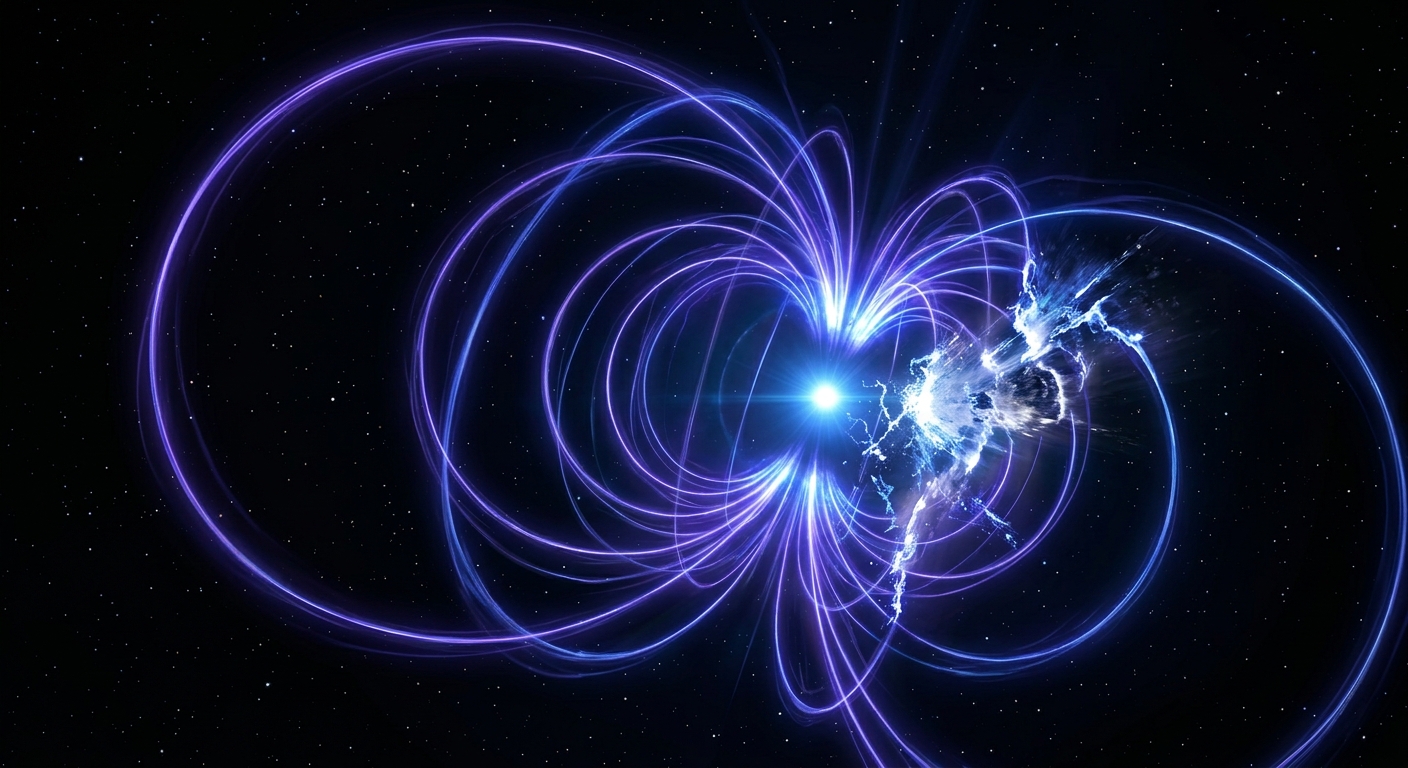
Start with the object. A neutron star is what a massive star leaves behind when its core collapses — roughly twenty kilometres across, heavier than the Sun, dense enough that a teaspoon of it would weigh about as much as a mountain range. Most of the ones we have found are pulsars: spinning, beaming radio waves, slowing down gradually as that rotation is converted into radiation. A magnetar is the same object with a magnetic field somewhere around 10^14 to 10^15 gauss — Earth’s is about half a gauss — and a completely different power source. It is not running on its spin. It is running on the decay of that field, which means the field is both the engine and the fuel, and it does not last. A magnetar is conspicuous for a couple of thousand years. A pulsar beams for tens of millions.
The counting error
That asymmetry is the whole story. Sixty years of radio surveys have been built to find steadily beaming pulsars, and they are extremely good at it. Magnetars announce themselves violently — a starquake cracks the crust and releases more energy in a fraction of a second than the Sun manages in a hundred thousand years — and then subside into something much harder to classify. So counting the catalogue tells you how long each kind of object stays findable with the instruments we happen to have built. It does not tell you how many get born.
Building the galaxy in a computer
Celsa Pardo-Araujo and Nanda Rea at the Institute of Space Sciences in Barcelona, with Michele Ronchi at ASTRON and Vanessa Graber at Royal Holloway, went at the problem the other way round. Their population synthesis assumes a distribution of magnetic fields and spins at birth and then evolves an entire simulated population forward — spin-down, magneto-thermal evolution as the field decays and the crust cools, and Galactic dynamics as the objects drift away from their birthplaces on the kicks their supernovae gave them. Run that simulated sky through the same detection filters the real surveys use, and ask which starting assumption reproduces what we actually observe.
The tightest anchor is the twenty-four isolated neutron stars known to be younger than two thousand years, because nothing in that group has had time to fade. Magnetars and central compact objects make up about 59% of it. Combine that with a volume-limited sample of the X-ray dim isolated neutron stars and the birth fraction for magnetars averages around half the entire population — 40 to 70% if the birth-field distribution peaks near 1 × 10^14 gauss, 30 to 50% if it peaks higher. As Pardo-Araujo puts it, the essential step is modelling the different classes of isolated neutron star in a unified way, with their possible evolutionary connections, rather than as separate species.
What breaks
Two things, and the first is arithmetic. If half of all neutron stars are magnetars and magnetars fade within a few thousand years, the galaxy has to be replenishing them faster than assumed. The paper derives a core-collapse supernova rate of about two per century — higher than the one-to-two figure that has been conventional, and arrived at from a direction that has nothing to do with counting supernovae.
The second reaches well beyond the Milky Way. Superluminous supernovae, the stubborn plateaus in gamma-ray burst afterglows, and fast radio bursts — the subject of Thursday’s episode, where 109 of them were used to weigh the ordinary matter of the universe — are all commonly explained by a newborn magnetar sitting in the wreckage and dumping magnetic energy into it. We know that is physically possible: in 2020 the galactic magnetar SGR 1935+2154 produced a fast radio burst. What the model lacked was supply. A central-engine explanation for a common class of extragalactic transient needs the engines to be common too. At half of all neutron stars, the budget works.
The honest caveats
This is a model tuned to reproduce observations, not a census; the headline figure depends on assuming a two-peaked distribution of birth fields. The anchor sample is twenty-four objects. And ‘magnetar’ here means a dipole field above about 10^13.5 gauss — a threshold chosen by physicists, not a boundary drawn by nature. Rea’s own suggested next step is the right one: test the result in an extragalactic context, which is where the transients are.
It is worth noting where this field began and where it still lives. On 5 March 1979 a wave of gamma rays saturated detectors on nine spacecraft at once, and was traced to the N49 supernova remnant in the Large Magellanic Cloud — SGR 0526−66, a southern-sky object in a southern-sky galaxy, and the event that eventually gave magnetars their name. Four decades later the Murchison Widefield Array in Western Australia, on the site that will host SKA-Low, turned up GLEAM-X J162759, switching on for a minute every eighteen minutes and defying every existing category. The paper that took it seriously as a possible ultra-long-period magnetar came out of the same Barcelona group, using the same magneto-thermal machinery behind this week’s result. A survey on Wajarri country finds something nobody can classify; a theory group in Spain builds the model; four years later the model tells us we have been miscounting the galaxy.