Half the Neutron Stars
In this episode
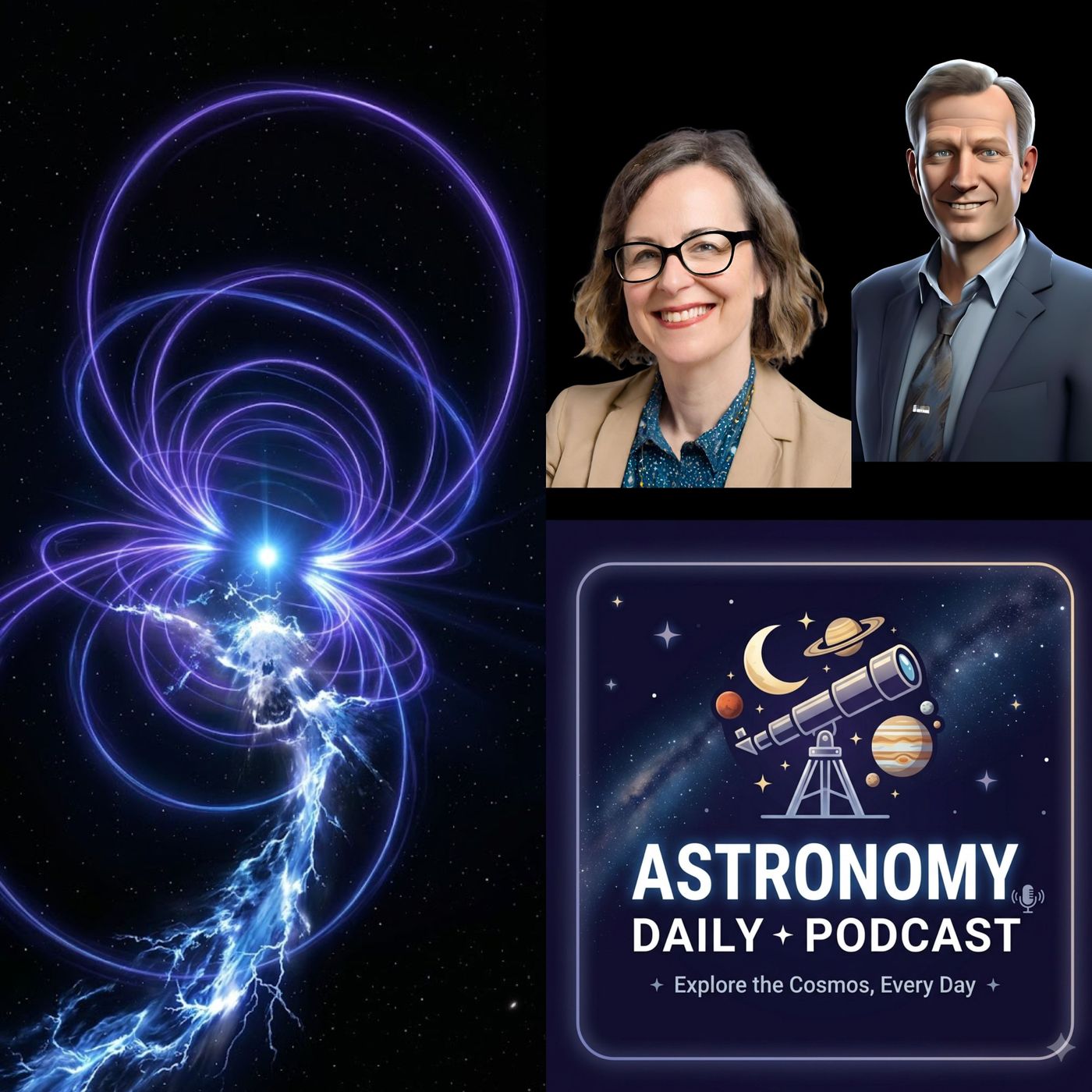
Today's episode — S05E191, Friday September 11, 2026: Main story: A population-synthesis study published in Nature Astronomy on 10 September argues that magnetars make up roughly half of all neutron stars, not the one-in-a-hundred implied by the catalogues. Celsa Pardo-Araujo and Nanda Rea (Institute of Space Sciences, ICE-CSIC, Barcelona) with Michele Ronchi (ASTRON) and Vanessa Graber (Royal Holloway) modelled the whole isolated-neutron-star population as one family rather than four separate classes, evolving spin-down, magneto-thermal decay and Galactic dynamics together, then filtering the simulated population the way real surveys filter the sky. Of the 24 known neutron stars younger than 2,000 years, magnetars and central compact objects are about 59%; the derived birth fraction averages ~50% (40–70% or 30–50% depending on the assumed birth-field distribution, which peaks at 1–2.5 × 10^14 gauss). Two consequences: the Galactic core-collapse supernova rate has to be higher than assumed, around two per century, and magnetar central-engine models for superluminous supernovae, gamma-ray burst plateaus and fast radio bursts finally have the supply to work. Caveats: it is a model rather than a census, the anchor sample is 24 objects, and 'magnetar' is defined by a field threshold. Southern thread: the field began with SGR 0526−66 in the Large Magellanic Cloud on 5 March 1979, and the same Barcelona group modelled GLEAM-X J162759, found with the Murchison Widefield Array in Western Australia. The rest of the news: · Chariklo's rings: The first stellar occultation ever planned specifically for JWST — 18 October 2022 — has been published in Science Advances, led by Yücel Kılıç, Pablo Santos-Sanz and Celia Navas (IAA-CSIC) with Nicolas Rambaux, Bruno Sicardy and Josselin Desmars (LTE) and Damya Souami (LIRA). Against the 2017 ground-based occultations, the inner ring C1R is about 50% more opaque and the outer ring C2R about 60% less, with the ring positions unchanged. Chariklo is the largest known centaur at ~125 km radius; the rings sit at 390 and 405 km and are a few km wide. Candidate explanations: material loss from C2R, material arriving at or collisions grinding down C1R — or a wavelength effect, since infrared is being compared with visible light. The rings were discovered in 2013 by an occultation campaign across Chile, Brazil, Argentina and Uruguay. · Mercury under bombardment: Kilpua et al. report in Nature Astronomy (8 September) that BepiColombo's fourth Mercury flyby in September 2024 — 165 km above the surface, closer than its eventual science orbit — coincided with a major solar particle eruption. The Finnish-built SIXS instrument watched energetic electrons and protons penetrate Mercury's magnetosphere and precipitate onto the surface over a wide area. That bombardment both sputters atoms off the surface and drives the X-ray fluorescence used to read its composition, and Mercury's small, weak magnetosphere makes it a stand-in for Earth during an extreme solar storm. The spacecraft separated its transfer module on 3 September; gravity capture is 21 November. · Europe buys a way home: ESA has awarded The Exploration Company a contract worth up to €760M under ALADDIN (Autonomous LEO Accelerated Demo Docking to ISS Node) — €310M for the demonstration mission, with ESA funding 60% and the company 40%, plus €450M in options for two further flights. The Nyx capsule flies on Ariane 6 and must dock with the ISS no later than Q2 2029, with up to €50M in additional incentive for using European launch vehicles. Europe has flown cargo up before, with the five ATVs, but has never returned anything from orbit. CEO Hélène Huby: 'It is the first time in Europe that a five-year-old space startup wins a contract worth hundreds of millions of euros.' The company's Mission Possible capsule survived reentry in June 2025 but was lost before splashdown — a partial success in its own words. Thales Alenia Space...Anna: Hello and welcome to Astronomy AstroDailyPod. It's Friday the 11th of, uh, September 2026. This is series five, episode 191. And I'm Anna. Avery: And I'm Avery. Anna. Today's lead is a paper arguing that one of the rarest, strangest objects in the galaxy isn't rare at all. Anna: Magnetars. Neutron stars with magnetic fields so strong the number stops meaning anything. And we know of about 30 of them against a few thousand ordinary radio pulsars. So the picture has always been exotic, freakish.
One in a hundred. A new paper in Nature Astronomy says that picture is a counting error and the real figure is closer to one in two. Avery: Half. Half of all neutron stars. Anna: Half. And if that's right, it doesn't just reshuffle a catalogue. It changes how many supernovae, uh, our galaxy has to be producing. And it quietly props up. The leading explanation for some of the most extreme events in the universe, including the fast radio bursts we spent yesterday's lead on. Avery: After that, the rings around a small icy body 2 billion kilometres away have changed.
One thickened, one thinned in the space of five years. And the James Webb Space Telescope caught it by watching the thing pass in front of a star. Anna: A spacecraft skimming 165 kilometres above Mercury at the exact moment the sun let go of a burst of particles and measuring them landing on the surface. Avery: Europe writing a 760 million euro cheque for something it has never once been able to do. Bring cargo home from orbit. Anna: And a quick one on Parker solar probe checking in from its 29th trip through the sun's atmosphere.
Avery: Plus the sky for both hemispheres. New Moon was this afternoon, so tonight is as dark as September gets. And there's a genuinely lovely pairing this weekend that the south gets the better view of. Let's get into it. Anna: Ready when you are. Avery: Start me at the beginning. What's a magnetar? Anna: Start one step further back. A neutron star. Take a star 8 to 20 something times the mass of the sun, magnifying, run it out of fuel and the core collapses in about a second. What's left is a ball roughly 20 kilometres across with more mass than the sun packed into it.
A teaspoon of the material weighs about as much as a mountain range. Avery: And they come in flavours, that's the part that matters. Anna: Today we've catalogued them as separate species, largely because of how we found them. There are radio pulsars, the lighthouse ones, thousands of them, spinning fast and beaming. There are central compact objects sitting quietly inside supernova remnants Doing almost nothing. There are X ray dim isolated neutron stars, which are exactly as boring as they sound.
And then there are magnetars, which are not boring. The opposite. A magnetar's magnetic field is somewhere around 10 to the 14, 10 to the 15 gauss. Earth's is about half a gauss. A hospital MRI about 15,000, so something like a quadrillion times Earth. And structurally, the key point is that a magnetar isn't powered by its spin the way a pulsar is. It's powered by that field decaying. The field is the fuel tank. Avery: What does that look like from the outside? Anna: Violence in short bursts. The crust is a rigid solid under enormous magnetic stress.
And every so often it cracks a starquake and the object releases more energy in a fraction of a second than the sun manages in a hundred thousand years. In 2004, one of them put out a flare that measurably ionised Earth's upper atmosphere from 50,000 light years away. Avery: And we know of about 30. Anna: About 30 confirmed against several thousand radio pulsars. Which is where the counting error creeps in, because those two numbers are not measuring the same thing. Avery: Explain that. Anna: A radio pulsar is a long lived, steady beacon.
It'll beam for tens of millions of years, and we've spent 60 years building surveys designed to catch exactly that. A magnetar is the opposite. Bright and obvious for a few thousand years, powered by a field that is actively destroying itself. And then it fades into something much harder to identify. So if you count what's in the catalogues, you're counting how long each type stays visible to the instruments we happen to have built, not how many get born. Avery: So how do you count births instead of sightings?
Anna: You build the galaxy in a computer. That's this work. Celsa Pardo Araujo and Nanda Rea at the Institute of Space Sciences in Barcelona with Michelle Ronke at ASTRON in the Netherlands and Vanessa Graeber at Royal Holloway in London. Published this week in Nature Astronomy. It's a population synthesis. Assume a distribution of magnetic fields and spins at birth, then evolve the whole simulated population forward. Avery: Evolve how? Anna: Three things at once, which is the technical advance.
The spindown, how the rotation bleeds away, the magnetothermal evolution, how the field decays and how the crust coolswhich are coupled to each other and. And the galactic dynamics. These things get kicked at birth by the supernova and drift away from where they were born, which changes how far off and how obscured they look. Then you run the simulated population through the same detection filters as the real surveys and ask which starting assumption produces the sky we actually see. Avery: And the anchor is what?
The full catalogue. Anna: The tightest anchor is the young end, and it's a small number. There are 24 known isolated neutron stars in our galaxy younger than 2000 years. That's the sample where nothing has had time to fade. So it's the fairest census we've got. And in that sample, magnetars and central compact objects together make up about 59%, Avery: nearly 6 in 10 of the young ones. Anna: They combine that with a volume limited sample of the x ray dim objects, and what comes out is a birth fraction for magnetars averaging around 50% of the entire neutron star population.
The range depends on what you assume about the field distribution at birth. If it peaks around one times 10 to the 14 gauss, you get 40 to 70%. If it peaks a bit higher, around two and a half times 10 to the 14, you get 30 to 50. Avery: So the headline number is about half with honest width on it. Anna: About half with width. And Pardo Araujo's own framing of why it took this long is worth quoting. She says it's essential to model the different types of isolated neutron star in a unified way, together with their possible evolutionary connections, because that's what lets you estimate consistently how many magnetars form.
In other words, the mistake was treating four catalogues as four species instead of one population seen at different stages. Avery: Right. So what breaks if this is true? Anna: Two things. And the first is a lovely piece of arithmetic. If half of all neutron stars are magnetars, and magnetars are only visible for a couple of thousand years, then to keep the observed population topped up, the galaxy has to be making neutron stars faster than we'd assumed. They derive a core collapse supernova rate of about 2 per century.
2.01 with a generous error bar running from about 1 to nearly 4. And the old number, the conventional figure, has sat at roughly one to two per century for a long time. And estimates have often drifted towards the low end. So this pushes the galaxy's supernova rate up from a completely independent direction. That's the part I like. It's not a supernova paper and it still lands on the supernova rate. And the second thing, the second is bigger, and it's about the rest of the universe. There's a family of extreme events nobody can fully explain.
Super luminous supernovae, ten to a hundred times brighter than a normal one. The long plateaus in gamma ray burst afterglows where something keeps injecting energy after the explosion should be over and fast. Avery: Radio bursts, which was yesterday's lead from Anna: the other end, a hundred and nine of them used to weigh the ordinary matter of the universe. And for all three, the leading explanation is the a newborn magnetar in the middle, dumping its magnetic energy into the debris. We know it's physically possible because in 2020, a magnetar in our own galaxy, SGR 1935, 2154, produced a fast radio burst and settled that question.
Avery: So what was missing was the supply. Anna: Exactly. The supply. A central engine model needs there to be enough engines. If magnetars were a 1% curiosity, then explaining a whole class of common extragalactic transients with them is a stretch. If they're half of all neutron stars, the budget works. The paper is explicit that this lends strong support to the models. It doesn't prove them, it makes them affordable. Avery: Caveats. Give me the honest ones. Anna: 3. First, this is a model, not a census.
Nobody counted 50 million magnetars. It's a simulation tuned to reproduce what we see. And if the assumed shape of the birth field distribution is wrong, the answer moves. The paper is up front that the 50% depends on assuming a 2 peaked field distribution at birth. Second, the anchor sample is 24 objects. 24. That's the tightest constraint they have. And it's also a very small number to hang a galaxy on. And third, magnetar here is defined by a threshold, a dipole field above about 10 to the 13.5 gauss.
And nature doesn't come with a threshold. Some objects sit right on the line. Avery: And where does the work go next? Anna: Ria's answer is the obvious one and also the right one tested outside our galaxy. A, uh, natural extension, she says, would be to cheque these results in an extragalactic context, which is exactly where the transients are. Avery: And there's a southern thread here, isn't there? Anna: There's a good one, and it's not decorative, it's foundational. The entire field of magnetars starts in the southern sky.
On 5 March 1979, a burst of gamma rays swept through the solar system so hard that it saturated instruments on nine separate spacecraft. And when it was traced back, it came from the N49 supernova remnant in the Large Magellanic Cloud, SGR 0526 66, a southern sky object in a southern sky satellite galaxy. That event is the reason the word magnetar exists at all. Avery: And the modern end? Anna: The modern end runs through Western Australia. In 2022, a survey with the Murchison Widefield Array at Inyarimanha Il Ghari Bundara, the same site that'll host Ska Lo turned up Gleam XJ16000 2759, an object switching on for a minute at a time every 18 minutes.
Far too slow for anything we thought could produce radio emission like that. And the follow up that took that Australian discovery seriously as a possible ultra long period magnetar was led out of the same Barcelona group using the same magnetothermal machinery behind today's result, same tools, same people. Southern data, which is how this actually works. A wide field radio survey on Guadari country finds something nobody can classify. A theory group in Spain builds the model that might explain it.
And four years later the model tells us we've been miscounting the whole population. Avery: Storey2 and it's small, distant and genuinely strange. Chariklo is a centaur, one of the icy bodies on unstable orbits between Jupiter and Neptune. In Chariklo's case, crossing between Saturn and uranus. It's about 250 kilometres across, so a radius of roughly 125, which makes it the largest centaur we know of. And in 2013, it became the first object smaller than a planet ever found to have rings. Anna: Found how?
You can't image something that small at that distance. Avery: You can't. You watch it pass in front of a star and time the shadow A, uh, stellar occultation. The star blinks out. You measure for exactly how long and from telescopes at different sites, you reconstruct the shape of whatever passed in front of. In 2013, a campaign strung across Chile, Brazil, Argentina and Uruguay caught Chariklo doing that. And the star didn't blink once. It blinked twice on the way in and twice on the way out. Rings, two of them sharp, narrow and a complete surprise.
At the time, rings were something planets had. They sit about 390 and 405 kilometres from the centre, one a few kilometres wide each. And they've been called Chariklos pocket rings ever since. Anna: And Webb has now looked. Avery: Webb looked on 18 October 2022, the first stellar occultation ever specifically planned for the telescope. The payoff is wavelength. Webb sees out to five microns in the infrared, which isn't available from the ground. And it resolved the rings to about a kilometre. Published this week in Science Advances, led by Yucel Kilitz, Pablo Santos Sanz and Celia Navis at the Institute of Astrophysics of Andalusia with Nicolas Rambo, Bruno Siccardi and Jocelyn Demars in Paris.
Anna: And what changed? Avery: Both rings in opposite directions. Compared with the ground based occultations of 2017, the inner ring is now about 50% more opaque. The outer ring, C2R, has gone the other way. Its opacity has dropped by around 60% and the positions haven't moved at all. The rings are where they were. It's the material in them that's different. Anna: In five years. Avery: In five years around an object that takes 63 years to go round the sun. That's the finding. These are not static structures you can photograph once and file away.
They're dynamically active on a timescale a human being can sit through. Anna: What would do that? Avery: Nobody knows yet, and the paper says so. The outer ring thinning could be straightforward material loss. The inner one thickening could be material arriving or collisions grinding larger particles into finer grains, which are more opaque per kilogramme. And the team adds a third possibility that isn't astrophysics at all. They're comparing infrared measurements with older visible light ones.
So some of the difference could be about what each wavelength is sensitive to, rather than the rings actually changing. Anna: So the result is a real change, a suspected cause and an unresolved confound. Avery: That's a fair summary. And it's why the next occultation matters more than this one. The southern hemisphere. Point here is that this whole technique is ours by geography and by habit. Chariklos rings were discovered from South American soil. Occultation chasing is a discipline where a well placed amateur telescope in rural Australia or New Zealand can contribute real data.
And the shadow tracks fall where they fall, which is often down here, storey three. Anna: And it's a piece of luck that turned into a result. BepiColombo, the joint European and Japanese mission to Mercury, which we've been following as it comes in to arrive, made its fourth flyby of the planet in September 2024 and it came in low, 165 kilometres above the surface, which is closer Avery: than it'll be when it's actually in Anna: orbit, closer than the science orbit, which is the point the team keeps making.
And at the exact moment it was down there, the sun let go of a major eruption of energetic particles. The lead author, Kilpua at the University of Helsinki, puts it plainly. The fourth flyby was unique. The spacecraft was much closer to the surface than it will ever be in its final orbit. And they were lucky that a major particle eruption happened on the sun at precisely that moment. Avery: So what did it see? Anna: It watched. The particles get through. High energy electrons and protons penetrated Mercury's magnetic field and precipitated onto the surface across a wide area.
The instrument is called sixis, the Solar Intensity X Ray and Particle Spectrometer, designed and built in Finland, and the work has just been published in Nature Astronomy. Avery: Why does it matter where particles land? Anna: Two reasons. And the first is practical. When energetic particles hit an airless surface, they knock atoms and molecules off it and they make the surface fluoresce in X rays. That fluorescence is exactly how you read the chemical composition of a planet you can't land on.
So if you want to map what Mercury is made of, you need to know what's bombarding it and where. This is calibration for the mission's own science. Avery: And the second? Anna: The second is that it's weathering over geological time. That bombardment is one of the things reworking the surface, along with the solar wind and micrometeorites. And there's a third payoff that reaches back here. Rami Vainio at the University of Turku, the CO investigator, makes the point that Mercury has a real magnetic field, but a small, weak magnetosphere, which makes it a natural stand in for what Earth looks like during an extreme solar solar storm.
Mercury is the experiment we can't run on ourselves. Avery: And where is the spacecraft now? Anna: In the middle of the most interesting stretch of its life, it separated its transfer module, the big electric propulsion stack that's been doing the work for eight years. On the 3rd of September, eight days ago, gravity capture at Mercury is on the 21st of November. The Japanese orbiter gets released around the 9th or 10th of December. And the European orbiter reaches its final science orbit in March, with routine science from April.
So this flyby result is arriving as a kind of advanced sample of what the mission is about to start doing properly. Avery: And it's money rather than physics, but it's the kind of money that changes what's possible. Yesterday, the European Space Agency awarded a contract worth up to 760 million euros to a German startup called the Exploration Company to build a spacecraft that can carry cargo to the International Space Station. And this is the part Europe has never done. Bring it back. Anna: Never.
Europe flew cargo to the station for years. Avery: Flew it up, yes. The ATVs, five of them, big and successful. Every one of them was then deliberately destroyed on the way down. Europe has never returned anything from orbit to the ground. That capability belongs to the United States, Russia and China. And it's the difference between shipping and shipping, both ways. Experiments, you can actually get back, Hardware you can inspect, samples that survive. Anna: What's the shape of the deal? Avery: It runs under a programme ESA calls Aladdin.
And the structure is 310 million euros for the demonstration mission, with ESA covering 60% of that and the company funding the other 40, plus 450 million in options for two further missions. The vehicle is called Nix. It flies on Ariane 6 and it has to dock with the space station no later than the second quarter of 2029. There's also up to 50 million euros in additional incentive for flying on European launch vehicles, which tells you what else this contract is really for. Anna: And the company is how old?
Avery: Founded in 2021. Their chief executive, Ellen Huby, is quite direct about how unusual that is. She says it's the first time in Europe that a five year old space startup has won a contract worth hundreds of millions of euros. ESA's Daniel Neuenschwander frames it as getting Europe one step closer to a capability only a handful of nations have mastered. And it's worth noting ESA hasn't closed the door on the alternative. Thales Alenius Space in Italy is still in a parallel tender. Anna: Has the company flown anything?
Avery: It has. And this is the honest caveat. In June 2025, they flew a small reentry capsule called Mission Possible. As a rideshare, it launched, it operated in orbit, it survived reentry and then contact was lost shortly before splashdown and the capsule was not recovered. The company called it a partial success, which is fair in both directions. So the jump from that to docking with the space station and returning intact is a very large one on a fixed timeline. Anna: And the strategic read? Avery: It's the same thread we were pulling on six days ago.
With Isar Aerospace reaching orbit from Norway within one fortnight, Europe has launched to orbit from its own soil for the first time and bought itself a route home. The target isn't really the space station either. The ISS has a handful of years left. It's whatever commercial stations replace it. And who gets to service them? Anna: One quick one before the sky. NASA's Parker Solar Probe has reported in after its 29th close approach to the sun, which it made on 4 September. Still holding the record, still holding it.
And that's now the eighth time it has 430,000 miles an hour, about 690,000 kilometres an hour, and 3.8 million miles from the surface, which are exactly the numbers it set on Christmas Eve 2024. It's not going faster or closer. It's repeating the same extraordinary pass over and over, which is the whole design. Avery: And it goes silent while it does it completely. Anna: The encounter ran from the 30th of August to the 9th of September, and for nine days of that it's on its own with no contact too close to the sun to talk.
It sent a beacon tone on the seventh to say it was healthy. This particular pass was aimed at the north pole of the sun, looking at structures and activity up there, and in one day it sweeps through nearly 40% of the solar circumference. Avery: When do we see anything? Anna: Telemetry started flowing today and the science data comes down between the 13th and the 27th. And the mission itself has been extended through 2029 and after this year's Heliophysics review. So there's plenty more of this to Avery: come and to the sky.
And this is a good weekend for a simple reason. New Moon fell this afternoon, Sydney time at 27 minutes past 2. Which means tonight and tomorrow night are the darkest of the month. And the moon comes back as a thin evening crescent just in time to do something pretty. Anna: Southern hemisphere first. Avery: From Sydney and similar latitudes, Venus is the evening object and it wants dealing with promptly. Low in the west after sunset and setting quickly. So the window is the first 45 minutes once the sky darkens.
Worth the trouble because it's building towards greatest Brilliancy on the 18th at magnitude -4.8, about as bright as Venus ever gets. Anna: And the pairing you mentioned, Sunday and Avery: Monday evening, the 13th and 14th, a very thin waxing crescent sweeps past Venus and on the 14th they're about half a degree apart. That's a moon width. Spica is right there too. So there's a third point in the picture and this one is genuinely ours. Earth Sky's own note is that the southern hemisphere gets the better view.
Find a clear low western horizon and look as soon as the sky starts to colour. Anna: Saturn. Avery: Saturn is the reliable one for everybody. Rising in the east not long after sunset, well up by mid evening, heading for opposition on the 4th of October. With the rings about 7 degrees open and with no moon in the sky, the core of the Milky Way is still high after dark down here. Sagittarius and Scorpius overhead in the early evening. The best naked eye view in the sky and ours for a few more weeks.
Anna: There's one more southern thing, and it's subtle. Avery: The zodiacal light sunlight scattered off dust in the plane of the solar system, looking like a faint pyramid leaning up from the horizon. It's an equinox phenomenon. And right now in the southern hemisphere it's an evening object. Look west after true darkness and it's often called the false dusk. You need a properly dark sight and no moon, which is precisely what this week gives you. It runs through to early November North Anna: America your turn and you get the same thing at the other end of Avery: the night you do for the northern hemisphere in September the zodiacal light is a pre dawn object.
Look east in the couple of hours before sunrise and it's called the false dawn for the obvious reason. Around the 15th is well flagged. Same dust, same geometry, opposite end of Anna: the night and the planets from the north. Avery: The morning sky is where your action is. Jupiter dominates the pre dawn east and is closing on Regulus with Mars nearby high in the east near Castor and Pollux shortly before sunrise. Saturn is your evening and overnight object too. Around 50 degrees up in the south after midnight.
The best it's looked all year. And for telescope owners there's a nice Saturn event early Saturday morning. Dione transits the north polar region around 2:55am M Eastern and Tethys slides into Saturn's shadow around 2:10. Space weather quieter than it was. The convoy of coronal mass ejections From Active Region 4524 produced a couple of minor G1 storms on the 8th and 9th and conditions have eased back to quiet to unsettled as those effects fade. No storm watch running. If more arrives it'll be the northern tier of the United States.
The UK and northern Europe first and Tasmania and the south island of New Zealand down here. Anna: Safety passage. Avery: Yes, and it's in every episode for a reason. Venus at minus 4.8 is bright enough to find in broad daylight, which is a real and rewarding thing to do. And it is also the one hobby that puts you in the habit of sweeping the sky near the sun. So never point binoculars or a telescope anywhere near the sun without a purpose built properly fitted solar filter over the front of the instrument.
Eclipse glasses must be certified to ISO 123122 and even certify. Glasses are for naked eye use only. They are not a filter for optics. Putting a telescope behind them concentrates the light and they fail instantly. Anna: And looking ahead, the equinox on the Avery: 22nd, spring for us, autumn for the north. The harvest moon sits near Saturn in the Evening sky on the 26th. Then Saturn's opposition on the 4th of October and two nights later on the 6th, Saturn. The pre dawn lunar occultation of Jupiter which is being billed as the spectacular event of the year.
We'll be building up to that one properly. Anna: That's Astronomy daily for Friday, 11 September Magnetars may be half of all the neutron stars in the galaxy rather than one in a hundred, which raises the supernova rate and makes the magnetar engine explanation for fast radio bursts and super luminous supernovae affordable. For the first time. Chariklo's two tiny rings have changed in opposite directions in five years. BepiColombo caught the sun bombarding mercury from 165 kilometres up. Avery: Europe has bought itself a way home from orbit for the first time.
Parker solar probe has checked in from its 29th pass through the sun's atmosphere and there's a moon and Venus pairing this weekend that the southern half of the world gets the better seat for. Anna: Everything we covered with links to the papers and the source releases is in the show notes and at astronomydaily IO, where you'll also find the full back catalogue and the newsletter. Avery: And the contact form on the site is real and we read it more than one storey in the past fortnight. Started as a listener question.
You'll find us on X at astrodaily. Pod Astronomy AstroDailyPod is part of the bytes.com podcast network. Anna: I'm Anna. Avery: And I'm Avery. Clear skies and if you can get away from the lights tonight, do it doesn't get darker than this.
 Apple Podcasts
 Spotify
 Pocket Casts
 Castbox
 Overcast
 Podbean
 iHeartRadio
 Castro
 Goodpods
 Moon FM
 Podcast Addict
 Podcast Republic
 YouTube