Europe Launches From Europe: Sixty-Nine Years Late, and Worth the Wait
Astronomy Daily · S05E187 companion post · Monday, 7 September 2026 · astronomydaily.io
Here is a fact that sounds like a mistake until you check it. In the entire history of the space age, no vehicle had ever reached orbit from Western European soil. Not one. Europe has been a first-rank space power for half a century — Ariane, Rosetta, Gaia, Huygens touching down on Titan — and every one of those missions left the ground from Kourou, in French Guiana, on the north-east coast of South America.
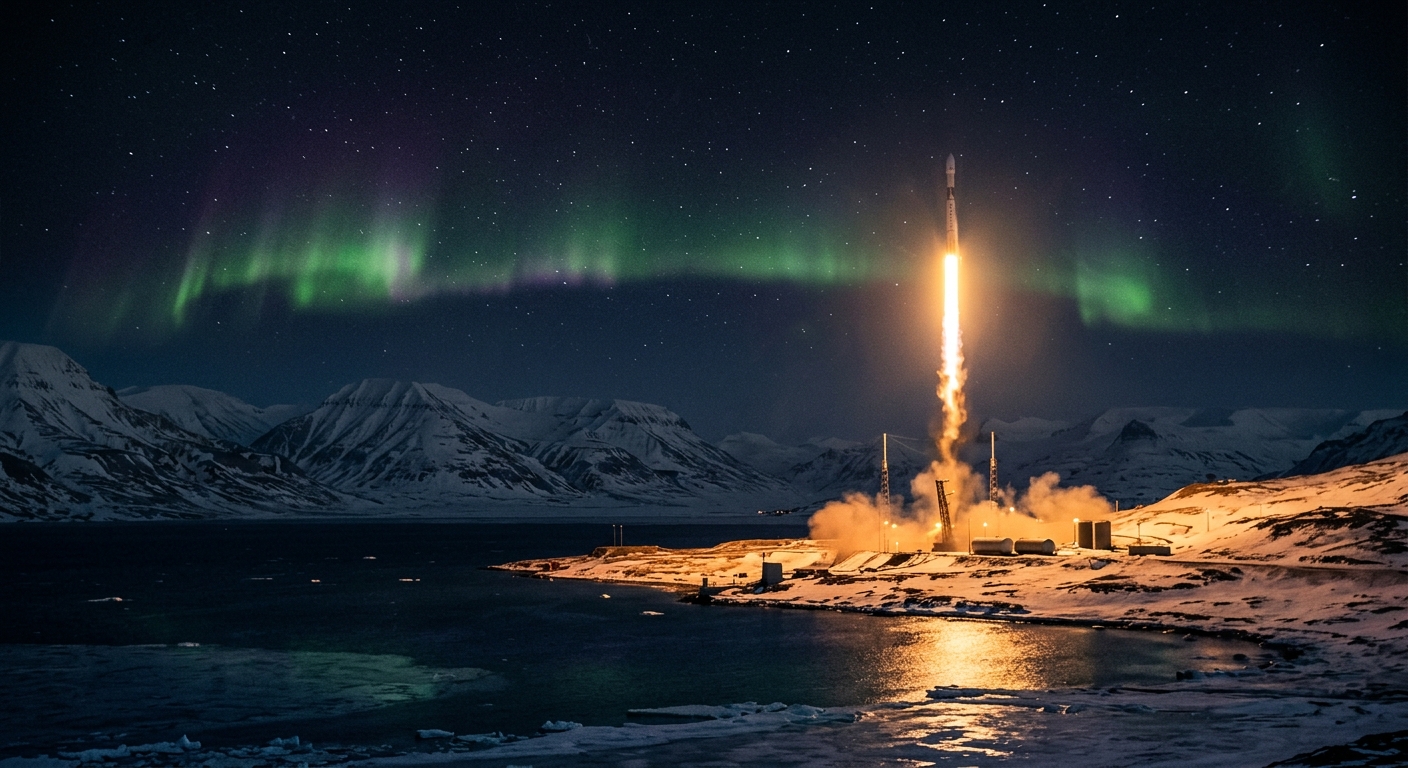
On Friday 5 September, at 22:12 central European time, that finally changed. A 28-metre rocket called Spectrum lifted off from Andøya Spaceport — an island roughly 300 kilometres inside the Arctic Circle in northern Norway — and delivered six payloads to orbit. It was built by Isar Aerospace, a German company spun out of the Technical University of Munich in 2018.
The rocket is modest by the standards of the headlines it earned. Two stages, nine Aquila engines on the first and one vacuum-optimised Aquila on the second, all built in-house, lifting about 700 kilograms to sun-synchronous orbit from Andøya. That is small-launcher territory — nowhere near Ariane 6, which lifts twenty tonnes. The genuinely unusual part is the propellant: liquid oxygen and propane, a combination almost nobody else has committed to.
This was Spectrum’s second flight. The first, on 30 March 2025 from the same pad, lasted about thirty seconds before a vent valve opened during pitch-over and the vehicle lost attitude control. Eighteen months of software changes and margin work followed, along with a run of scrubs this year; there were people writing the company off as recently as last week. Friday’s flight was clean — nine engines lit, stage separation, fairing away, and a second stage that reached an elliptical orbit of roughly 180 by 500 kilometres before restarting and circularising. That restart deserves a moment: many small launchers need a separate kick stage to do it, and Isar built the capability into the upper stage itself.
The manifest was six payloads: five cubesats from TU Berlin, NTNU in Norway, the University of Maribor in Slovenia, TU Wien in Austria and the Bulgarian company EnduroSat, plus a fixed experiment from the German firm Dcubed. They are testing radiation-tolerant perovskite solar cells and how batteries behave after being hibernated in orbit. It is an unglamorous manifest, and that is exactly why it matters. These are the payloads that spend years queueing for a rideshare slot on someone else’s rocket, on someone else’s schedule, to someone else’s orbit.
Which explains why ESA sent cameras. Between 2022 and 2024 Europe found itself in a strange position: access to Russian Soyuz rockets ended abruptly, Ariane 5 retired before Ariane 6 was ready, and Vega C was grounded after a failure. For two or three years a continent that builds some of the finest spacecraft in the world had to buy rides from SpaceX to launch its own science missions. The response was not to build one bigger rocket but to stop having a single point of failure — which is the logic behind ESA’s launcher competition, and the reason a German start-up flying from a Norwegian island gets treated as strategic infrastructure. Isar has raised well over half a billion euros against that thesis and its Munich factory is built for more than thirty vehicles a year, with vehicles three through seven already in production.
That number is also the caveat. One successful flight is one successful flight, and cadence is where small launch companies historically come unstuck. Norway, meanwhile, has gone from operating a sounding-rocket range to hosting the only orbital launch site on the European side of the Atlantic, with two more pads planned.
And there is a Southern Hemisphere version of this story that deserves more attention than it gets. In July 2025, Gilmour Space launched Eris — Australia’s first home-built orbital rocket — from the Bowen Orbital Spaceport in Queensland. It flew for fourteen seconds. Speaking at the International Astronautical Congress in Sydney a few months later, CEO Adam Gilmour noted that companies typically need about three attempts to reach orbit, and said plainly that they were not going to give up.
Isar’s first flight lasted thirty seconds. Its second reached orbit. That proves nothing whatsoever about Eris — rockets do not work by analogy, and every vehicle fails in its own way. But it is a reasonably encouraging map of the road out of a very short first flight, and the underlying argument is identical at both ends of the planet: a country that can build satellites but cannot launch them is a customer, not a space power. Norway has just stopped being only a customer. Queensland is still trying.
You can hear the full story, along with the week’s other news — why the gaps in stellar streams may not be dark matter after all, a white dwarf pair orbiting every 374 seconds in the southern sky, and peptides that fold happily in concentrated sulfuric acid — in today’s episode of Astronomy Daily.
Sources
• Isar Aerospace — Mission updates: https://isaraerospace.com/mission-updates-overview
• ESA — Spectrum launches to orbit: https://www.esa.int/ESA_Multimedia/Images/2026/09/Spectrum_launches_to_orbit
• NASASpaceflight — Isar Aerospace ‘Onward and Upward’: https://www.nasaspaceflight.com/2026/09/isar-onward-and-upward/
• Space.com — Private German rocket makes history: https://www.space.com/space-exploration/launches-spacecraft/isar-aerospace-second-launch-norway-andoya-spaceport-spectrum-rocket
• Space.com — Australia’s Gilmour Space eyes a second orbital launch attempt: https://www.space.com/space-exploration/launches-spacecraft/australias-gilmour-space-not-going-to-give-up-as-it-eyes-2nd-orbital-launch-attempt-in-2026