Eclipse Eve: The Sky’s Two-Part Show
Related Episode
Eclipse Eve: Totality Returns to EuropeEvery so often the sky arranges a moment worth rearranging your evening for. Tomorrow — 12 August 2026 — is one of them. In fact it’s two, about twelve hours apart, and they share a single cause: a New Moon.
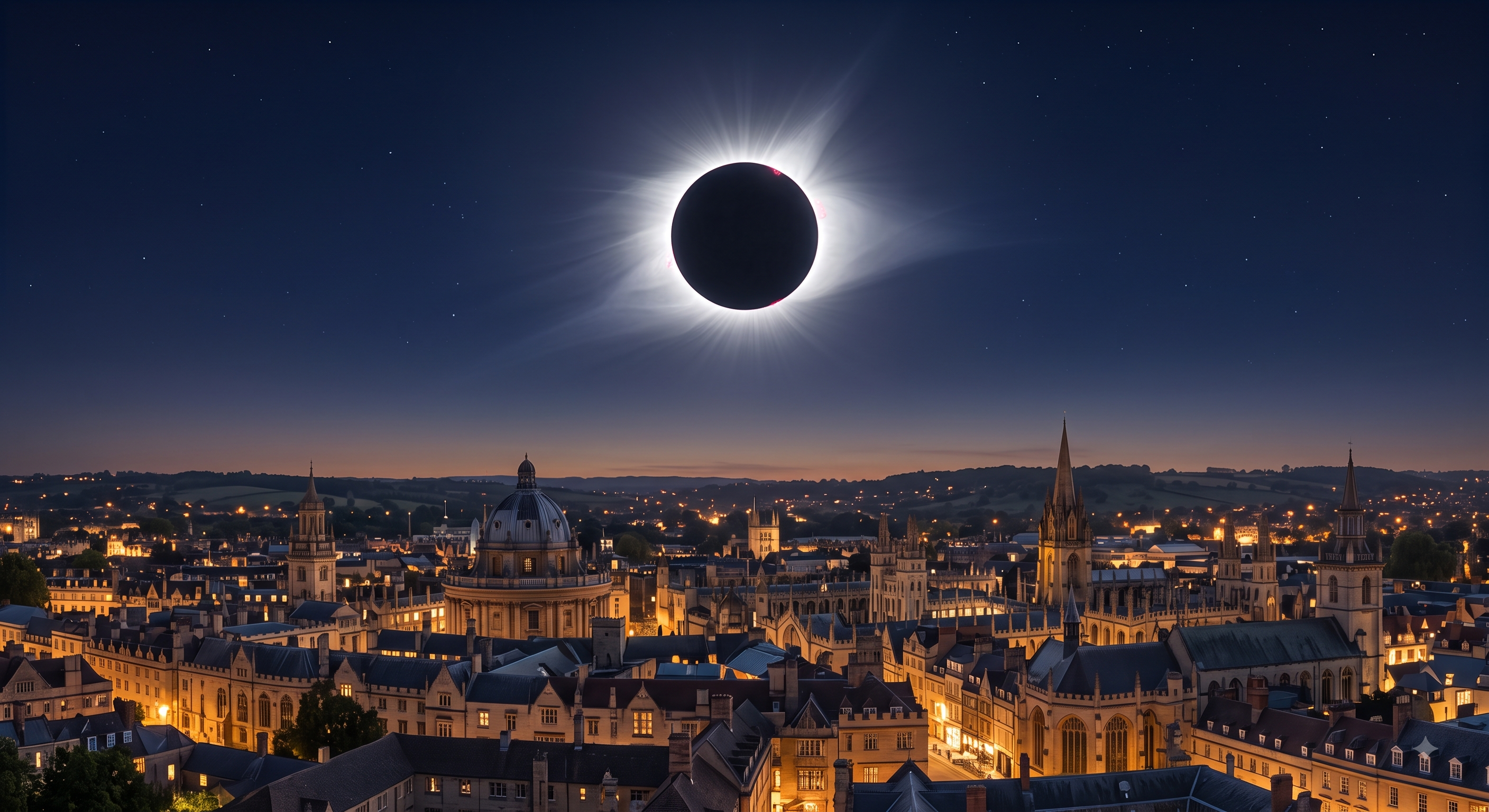
First, by day, comes the headline act: a total solar eclipse. It’s the only one anywhere on Earth this year, and the first to touch mainland Europe since 1999 — a gap of twenty-seven years. What makes it stranger still is its path. Most total eclipses sweep roughly west-to-east across the middle of the planet. This one goes over the top of the world. The Moon’s shadow first lands in the far north of Siberia, arcs up across the North Pole, then drops onto eastern Greenland, crosses the west coast of Iceland — Reykjavík included — and finishes over northern Spain and the north-western tip of Portugal.
Totality is brief — at most about two minutes and eighteen seconds on the centreline — but the staging is unforgettable. By the time the shadow reaches Spain, the eclipsed Sun sits low in the west, close to the horizon in the last light before sunset. A corona flaring out over a Spanish skyline at dusk is the image thousands of eclipse-chasers have planned years around, and tonight most of them are converging on Spain and Iceland, watching the forecasts.
Be clear about who sees what. Totality belongs to that narrow northern path. A far wider region — much of North America, especially eastern Canada and the north-eastern United States — gets a partial eclipse, low and near sunset. The Southern Hemisphere, including all of Australia, sees none of it. All told, on the order of a billion people fall under at least a partial shadow: one event, a billion possible witnesses.
Those few minutes of totality aren’t only a spectacle; they’re rare working time for solar physicists, one of the only chances to study the Sun’s faint corona directly from the ground. Observatories along the track are ready, and the European Space Agency will livestream from the Javalambre Observatory in Spain, blending telescope feeds and drone footage so anyone, anywhere, can watch.
One rule matters more than any other: a partial eclipse is never safe to view with the naked eye. Use certified eclipse glasses meeting the ISO 12312-2 standard, or watch by indirect projection such as a pinhole. Ordinary sunglasses and phone cameras will not protect your eyes. The only moment direct viewing is ever safe is during true totality — and that happens only inside the path.
Then, after dark, the second act. Because a total eclipse can only happen at New Moon, that same night the sky is completely moonless — and the Perseid meteor shower reaches its annual peak in the darkest conditions it has enjoyed in roughly twenty years. The Perseids are debris from comet 109P/Swift-Tuttle, and Earth sweeps through its dust trail each August. Forecasters are measured about the numbers this year — perhaps thirty to fifty meteors an hour from a genuinely dark site rather than the textbook hundred — but there’s a slim chance Earth clips an older dust trail near the peak for a short bonus burst. No guarantees; just the kind of maybe that gets people out of bed.
For the Northern Hemisphere it’s a rare double-header: eclipse by day, meteors by night, best from about 2 a.m. until dawn. For the Southern Hemisphere the honest advice is different. You can’t see the eclipse, and the Perseids barely clear our northern horizon — so don’t chase them from Sydney. Look instead to the pre-dawn eastern sky, where a line-up of planets is beautifully placed for us, to brilliant Venus low in the west after sunset, and — with binoculars — to Comet 10P/Tempel 2 drifting through southern skies.
Meanwhile, off the sky, it was a big day on the pads: a Chinese Long March 7A was lost in a fireball shortly after launch, a private Zhuque-3 booster-landing attempt hung in the balance, and Japan quietly brought its own navigation constellation up to full strength. But tomorrow, the sky is the story. Glasses on for the Sun; eyes up for the meteors. Clear skies.