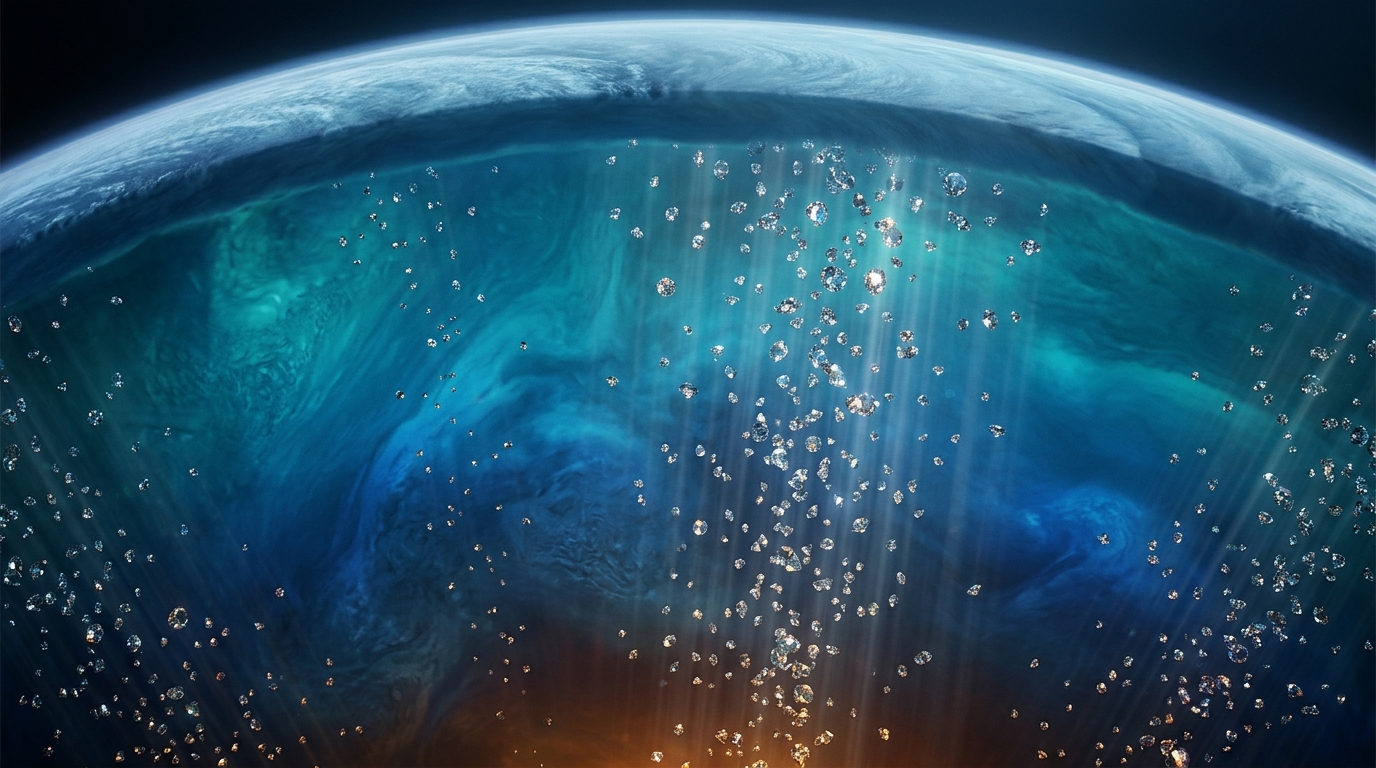
Diamond Rain, Decoded: Twenty Years of Disagreement, Solved
Related Episode
Diamond Rain, Decoded: Twenty Years of Disagreement, SolvedIn this episode of Astronomy Daily: a lab recreation of Neptune’s crushing interior solves a 20-year diamond mystery, the Roman Space Telescope’s strange spy-satellite past, a confirmed NOAA storm watch, an AI that sees solar storms coming early, SpaceX’s $100 billion Louisiana spaceport, and tonight’s lunar eclipse. Episode: S05E178
Diamond Rain, Decoded: Twenty Years of Disagreement, Solved
It’s a big one today — Anna and Avery are running an extended episode to cover six genuinely distinct stories, from a lab experiment that recreated the inside of an ice giant planet to a space telescope with one of the strangest hardware origin stories in modern astronomy. Here’s the full rundown, with links to everything referenced.
Solving a 20-year argument about diamond, inside a lab
Physicists at Lawrence Livermore National Laboratory, led by Marius Millot, have resolved a two-decade disagreement over exactly what temperature diamond melts at under extreme pressure — a question that matters far beyond curiosity, because it turns out to sit at the intersection of planetary science and fusion energy research.
Using the Omega Laser Facility at the University of Rochester’s Laboratory for Laser Energetics, the team fired intense lasers at tiny diamond samples, vaporizing their outer layer and driving a shockwave through the rest. In about a billionth of a second, that shockwave crushed each sample to roughly 1 terapascal of pressure — about three times the pressure at Earth’s core, and higher than conditions found deep inside Neptune or Uranus — while flash-heating it to temperatures hotter than the surface of the Sun.
Neptune and Uranus are known as “ice giants” because beneath their cloud tops, they’re believed to hold deep mantles of compressed water, methane and ammonia under conditions extreme enough to scramble ordinary chemistry. A landmark 2017 LLNL-led experiment first demonstrated that carbon squeezed under these conditions crystallizes into nanodiamonds — the original “diamond rain” finding, with diamonds potentially falling through these planets’ interiors for billions of years and building up in thick layers around their rocky cores.
What this new study adds is far more precise: the actual melting temperature of diamond itself at these pressures. For roughly twenty years, laboratory measurements and quantum-mechanical simulations disagreed by close to 1,000 degrees, and nobody could say with confidence which was correct. Using sharper X-ray diffraction diagnostics than earlier experiments had available, Millot’s team found the real answer matches the quantum simulations almost exactly — and discovered that diamond holds its normal crystal structure right up until the instant it melts, with no intermediate phase, the way some models had predicted. They also confirmed something almost poetic: just as ice floats on liquid water, solid diamond floats in liquid carbon under these conditions.
The practical payoff is in fusion energy. Facilities like the National Ignition Facility use inertial confinement fusion, compressing small fuel capsules — often built with diamond shells — with powerful lasers until the fuel inside fuses. Get the compression shock wrong, even slightly, and you introduce instabilities that waste energy or ruin the implosion entirely. Knowing diamond’s precise melting point lets researchers use a gentler, slower initial shock while still guaranteeing the shell melts completely at exactly the right moment — a change models suggest could roughly triple the energy gain from these fusion implosions, without needing bigger or more expensive lasers. The findings, published in Nature Physics, are being described by the team as “atomic-scale benchmarks” for future simulations of extreme matter, from planetary interiors to fusion capsules.
From spy satellite to space telescope: Roman’s strange road to Sunday
With NASA’s Nancy Grace Roman Space Telescope just three days from its Sunday, August 30 launch (7:26 a.m. Eastern, aboard a SpaceX Falcon Heavy), we wanted to tell a different story about it than the launch-readiness update — because its hardware has one of the more unlikely backstories in modern astronomy.
Back in 1999, the National Reconnaissance Office — the US intelligence agency responsible for spy satellites — launched a program called Future Imagery Architecture, contracting Boeing to build next-generation optical and radar reconnaissance satellites. The program expanded after 9/11 amid heightened national security spending, but collapsed in 2005 under billions of dollars in cost overruns, described at the time by the New York Times as “perhaps the most spectacular and expensive failure in the 50-year history of American spy satellite projects.”
The hardware sat unused for years, until the National Academy of Sciences’ 2010 decadal survey named what would become Roman as astronomy’s top priority for the coming decade. NASA announced plans in 2011 to repurpose leftover NRO hardware, and in 2012 the NRO formally donated two complete, unused telescopes — each with an optical assembly roughly comparable to Hubble’s, and valued at around $250 million — to the space agency.
It wasn’t a simple handoff: all the electronics had to be replaced, and large portions of the original technical documentation remained classified, forcing Roman’s engineers to reverse-engineer parts of a system built by an entirely different team for an entirely different purpose. Experts still disagree on whether repurposing the hardware genuinely saved money once all that rework is accounted for. NASA still holds the second donated telescope, with no announced plans for its use. As of this week, the encapsulated Roman observatory has moved into SpaceX’s hangar at Launch Complex 39A and is being mated to its Falcon Heavy, with a Launch Readiness Review scheduled for Friday, August 28.
The rest of the news
NOAA’s Space Weather Prediction Center has issued an official G2 (moderate) geomagnetic storm watch for Friday, August 28, following Tuesday’s M6.9 solar flare from sunspot region 4513 — a firm escalation from earlier hedged forecasts. A coronal hole high-speed solar wind stream arrives first, starting tonight, with the CME’s effects layering in on top of it Friday. Aurora chances improve for northern-tier US states, the UK and similar latitudes; minor storming isn’t expected to reach much past Tasmania in the Southern Hemisphere.
Fittingly, researchers at the New Jersey Institute of Technology have built a Transformer-based AI model, nicknamed EarlyDetect, that can spot the hidden precursor signals of a solar active region forming roughly 9.24 hours before it’s even visible on the Sun’s surface — trained on acoustic and magnetic field data from NASA’s Solar Dynamics Observatory. It’s not ready for real-time forecasting yet, but it points toward pushing space-weather warning windows back even further than today’s CME-tracking approach allows.
SpaceX and Louisiana Governor Jeff Landry this week announced Starbase Louisiana, a planned $100 billion second Starbase on the Gulf Coast in Vermilion Parish — five launch complexes, ten pads total, with onsite propellant production and deep-water shipping access. Construction is targeted to start in 2027, with a first launch aimed at 2029, built for the kind of launch cadence Elon Musk has floated for Starship’s future — more than 30 flights a day by 2030.
Tonight’s Sky
A deep, 96%-partial lunar eclipse unfolds tonight into tomorrow morning, with the partial phase beginning at 2:34 UTC, maximum eclipse at 4:13 UTC, and the partial phase ending at 5:52 UTC — all August 28 by universal time. That’s 10:34 p.m. through 1:52 a.m. Eastern for US listeners, with peak coverage just after midnight. It’s a good show across the Americas, and low on the horizon for parts of Europe and Africa — but Australia and the rest of Asia-Pacific will be in broad daylight when it happens, around 2:13 p.m. in Sydney. No filters or eclipse glasses needed to watch it, unlike a solar eclipse — just clear skies and a view of the Moon. Locally, Venus remains the easy target low in the west after sunset, with Saturn well placed rising in the east after dark.
Follow us: @AstroDailyPod