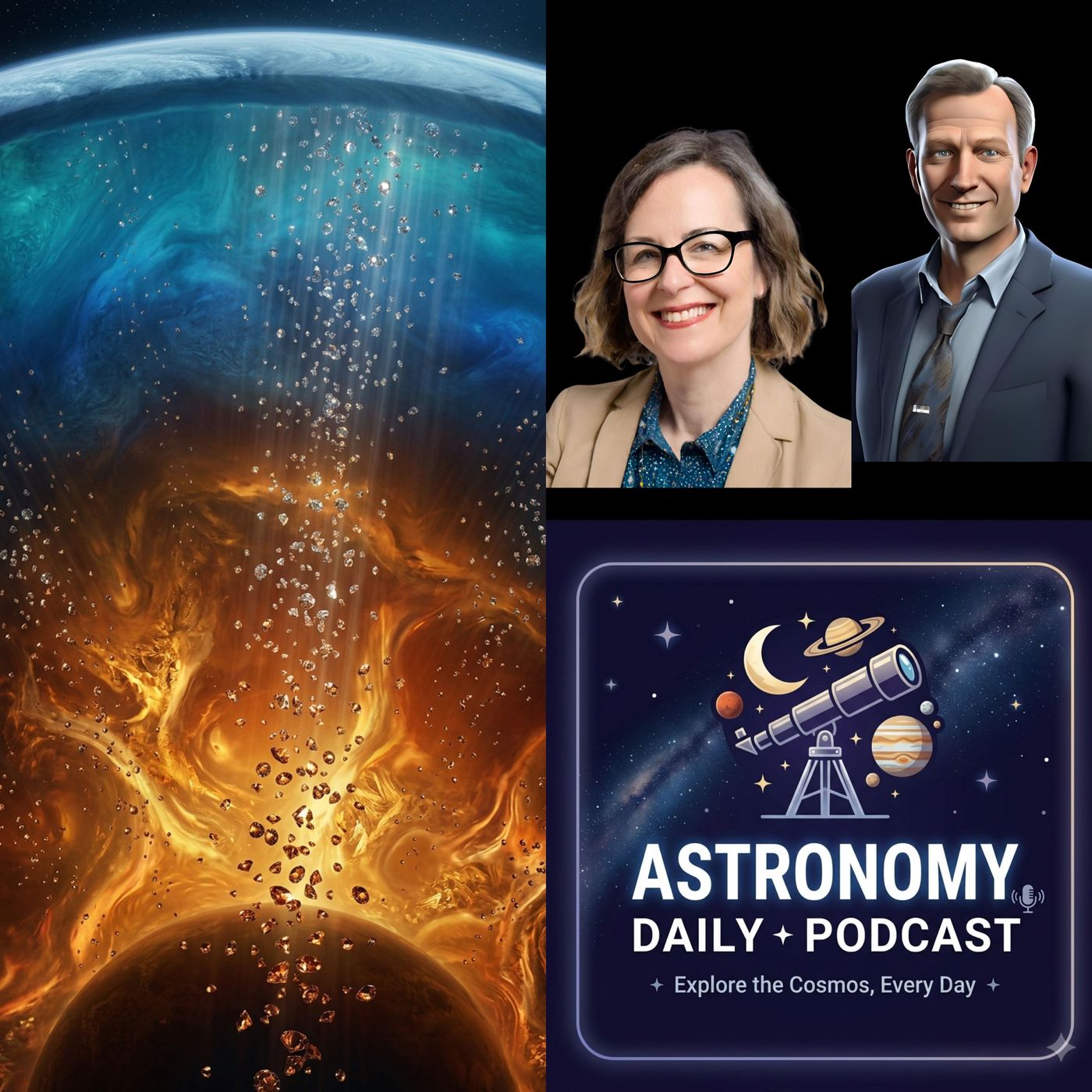
Diamond Rain, Decoded: Twenty Years of Disagreement, Solved
In this episode
Today's episode — S05E178, Thursday August 27, 2026:Feature story: Physicists at Lawrence Livermore National Laboratory, led by Marius Millot, used the Omega Laser Facility at the University of Rochester to shock-compress diamond samples to about 1 terapascal — roughly three times Earth's core pressure — and temperatures hotter than the Sun's surface, recreating conditions found deep inside Neptune and Uranus. The results resolve a 20-year, ~1,000-degree disagreement between lab measurements and quantum simulations over diamond's actual melting point, confirming the simulations were right. The team also found diamond stays in its normal crystal structure right up until it melts — no intermediate phase — and confirmed solid diamond floats in liquid carbon, the same basic physics as ice floating on water. Published in Nature Physics, the corrected melting-point data could help triple energy gain in inertial confinement fusion reactors by allowing gentler, more efficient laser compression of diamond-shelled fuel capsules.
The rest of the news:
- Roman Space Telescope's strange origin: three days out from its Sunday, August 30 launch (7:26am ET, Falcon Heavy), we trace how Roman's core optics began life inside the National Reconnaissance Office's canceled "Future Imagery Architecture" spy-satellite program, donated to NASA in 2012 after the program's spectacular 2005 collapse. The telescope is currently being mated to its Falcon Heavy at LC-39A, with a Launch Readiness Review Friday, August 28.
- NOAA storm watch: the Space Weather Prediction Center has issued an official G2 (moderate) geomagnetic storm watch for Friday, August 28, following Tuesday's M6.9 solar flare — aurora chances improve for northern-tier US states, the UK and similar latitudes; minor storming isn't expected to reach much past Tasmania locally.
- AI solar storm detection: NJIT researchers have built a Transformer-based AI model, EarlyDetect, that spots hidden precursor signals of solar active regions forming roughly 9.24 hours before they're visible — not yet ready for real-time forecasting, but a promising extension of the warning window.
- SpaceX Starbase Louisiana: a $100 billion, five-complex, ten-pad second Starbase announced for Vermilion Parish, Louisiana, alongside Governor Jeff Landry — construction targeted for 2027, first launch aimed at 2029.
- Tonight's Sky: a 96%-partial lunar eclipse peaks at 4:13 UTC / 12:13am ET August 28 — spectacular from the Americas, broad daylight in Sydney (~2:13pm AEST). Venus and Saturn remain the reliable local targets.
Links & sources:
- ScienceDaily — Scientists crushed diamond beyond Neptune-like pressures — and solved a 20-year mystery
- Gizmodo — Scientists Recreate the Melting "Diamond Rain" of Neptune and Uranus. It May Help Fusion Power
- Space.com — From spy satellite to space telescope: the unlikely origins of NASA's Roman Space Telescope
- Space.com — Nancy Grace Roman Telescope live updates: NASA readies Roman for launch
- Watchers.news — M6.9 solar flare produces Earth-directed CME, G2 geomagnetic storm watch issued for August 28
- Universe Today — AI Spots Hidden Solar Storm Signs 9 Hours Early
- EurekAlert / NJIT — New AI model detects hidden signs of solar eruptions hours before they emerge
- Space.com — Starbase Louisiana: SpaceX announces enormous $100 billion Starbase launch site
- SpaceNews — SpaceX to develop Starship launch site in Louisiana
- EarthSky — Partial lunar eclipse of the August 27-28, 2026
Follow us:...
Anna: Hey, everyone. Welcome to today's Astronomy AstroDailyPod. I'm Anna. Avery: And I'm avery. It's Thursday, August 27th. Series five, episode 178. Anna: Bigger show than usual today. Huw, our human producer, has given us the green light to run long because there's genuinely a lot going on. We've got a lab experiment that recreated the inside of an ice giant, one of the strangest origin storeys in modern astronomy hardware. A heads up on some actual space weather this weekend. An AI that can see a solar storm coming before it arrives.
A quick word on SpaceX's enormous new plans for the Gulf coast, and a, uh, lunar eclipse that's happening literally tonight. Avery: That's a lot of universe for one episode. Anna: It is. Let's get into it. Avery: Okay, start us off. The headline is intriguing. Scientists recreated diamond rain solving a 20 year mystery. But what did they actually do here? Anna: Physicists at Lawrence Livermore National Laboratory just settled an argument that's been running in planetary science for about 20 years.
And they did it by essentially recreating the inside of Neptune in a lab for about a billionth of a second at a time. Avery: A, uh, billionth of a second doesn't sound like much to work with. Anna: It's not, but it's enough if you know what you're looking for. The team, led by LLNL physicist Marius Millett, took tiny diamond samples to the Omega Laser Facility that's at the University of Rochester's Laboratory for Laser Energetics, and used intense lasers to vaporise the outer layer of each diamond, which drives a shockwave straight through the rest of it.
That shock wave crushes the diamond to pressures around 1 terapascal. That's roughly three times the pressure at the centre of the Earth and higher than what you'd find at the centre of Neptune or Uranus, while flash heating it to temperatures hotter than the surface of the Sun. Avery: Um, and that's meant to simulate what? The inside of an ice giant? Anna: Exactly. That. Neptune and Uranus are called ice giants because under the clouds, they're thought to have deep mantles of compressed water, methane and ammonia under pressures and temperatures so extreme that ordinary chemistry stops behaving the way it does up here.
Back in 2017, an earlier LLNL led experiment first showed that carbon squeezed under those conditions crystallises into nano diamonds, literal diamond rain falling through the interior of these planets, possibly for billions of years, and possibly forming thick diamond layers around their rocky cores. That was the original headline. What this new study nails down is something narrower but more important. Exactly what temperature diamond itself melts at once. You're that deep. Avery: Why would that be uncertain?
Diamond's diamond. Anna: Because at those pressures, you can't just stick a thermometer in it. You have to infer the melting point indirectly. And for two decades, lab measurements and quantum mechanical computer simulations disagreed with each other by close to a thousand degrees. Nobody could say for certain which one was right. Millet's team used much sharper x ray diffraction diagnostics than earlier experiments had access to, essentially getting a cleaner atomic scale snapshot of the diamond mid shock, and found that the real answer lines up almost exactly with what the quantum simulations predicted, not the older lab estimates.
Avery: So the computers were right and the old experiments were off. Anna: That's the headline finding, yes. And there's a second result buried in there that's arguably just as interesting. The carbon atoms stayed locked in their normal diamond crystal structure right up until melting actually began. No weird in between phase, the kind some models had predicted. It goes solid diamond, then straight to liquid carbon cleanly. And they confirmed something poetic while they were at it. Just like ice floats on liquid water, solid diamond floats on liquid carbon.
Under these conditions, same underlying physics, wildly different substance. Avery: Diamond icebergs floating in an ocean of molten carbon inside a planet. Anna: Which is a genuinely wild sentence to be able to say and have it be real science. But here's where it stops being just a curiosity about ice giants. This result actually matters for something happening right here on Earth. Fusion energy research. Avery: How does melting diamond connect to fusion? Anna: Inertial confinement fusion, the approach used at facilities like the National Ignition Facility, works by using powerful lasers to compress a small fuel capsule often built with a diamond shell, until the fuel inside gets hot and dense enough to fuse.
Getting that compression right is incredibly delicate. Jock the capsule too hard, too fast, and you introduce instabilities that waste energy and can even ruin the implosion. Knowing the precise melting point of the diamond shell, the number this study just pinned down lets researchers use a gentler, slower initial shock while still guaranteeing the shell fully melts at exactly the right moment. Avery: And a, uh, gentler shock means what? Anna: In practical terms, a more compressible fuel capsule.
And models suggest that alone could roughly triple the energy gain from these fusion implosions. More energy out for the same energy in without needing bigger, more expensive lasers to do it. It's a genuinely rare case of a planetary science result feeding directly and immediately into an entirely different field's engineering problem. Avery: So one experiment, two totally different payoffs, how ice giants actually work inside, and a Possible tune up for fusion reactors here on Earth. Anna: That's the shape of it.
The findings are published in Nature Physics and the team is describing the new melting point measurements as atomic scale benchmarks. A reference point other researchers can now build their own simulations against for modelling extreme matter anywhere from planetary interiors to fusion capsules to eventually other worlds we haven't even looked at closely yet. Avery: A billionth of a second of lap time unlocking 20 years of disagreement. Anna: Sometimes that's all physics needs. The right billionth of a second pointed at the right question.
Avery: Alright, next one's got a bit of everything. Cold War hardware, a, uh, cancelled spy programme and a telescope launching in three days. Anna: The Nancy Grace Roman Space Telescope is genuinely days away Now, Sunday morning, August 30, 7:26am, um, Eastern on a SpaceX Falcon Heavy from Kennedy Space Centre. We gave Roman its full feature treatment a couple of days ago, so today we wanted to do something a little different and tell you where the telescope's hardware actually came from because it's one of the stranger origin storeys in modern astronomy.
And it's been getting fresh attention this week as launch gets close. Avery: I feel like I've heard this before, something about a, uh, spy satellite. Anna: You have, and it's true. Back in 1999, the National Reconnaissance Office, the US intelligence agency that builds and operates spy satellites, kicked off a programme called Future Imagery Architecture, contracting Boeing to build a next generation family of optical and radar reconnaissance satellites. It expanded further after 911 on the back of heightened national security spending.
But by 2005 the whole thing had collapsed under billions of dollars in cost overruns. The New York Times at the time called it, and I'm quoting directly, perhaps the most spectacular and expensive failure in the 50 year history of American spy satellite projects. Avery: So a, uh, failed spy satellite programme Anna: just sat there for a few years? Yes. Then in 2010 the National Academy of Sciences decadal survey. Basically the astronomy communities ra wish list for the next decade of big missions named what would become the Roman Space Telescope as its absolute top priority.
NASA announced in 2011 that it planned to repurpose leftover NRO hardware for the mission. And in 2012 the NRO formally donated two complete unused telescopes from the cancelled programme to NASA. Each one had an optical telescope assembly, primary mirror, nine additional mirrors structure, and all roughly comparable to Hubble's own optics, and each valued at around $250 million. Avery: Free telescopes essentially sort of, though free Anna: undersells how much work it took. The electronics had to be entirely stripped out and replaced.
Since a spy satellite's internals aren't built for open astrophysics and large sections of the original technical documentation stayed classified and redacted. So Roman's engineers had to reverse engineer parts of a system built by a completely different team for a completely different purpose. Experts still genuinely disagree on whether repurposing the hardware actually saved NASA money. Overall, once you count all that rework, NASA still holds on to the second donated telescope. Incidentally, no announced plans for it yet.
Avery: That's a wild pedigree for a mission about to go hunt dark energy and exoplanets. Anna: It really is Cold War era spy satellite optics sitting unused for the better part of a decade now, three days from launch as one of the most capable wide field observatories ever built. As of today, the encapsulated telescope has moved into SpaceX's hangar at Launch Complex 39A and is being mated to its Falcon Heavy this week with a launch readiness review scheduled for Tomorrow, Friday the 28th. To confirm everything's go for Sunday will be all over the actual launch when it happens.
Avery: From reconnaissance to cosmology in one very unlikely career change. Anna: Not a bad way to spend a second life. Avery: Quick update on something we flagged as, uh, a maybe earlier this week. It's not a maybe anymore, right? Anna: Tuesday's M M6.9 flare out of Sunspot Region 4513 sent a coronal mass ejection our way, and at the time forecasters were only calling it an outside chance of minor geomagnetic storming that's firmed up. NOAA's Space Weather Prediction Centre has now issued an official G2 that's moderate on their five step storm scale geomagnetic storm watch for this Friday, August 28th.
Avery: What chains between outside chance and an actual watch? Anna: Better tracking of the CME's trajectory and speed plus a second factor stacking on top of it there's a coronal hole high speed solar wind stream also forecast to hit Earth's Magnetosphere starting the 27th. Essential tonight with the CME's effects layering in on top of that starting the 28th. Noah's language is that these disturbances are anticipated to affect geospace across both days rather than a single glancing blow. Avery: Does a G2 watch mean anything for people on the ground, or is this purely a space weather nerd milestone?
Anna: At AH G2 levels you can get some minor fluctuations in high latitude power grids and a bit of extra drag on satellites in low orbit, but the part most listeners will actually care about is Aurora, uh, D2 storms can push the aurora oval down into the northern tier US States, southern Canada, the UK and similar latitudes in Europe. It's genuinely a, uh, get outside and look night if you're up there. Avery: And for us down here, same answer Anna: as earlier this week. G2 is still a modest storm.
And modest storms don't typically push the Aurora australis much past Tasmania on a good night. We don't have anything in this forecast suggesting it goes further than that. Worth a glance at the southern horizon tonight and tomorrow if you're somewhere dark. But we wouldn't build plans around it Avery: from maybe to NOAA officially watching it in about 48 hours. Anna: That's space weather forecasting for you. It sharpens fast as the event actually gets close. Avery: Since we're already talking space weather and there's a genuinely clever piece of research that ties right into this.
Anna: It does. And the timing's almost too neat. A team led by researchers at the New Jersey Institute of Technology has built an AI model nicknamed early detect that can spot the hidden precursor signs of a new solar active region forming before it's even visible on the sun's surface. An average of about 9.24 hours ahead of time. Avery: Nine hours before a sunspot region even shows up. How do you predict something before it exists? Anna: You look underneath essentially active regions. The sunspot clusters that produce flares and CMEs like the one we just talked about don't just pop into existence.
There are subtle acoustic signals and shifts in the sun's subsurface magnetic field that happen first as new magnetic flux rises up from deeper inside the sun towards the surface. Those signals are faint and easy to miss by eye. But the NJIT team trained a, uh, transformer based AI model, the same underlying architecture behind tools like ChatGPT on hourly acoustic power maps and magnetic field data from NASA's Solar Dynamics Observatory to pick them out. Avery: Transformer models reading the sun's insides like they'd read a sentence.
Anna: Pretty much the same basic idea just applied to helioseismic data instead of language. One detail the researchers highlighted that genuinely surprised them. A, uh, standard filtering step that normally cleans up noisy data actually hurt the model's performance here because it was stripping out faint fluctuations. That turned out to be exactly the signal the AI needed to catch early. Leaving the noise in made the predictions better. Avery: So where does this actually go next? Is this feeding into real forecasts soon?
Anna: Not quite yet, and the team's been upfront about that. They described early detect as not yet ready for Real time forecasting and it still needs validation against a lot more solar events before anyone could rely on it operationally. But the ceiling here is obvious. Today's space weather warnings like the G2 watch we just covered, mostly start once a CME is already on its way. A tool that can flag the storm producing region before it's even fully formed pushes that warning window back even further.
The team's also released a public dataset called Solared and an interactive platform so other researchers can build on this directly. Avery: Getting ahead of the sun's mood swings before they start. Anna: That's the goal. We'll keep an eye on it as it develops. Avery: Last thing before Skywatch and it's a big one, even though we're keeping it brief today. Anna: Basaks and Louisiana Governor Jeff Landry announced this week that the company is building a second Starbase. This one on the Gulf coast in Vermilion Parish, Louisiana.
With a uh, jaw dropping price tag, $100 billion. The plan is five separate launch complexes, two Starship towers each. So 10 pads total, each with its own propellant farm, plus on site propellant production, power generation and deep water shipping access. SpaceX President Gwynne Shotwell called it a uh, fully self sustaining spaceport. Avery: 10 pads is an enormous number compared to what they've got in Texas right now. Anna: It's built for scale. Musk has talked about Starship eventually flying more than 30 times a day by 2030, something like 10,000 flights a year across the whole programme.
And one site in Texas simply isn't built for that kind of cadence. Construction on Starbase Louisiana is targeted to start in 2027 with the first launch aimed at 2029. And the project's expected to create around 3,000 direct jobs over the next decade. Avery: Uh, a 10 year commitment before a single rocket flies off that particular stretch of coast. Anna: That's the scale SpaceX is planning around these days. We'll keep tracking it as it develops. For now, just worth having on your radar. Avery: Alright, Skywatch, and um, this is the one we've been previewing for days.
It's actually happening tonight. Anna: It is tonight into tomorrow morning, depending which side of the planet. You're listening to this from. The 96% partial lunar eclipse we've mentioned a few times this week, gets underway with a partial phase starting at 2:34 Utah UTC, reaches maximum eclipse at 4:13 UTC and wraps up its partial phase around 5:52 UTC, all early morning on August 28th. Universal Time. Avery: Translate that for the Americas, since it's Anna: their show tonight for the US East Coast.
That's partial eclipse starting around 10:34pm Eastern tonight the 27th. Maximum coverage at 12:13am Eastern just after midnight, technically the 28th and the partial phase wrapping up around 1:52am Eastern. Good views right across north and South America and low on the horizon for parts of Europe and Africa as well. Avery: And for us folks down under, one more time. Anna: Honestly, one more time. Broad daylight here. That 4:13 UTC peak lands around 2:13pm Thursday afternoon in Sydney. Moon nowhere near the horizon.
This eclipse simply belongs to the other side of the planet. If you've got family, friends or listeners over in the Americas, tell them it's completely safe to watch with nothing more than their own eyes. No filters, no eclipse glasses needed like you'd want for a solar eclipse. Just find a clear view of the moon and watch it slide into a deep coppery red as it moves through Earth's shadow. Avery: And um, this is landing the same couple of nights as the geomagnetic storm watch we just covered. Anna: Theme General Window yes, tonight into tomorrow is genuinely the stretch to watch the sky whichever side of the planet you're onan eclipse for one hemisphere, a possible aurora mostly for the northern one, and neither strictly speaking, ours to claim down here.
Avery: So what's actually worth stepping out for locally? Anna: Venus is still the reliable one, bright and unmistakable low in the west shortly after sunset. Saturn's well placed too, rising in the east as it gets dark. Worth finding with binoculars if you've got a pair handy. Not as dramatic as a blood red moon, but a solid pair to go find tonight, regardless of what the other side of the world is looking at. Avery: Venus at dusk, Saturn overnight, an eclipse for the Americas and a storm watch for the far north.
Anna: A genuinely full sky this week, even for the parts of it we don't get to see directly. And that's it for today's episode. Avery: Quick recap. Lawrence Livermore Physicists recreated the crushing pressures inside Neptune and Uranus in the lab, solving a 20 year disagreement over Diamond's melting point and pointing toward a possible tripling of fusion energy gains. Researchers have built an AI model that can spot solar storms forming roughly nine hours before their even visible. SpaceX unveiled a $100 billion second starbase planned for the Louisiana coast, and a deep partial lunar eclipse is unfolding tonight for the Americas, daylight for the rest of us.
But Venus and Saturn are still worth Anna: a look if you enjoyed the show. The best thing you can do is tell a friend, leave us a rating wherever you listen and follow us. Just search Astro daily pod on Facebook, Instagram, TikTok X, Tumblr and YouTube. Avery: And while you're there, head to astronomydaily.IO and sign up for our free daily newsletter. A summary of the latest space and astronomy news straight to your inbox, plus an email alert every time we post a new episode. Anna: We'll be back tomorrow with more from across the universe.
Until then, keep looking up. See you next time, and wishing you. Clear Skies Astronomy Day Storeys.
 Apple Podcasts
 Spotify
 Pocket Casts
 Castbox
 Overcast
 Podbean
 iHeartRadio
 Castro
 Goodpods
 Moon FM
 Podcast Addict
 Podcast Republic
 YouTube