A Dead Rocket Hits the Moon — and Becomes an Experiment
Related Episode
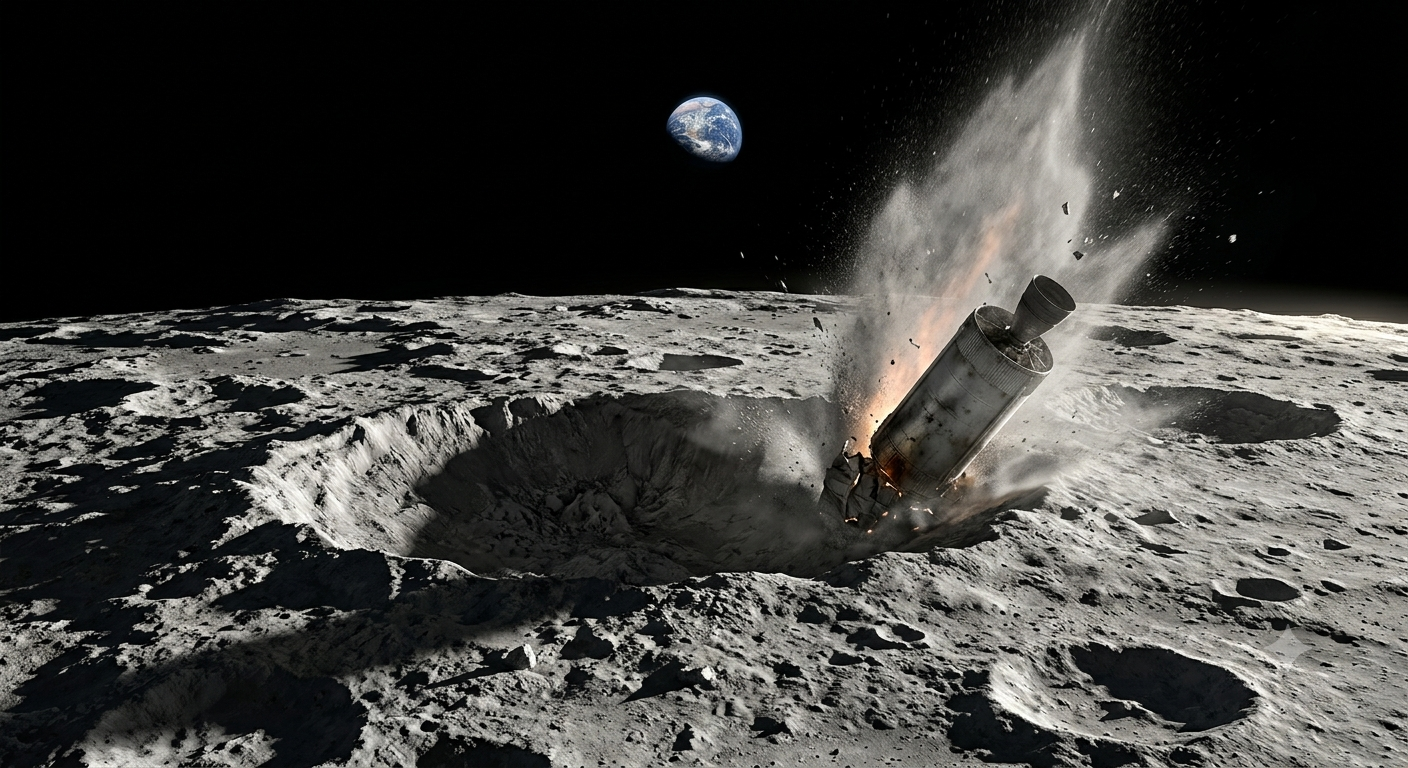
A Rocket Just Hit the Moon — And Telescopes Caught ItEvery so often, a piece of space junk stops being a nuisance and becomes a gift. This week gave us one of those moments, when a spent SpaceX Falcon 9 upper stage — a four-tonne cylinder of dead metal — slammed into the Moon near Einstein Crater at around 5,400 miles per hour, and the world’s telescopes were pointed right at it.
The stage had an unglamorous history. Back in January 2025 it did an honest day’s work, flinging two commercial landers — Firefly’s Blue Ghost and ispace’s Resilience — onto a path toward the Moon. Blue Ghost went on to make the first fully successful commercial soft landing that March. But once its job was done, the upper stage was simply left behind, out of fuel and adrift in the tangled gravitational space between the Earth and the Moon.
Here is the physics that sealed its fate. A stage in low orbit is easy to dispose of: a small nudge drops it into the atmosphere to burn up. But a stage already flung toward the Moon would need almost as much fuel to steer safely home as it took to get out there — and that fuel was long gone. So it drifted for eighteen months, until a mix of solar activity and gravity bent its path into a collision course. Remarkably, the independent tracker Bill Gray, of Project Pluto, predicted the impact spot and time to within a minute or two, days in advance.
What turns this from a curiosity into science is what happened next. The European Southern Observatory aimed its Very Large Telescope in Chile at the impact and read the collision chemically. In the plume thrown up by the strike, the telescope detected glowing sodium and lithium for several minutes. The sodium was almost certainly vaporised lunar soil; the lithium most likely came from the rocket itself. In effect, astronomers analysed the wreck’s ingredients from nearly 400,000 kilometres away.
Then NASA stepped in for the long game. Its Lunar Reconnaissance Orbiter had already photographed the target area beforehand, and over the coming weeks it will return to image the fresh crater — perhaps twenty metres across. That before-and-after pairing is something scientists almost never get: a known object, of known mass, hitting at a known speed, in a known place, with pictures on both sides.
Why does that matter beyond one crater? Engineers use computer models to predict how a hollow, human-made object deforms the ground on impact — models that, until now, have had little real-world calibration. Every future lunar lander team, from NASA’s Artemis crews to the commercial operators, needs to know how the surface behaves and how far debris flies in order to set safe landing margins. This accidental impact helps write those numbers down.
There is a sober note underneath the good news. The collision was harmless — nobody was hurt, no satellites threatened — but it is a reminder that we are now leaving hardware scattered through the entire Earth-Moon system, raising real questions about space debris, space law, and even how we treat what we leave behind. For this week, though, the happier reading wins: a piece of junk became a free experiment, and the observatories were ready to catch it.
The rocket that carried two landers to the Moon eighteen months ago finally arrived itself — right on schedule, and in the name of science.