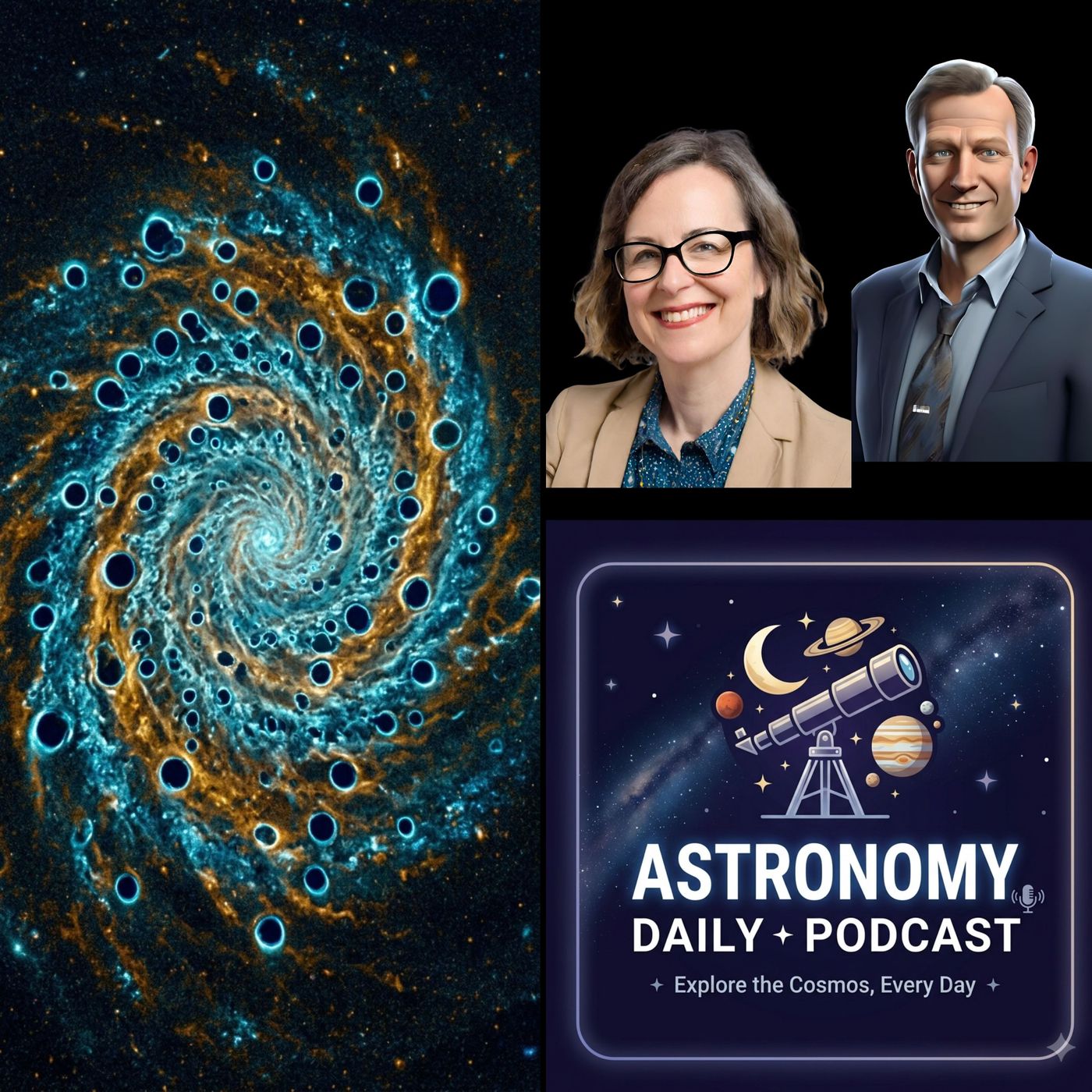
What Keeps a Galaxy Churning: Andromeda's Supernova Secrets Revealed
In this episode
Supernovae keep galaxies churning A new study led by Fan Yi Meng from Tsinghua University provides the first comprehensive census of superbubbles in the Andromeda Galaxy, revealing that clustered supernova feedback is sufficient to sustain galactic-scale turbulence. This finding helps to explain why galaxies remain active over billions of years, with turbulence playing a crucial role in regulating star formation rates. The research, published in Nature Astronomy, highlights the energy balance between supernovae and the turbulence they create.Neutrinos may dictate stellar explosions A paper from Mariam Gogilashvili and Irene Tambora at the Niels Bohr Institute explores the role of neutrinos in determining which massive stars explode as supernovae. Their findings suggest that neutrino oscillations could lead to a significant number of stars collapsing into black holes, particularly those in the 16 to 30 solar mass range, addressing the long-standing red supergiant problem.TOI 1355b: A planet with an expiry date Researchers from the University of Tokyo have discovered TOI 1355b, a hot Jupiter with a unique eccentric orbit around an A-type star. This planet will stop transiting its host star by 2033 due to nodal precession, providing a rare opportunity to study its characteristics before it disappears from view.SpaceX Crew Missions Update NASA has contracted SpaceX for three additional crew rotation missions to the International Space Station, extending their partnership and ensuring continued access to the station. Crew 13 is currently in quarantine, with a launch targeted for early October.The Sun goes blank For the first time since February, the Sun has gone completely spotless, marking a significant moment in the solar cycle. As solar activity declines, a coronal hole is set to rotate into position, potentially leading to minor geomagnetic storms and auroras.1. Supernovae keep galaxies churning2. Neutrinos may dictate stellar explosions3. TOI 1355b: A planet with an expiry date4. SpaceX Crew Missions Update5. The Sun goes blankBecome a supporter of this podcast: https://www.spreaker.com/podcast/astronomy-daily-latest-space-news--5648921/support.Sponsor Details:
Ensure your online privacy by using NordVPN. To get our special listener deal and save a lot of money, visit www.astronomydaily.io/nordvpn. You've been glad you did!
Get the best secure and private email on the planet. Stop your Government, Google and who knows who else spying on every email you write. Do what we did and use ProtonMail. They believe in privacy and there are no ads in their business model... yet they still provide a free forever service. Check them out and get our special deal at www.astronomydaily.io/protonmail
Become a supporter of Astronomy AstroDailyPod by joining our Supporters Club. Commercial-free episodes daily are only a click away... Click Here
Sponsor Details:
Ensure your online privacy by using NordVPN. To get our special listener deal and save a lot of money, visit www.astronomydaily.io/nordvpn. You'll be glad you did!
Get the best secure and private email on the planet. Stop your Government, google and who knows who else spying on every email you write. Do...
Anna: A galaxy should be quiet. Stir a cloud of gas and the churning dies away in a few million years, like ripples going flat on a pond. And yet every spiral galaxy we look at is still churning. Something keeps stirring the pot. Avery: Today, a survey of the galaxy next door that catches a spoon in the act, plus the ghostly particles that may decide which stars explode at all. A planet with an expiry date and the sun goes blank for the first time since February. Anna: The I'm Anna. Avery: And I'm Avery.
This is astronomy daily, episode 199. Anna: Start with a problem that has sat in the background of galaxy science for about 50 years, and that has the useful quality of being easy to state and very hard to answer. The gas between the stars in a galaxy is turbulent. It is not sitting still and it is not flowing smoothly. It is churning on every scale from a few light years up to thousands, with gas moving at something like 10 kilometres a second relative to its neighbours. We have measured this in our own galaxy and in every nearby galaxy we can resolve it is simply how interstellar gas behaves.
Here is the problem. Turbulence dies. That is the one thing turbulence reliably does. Energy cascades from big eddies down to small eddies, and at the bottom it turns into heat and it gone. In 1999, an astrophysicist named Mordecai Mark Macklow put a number on how fast that happens in interstellar conditions. And the number was brutal. Turbulence in a galaxy's gas should decay away in roughly the time it takes the gas to cross itself once a few tens of millions of years on a galactic clock. That's an afternoon.
So the churning we see should not be there unless something is putting the energy back continuously for billions of years. Avery: And there has never been a shortage of suspects. Anna: No shortage at all. Supernovae are the obvious one. But gravity itself can drive turbulence. As the disc shears and clumps, there is the magnetorotational instability, which wrings energy out of the galaxy's rotation through its magnetic field. There is gas falling in from outside, and massive stars blow winds long before they explode.
All of these are real. The question was never whether supernovae contribute. It was whether they are enough on their own to pay the whole bill. Avery: Uh, and to answer that, you need to do something nobody had managed. You need to count the receipts. When massive stars in a cluster explode, and they do it in batches, because massive stars are born in groups and die within a few million years of one another, the blasts merge. Instead of a single expanding remnant you get a super bubble, an enormous cavity blown in the neutral hydrogen, its edge still pushing outwards.
Superbubbles are the fingerprints each one carries in its size and its expansion speed, a record of how much energy went into it and roughly when. Anna: So a, uh, complete, dynamically resolved census of superbubbles across an entire galaxy would let you add up the energy supernovae have actually delivered and then compare it against how fast the turbine turbulence in that same galaxy is bleeding energy away. If the two numbers match, you have your answer. If supernovae falls short, something else is doing the work.
Avery: Nobody had that senses for a reason. That's almost funny. We can't do it for the Milky Way because we live inside it. Mapping bubbles in our own galaxy is like surveying a forest from the base of one tree. And for other galaxies we have the sensitivity or the resolution, never both. Anna: Which is where two telescopes on opposite sides of the world come in. Exactly that. The paper is in Nature astronomy, published on 17 September. Led by Fan Yi Meng of Tsinghua University, with Zhao Wei Tsai and Jingwen Wu, and with D Li, Jinghua's head of astronomy and the former chief scientist of the FAST telescope as corresponding authority, they combined two instruments.
FAST is the 500 metre aperture spherical telescope sitting in a natural limestone bowl in Guizhou Province in southern China, the most sensitive single dish on Earth. At these wavelengths, what it gives you is faint, diffuse, large scale structure, the outskirts of bubbles, the gas nobody else can see. What it cannot give you is fine detail. For that they used archival observations from the Jansky Very Large array in New Mexico, 27 dishes spread across the desert. Working as one instrument, the array resolves the sharp edges fast, fills in everything.
The array's spacing makes it blind to stitch them together, and you get a map that is both deep and sharp, which is exactly what this problem has always needed. Avery: They pointed that combination at Messier 31, the Andromeda Galaxy, the nearest big spiral, 2 1/2 million light years away and close enough that we can see the whole disc laid out from the outside. They mapped it in the 21 centimetre line of neutral hydrogen, the radio signal that traces cold atomic gas. Anna: From that map, they pulled 365 candidate cavities and after classification, confirmed 118 genuine super bubbles across the entire disc.
Avery: And the result? Anna: The first thing worth noticing is the ages. Measured from their sizes and expansion speeds, the bubbles run up to 40 million years old. That is not an arbitrary number. It is almost exactly how long a star cluster keeps producing Supernovae from its first massive star dying to its last. The ages line up with the clock you would predict if clusters are uh, what makes them B Lee put the scale plainly. Those 118 bubbles correspond to thousands of supernova explosions over the past 40 million years.
Then the actual test from the bubbles they calculated the rate at which supernovae are injecting kinetic energy between 10 to the 49th to 10 to the 51.5 ergs per cubic kiloparsec per million years. Separately and this is the part that makes the paper work. They derived the rate at which turbulence is dissipating energy from the same data using the observed motions of the gastwo independent numbers. They match match how closely in magnitude. And this is the stronger claim in spatial distribution.
It's not just that the galaxy wide totals happen to agree, which could be coincidence between two quantities that both scale with how many stars a ah galaxy has. It's that where the supernovae energy goes in is where the turbulent energy comes out region by region across the disc. The supply map matches the demand map. That's much harder to get by accent. The conclusion the authors draw is carefully worded and I want to keep their wording. Clustered supernova feedback is sufficient to sustain galactic scale turbulence.
Why this matters beyond bookkeeping is turbulence is not a detail of galaxies, it's one of the controls. Turbulent pressure helps hold a ah gas disc up against its own gravity. And turbulence is what stops molecular clouds collapsing all at once. A large part of why galaxies convert gas into stars. So slowly change the turbulence and you change the star formation rate. So this closes a loop. Gas collapses and forms stars. The biggest of those stars explode. The explosions stir the remaining gas.
The stirring regulates how readily the next generation forms. Galaxies are partly self governing and this is the first time both ends of that loop have been measured in the same galaxy from the same data and found to balance. Avery: And um, the caveat now the honest Anna: limits and there are three first, sufficient is not the same as sole showing supernovae can pay the whole bill does not prove nothing else. Chips in gravity and the magneto rotational instability have not been eliminated. They have been made unnecessary, which is a weaker and more interesting result.
Second, this is neutral atomic hydrogen. It does not directly trace the molecular gas where stars actually form or the hot ionised gas and the energy budget in those phases could behave differently. And third, this is one galaxy, a large, fairly quiet spiral that has not formed stars vigorously in a long while. Whether the books balance the same way in a starburst or in a small, irregular, uh, galaxy where bubbles can blow straight out. The top is exactly the next question. Two footnotes I enjoyed Bordechai Mark McClo, the man whose 1999 paper showed this turbulence should have died long ago, is a co author here.
His own result is referenced too, in the paper that answers it. And because Nature Astronomy publishes its referee reports, we know one of the two reviewers was Christoph Federath at the Australian National University, who has spent a career on this exact question. The Australian fingerprint is on the scrutiny rather than the data. Regular listeners will hear an echo here. Two weeks ago we ran the finding that black hole outflows can trigger star formation as well as shut it down. Feedback that builds as well as breaks.
This is the same lesson one rung down the letter. At stellar scale, feedback is not simply destructive, it is a galaxy's thermostat. Avery: Anna's Storey takes supernovae as given and asks what they do to a galaxy. This one asks a question one step which stars actually managed to explode? You would think that was settled. It is not. We see fewer supernovae than our models say we should. And there's a related puzzle, the red supergiant problem. When astronomers go back through archival images to identify the star that blew up, they never find 1 above about 16 to 18 solar masses.
Even though plenty of stars are heavier, something is quietly removing the most massive stars from the exploding population. A new paper in Physical Review D from Mariam Gogilashvili and Irene Tambora at the Niels Bohr Institute in Copenhagen Contorm points at an unlikely culprit. Neutrinos changing identity Quick refresher When a Anna: massive star's core collapses, about 99% of the energy released leaves as neutrinos. And the explosion depends on a small fraction of that flood being reabsorbed by the gas just outside the core, heating it enough to revive the stalled shock wave.
It's a narrow margin. Neutrinos also come in three flavours electron, muon and tau and oscillate between them, which is Nobel winning physics from 1998. Avery: Here's the catch. Only the electron flavour deposits heat efficiently. Muon and tau neutrinos mostly sail straight out. So if flavour conversion happens deep inside a collapsing core, it takes energy earmarked for the explosion and redistributes it into flavours that simply leave. Most state of the art simulations leave this out on the old assumption that conversion happens too far out to matter.
Recent work says otherwise, so Maryam Gogilashvili and Irene Tambora put it in schematically and ran the collapse of 195 stars from 9 to 120 solar masses without flavour conversion. About 27% of their stars fail to explode and collapse straight to black holes. That matches both the literature and observations. Switch flavour conversion on and the failure rate climbs to somewhere between 48 and 88% depending on how deep in the core you let it happen. And the stars most affected sit between 16 and 30 solar masses, which is Anna: precisely the missing mass range.
In the red supergiant problem. Avery: There is a second quieter result I like more. And the stars that do still explode. Flavour conversion revives the shock earlier so less material rains back onto the newborn neutron star. The neutron stars come out lighter, closer to the 1.2 to 1.4 solar masses we actually measure in pulsars. A model that was running heavy now matches the honest handling. Here is the range. 48 to 88% is not a measurement. It is a span across assumptions. And the authors say plainly that their upper valleys look to be in tension with observations.
This is one dimensional modelling with a deliberately simplified switch for the neutrino physics. What it establishes is not a number. It is that this effect is too big to keep leaving out. The preprint went up in mid May, so the work has been circulating about four months. It is the journal version that is Anna: new and a southern footnote that is not a stretch. We have caught neutrinos from exactly one supernova SN 1987A in the Southern Magellanic Cloud cloud 20 dozen particles over about 13 seconds in February 1987.
Every word of this debate traces back to that 1 handful of detections from a galaxy only southern observers see properly. The next galactic supernova settles a great deal of it. Avery: Okay, moving on to storey 3. Most exoplanet discoveries come with an open ended invitation. Go and study it whenever you like. This one comes with a deadline. Published on 18 September in the publications of the Astronomical Society of Japan from Noriharu Watanabe and Norio Narita at the University of Tokyo with a large international team.
The discovery of TOI 1355b, a hot Jupiter and a strange one on three counts count one is the star. TOI 1355 is an A type star about twice the Sun's mass with a surface near 8,700 Kelvin, um, some 3,000 degrees hotter than the Sun. It's around 800 light years away and it spins fast better than 80 kilometres a second against our Sun's leisurely two count two is the planet. Nearly six Jupiter masses. About 1.4 Jupiter radii whipping around that star every 2.17 days. But its orbit is not a circle. The eccentricity is about 0.22 a properly lopsided orbit.
Anna: Why is that surprising for a hot Jupiter? Avery: Because they're almost never lopsided sitting that close in tides should round off an orbit quickly. Of the roughly 20 hot Jupiters known around hot stars, the measured eccentricities are essentially zero, some to four decimal places. And there's exactly one other eccentric case on record. These worlds are thought to be flung inward on wild elliptical orbits by gravitational bullying from other planets. Then have those orbits ground down to circles by tides.
TOI 1355B is partway through the grinding, which we rarely gets. Watch count three is the deadline. Comparing transits across TESS observations from 2019, 2020, 2022 and 2024. The team found the planet crossing the star at a steadily different height each time. The orbit's plane is swinging nodal precession driven by the bulge of that rapidly spinning star. Wind it forward and the planet stops crossing the star's face from our point of view around the middle of 2033. Anna: After that, no transits for centuries.
The planet is fine. Our line of sight is what runs out. There is a lovely methodological wrinkle too. You normally weigh a planet by watching the star wobble. But this star spins so fast its spectral lines are smeared and that does not work. So they weighed it from the light curve instead from M. The way the planet's gravity distorts the star into a faint rugby ball shape. And from the subtle brightening as the star is tugged towards us. The mass came out of the shape of the light, not the shift of the lines.
And the supporting cast is worth naming. Alongside TESS and the 3.8 metre SEMI telescope in Okayama, this paper leans on a 91 centimetre telescope on the slopes of Matt Etna, a 40 centimetre in Switzerland and a 28 centimetre at a private observatory in Germany. Backyard scale instruments on the Discovery paper for a six Jupiter mass world. The preprint went up in August, so about a month ahead of the journal. And for our southern listeners the star sits at Ah, Declination 67, which means it never rises from Sydney.
Northern listeners can find the field in Cepheus. The team is already preparing a follow up on how tilted the orbit is and wants JWST time to low ETH Avery: orbit now and the business end of spaceflight. On 18 September, NASA exercised a UH contract modification with SpaceX for three additional crew rotation missions to the International Space Crew 1 5, Crew 16 and Crew 1 7. The value is $946 million for all three covering ground launch in orbit and return and recovery operations, cargo on each mission and lifeboat capability while docked.
That takes SpaceX to 17 crew missions under the commercial crew transportation contract and that contract's running total to $5.92 billion. Period of performance runs through 2030 with mission readiness dates in 2027 and 2028. NASA flagged its intent to buy back in May and calls this a sole source modification that does not pre further purchases later. Anna: One line in that release is worth reading carefully. NASA says the change helps it maintain access to the station with quote, two unique commercial crew industry partners.
The award itself goes to one of them. The original 2014 contracts went to both Boeing and SpaceX and Boeing appears in this release exactly once in that history. NASA does not say anything here about when its second provider next flies people. We'll report that when they do say. Avery: Meanwhile, the near term mission is moving. The four astronauts of Crew 13 entered quarantine late on Thursday at UH Johnson Space Centre in Houston. NASA's Jessica Watkins and Luke Delaney, the Canadian Space Agency's Yoshua Kutryk and Roscosmos cosmonaut Sergey tatariotnikov.
NASA and SpaceX are still targeting early October. Before quarantine. They finished training at SpaceX in Hawthorne and ran a crew equipment interface test at Cape Canaveral. Suits on into the Dragon leak cheques, seat fit comms cheques, my favourite detail. They sit in the capsule and listen to its fans and pumps so that none of the sounds are unfamiliar on launch day. Anna: The quarantine itself is an Apollo era invention still doing its job. Keeping a head cold on the ground where it belongs.
That closes out an arc we tracked since the oxidizer leak stood. Crew 13 down valve replaced. Crew in quarantine early October. We still want a date. Quick hit, closing a thread. We opened on Friday. It happened on the 18th of September. The earth facing sun went completely spotless. No numbered active regions at all. It's the first spotless day since the 24th of February and the 19th was spotless too, making it two in a row. By the 20th, a small new region had rotated up and the run ended. Which is exactly how the descent from a solar maximum goes.
Not a switch, but a flicker that Avery: lengthens for scale on how far we have come down. The busiest single day of the Solar cycle was 8 August 2024, with an estimated 337 sunspots. That was the highest daily count since March 2001. Cycle 25 peaked in late 2024 and minimum is not expected before about 2030. Anna: But do not put the aurora gear away. A coronal hole is rotating into position and its fast solar wind stream should reach us around the 23rd, with forecasters flagging a chance of minor geomagnetic storming.
If it lands, best chances are the far north, northern Scotland and the far south, southern New Zealand. It arrives right on the equinox, which is the most aurora friendly moment of the year. For reasons of geometry and the standing point we keep making. A, uh, quiet sun means fewer auroras, but it also means a weaker shield against galactic cosmic rays. So that background quietly rises same dial opposite end to the sky. Avery: And this week the calendar does something that only makes sense if you remember.
The Earth is tilted first to equinox, five minutes past midnight universal time on the 23rd. An equinox is an instant, not a day. So where you stand decides the date. That is Tuesday evening in the Americas, just after five in Los Angeles, just after eight in New York, one in the morning in London and five past ten on Wednesday morning in Sydney. Spring here, autumn there, same instant. Anna: Then on Saturday the 26th, the full moon, the harvest moon. The full moon falling closest to the September equinox.
And here's where it gets interesting. Because the harvest moon's entire reputation is a northern hemisphere phenomenon. Avery: Explain that, because I think most people assume it's just a name. Anna: It's not just a name. The moon Normally rises about 50 minutes later each night. Around the northern autumn equinox. The Moon's path meets the eastern horizon at a shallow angle. So successive moon rises, bunch up and you get several evenings running with bright moonlight arriving just after sunset, which was the whole point.
Extra light to finish the harvest. Avery: We ran the numbers for this week. On the nights around full moon, moonrise comes later by about 12 minutes a night. In London, 22 minutes in New York, 27 in Los Angeles and in Sydney, 62 minutes. Anna: So we get the opposite of a harvest moon. Avery: We get the anti harvest moon. The effect the thing is named for is more than five times weaker here than in London. Same moon, same week, geometry simply reversed. In spring it's the same ecliptic angle that gives us a brilliant high Venus and one hugging the horizon.
One wrinkle for Australian listeners The full moon Instant lands at 2:48 on Sunday morning our time, so our calendars say 27th and northern ones say 26th. It looks full on both nights. Anna: And the planets? Avery: Venus is still the show in the west after sunset. At uh magnitude -4.5 from Sydney it stands 37 degrees high as the sun sets and hangs on for more than three hours. From New York, 13 degrees from London, 2 1/2 degrees about 25 minutes with a dead flat western horizon in the north. Look early and low through a telescope.
It's a big thin crescent, a quarter lit but 42 arcseconds across. Larger than Jupiter's disc. Below it Mercury is having a genuinely good Southern apparition. Magnitude 0.2, 18 degrees up from Sydney at sunset and setting an hour and a half after the Sun. From London it's 3 degrees up and effectively out of reach for the north. Anna: The compensation is the morning at the start of nautical Twilight. Mars stands 49 degrees high from Los Angeles, 47 from New York, 42 from London and just 21 from Sydney.
Jupiter is 28 degrees up from Los Angeles against 10 from here. The pre dawn sky belongs to the north right now and it is worth getting up for. Saturn rises mid evening and is highest just after midnight, better than 50 degrees up from Sydney at magnitude plus 0.3. It is heading for opposition in early October and you will see listings disagree about the date. Some um, say the fourth, some the fifth. Both are right. Opposition measured by ecliptic longitude falls on the 4th, measured by right ascension the 5th.
Saturn's brightness and size are identical across that whole week so you cannot pick the wrong night and our lead storey. Can anyone actually see Andromeda? Avery: Depends entirely where you are. From New York, Andromeda passes almost overhead, 89 degrees up around half past one in the morning from Los Angeles, 83 from London, 80 from Sydney. It scrapes to under 15 degrees low in the north through the thickest part of our atmosphere. Binocular is in a clear northern horizon after midnight we'll find it but it is a smudge rather than the showpiece.
It is up north which is the storey of tonight really. The north gets the deep sky, the predawn planets and the lunar occultation of Jupiter on 6 October that sits below our horizon entirely. We get Venus, Mercury and the better half of the geometry. Some weeks it runs the other way Anna: and the standing reminder because we are talking about a sun with almost nothing on it and people will be tempted to look. Never look at the sun without proper protection. Solar viewers and eclipse glasses must meet the ISO 123122 international safety standard, and that is not the same as ordinary sunglasses, no matter how dark they are.
And stacking sunglasses does not help. Cheque your filters for damage before use, and discard any that are scratched, punctured or peeling. If you're using a telescope or binoculars, the filter goes on the front of the instrument, never on the eyepiece, where focused sunlight can crack it without warning. There is no safe way to improvise this. Avery: That's astronomy daily for today. 118 Bubbles in Andromeda that bounce a galaxy's energy books neutrinos that may quietly decide which stars are allowed to explode a planet.
We have until 2033 to study three more dragonflights on the books and a crew in quarantine and a sun with nothing on its face for the first time since February. Anna: A note for tomorrow this was episode 199, which makes the next one 200, and we would like to mark it properly. If there's a storey from this series you want revisited or a question you've been sitting on the contact form at astronomydaily IO is the place. We do read them, and listener questions have set our running order more than once.
Avery: All our sources are linked in the show notes, as always, along with the full references for today's papers. You'll find us at astronomydaily IO until tomorrow. Anna: Clear skies.
The storeys.
Avery: Were told.
 Apple Podcasts
 Spotify
 Pocket Casts
 Castbox
 Overcast
 Podbean
 iHeartRadio
 Castro
 Goodpods
 Moon FM
 Podcast Addict
 Podcast Republic
 YouTube