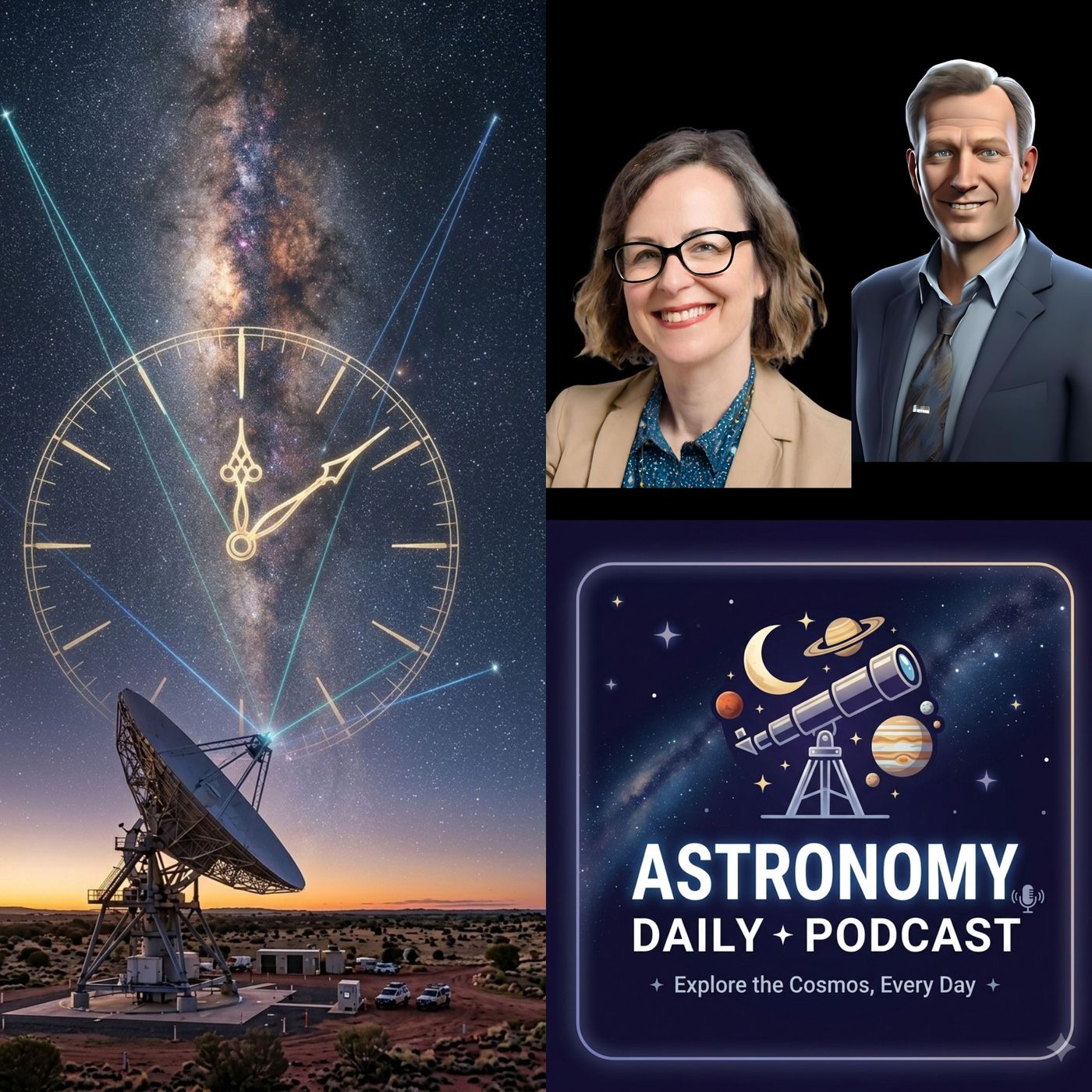
Time's Tipping Point: The End of Leap Seconds and a Lunar Clock Revolution
In this episode
Show notes Time Lets Go of the Sky On 15 October 2026 the 28th General Conference on Weights and Measures in Versailles adopted Resolution 5: UTC becomes continuous on 20 May 2027, ending leap seconds, with the UTC–UT1 gap allowed to reach one hour. The driver: a growing chance (about 30% by 2035) of a first-ever negative leap second. Resolution 6 starts work on an international lunar reference time scale traceable to UTC; Resolution 4 prepares an optical-clock redefinition of the second for 2030. Earth's rotation (UT1) is still measured — by VLBI, with Australia's AuScope dishes part of the network. The Week That Was WISE 0855's changing water clouds (JWST); Hera's 93-minute braking burn; Artemis II's five lunar impact flashes; UCL questions the chemical evidence for hypernovae; the Arsia Mons cloud needs ice from nothing; the first green star. Also: ZTF J0440+2325, Meteor 2-7, Juno's crumpled magnetodisk, WASP-17 b, two planetary families, and new Magellanic Cloud pulsars from the Parkes archive. Skywatch First quarter Mon 19 Oct 03:12 AEDT (16:12 UTC Sun). Mercury 24° up at sunset from Sydney vs 10° LA, 7° NY, 3° London. Venus gone from northern evening skies; inferior conjunction ~03:00 UTC Sat 24 Oct. Saturn all evening, rings ~7° open. Orionids peak 21–22 Oct; Moon sets ~03:00–03:40 local, radiant 39–70° up at 04:30. Mars–Jupiter 11.5° apart, 1.2° on 16 Nov. AR4551 beta-gamma-delta. Solar safety: ISO 12312-2 filters only. Sources · BIPM — Resolutions adopted at the 28th CGPM: https://www.bipm.org/en/-/cgpm-2026-resolutions-adopted · BIPM — Resolution 5 (2026): https://www.bipm.org/en/cgpm-2026/resolution-5 · BIPM — Statement by the CCTF President, 15 Oct 2026: https://www.bipm.org/documents/d/guest/statement-cctf-president-cgpm-2026 · AuScope VLBI array (Lovell et al.): https://arxiv.org/abs/1304.3213 · ESA — Braking news! Hera: https://www.esa.int/Space_Safety/Hera/Braking_news!_Time_for_ESA_s_Hera_asteroid_mission_to_go_slow · JAXA — MMX launch schedule: https://global.jaxa.jp/press/2026/08/20260820-1_e.html · EarthSky — Sun news, AR4551 (16 Oct): https://earthsky.org/sun/sun-news-activity-solar-flare-cme-aurora-updates/ · Week That Was sources: see S05E202–S05E206 show notes.Become a supporter of this podcast: https://www.spreaker.com/podcast/astronomy-daily-latest-space-news--5648921/support.
Sponsor Details:
Ensure your online privacy by using NordVPN. To get our special listener deal and save a lot of money, visit www.astronomydaily.io/nordvpn. You'll be glad you did!
Get the best secure and private email on the planet. Stop your Government, google and who knows who else spying on every email you write. Do what we did and use ProtonMail. They beleive in privacy and there are no ads in their business model...yet they still provide a free forever service. Check them out and get out special deal at www.astronomydaily.io/protonmail
Become a supporter of Astronomy Daily by joining our Supporters Club. Commercial free episodes daily are only a click way... Click Here
This episode includes AI-generated content.
Anna: Hi, everyone. It's Saturday, the 17th of October, and this is the weekend wrap from Astronomy AstroDailyPod. I'm Anna. Avery: And I'm Avery. On Thursday, in a palace just outside Paris, the world decided that its clocks will stop waiting for the Earth. Anna: No more leap seconds from May next year. And, um, in the same session, the first formal step towards an agreed time for the Moon. Avery: Then we look back over the week, whether on a world without a sun, Hera breaking hard for an asteroid, five flashes on the far side of the Moon, a cloud on Mars that our models said couldn't form, and the first green star.
Anna: And in the sky, watch Mercury's last good week for the south Venus about to vanish and why the Orionids are a, uh, set an alarm shower this year. Let's get into it. To understand Thursday's decision, you, you need to know that the world has been running two clocks side by side for more than 50 years. The first is atomic time. Hundreds of atomic clocks in laboratories around the world are, uh, averaged together into a timescale that ticks with extraordinary steadiness. The civil version of that, the one your phone ultimately follows, is coordinated Universal Time UTC.
The second clock is the Earth itself. Astronomers call it UT1. It's simply the angle the planet has turned through, measured against the distant sky. And the Earth is a terrible clock. Its spin wobbles with tides, with the weather, with ocean currents, with the slow sloshing of the liquid core. Over the long run, tidal friction from the Moon has been slowing it down, Avery: so the two clocks drift apart. Since 1972, the rule has been that UTC is never allowed to get more than nine tenths of a second away from the Earth's rotation.
When the gap gets close to that, the International Earth Rotation and Reference System Service announces a leap second. And every clock on the planet that follows UTC has to count a 61st second in one particular minute. Anna: That has happened 27 times. The last one was at the end of 2016 in July, the IERS confirmed there won't be one at the end of this year either. So we'll reach a full decade without one. Avery: It's worth remembering that for most of history, these were the same clock. Until 1956, the second was defined as a fraction of the average solar day.
Then, because the day wasn't steady enough, it was redefined as a fraction of the year. Still astronomy, only in 1967 did the second leave the sky entirely and move into the cesium atom. Leap seconds were the compromise that kept the two loosely tied together. Anna: So why now, that decade without one Avery: is actually the reason for Thursday's vote. For most of the leet second era, the Earth was running slow, so the correction was always the same. Add a second. But in recent years, the planet's rotation Anna: has been running slightly fast, which raises a possibility.
Nobody has ever had to deal a negative leap a minute with only 59 seconds in it. The resolution itself puts a number on it. A workshop held in March last year by the Consultative Committee for Time and Frequency and the iers, including experts on Earth's rotation, estimated that the probability of a negative leap second rises rapidly in the near Future, reaching about 30% by 2035. And the delegates were blunt about the risk. A negative leap second has never been applied. The resolution describes it as a high risk to critical infrastructure that is largely unprepared and says the cost of getting ready would be similar to what industry spent preparing for the millennium bug.
Avery: There's a quieter problem too. Positive leap seconds already cause trouble. So big service providers have each invented their own workarounds, smearing the extra second across hours of the day in different ways. The resolution notes that this leaves different systems disagreeing with each other about what time it is, and that some users were starting to abandon UTC altogether for satellite navigation time. Anna: So, um. On Thursday 15th October, at the 28th General Conference on Weights and Measures in Versailles, member states adopted what's called Resolution 5.
It was carried by a majority vote. Avery: Two decisions. First, UTC becomes a continuous timescale on 20 May 2027. No more leap seconds after that in either direction. Anna: And second, the allowed gap between UTC and the Earth's rotation grows from under a second to one hour, 3600 seconds. The resolution says that ensures UTC's long term continuity for several centuries. Avery: Back in 2022, the same conference had agreed to do this by 2035. What changed is that, uh, the negative leap seconds stopped looking theoretical, so they brought it forward by eight years.
Anna: The president of the Time Committee, Noel Demark, said it came after 30 years of debate. Now, the honest caveats, because the headlines this week have been a bit dramatic. First, this is a decision about the clock, not about the Earth. The planet will keep turning exactly as it was going to. Avery: Second, the drift is slow. We're talking seconds per decade, not minutes. Nobody will notice the sun rising at the wrong time in their lifetime. The resolution itself makes the point that most of us already live an hour or more away from local solar time because of time zones and daylight saving.
Anna: And third, what happens if the gap Ever approaches that one hour limit is left to people several centuries from now. The resolution sets the limit. It doesn't spell out the fix. Avery: Here's the bit I find most interesting for this. Astronomers still need UT1. If you want to point a telescope at a star or work out where a satellite is over the ground, you need to know exactly how far the Earth has actually turned. That number keeps being published by the iers and broadcasts in satellite navigation signals.
It just stops being fed back into your clock every few years. Anna: And the way the Earth's rotation is measured is pure astronomy. The technique that's unique in its ability to pin down UT1 is very long baseline interferometry. Radio dishes on different continents all observe the same distant quasars billions of light years away and time the arrival of the signal at each dish. Avery: Because those quasars are so far away, they're effectively fixed, they make the most stable reference frame we have.
The tiny differences in arrival time tell you how the dishes and, um, the whole Earth under them have rotated. Anna: And Australia is part of that network. Oscope's 12 metre dishes at Hobart in Tasmania, Catherine in the Northern Territory and Yerra Gadi in Western Australia. Observe in the International Geodetic VLBI sessions. So the length of your day is quite literally partly measured from Australia against quasars. Avery: Which is a nice callback to episode 197, when we covered the Earth's centre of mass.
Wobbling with the seasons. Same idea. The ground we stand on is not a fixed platform and, um, it takes the whole sky to measure it. Anna: Resolution 5 got the headlines, but the same session adopted Resolution 6. And for space exploration, it may matter more. It's the first international step towards a lunar reference timescale, the Moon's equivalent of utc. Avery: The problem is relativity. A clock on the Moon sits in weaker gravity and moves differently from one on Earth, so it runs fast. A widely cited estimate puts that at roughly 56 millionths of a second a day.
Anna: That sounds tiny, but light travels about 17 kilometres in 56 microseconds. If you're building navigation on the Moon, landers and rovers and astronauts working near each other, an error that grows by kilometres a day is not acceptable. Avery: And, um, several agencies are building lunar navigation systems at the same time. The Resolution's stated aim is to avoid a proliferation of competing lunar timescales and to keep whatever is chosen traceable back to utc. For now, it asks space agencies to share how they handle the relativistic corrections.
It doesn't define the timescale yet that work is still to come. Anna: One more Resolution 4 starts the groundwork for redefining the second itself. Since 1967, the second has been defined by cesium atoms. The best optical clocks now beat the best cesium fountain clocks by around a factor of 100, which means the definition Avery: has become the limitation, not the technology. Two options are on the pick one optical transition or average several. The aim is a vote at the next conference in 2030. Anna: So in a single afternoon in Versailles, the world agreed to stop chasing the Earth's spin with its clocks, started building a clock for the moon and began retiring cesium.
Not bad for a meeting most people have never heard of. Avery: And next week we'll be watching a spacecraft head for Mars moons. More on that in the outro. Anna: Next, let's move on to our wrap of the space news from the past week. Avery: Monday's lead was wise 0855, the coldest brown dwarf we know, about seven and a half light years away, with no star to warm it. A team led from the University of Arizona used JWST's NirSpec to take a spectrum every 15 minutes for 11 hours, Anna: and the atmosphere changed while they watched.
Carbon monoxide and phosphine rose and fell together, which points to convection dredging deep gas upward. Higher up, patchy water clouds thickened and thinned the careful bit. Avery: Some headlines said these were the first water clouds seen outside the solar system. They're not water clouds were claimed for this object in 2014 and 2016. What's new is seeing them change. The paper is a Preprint posted about three weeks before we covered it Tuesday. Anna: We led on ESA's Hera closing on the Didymos binary asteroid, the system NASA's DART mission struck in 2022.
Avery: On 7 October, its second launch anniversary, Hera caught its target for the first time. Didymos and its moonlit dimorphos together as a single pixel from about 236,000 kilometres away. Anna: Then early on Thursday the 15th, the big one three thrusters burning continuously for 93 minutes to shut a few hundred metres per second, with ESA's new Norsha antenna in Western Australia lined up to pick up the signal afterwards as we record. Avery: ESA hasn't yet published the result, which is normal, while the Flight Dynamics team checks the new trajectory will bring it to you when they do.
Anna: Next up is a second shorter burn of about 31 minutes on Thursday the 22nd. Then three small manoeuvres to bring HERA almost to a stop beside the asteroids ahead of close up observations from 25 to 30 kilometres away in November and December. Avery: Wednesday, NASA's preliminary lunar science report from Artemis 2. During a 54 minute stretch when the sun was hidden behind the moon, the crew watched the dark lunar surface and reported five faint flashes of light rocks, Anna: each only a few centimetres across, hitting the moon.
One of those flashes was marked independently by all three crew members who logged them, which is about as good as eyewitness evidence gets. They may be the faintest lunar impact flashes ever seen by human eyes. Avery: Also on Wednesday, Anmol Aggarwal and Ralph Schoenrich at UH University College London, in two papers in the Monthly Notices of the Royal Astronomical Society, went after one of the lines of evidence for chemical fingerprints in very old stars. Anna: They found that ordinary supernovae enriching the gas unevenly explain three of the four stars thought to carry a hypernova signature.
The fourth, a giant rich in silver and uranium, fits a neutron star merger plus one ordinary supernova and the honest framing. Avery: That doesn't mean hypernovae don't exist. Very energetic explosions linked to gamma ray bursts have been observed directly. What's in question is whether these old stars require them. Anna: Thursday took us to Mars. Every morning in the southern spring and summer, a thin cloud up to 1800 kilometres long streams from the 20 kilometre volcano Archia Mons, then vanishes by afternoon.
Avery: For years, the models couldn't make it. Jorge Hernandez Bernal and colleagues at LMD in Paris, writing in Nature Geoscience, only reproduced it by letting ice form directly from vapour with no dust to seed it. The air over the volcano cools by around 30 degrees in 10 minutes and the humidity soars to more than 100,000 times everyday earth levels before it freezes. Anna: It's a modelling result sufficient not yet observed directly. Avery: And Friday, colour Mark Hollins and colleagues at the University of Warwick took white dwarf spectra astronomers already had and ran them through a model of human colour vision.
Anna: Wdj1336435 comes out green chartreuse because sodium from the rocky remains of its own planetary system absorbs the orange light. WDJ 10, 11, 28, 45, 48 light years away. Maybe the reddest star ever recorded a deep salmon pink. Avery: Two caveats. These colours are computed not seen. No white dwarf is close enough to see its colour by eye and the typical white dwarf turns out to be white. Of the 151 within about 65 light years, only around 1 in 30 has an unusual colour. Anna: A few more from the week quickly Monday VTF Jo440 uh 5 a red dwarf pulling gas off a brown dwarf of about 25 Jupiter masses on an 87 minute orbit.
The MIT led team in Nature Astronomy calls it the first confirmed case of stable mass transfer from a substellar object onto a star. Avery: Also Monday the dead Soviet weather satellite Meteor2.7, launched in 1981, broke apart on 5 October about 8, 850 kilometres up and the breakup was picked up by LeoLab's radar in western Australia. The cause is still unknown. Anna: Wednesday Juno found Jupiter's vast magnetic disc is crumpled, rippling as it rotates, crossing the spacecraft four times in 10 minutes in one pass.
And simulations from the Indian Institute of Science suggested strong magnetic fields could let a white dwarf grow to around 2.4 solar masses, well past the usual limit Avery: near 1.4 Thursday JWST mapped the edge of the hot Jupiter WASP 17b, about 860 Kelvin at the morning edge and 1520 at the evening edge, the largest contrast yet measured. And an INF led team found that nearly 300 well measured multiplanet systems fall Anna: into two distinct families and Friday a southern one. Reprocessing archived mrion data from CSIRO's Parkes telescope turned up six pulsars, five of them in the Large Magellanic Cloud, plus the slowest radio pulsar yet found in the Small Magellanic Cloud.
Both are preprints and both are reminders that old data still has surprises in it. Avery: That's the week that was moving on Anna: to skywatch, starting with the moon. First quarter is at 16:12 Universal Time on Sunday. That's 3:12 on Monday morning in Sydney, 9:12 Sunday morning in Los Angeles, 12:12 in New York and 5:12 Sunday afternoon in London. So all week the moon is in the evening sky and growing. Avery: Southern Hemisphere this is Mercury's last strong week. Tonight From Sydney it's 24 degrees up in the west at sunset and doesn't set until two hours after the sun.
Even by Wednesday it's still 22 degrees Anna: up from Los Angeles. It's under 10 degrees at sunset and sets within the hour. New York 7 degrees, London under 3 Northern. Listeners, you'd need a flat western horizon and binoculars and please wait until the sun is fully down. Avery: Venus is the bigger story from the Northern Hemisphere. It's already gone below the horizon by sunset from Sydney Tonight it's still 11 degrees up at sunset and sets an hour later. But by Wednesday it's down to 5 degrees in half an hour.
Anna: Venus Reaches inferior conjunction passing between us and the sun around three universal time next Saturday the 24th. That's early Saturday afternoon in Australia and Friday evening in the Americas. It slips about six and a half degrees from the sun then reappears in the morning sky. Avery: It's the same geometry we keep coming back to in southern spring. The evening ecliptic uh stands up steeply so the south keeps Venus and Mercury Anna: longer and after dark everyone gets Saturn. It's only a couple of weeks past opposition, rising in the east around sunset and well placed by mid evening from all four cities.
Its rings are tilted only about 7 degrees towards us at the moment. So in a small telescope they look like a uh, thin bright line across the planet. They were exactly edge on in March last year and are slowly opening again with the south face of the rings towards us. So each year they'll look a little wider. Avery: Now uh, what about the Orionids? Anna: The Orionid meteor shower peaks on the night of the 21st into the 22nd. These are dust grains from Hallie's Comet, the same comet that gives us the Eta Aquarids in May.
Avery: The catch this year is a bright roughly 80% moon. But it sets in the small hours about 3:40am in Sydney, 3:20 in Los Angeles, 3:10 in New York and UM 2:50 in London. That leaves a dark window before dawn Anna: and at 4:30am M the radiant in Orion is around 70 degrees up from Los Angeles, 63 from New York, 53 from London and 39 from Sydney. So the north is favoured but the south is perfectly respectable. Typical rates under dark skies are around 20 an hour. Go after moonset, look away from the radiant and give your eyes 20 minutes while you're up.
Avery: Mars and Jupiter this morning they're 11 and a half degrees apart, closing to under nine by next weekend and to just over one degree on the 16th Anna: of November at nautical dawn. This is a northern showpiece. Mars around 60 degrees up and Jupiter around 50 from Los Angeles and New York, 50 and 42 from London. From Sydney they're lower 23 and 19 degrees but easy. Jupiter is the bright one, Mars is the orange one above it. Avery: Finally the sun has woken up a large active region. AR4551 has developed the most complex magnetic classification there is Beta Gamma Delta, which gives it the potential for strong flares if it launches an Earth directed eruption.
Aurora watchers in Tasmania and southern Victoria and across Canada, the northern U.S. and Scotland. We'll want to check the Bureau of Meteorology, Space weather Services and NOAA's Space Weather Prediction Centre. It's a possibility, not a forecast. Anna: And if all that sunspot talk tempts you to look, never look at the sun directly or through binoculars, a telescope or a camera without a certified ISO 12312 solar filter covering the front of the instrument. Ordinary sunglasses are not safe. Projection or a properly filtered telescope is the way to see sunspots.
Avery: On Monday we'll be on launch E for JAXA's Martian moons exploration mission MMX, which is aiming to bring back the first sample from Phobos. With the capsule due to land in South Australia in 2031, it's a fitting follow on to today's lead. MMX will spend years working at Mars, kept on time by atomic clocks on Earth and tracked by the deep space stations that serve every mission out there. Anna: Launch is set for 441 Tuesday morning Japan time. That's 641 Tuesday morning in Sydney, 1241 Monday lunchtime in Los Angeles, 341 Monday afternoon in New York, and 841 Monday evening in London.
Avery: If you have a question you'd like us to chase, the contact form is @Astronomydailyio and you'll find us@Astrodaily pod. On social media, Astronomy AstroDailyPod is part of the bytes.com podcast network. Anna: Thanks for spending part of your weekend with us. I'm Anna. Avery: And I'm Avery Clear Skies and we'll see you Monday.
Anna: Mhm.
You
Avery: stories we told.
 Apple Podcasts
 Spotify
 Pocket Casts
 Castbox
 Overcast
 Podbean
 iHeartRadio
 Castro
 Goodpods
 Moon FM
 Podcast Addict
 Podcast Republic
 YouTube