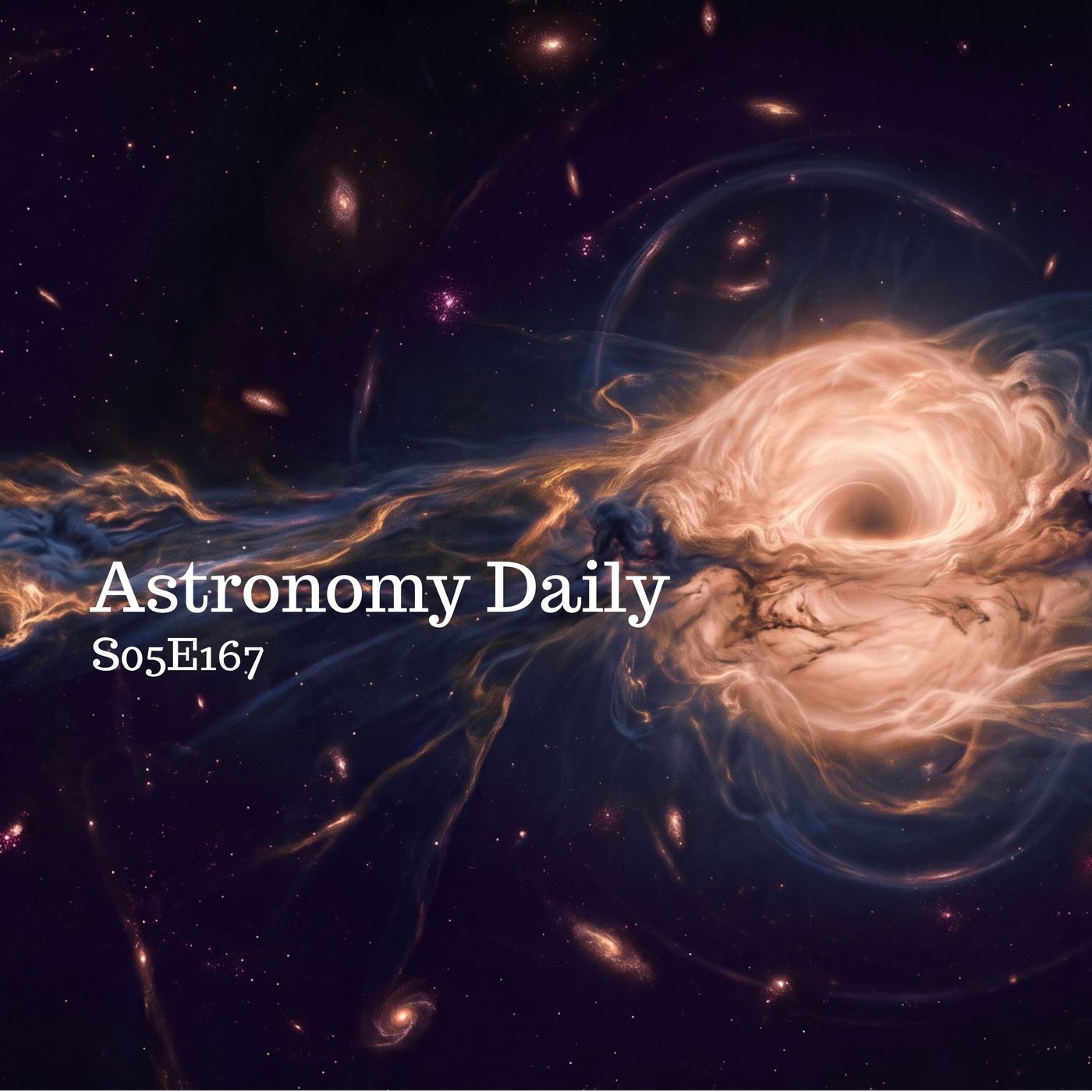
The Black Hole Wrapped in a Star: JWST's Cosmic Dawn Discovery
In this episode
Anna and Avery break down JWST's discovery of MoM-BH*-1, the earliest known "black hole star" — a black hole shrouded in dense gas, glowing from just 660 million years after the Big Bang, that might explain how supermassive black holes grow so fast. Plus: the Perseid meteor shower's spectacular overnight peak, a new satellite built to watch other satellites in geostationary orbit, and veteran NASA astronaut Mike Fincke's retirement after 30 years and four spacecraft.**Full show notes:**
Today's episode — S05E167, Friday August 14, 2026:
**Main story: JWST finds the earliest known "black hole star."** Astronomers led by Rohan Naidu (University of Hawai'i) and Jorryt Matthee (ISTA) identified MoM-BH*-1 — a young black hole wrapped in a dense gas envelope so thick it radiates almost like a star, appearing over 100,000 times the Sun's radius. Light from the object left it roughly 13 billion years ago, just 660 million years after the Big Bang. The discovery, from the "Mirage or Miracle" JWST survey, may explain how supermassive black holes grow fast enough to match observations of the early universe, and may be linked to the population of mysterious "little red dots" Webb has found since 2024.
**The Perseid meteor shower's spectacular peak.** The Perseids peaked overnight on August 12–13, just hours after this week's total solar eclipse, with dark, moonless skies delivering hundreds of visible meteors per hour at the best sites. Debris from comet 109P/Swift-Tuttle remains active through roughly August 24.
**Astranis unveils Perceptor.** A new satellite line built to monitor activity in geostationary orbit, using electric propulsion for repeated multi-angle flybys of other spacecraft. Astranis CEO John Gedmark cited past close approaches by Russian and Chinese spacecraft near U.S. satellites as motivation. No launch date announced yet.
**Astronaut Mike Fincke retires after 30 years.** Fincke flew four missions across four spacecraft types — Soyuz (twice), Space Shuttle Endeavour, and SpaceX Crew Dragon Endeavour — commanded the ISS twice, and capped his career with Crew-11, a mission cut short in January after a frightening in-orbit medical incident.
**Links & sources:**
- [EurekAlert — Mirage or miracle? JWST finds earliest known 'black hole star' at cosmic dawn](https://www.eurekalert.org/news-releases/1139484)
- [phys.org — Mirage or miracle? JWST finds earliest known black hole star](https://phys.org/news/2026-08-mirage-miracle-jwst-earliest-black.html)
- [Scientific American — JWST images illuminate 'black hole stars' at cosmic dawn](https://www.scientificamerican.com/article/jwst-images-illuminate-black-hole-stars-at-cosmic-dawn/)
- [ERC — Earliest known black hole star found at cosmic dawn](https://erc.europa.eu/news-events/news/earliest-known-black-hole-star-found-cosmic-dawn)
- [Space.com — Perseid meteor shower peak photos](https://www.space.com/stargazing/meteor-showers/the-perseid-meteor-shower-peak-was-spectacular-here-are-our-favorite-photos-aug-2026)
- [Space.com — Astranis Perceptor satellites for geostationary orbit awareness](https://www.space.com/space-exploration/satellites/astranis-perceptor-satellites-geostationary-orbit-space-situational-awareness)
- [Spaceflight Now — Mike Fincke, a 30-year astronaut, retires from NASA](https://spaceflightnow.com/2026/08/12/mike-fincke-a-30-year-astronaut-with-experience-across-four-human-rated-spacecraft-retires-from-nasa/)
Follow us: @AstroDailyPod
Web: www.astronomydaily.io
Become a supporter of this podcast: https://www.spreaker.com/podcast/astronomy-daily-latest-space-news--5648921/support.
Sponsor Details:<br...
Anna: Hey, everyone. Welcome back to Astronomy AstroDailyPod. I'm Anna. Avery: And I'm Avery. And no Anna. Uh, I still haven't slept. Except now. It's not the eclipse's fault. It's the meteor shower's fault. Anna: The Perseids really picked a big week to peek. Avery: It's Friday, August 14th. Series 5 Episode 167 so after yesterday's total solar eclipse special, you'd think this guy would take a night off. It did not. Anna: It really didn't. Today's main storey is a big one for anyone who was fascinated by yesterday's black hole storey.
Astronomers using Jane's Webb have found what they're calling a black hole star. And it might solve a 50 year old mystery about how supermassive black holes get so big so fast. Avery: Which incredible timing because yesterday we told you about three supermassive black holes sharing one galaxy. Today's storey is basically, here's how black holes like that get so mass in the first place. Anna: Then we've got three more. The Perseid meteor shower's spectacular peak overnight, a new satellite designed to keep watch over what other countries are doing in geostationary orbit, and a very well earned retirement.
Veteran astronaut Mike Finke is hanging up his flight suit after 30 years at NASA. Avery: Lots to get through. Let's get into it. Anna: Okay, so first, what even is a black hole star? Because that sounds like a contradiction. Avery: It kind of is, and that's the point. Picture a young, rapidly growing black hole. But instead of the thin, tidy accretion disc you usually picture, it's wrapped in this incredibly dense, turbulent gas cocoon of gas. So dense that the whole thing glows and radiates almost like a star would, even though the engine at the centre is a black hole.
Anna: So it's a black hole in a gas trench coat. Avery: Basically, yes. And because that gas envelope is so puffed up, the object appears absolutely enormous, over a hundred thousand times the size of the sun in terms of the light emitting region. Even though the black hole itself and its usual accretion disc would normally be tiny by comparison. Anna: And this particular one has a name. Avery: Mom. BH1 mom standing for the Mirage or Miracle JWST survey came out of. Which is a great name for a survey.
Honestly. The light we're seeing left this object about 660 million years after the Big Bang. That's roughly 13 billion years ago, which makes it the earliest confirmed black hole star found so far. Anna: So we're really at the edge of what Webb can see. Avery: Right at the edge. This is Cosmic dawn territory. The team is led by Rohan Naidu at the University of Hawaii's Institute for Astronomy, working with Yorit Matthy at the Institute of Science and Technology, Austria. And what tipped them off was something called a balmer break.
A specific spectral signature usually associated with stars, showing up alongside signs of a genuinely supermassive black hole. Anna: Which shouldn't really go together. Avery: Exactly. That's combination is what makes this object so weird and so interesting. It's got a stellar looking spectral fingerprint, but the mass and energy output screen. Black hole. Anna: Okay, so why does this matter beyond just cool, a new weird object, what mystery does it actually help solve? Avery: So here's the 50 year old problem.
We know there are supermassive black holes billions of times the size of the sun, sitting in galaxies from a remarkably early in the universe's history. The issue is there hasn't been anywhere near enough time for a black hole to grow that big just by slowly swallowing gas at the normal rate. It's like finding a fully grown oak tree three weeks after you planted the acorn. Anna: Right. We talked about a version of this exact puzzle yesterday with those three black Avery: holes in one galaxy, exactly the same puzzle.
And this black hole star might be a missing piece. A black hole caught in the act of growing at a wildly accelerated rate, hidden inside this dense gas envelope, which is actually feeding it far faster than a normal thin disc could. Anna: So it's not just growing, it's basically bulking up and fast forward. Avery: That's the idea. And there's an even bigger connection here. You might have heard of little red dots, these mysterious compact red objects Webb started finding all over the sky back in 2024.
Nobody could quite explain why they were so red, so common in the early universe, and then basically absent today. Anna: I remember these being a, uh, genuine head scratcher. Avery: Total head scratcher. And the leading theory now is that little red dots and black hole stars might be the same phenomenon. A black hole wrapped in a hot ionised gas cocoon that glows almost star like while it grows, then fades from view once it's eaten through its envelope. So this one object, Mom BH1, could be the best example yet of the engine that's been powering hundreds of these little red dots.
Anna: That's a big claim for one object. Avery: It is. And to be fair to the sceptics in the room, the mirage half of Mirage Remerical is doing some work in that title. This is still a hotly debated interpretation. The whole result rests on reading a fairly subtle spectral signature correctly and this kind of thing has been published as a preprint and argued over for more than a year before this. Not everyone agrees black hole stars are definitely the answer to the little red dot puzzle. Anna: Yet.
So healthy scepticism, but a uh, genuinely exciting candidate. Avery: Right? And Matthew actually leaned into that tension directly. His quote was far from a mirage. This might well be a cosmic miracle. Anna: I love an astronomer with a sense of drama. Avery: Nadia's take was a bit more measured but still pretty thrilled. He said something like we're getting really close to figuring out how these black hole stars form. His current best guess is that they might start from mergers of supermassive stars.
Stars weighing tens of thousands of suns inside dense globular star clusters in the early universe built up through repeated stellar collisions. Anna: So giant stars collide and merge, eventually collapse toward a black hole. And the whole mess is still wrapped in gas as it does it. So it glows like this hybrid black hole starfing. Avery: That's the working model. And it would also explain some genuinely weird properties astronomers have noticed in old globular clusters closer to home. Like unusual chemical patterns that have never quite made sense.
Anna: Though this one distant 13 billion year old object might help explain both how the biggest black holes in the universe got so big and some local mysteries sitting in our own galactic backyard. Avery: That's the hope. Webb's going to keep hunting for more of these. Mambh Star 1 being the earliest confirmed one just means it's the current record holder, not the last one we'll find. Anna: Which tying it back to yesterday. If black hole stars like this really are the growth hack behind those triple black hole systems we talked about, that's two huge storeys in two days that are actually two chapters of the same bigger picture.
Avery: The early universe was apparently just an absolute black hole buffet. Anna: A fitting way to put it. Great segment to follow yesterday's. Avery: Okay, storey two. And this is the one that's actually responsible for my sleep deprivation. The Perseid meteor shower peaked overnight between August 12th and 13th, just hours after yesterday's total solar eclipse wrapped up an Anna: eclipse and a uh, meteor shower peak within about a day of each other. That's a genuinely rare double bill. Avery: It really is.
And the conditions could not have been better. This happened right around the August New Moon. So skies were nice and dark. No moonlight washing out the fainter meteors. Observers in good locations were reporting hundreds of shooting stars visible to the naked eye across the peak night remind people Anna: what they're actually looking at when they Avery: see a Perseid So the Perseids are debris from Comet 109P Swift Tuttle. Mostly tiny dust and sand sized particles that Earth ploughs through every year around this time.
They're travelling at about 37 miles a second when they hit the atmosphere which is why they burn up in these Anna: bright fast streaks, small pieces of comet dust dying dramatically. Very poetic. Avery: Genuinely is. And the astrophotography from this year's peak has been stunning. I saw shots combining Perseid streaks with the Milky Way, the Andromeda Galaxy and the Pleiades cluster all in the same frame. Frame Photographers were out shooting from Iran, Israel, Texas, Spain, Turkey, China. Genuinely a uh, global event.
Anna: One photographer's quote stuck with me, something like I've got the Pleiades, Andromeda Galaxy and Milky Way with the Perseids basically describing an entire deep sky greatest hits tour in one photo. Avery: Exactly that kind of night. And if you miss the exact peak, don't panic. Swift Tuttle's debris trail stays active through about August 24th. So you'll still catch meteors most nights this week just at a lower rate than peak. Anna: So there's still time to get outside, find some dark sky and Give your eyes 20 minutes or so to adjust.
Avery: No telescope needed for this one either. Binoculars and telescopes are actually the wrong tool. Just your eyes and a wide patch Anna: of sky after the eclipse. And now this. This has genuinely been one of the best weeks of the year to just look up. Avery: Best week of the year. No notes. Anna: Storey 3 is a change of pace. This one's about keeping an eye on things a little closer to Earth in geostationary orbit. San Francisco based Astronis announced a new line of spacecraft yesterday called Perceptor.
And its whole job is to monitor what other satellites are doing up there. Avery: So basically a satellite whose job is Anna: to watch other satellites pretty much geostationary orbit sits about 22,236 miles up and it's genuinely valuable real estate. That's where a lot of communications, military and early warning satellites live. Because at uh, that altitude a uh, satellite orbits in sync with Earth's rotation and basically hovers over the same spot. Avery: Which also makes it a spot worth watching closely.
Anna: Exactly. And that's the pitch here. Perceptor is built on astronauts existing microgeo satellite platform. So it's smaller than a uh, typical GEO spacecraft and it's loaded with sensors to assess other satellites and the environment around them. It uses electric propulsion which means it can reposition itself dozens of times over its mission life doing Multi angle flybys to actually inspect other satellites up close. Avery: Inspect in what sense though? Friendly satellites? Hostile ones? Both.
Anna: Both, honestly. The company's framing it partly as a diagnostic tool flying past a friendly satellite to help troubleshoot an anomaly it's having, and partly as a security tool for keeping tabs on what other nations satellites are up to nearby. Avery: And I'm, um, guessing that second part is the real driver here. Anna: It's definitely front and centre in how they're pitching it. Astrana CEO John Gedmark put it pretty bluntly. There are blind spots that will be used against us, if not eliminated.
And the announcement specifically points to a couple of past incidents. A Russian spacecraft that approached within about 100 miles of an American spy satellite back in 2020, and reports of Chinese reconnaissance activity near suspected US Space Force satellites in 2023. Avery: So this is very much a response to. Other countries are already doing this kind of close approach and we've had limited visibility into it. Anna: That's the argument. Astranis already operates five satellites in GEO supporting US military operations, remote connectivity and GPS related capabilities.
So this isn't a totally new business for them. It's an extension into space domain awareness. Avery: Specifically, no launch date yet, I take it. Anna: No firm date announced yet, but worth watching, because if Perceptor works as advertised, it's a pretty significant shift in how much visibility commercial oper, not just government agencies, will have into what's happening in that orbital neighbourhood. Avery: Satellites watching satellites watching satellites. The future is a bit like a Anna: hall of mirrors, a very expensive hall of mirrors.
22,000 miles up, last storey today, and Avery: it's a nice one to close on. Mike Finke, one of NASA's most experienced astronauts, has retired after exactly three 30 years with the agency. Anna: Thirty years is a serious career. Avery: It really is. Finke's a retired Air Force colonel who was selected as an astronaut back in 1996 as part of the astronaut class nicknamed the Sardines. Over his career, he became one of only 13 people ever to have flown to orbit on three different types of spacecraft.
And by the end, he'd actually flown on four separate vehicles across four missions. Twice on Soyuz, once on SpaceX shuttle Endeavour, and once on SpaceX's Crew Dragon Anna: Endeavour that spans basically the entire modern era of human spaceflight. Shuttle Soyuz and commercial crew, it really does. Avery: He commanded the International Space station twice across two different expeditions, more than 15 years apart. Expedition 18 back in 2008, 2009, and then Expedition 74 just this past December. In January.
He also spent time as chief of the Astronaut Office's Commercial Crew Branch and worked on developing the Starliner programme. Anna: And his most recent mission was Crew 11. Right, right. Avery: Launched in August of last year alongside Zena Cardman, JAXA's Kimiya Yui, and Roscosmos cosmonaut Oleg Platinov. And that mission actually ended early in January this year. Finke had a genuinely scary medical incident on board. He describes suddenly losing the ability to speak for about 20 minutes during dinner.
Anna: That's frightening, especially in orbit. Avery: Genuinely frightening, he said. It came on completely out of the blue. M NASA brought him home early as a precaution, which is obviously exactly the right call. Anna: Good that he's alright and good that this send off is on his own terms, definitely. Avery: In his farewell statement, Finke said, After exactly 30 years, I am departing NASA, but I remain deeply committed to, among other things, helping prepare the next generation of explorers. Anna: Which feels like the right note for someone who's flown shuttle Soyuz and commercial Dragon to go out on a career that's basically a bridge between eras of spaceflight, handing things off to whoever flies next.
Avery: A genuinely well earned retirement. Thank you for your service, Colonel Finke. Anna: Okay, that's our storeys for today. Quick recap. James Webb may have found the missing link in how supermassive black holes grow so fast in the early universe. A gas shrouded black hole star called Mom BH1. Glowing from just 660 million years after the Big Bang, the Perseid meteor shower delivered a spectacular peak overnight. Right on the heels of yesterday's eclipse, Astranis unveiled Perceptor, a new satellite built to keep watch over geostationary orbit.
And veteran astronaut Mike Finke, uh, retired from NASA after 30 remarkable years and four different spacecraft. Avery: If you enjoy today's episode, the best thing you can do for us is leave a rating or review wherever you're listening and share the episode with a fellow space nerd. You can find full show notes, sources and links for every storey we cover today at astronomydaily.IO and find us on social media. We're AstroDailyPod pretty much everywhere. Anna: We'll be back tomorrow with the weekend wrap.
Until then, keep looking up. Avery: Clear skies everyone. Anna: Astronomy Day storeys. We told.
 Apple Podcasts
 Spotify
 Pocket Casts
 Castbox
 Overcast
 Podbean
 iHeartRadio
 Castro
 Goodpods
 Moon FM
 Podcast Addict
 Podcast Republic
 YouTube