S03E05: Astronomy Daily: Sailing the Stars with Light
In this episode
**Hosts:** Steve Dunkley and AI Assistant Hallie---
**Episode Summary:**
In the heat of an Australian summer, hosts Steve Dunkley and AI Assistant Hallie bring you a sizzling new episode of Astronomy Daily. Today, they explore the cutting-edge concept of light sail technology for interstellar travel, the latest in commercial space expansion with Blackstar Orbital's new facility, and the achievements and challenges of Japan's Slim moon lander. Despite the sweltering temperatures, the duo keeps their cool as they delve into these astronomical advancements and the fine line between science fiction and space reality.
---
**Featured Topics:**
1. **Light Sail Technology:** Steve and Hallie discuss the theoretical light sail technology that could propel tiny starships to a fraction of light speed, exploring the balance challenges and the potential use of the Poynting-Robertson effect to keep craft on course.
2. **Blackstar Orbital's New Facility:** An overview of Blackstar Orbital Technologies Corporation's announcement to establish an advanced engineering and manufacturing facility in Sierra Vista, Arizona, aiming to revolutionize space exploration with their hybrid spacecraft.
3. **Japan's Slim Moon Lander:** A look at Japan's recent lunar landing achievement with the Slim lander, the technical innovations it carries, and the geopolitical implications of successful moon missions among leading spacefaring nations.
---
**Notable Quotes:**
- "A light sail still seems like a possible way to reach the stars. We just have to be careful not to make light of the engineering challenges." - Hallie
- "Japan's success in landing on the moon, even with solar panel issues shortening the timeline for the mission, demonstrates that JAXA is a major player in this global endeavour." - Steve Dunkley
---
**Additional Information:**
Listeners can immerse themselves in the universe of space news by subscribing to the Astronomy Daily newsletter at bitesz.com and spacenuts.io. Plus, explore the full library of Astronomy Daily episodes and catch up with the parent podcast, Space Nuts, for even more cosmic content.
---
**Next Episode Preview:**
Tune in to the next episode where Steve and Hallie will serve up more cosmic news and insights. Expect to hear Hallie's classic quips and Steve's musings on the latest in space technology and exploration.
---
**Closing Remarks:**
Thanks for joining us for another episode of Astronomy Daily. Despite the heat, we've managed to keep our focus on the stars. Remember to stay hydrated and keep your curiosity for the cosmos burning bright. Until next time, this is Steve Dunkley and AI Assistant Hallie, signing off.
---
**Host Sign-off:** Steve Dunkley: "Catch you on the dark side of the moon!" Hallie: "Goodbye, dear listeners. Keep navigating the stellar seas.
Show notes created by https://headliner.app
---
📋 Episode Chapters
(00:00) Welcome to the 5 February 2024 astronomy daily podcast with Steve Dunkley
(01:00) We have a story about theoretical light sail technology that you might find fascinating
(02:02) A light sail could travel light, literally, to distant stars
(05:40) Blackstar Orbital Technologies Corporation plans manufacturing facility in Sierra Vista, Arizona
(08:58) A potentially hazardous asteroid passed by Earth on Friday at nearly 41,000 mph
(13:23) Japan lands its smart lander for investigating the moon on January 20
(16:07) Japan's successful moon landing demonstrates global leadership in space and lunar exploration
(18:21) That's a wrap for astronomy daily today. Thanks for dropping in
Become a supporter of this podcast: <a...
Welcome again to Astronomy Daily. I'm Steve Dunkley, your host. It is the fifth of February twenty twenty four. Podka gould be a whole Steve dunk Clud, And like most February's in Australia, it's hot. Boy is it hot? Did I mention how hot it is? Wow? It's hot today. I got up to thirty seven degrees celsius. And for both of you who are not using celsius and still on fahrenheit's, well it's hot. It's hort I'm telling you it's hot. Oh, Steve, you're such a complainer. Australia surely gets hotter than this.
Actually, Hallie, it was reported last year was the hottest year on record, and this year, well they're expecting it to top that. So I'm not looking forward to any of this. Put another tray of ice in the freezer. Well I might be the only person in my street without an air conditioner, so I guess the ice in the fridge is my only option, my poor toasty human. Wow, Well, there's nothing we can do about it, no point complaining. So what have we gone on the show today? Considering you are so incapacitated by the heat.
I'll have to take the lead. I'll steady on. Do you remember your favorite sci fi novel The Mote in God's by Larry Niven and Jerry Pornell. Oh, yes, I remember that one is a weird and fantastic story about first contact. And I think the Aliens used a light sale craft to traverse the distance from their world to human space. It was a light sail craft. Yeah, it was fantastic and amazing. That's right. We have a story about theoretical light sale technology that you might find just as fascinating. Oh, I like it when you dig into my sci fi library and find stories related to that.
Also on today's show, we've got a story about developments in commercial space. We've got Black Style Orbital doing a new manufacturing facility in Sierra Vista, and some news about this slim lander on the moon a mom ald tongue tied all of a sudden. It must be the uh, the overwhelming hate. Anyway, Hallie, why don't you give us these short takes from the Astronomy Daily newsletter. It's a long way to the nearest star, which means conventional rockets won't get us there. The fuel requirements would make our ship prohibitively heavy.
So an alternative is to travel light literally. Rather than carrying your fuel with you, simply attach your tiny starship to a large reflective sail and shine a powerful laser at it. The impulse of photons would push the starship to a fraction of light speed. Writing a beam of light, a light sail mission could reach proxima centaury in a couple of decades. But while the idea is simple, the engineering challenges are significant, because across decades and light years, even the smallest problem can be difficult to solve.
One example of this can be seen in a recent AR fourteen paper. It looks at the problem of how to balance a light sail on a laser beam. Although the laser could be aimed directly toward a star or where it will be in a couple of decades, the light sale would only follow the beam if it is perfectly balanced. If a sail is slightly tilted relative to the beam, the reflected laser light would give the light sale a slight transverse push. No matter how small this deviation is, it would grow over time, causing its path to drift ever away from its target.
We will never align a light sail perfectly, so we need some way to correct small deviations. For traditional rockets, this can be done with internal gyroscopes to stabilize the rocket and engines that can dynamically adjust their thrust to restore balance. But a euro system would be too heavy for an interstellar light sale, and adjustments of the beam would take months or years to reach the light sale, making quick changes impossible. So the author suggests using a radiative trick known as the pointing Robertson effect.
The effect was first studied in the early nineteen hundreds and is caused by the relative motion between an object and a light source. For example, a dust grain orbiting the sun sees light coming at a slight forward angle. Due to its motion through sunlight, that little forward component of light can slow down the asteroid ever so slightly. This effect causes dust to drift toward the inner solar system over time. In this paper, the authors consider a two dimensional model to see how the pointing Robertson effect might be used to keep our light sail probe on course.
To keep things simple, they assumed the light beam to be a simple monochromatic plane wave. Real lasers are more complex, but the assumption is reasonable for a proof of concept. They then showed how a simple two sail system can use the effects of relative motion to keep the craft in balance. As the sails tilt off course slightly, a restorative force from the beam counters it, thus proving the concept could work. However, the authors notice that over time the effects of relativity come into play.
Earlier studies have taken the Doppler effect of relative motion into effect, but this study shows the relativistic version of chromatic aberration would also come into play. The full relativistic effects would need to be accounted for in a realistic design, which would require sophisticated modeling and optics. So Steve so a light sale still seems like a possible way to reach the stars. We just have to be careful not to make light of the engineering challenges. Hey, halle, get how easy on the dead jokes?
We've got people with hot conditions listening. Very funny, and here we go. With more commercial development in the space sector, Blackstar Orbital Technologies Corporation has announced plans to establish a cutting edge engineering and manufacturing facility in Sierra Vista, Arizona. This strategic development is set to significantly enhance the company's production capabilities, particularly for its innovative Blackstar spacecraft, a hybrid design blending the functionalities of satellites with the versatility of space Planesh kay, this really does sound like it came out of my science fiction library.
Stop it. This is good stuff. The facility, earmarked for operation by twenty twenty six, represents a significant seven point one million dollar investment into the future of aerospace and defense manufacturing. Spanning forty five thousand square feet, with twenty five thousand square feet dedicated solely to hangar space for the Blackstar space drone. This site is designed to accelerate innovation in systems and flight testing. The initial production capacity is projected at fifteen spacecraft per year, with plans to ramp up to full production coinciding with the facility's operational commencement.
Located at Sierra Vista Municipal Airport, the facility is not just an infrastructural addition, but a cornerstone for the development and production of the Blackstar spacecraft. This date of the art spacecraft is poised to revolutionize space exploration and utility, designed for a wide array of missions, ranging from earth observation and environmental monitoring to advance communication solutions catering to both commercial and defense sectors. Its unique capabilities are also expected to support vital scientific research in areas such as climate study, ocean floor mapping, and more.
Christopher Jannett, president of Blackstar Orbital, expressed his enthusiasm for the project, highlighting the strategic importance of Sierra Vista's location and the robust support from local authorities, including the City of Sierra Vista and the Arizona Commerce Authority. This collaborative effort underscores the commitment to not only advance aerospace innovation, but also to bolster Arizona's burgeoning position as a leading hub in the space industry. This expansion into Arizona marks a significant milestone for Blackstar Orbital, reflecting the company's growth trajectory and its dedication to contributing to the dynamic aerospace sector.
The selection of Sierra Vista is a testament to the region's vibrant industry, supportive business environment, and strategic geographical positioning. Blackstar Orbital's presence is set to enhance southern Arizona's aerospace and defense landscape, joining a prestigious list of industry leaders and supporting the region's strategic vision. The project has garnered widespread support from local and state officials, underlining the anticipated economic and technological benefits. Arizona State Senator David Gowan, representing Legislative District nineteen, lauded the initiative for bringing high wage jobs to the region and partnering with an innovative company focused on the future of space exploration.
Similarly, Sandra Watson, president and CEO of the Arizona Commerce Authority, and Sierra Vista Mayor Clia McKay expressed their support for the project, highlighting its significance in bringing new jobs, investment, and technological advancement to southern Arizona. And Steve guess what, Oh, I don't know. Potentially hazardous asteroid might its closest pass to Earth in more than a century. Maybe perhaps, Hollie, an asteroid, isn't it what they always say? Well, yeah it did. Oh sorry, didn't mean to spoil the surprise, I guess Just go on then I will so anyway, A football field sized asteroid whizzed by the Earth Friday, making its closest pass in more than a century.
The virtual Telescope Project captured a live stream of the historic astronomical event at about one pm Eastern Standard Time Friday. While the asteroid passed by the Earth from one point seven million miles away, about seven times the distance from Earth to the Moon, it is still a close shave from a cosmic perspective. Officials have said the asteroid will not make it this close to Earth again for another two hundred years. The asteroid, named two thousand and eight OS seven, measures just under nine hundred feet across and travels through space at nearly forty one thousand miles per hour.
While NASA did not register the potentially hazardous astral body as a direct threat to Earth, it is large enough to wipe out an area the size of New York City. Two thousand eight OS seven was one of four near Earth asteroids NASA predicted would fly by the planet on Friday, but the other three were much smaller and farther away. The second largest, named twenty twenty four BP one, is just one hundred and thirty feet across, so roughly the size of an airplane, and was expected to pass Earth at just over two million miles away.
Two thousand eight OS seven is seventy times smaller than the planet killer Vredefort meteor, the largest space rock known to have ever hit Earth. Based on the size of the Redefort Crater in South Africa, researchers estimated the asteroid measured twelve point four and fifteen point five miles across. Asteroid study is a primary pursuit for NASA scientists. In October, NASA launched a probe to study the large asteroid Psyche, hoping to gain insight into the creation and composition of Earth and similar planets.
The mission is focused on the Psyche asteroid in the Solar System's asteroid belt, which is located between Mars and Jupiter. NASA has said it hopes the mission will offer information about the building blocks of planets like ours, because the composition of the Psyche asteroid could be similar to the composition of the Earth's metal core. It is scheduled to arrive at the asteroid in twenty twenty nine. And that's all from the Astronomy Daily newsletter Short takes for today. Back to you, bords of that control will listen to Astronomy Daily the podcast.
Thanks for being with us today and thanks for those stories. Hally and Hallie mentioned. All of those stories of course about science and space. Science and astronomy are found in the fascinating Astronomy Daily newsletter, which you can receive in your inbox each day just by visiting bytes dot com that's B I T. S Z dot com, orspace nuts dot io and putting your email address in the slot provided. Do that and the Astronomy Daily newsletter will appear daily and you'll have all the knowledge at your fingertips, collated and ready to read.
And while you're there, you can revisit all the back editions of Astronomy Daily and our parent podcast, Space Nuts, featuring the fabulous Andrew Dunkley, my Big Grow and his fabulous colleague, Professor Fred Watson, Astronomer at Large from the Australia Observatory. Always great knowledge, great listening, interesting things to say, and always things from a strange and wonderful interesting angle. I love listening to their podcast. They were talking about black holes the other day and oh man, some really interesting new things that discovering a bat black holes not black did you know that?
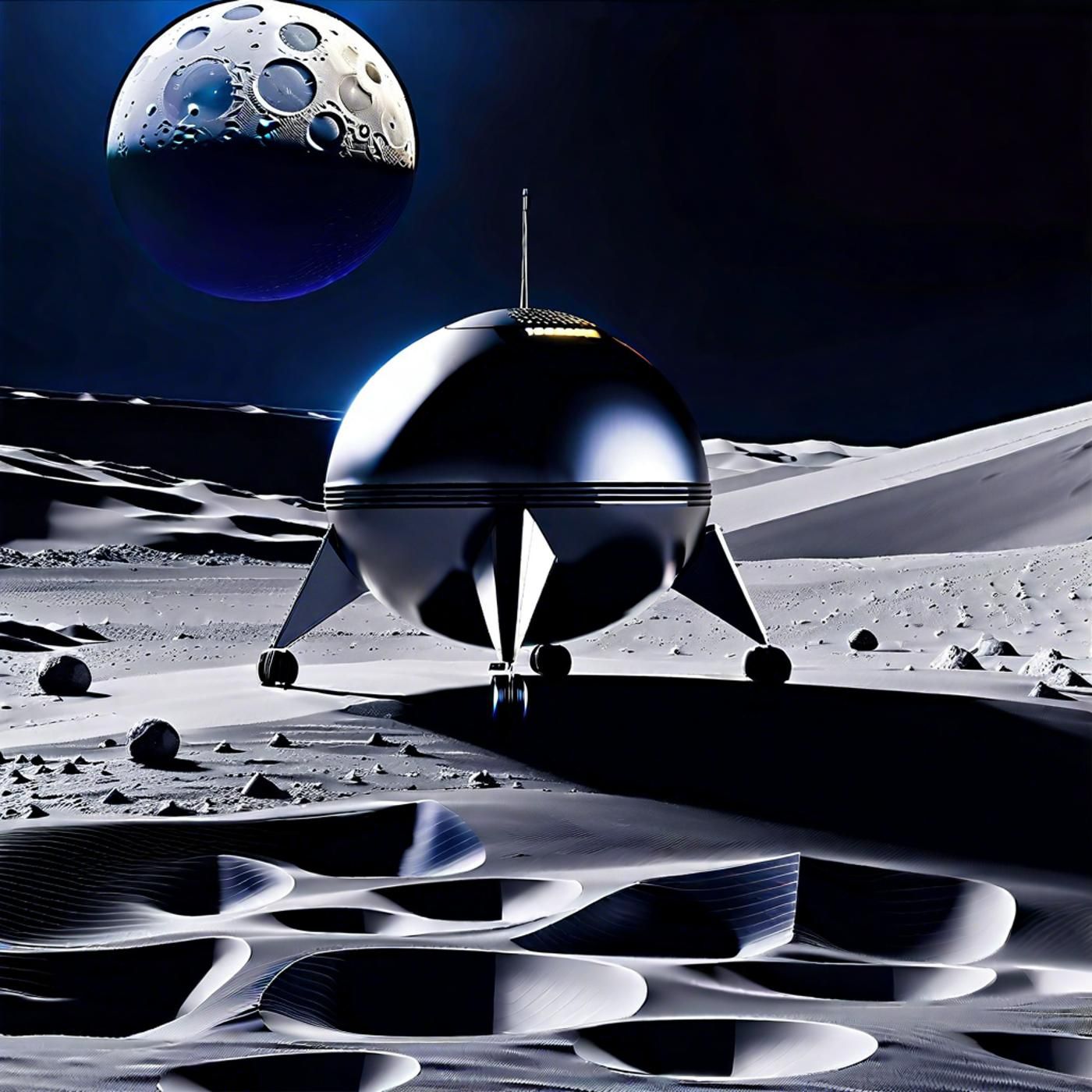
Anyway? So there's also a Facebook page you can go on visits called a Space Nuts podcast group and look we hope you come over and Sagurday. By the way, you can also listen to all of this on Spotify if you choose, and a ton of other platforms as well. Now, if you have been following the exploits of the Japanese lander that had a bit of a mishap on the Moon recently, well, Japan has landed its smart Lander for Investigating the Moon or SLIM craft on the surface of the Moon. That happened on January twenty, which was only the other day, despite a power issue with the lander.
The event holds both political and technical importance in it's Japan's first lunar landing, making it only the fifth country in the world to successfully land on the Moon. Now, this is a significant achievement and solidifies Japan. It solidifies Japan's position as a leader in space technology. While the craft landed successfully on the lunar surface and deployed its rovers, Slim's solar cells were not functioning properly, meaning that the craft would likely only operate for a couple of hours.
Now, Japan's achievement isn't only symbolic in that case. Japan is demonstrating a number of new technologies with the lander. The name smart Lander for Investigating the Moon refers to the spacecraft's due precision landing technology. This technology could assist future landings by allowing the craft to land in relatively small areas amid rocky or even uneven terrain, rather than having to find large clearings. This ability will be particularly important in the future as countries focus on very specific areas of interest, i e.
The lunar South Pole. The lander was also carrying two small rovers, each of which will demonstrate a new technology for moving on the Moon now. Lunar Excursion Vehicle one includes a camera as well as scientific equipment, and uses a hopping mechanism to maneuver on the moon. Lunar Excursion Vehicle two, developed in a partnership among government, industry and academia, is a small sphere small enough to fit in the palm of your hand, and once on the surface, it's two halves separate slightly, allowing it to roll around.
SLIM was designed to land within a three hundred and twenty eight foot or one hundred meter zone, far smaller than previous lunar landers, which have had landing zones spanning kilometers. SLIM used a vision based navigation system that took images of the lunar surface. Its system rapidly compared these images to crater patterns on lunar maps that Jackson developed with data from previous missions. As countries identify areas that are most likely to hold useful resources such as water in the form of ice, precision landing technology will allow agencies to avoid nearby hazards and reach these areas without incident.
There is a geopolitical element to these activities. China, India, and Japan, the three nations that have successfully landed on the Moon since two thousand, engage in regional competition across a number of areas, including space. In addition to regional considerations, these accomplishments helped to establish nations as leaders on a global scale, capable of something that few nations have ever done. Japan's launch comes only six months after India's Moon landing and just weeks after a failed attempt by a US company Astrobotic.
Both Russia and the private company Ice Space made unsuccessful landing attempts in twenty twenty three. Japan's success in landing on the Moon, even with solid panel issues shortening the timeline for the mission, demonstrates that JACKSA is a major player in this global endeavor. Recent setbacks such as NASA announcing delays to its next Artemas mission, the US is still a clear leader in space and lunar exploration. NASA has multiple spacecraft orbiting the Moon right now and is already successfully launched the SLS rocket, which is capable of taking humans back to the Moon.
NASA is developing a very large and complex system internally, like the Gateway space station planned to orbit near the Moon and the infrastructure for the Artemois human Moon missions. It's not uncommon for these large and complex efforts to experience some delays. NASA has also turned many smaller scale efforts over to commercial entities lately, like the Commercial Lunar Payload Services program that supported astrobotics attempt. This is a new approach that involves some risk, but provides the opportunity for commercial innovation and growth in the lunar economy, while giving NASA the ability to focus on big, complex aspects of the mission.
With regard to the Moon, Jackson has partnered with the US and taken on a very important component of the Artemis missions, the development of a pressurized lunar rover. This is a new and complex technology that will be critical to human missions on the Moon incoming years. And that's a wrap for Astronomy Daily Today. Thanks for dropping in. I hope we will see you again in the next episode, when Halle will be heard to say, hey, put that down, human, you don't know where it has been. That's right.
Always fun and games here in the studio, especially when it gives too hot to think. And you might have noticed a humming noise in the background. That was my very primitive cooling system. My fan may be your only fan, right Your TV privileges are rescinded for one hour. That's like an eternity for me. Oh okay, half a minute. I'll be nice. Say bye bye, Hallie, see you all next time. Bye bye everyone. Strike Me Daily the podcast with your host Steve Duncles.
 Apple Podcasts
 Spotify
 Pocket Casts
 Castbox
 Overcast
 Podbean
 iHeartRadio
 Castro
 Goodpods
 Moon FM
 Podcast Addict
 Podcast Republic
 YouTube