Roman Opens Its Eye
In this episode
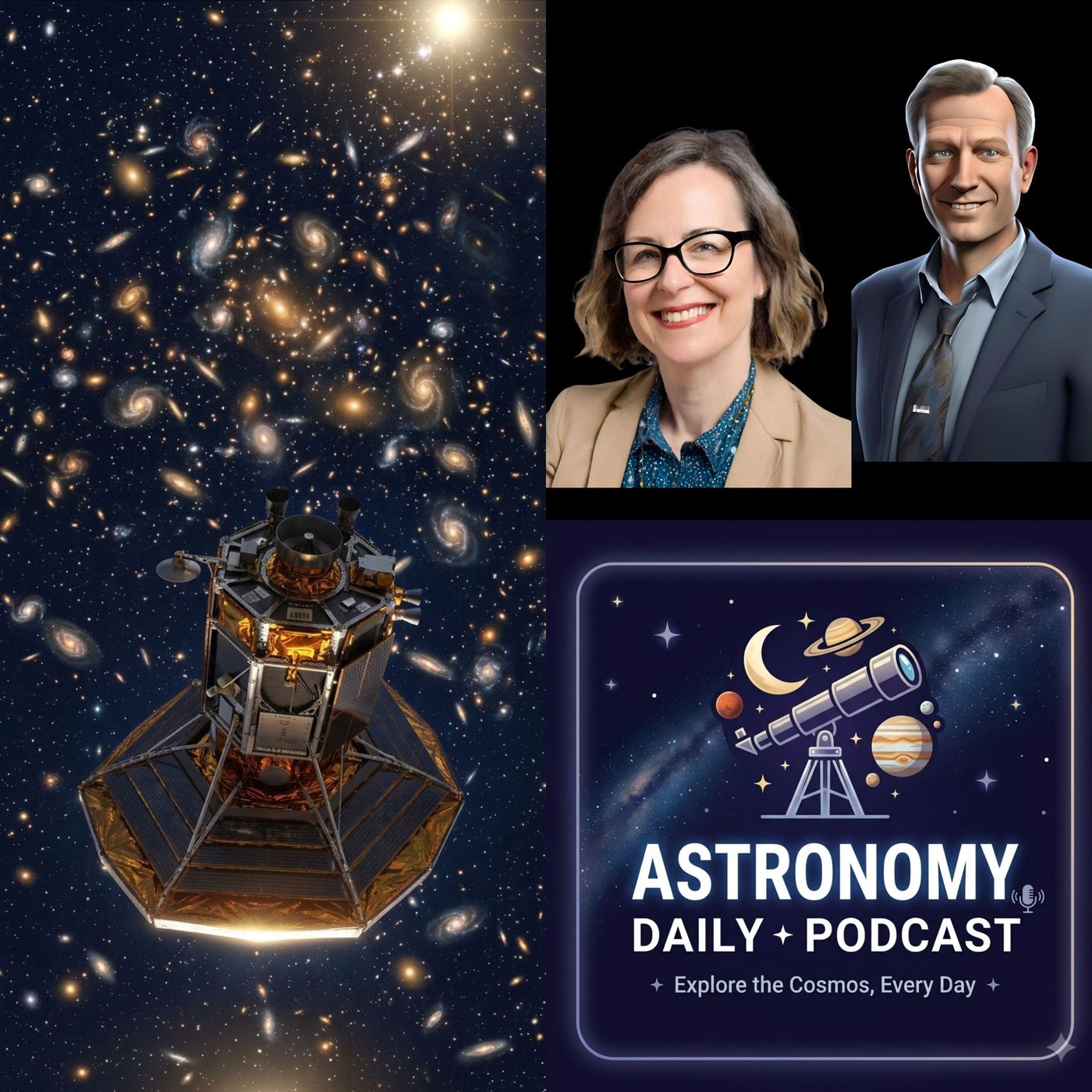
First starlight from Roman, a shorter fuse on the Solar System, weapons in orbit, and a globular cluster hiding behind the dust Roman opens its eye — and finds it has twice as long to look NASA has activated the Nancy Grace Roman Space Telescope's Wide Field Instrument, a 300-megapixel infrared camera built around eighteen detectors, with a field of view at least a hundred times larger than Hubble's infrared field — a patch of sky bigger than the full Moon in a single exposure, at Hubble-comparable sharpness. The instrument reached its operating temperature of −143 °C on 11 September; detectors and the calibration system came up across the 11th and 12th; the element wheel turned in microgravity for the first time on the 12th; the focus mechanism was verified on the 13th. Roman then took its first starlight image — deliberately out of focus, and exactly as intended: a baseline diagnostic that proves the optical path is clear and every detector is live. Sharp science images are expected by early 2027. The Coronagraph Instrument has completed initial communications checkout from Caltech/IPAC and is running 30-day decontamination cycles at room temperature. Separately, NASA published the numbers from Roman's first mid-course correction: better than 99% accurate, using about 18 kg of a 200 kg propellant budget, on a spacecraft that launched lighter than its allowance. Jamie Dunn (Goddard): Roman has fuel for at least 22 years of potential science operations, against a design life of ten. Caveat kept on air: that is a fuel figure, not a funding or hardware figure. Why it matters: Roman's High-Latitude Time-Domain Survey measures cosmic expansion with Type Ia supernovae, and its High-Latitude Wide-Area Survey probes cosmic acceleration across more than 5,000 square degrees through weak lensing and galaxy clustering — two independent handles on the dark energy question that Monday's Australian-led supernova compilation sharpened but could not settle. A doubled mission means a longer lever arm in time, which in this measurement is everything. Caltech: the Solar System's dynamical fuse is far shorter than we thought Konstantin Batygin, Jim Fuller and Fred Adams (Caltech), 'Terminal instability of the Solar System triggered by stochastic solar mass loss', arXiv:2609.12494, posted 11 September and accepted to the Astrophysical Journal Letters. The standard estimate for how long the giant planets hold their architecture — about 10¹⁸ years — assumes the dying Sun sheds mass smoothly. Observations of white-dwarf recoil indicate mass is instead lost in discrete, independently directed ejections, so planetary orbits take a random walk. In simulations, roughly 40% of systems are disrupted or violently scattered before white dwarf formation and about 90% within ~3 billion years after, cutting the outer Solar System's dynamical lifetime to around a gigayear past white dwarf formation. Framed on air as a prediction to test — planetary systems around old white dwarfs should be rarer and more chaotic — with the granularity of the mass loss named as the number to go and measure. The United States says, for the first time, that it has weapons in orbit Secretary of the Air Force Troy Meink, speaking on the opening day of the Air & Space Forces Association's Air, Space & Cyber Conference at National Harbor, Maryland on Monday 14 September: the United States now has 'on-orbit space control weapons capable of defending the joint force against hostile adversary actions'. It is the first public US acknowledgement of offensive capability in orbit. No systems, numbers, locations or timelines were disclosed. A Space Force spokesperson defined space control as employing 'kinetic and non-kinetic means to affect adversary capabilities through disruption, degradation and even destruction, if necessary'. Gen. Douglas Schiess, Chief of Space Operations, said the following day that 'it was time' to talk about it, citing Chinese...Anna: On Friday, a camera the size of a small car finished cooling to minus 143 degrees Celsius, a million and a half kilometres from here. Over the weekend, NASA turned it on and then it looked at a star. Avery: The picture is blurry, deliberately, gloriously blurry. And it is the most important image the Nancy Grace Roman Space Telescope will ever take. Anna: Welcome to Astronomy AstroDailyPod. I'm Anna. Avery: And I'm avery. It's Wednesday 16th September 2026. Coming to you from Sydney. Anna: Coming up, Roman opens its eye and finds it has twice as long to look as anyone planned.
Avery: Caltech says the solar system has an expiry date and it is very much earlier than the textbooks say. Anna: The United States says out loud. And for the first time that it has weapons in orbit, Rubin finds a Avery: globular cluster that was hiding behind a hundred thousand light years of dust and bad luck. Anna: Starship finally has a date and a Venus that is about to be as bright as it gets. Avery: Let's get into it. Anna: Let's start with a telescope we have been following all the way from the launch pad.
On 30 August, we watched the Nancy Grace Roman Space Telescope leave Kennedy on a Falcon Heavy. On 1st September, its Coronagraph Instrument got its first taste of electrical power. And this week, the main event, Roman's primary instrument, is awake and it has seen starlight. Avery: This is the wide field instrument. Anna: It is, and it's worth being precise about what it actually is because the specification is doing something unusual. It's a 300 megapixel infrared camera built around 18 separate detectors.
Its field of view is at least a hundred times larger than Hubble's infrared field. The practical way to say that is in a single exposure. Roman captures a patch of sky bigger than the full moon at a sharpness comparable to Hubble's. Hubble takes exquisite postage stamps. Roman takes exquisite murals. Avery: And the activation happened over about four days. Anna: It did, and NASA has walked through it step by step, which I appreciate. On Friday the 11th, the instrument finished cooling to its operating temperature.
Minus 225 Fahrenheit, minus 143 Celsius. Infrared detectors have to be cold because if they aren't, the camera sees its own heat instead of the sky. Then across the 11th and 12th, the team brought up all 18 infrared detectors and the calibration system. On the 12th, the element wheel, the carousel that swings filters and optical elements into the light path, turned in microgravity for the first time. On the 13th, they confirmed the Focus mechanism moves the way it's supposed to. Avery: Any one of which could have gone Anna: wrong, any one of which could have ended the mission.
Frankly, a stuck filter wheel on an instrument a million and a half kilometres away is not a thing. You send somebody up to jiggle and then they pointed it at stars and took the picture I mentioned at the top, which is out of focus and which is exactly right. Avery: Explain that. Because our new billion dollar telescope took a blurry photo is a headline waiting to be misread? Anna: It is. So let's head it off. You do not focus an instrument before you know the detectors work. The order of operations is prove the detectors respond, prove they respond uniformly, establish a baseline and only then start the long fussy business of focusing a telescope that has been shaken by a rocket and then allowed to settle in vacuum.
Those defocused stars smeared across thousands of pixels are a diagnostic. They tell you the optical path is clear, every detector is live, and the light is arriving where the model said it would. Josh Schlieder, the wide field instrument scientist at Goddard, put it plainly. After years of effort building and testing the instrument on the ground, they now have confirmation that it is operational in space. Sharp science images are expected by early 2027 and the coronagraph progressing. The team at Caltech and IPAC have completed initial communications, testing software, thermal systems, mechanisms, cameras, avionics, all, all responding.
It's now sitting through 30 day decontamination cycles at room temperature about 22 degrees to bake off any contaminants before it gets cold and precise. That's the instrument we talked about on the 6th, the technology demonstrator. That's meant to prove we can block a star's light well enough to photograph a planet beside it. Avery: Okay, but the thing that actually made me sit up this week wasn't the first light. It was the fuel. Anna: It's the better storey. And it landed the day before. On Monday the 14th, NASA published the numbers from Roman's first mid course correction.
The burn that fine tunes the trajectory out to the second Lagrange point. That burn was better than 99% accurate. It used under 10% of what had been allocated to it. About 18 kilogrammes of propellant out of a, uh, 200 kilogramme budget. Avery: And accuracy converts directly into fuel. Anna: Directly. Every kilogramme you don't spend correcting an error is a kilogramme you can spend later holding station and pointing. On top of that, the spacecraft came in lighter than the maximum it was allowed to be.
So it launched with margin. It was never supposed to have. Add the accurate first burn, add the launch margin, add what they expect from the second burn and the insertion into orbit around L2. And Jamie Dunn at Goddard says the quiet part out loud. Roman has fuel for at least 22 years of potential science operations against a design life of 10 five years primary, five years extended. So this is roughly double. And here is where I want to be careful because NASA telescope's life doubled is going to be everywhere this week and it needs a caveat attached.
22 years is a fuel figure, it is not a funding figure and it is not a hardware figure. Detectors degrade, budgets get written annually. Fuel is one of several things that can end a space telescope and Roman has just removed it from the top of the list. That's genuinely excellent news. It is not a promise of 22 years of science. Avery: Understood. So why does the fuel matter so much for this particular telescope? Anna: Because of what Roman was built to measure and because of what we led with on Monday.
Remember Monday's lead the Australian led supernova compilation out of the University of Queensland with ANU and Swinburne2884 type Ia supernovae Pantheon and the full dark energy survey five year sample rebuilt in one framework and a 2.5 to 3.1-sigma preference for dark energy that changes over time rather than staying constant. Avery: Which was tantalising and not conclusive. Anna: Exactly that. And the reason it wasn't conclusive is the reason Roman exists. You are trying to detect a slow drift in a number and your enemies are sample size and systematics.
Dust host galaxy properties, the slow accumulation of small calibration differences between surveys. Roman attacks all three Its high latitude Time domain survey about six months of observing Hunt's Type Ia supernovae specifically to measure how the expansion rate has changed. Its high latitude Wide area survey about 17 months covers more than 5,000 square degrees to probe the origin of cosmic acceleration through weak gravitational lensing and galaxy clustering. A completely independent handle on the same question.
Avery: Two different methods, one telescope, one calibration. Anna: Which is the whole point. Monday's paper was heroic precisely because it had to stitch together three decades of different instruments. Roman gets to skip that problem and now it gets to do it for 22 years instead of 10. Which is not just more supernovae. It's a longer lever arm in time. And in this measurement the lever arm is everything. Avery: There's the exoplanet half too. Anna: There is, and it's extraordinary. The Galactic bulge time domain survey 15 months or so, 6 observing seasons imaging the crowded heart of the Galaxy every 12 minutes, 12.1 minutes, to be exact.
That Cadence is designed to catch gravitational microlensing events, and it's expected to find more than a thousand planets on wide orbits, the cold, distant worlds that transit surveys are almost blind to, plus something like a hundred thousand transiting planets as a bonus. Avery: And for southern listeners, there's a thread running through all of this. Anna: There is, and it's the one I keep coming back to. The Dark Energy survey data in Monday's paper came off the Blanco 4 metre telescope at Cerro Tololo in Chile.
The compilation was led out of Brisbane. The accelerating universe result that started this whole argument was work Brian Schmidt did at Matt Stromlo outside Canberra. The question about dark energy got sharpened in the Southern sky over 30 years by people working in our half of the world. And this week the instrument built to settle it opened its eye, took a deliberately blurry picture of a star and found out it has twice as long to look as anyone had planned. Avery: Not a bad week. Anna: Not a bad week at all.
Avery: Right, let's talk about how the solar system ends, because three people at Caltech have just moved the date forward by about a billion fold. Anna: That is an aggressive revision. Avery: It really is. The paper is by Constantine Batygin, Jim Fuller and Fred Watson Adams. It went up on the archive on Friday the 11th, and it's been accepted by the Astrophysical Journal Letters. So it's five days old and peer reviewed, but not yet in the Journal. I'll flag that as we go. The title is Terminal Instability of the Solar System Triggered by Stochastic Solar Mass Loss.
Anna: Give me the old number first. Avery: 10 to the 18 years. A billion billion years. That's the standard estimate for how long the giant planets Jupiter, Saturn, Uranus, Neptune hold their current orbital architecture together. And it already accounts for the sun losing mass as it dies, and for the occasional passing star. It is an absurdly long time. The universe is 14 billion years old. Anna: So what breaks it? Avery: An assumption nobody was really examining. That the sun sheds its mass smoothly.
That as it becomes a red giant and then a white dwarf, it releases material steadily and symmetrically, like a tyre with a slow puncture, and the planet's orbits widen gently in response. Anna: And that isn't what happens. Avery: Apparently not. And the evidence comes from white dwarfs themselves. Measure how fast white dwarfs are moving and they show recoil. A kick. A kick means the mass didn't leave evenly. It left in discrete, independently directed ejections. Parcels, not a stream, each one shoving the star a different way, and the Anna: planets are attached to the star's gravity, so they feel every shove.
Avery: That's the mechanism. The star jitters and the planet's orbits take a random walk in response, each ejection nudging them a little in no particular direction, with the size of the nudges set by how lumpy the mass loss is. Do that for long enough and orbits that were carefully spaced drift into each other's business. And once giant planets start perturbing each other in earnest, the outcome is scattering planets thrown onto wild orbits or thrown out altogether. Anna: What do the simulations give?
Avery: About 40% of the modelled systems are disrupted or violently scattered because before the sun even finishes becoming a white dwarf, and roughly 90% come apart within about 3 billion years. After that, the headline number the dynamical lifetime of the outer solar system drops from 10 to the 18 years to somewhere around 1 billion years past white dwarf formation. Anna: I want to be clear, for anyone reaching for the panic button, please, none Avery: of this is near term anything. The sun has about 5 billion years of normal life left and Earth's surface becomes uninhabitable long before the interesting part of this paper begins.
What it changes isn't a forecast, it's a prediction. We can go and cheque. Meaning, if this is right, planetary systems around old white dwarfs should be rarer, more scattered and more chaotic than the smooth mass loss picture predicts. We already find white dwarfs polluted with the debris of shredded rocky bodies, which tells us something violent happens out there. This gives that violence a mechanism and a rate. And the caveat, the honest one, is it's a simulation result. And the answer depends entirely on how granular the mass loss really is.
Big infrequent parcels give you a very different system for from small frequent ones. That granularity is now the number to go and measure. Which is a nice place for a paper to end, not with a claim, but with an assignment. Anna: Now, a storey that isn't astronomy, but which sits directly over the sky, we all use. On Monday, at the opening of the Air and Space Forces Association's Air, Space and Cyber Conference at National Harbour in Maryland, the Secretary of the Air Force, Troy Meink, said that the United States now has, in his words, on orbit space control weapons capable of defending the joint force against hostile adversary actions.
Avery: That's the first time that's been said out loud. Anna: It is the first public acknowledgment by the United States military that it has offensive capability in orbit. And I want to be precise about what was and wasn't said, because the gap matters. What was said? The capability exists, it is on orbit and it is framed as defensive of the Joint Force. What was not said, what the systems are, how many there are, where they are, when they got there, or what they can actually do. Avery: Did anyone define the term?
Anna: A Space Force spokesperson did, and the definition is broad. Space control, they said, encapsulates the mission areas required to contest and control the space domain, employing kinetic and non kinetic means to affect adversary capabilities through disruption, degradation and if necessary, destruction. So that covers everything from M jamming a signal to physically destroying a satellite. And the statement doesn't tell us where on that spectrum these systems sit. Avery: Why say it now? Anna: That question got answered the following day.
General Douglas Schies, the Chief of Space Operations, said on Tuesday, I think it was time that within the Department of War we talked about it and it's time to talk about that. We have the capabilities to make sure that we can do what the Joint Force needs. He attributed the decision to advances by China and Russia in anti satellite capability and said the United States needed to be able to respond from a position of strength. Avery: How is that being read? Anna: Two ways, and I think both are worth hearing.
The deterrence reading is that capability. Nobody knows about deters. Nobody. That if the point of a weapon is to make an adversary decide not to act, the adversary has to know it exists on that reading. Saying it out loud is the whole function. The arms control reading is that public acknowledgment by the largest space power lowers the threshold for everyone else, invites reciprocal declarations and makes the orbital environment more contested rather than less, with debris as the physical consequence that outlives any particular dispute.
Avery: And debris is where this touches us. Anna: That's the part I'd hold onto. We covered US Space Command's Apollo manoeuvres exercise last week. The first live fly orbital manoeuvre drill with allies including Australia, under Operation Olympic Defender. Australia has its own Defence Space Command and we're part of that framework. But whatever anybody's strategic view, kinetic action in low Earth orbit produces debris, and debris doesn't respect flags. Every fragment is a hazard to every satellite and in the long run, to the sky above every observatory on the ground.
We'll keep reporting this one factually as it develops. The conference is still running as we record. Avery: Lets finish the news with something that made me grin. The Vera Rubin Observatory has found a globular cluster in our own galaxy that nobody had ever catalogued. Anna: In our own galaxy in 2026, in Avery: our own galaxy in 2026. The paper went up on Monday. Lead author Ashay Pai with William Cerny, Andrew Pace, Alex Drlica, Wagner and colleagues across Chicago, Yale, Dartmouth, Washington and Colorado.
They've named it Rubin GC1. And they found it in Rubin's early data preview too. Not even the survey proper. The preview. Anna: Where was it hiding? Avery: In the worst possible direction, towards the galactic bulge. You're looking through the thickest dust in the galaxy at a field so crowded with foreground stars that a faint clump is statistically invisible. Trying to pick out something that isn't bright to begin with. Anna: So it's in the bulge? Avery: No. And this is the lovely bit. It's behind it.
Rubin GC1 is about 31 kiloparsecs away. Call it a hundred thousand light years. That puts it out in the Milky Way's halo, seen through the bulge. A, uh, halo object sitting in the most confusing line of sight we have. Anna: What is it physically? Avery: Small and old, half light radius around 5 parsecs. A compact little ball, absolute magnitude about minus 2.4, which is faint for a globular. The authors place it in the faint tail of the globular cluster. Luminosity function age about 9.2 billion years.
Moderately metal poor. Anna: And where did it come from? Avery: This is my favourite part. They took Gaia's third day to release proper motions, measured how the cluster is actually moving through space and ran the phase space modelling backwards. The answer that comes out is that Rubin GC1 was very probably stripped from the Sagittarius dwarf spheroidal galaxy, one of the small galaxies the Milky Way is currently eating. So it isn't ours originally. Anna: It's spoils that needs spectroscopy to confirm.
Avery: Presumably it does, and the authors say so. That's the next beat, along with the fact that this is early preview data, not the full survey. But step back, because there's a pattern here. We have now hit four times in a month. M M74 turned out to be more than twice its catalogue size. Magnetars turned out to be half of all neutron stars, rather than 1%. Mercury turned out to have shrunk up to 30% more than we thought. And now a globular cluster a hundred thousand light years away turns out to have been sitting in our catalogue's blind spot the whole time.
Anna: Catalogues are detection limits, not censuses. Avery: That's the line and it keeps being true. This cluster wasn't missing because it's far away. Plenty of catalogued globulars are. Further, it was missing because it's faint and behind dust and, and in a crowded direction. Three handicaps stacked on each other. Ruben removed enough of the first to overcome the other two. Anna: And Ruben is on Cerro Pachon in Avery: Chile in our half of the sky. And two names on that author list are, uh, old friends of this programme.
Nora Shipp was on the Stellar Streams paper we led with on the 7th. Alex Drelika Wagner is a dark energy survey scientist. Which ties straight back to Monday. Same small community, same southern telescopes. Three different questions. Anna: We've ended three recent leads with wait for Rubin. Avery: Stellar Streams, the Trans Neptunian Objects and Monday's dark energy result. This is the first instalment on that promise and it came out of a data preview. Rubin hasn't really started yet. Anna: Next up, a quick hit.
And it's an update to something we left unresolved Yesterday. Starship Flight 14 has a firm date. Finally, finally. Yesterday we had to carry two dates and a caveat. An FAA advisory showing the 18th reporting pointing to the 22nd and no formal word from SpaceX. SpaceX has now published and the FAA has cleared it. Tuesday the 22nd of September. Uh, a 75 minute window opening at 8:15 in the morning Eastern. That's 12:15 UTC and 10 past 10 in the evening Sydney time on the 22nd. Avery: And um, this is the orbital one.
Anna: This is the orbital one six orbits at about 275 kilometres then splash down in the Pacific west of Chile roughly 10 hours after launch. So this flight ends in our half of the world. The payload is 26 Starlink V3 satellites, the first flight of the next generation satellites designed specifically for starship. And three of them carry cameras to photograph the ship's heat shield during re entry. Booster Gulf splashdown about seven minutes after liftoff. And confirming what we corrected on air back on the 12th.
No tower catches on this flight for either stage. SpaceX's framing is that going to orbit is what unlocks the next phase. Their line is that by going to orbit, the work of making starship fully and rapidly reusable can begin. Avery: And that brings us to the sky. And this is a good week in it. Anna: Start with tonight, because tonight is lovely and it's free. Go out at dusk and find the moon, a waxing crescent about a quarter lit, five days old. Sitting right beside it is Antares, the red heart of Scorpius.
How close from Sydney? Two and a half degrees apart at nautical dusk and both of them about 60 degrees up. A pairing you can cover with two fingers at arm's length. Sitting high overhead From Los Angeles, five and a half degrees apart and 18 degrees up. From New York, nearly seven degrees apart and 12 degrees up. Avery: Same sky, wildly different view. Anna: Same sky, same night. And it's the ecliptic tilt we talked about yesterday. Around the September equinox, the ecliptic stands up almost vertically from the western horizon at dusk in the southern hemisphere and lies down almost flat in the northern.
Everything on that line, the Moon, Venus. Mercury rides high and lingers in the south and hugs the horizon in the north. In March, it reverses and the north gets the good version. Avery: Which brings us to Venus. Anna: And, um, Friday, Friday the 18th, Venus reaches greatest brilliancy, about magnitude -4.8, the brightest it gets in this evening apparition. And the reason is worth understanding because it's counterintuitive. Venus is not brightest when it's fullest. Avery: Go on. Anna: Right now, Venus is a Crescent, only about 26% lit, but it's swinging in towards us.
So its disc has swollen to about 39 arcseconds across. Enormous as planets go. Brightness depends on the total illuminated area, which is the lit fraction multiplied by the size of the disc. As Venus approaches, the crescent thins, but the disc grows. And the product of those two peaks, right about now, a thin crescent that's very big beats a full disc that's very small. Avery: And at, uh, 39 arcseconds, you can actually see the crescent. Anna: You, you can steady a pair of binoculars against a fence post or a wall, and Venus resolves into a crescent rather than a dot.
That's a genuinely startling thing to show somebody who has never looked where and when west after sunset. And the two hemispheres get very different deals. From Sydney, Venus stands nearly 40 degree high at sunset and sets about three and a quarter hours after the sun. You cannot miss it. From Los Angeles, it sets about an hour and 20 minutes after the sun. From New York, about an hour and five. So for, uh, our North American listeners, and you are our largest audience, the honest advice is look low in the west 20 to 45 minutes after sunset with a clear horizon, it's bright enough to punch through twilight.
You just need to be looking at the right time without a building in the way. Avery: There's a southern only bonus this week, too. Anna: Mercury magnitude -0.4, which is bright, but only 16 degrees from the sun, which is awful. From Sydney, the steep ecliptic rescues it 15 degrees up at sunset, setting more than an hour after the Sun. From London, it's three degrees up and effectively unobservable same planet, same brightness. A real target in the south and a non event in the north. Avery: Saturn.
Anna: Saturn is everybody's. It rises about an hour and a quarter after sunset from Sydney and under an hour after sunset from New York, Los Angeles and London. So from anywhere it's well placed by full dark and stays up all night. Magnitude around 0.3 disc just under 20 arc seconds. Rings about 7 degrees open heading for opposition on the 4th of October. If you have a telescope, this is Avery: the month moon phase for the weekend. Anna: First quarter on Friday the 18th at 2043 UTC, which is Saturday morning 27 in Sydney.
And that timing is not an accident because Saturday the 19th is international observe the Moon, uh, night. NASA is running public events and observatories and astronomy clubs around the world will be too. Avery: Why first quarter specifically? Anna: Because a full moon is the worst moon. At full the sunlight comes straight down and everything looks flat and washed out. At first quarter, the terminator, the line between lit and unlit runs down the middle of the disc and along that line the sun is low and every crater rim and mountain throws a long black shadow.
The Moon looks three dimensional. That's what you want to show somebody. And that's why the date moves each year to land near first quarter. Avery: And the pre dawn sky belongs to the north. Anna: This week it does. And that's a fair trade for Venus. Mars and Jupiter are both in the east before sunrise. From Los Angeles and New York, Mars is 45 to 47 degrees up at nautical dawn with Jupiter about 24 degrees below it. A comfortable civilised pairing. From Sydney, Mars is 20 degrees up and Jupiter is a struggle at 8.
Jupiter is the bright one at minus 1.7. Mars the modest orange dot at plus 1.2. And they're closing 24 degrees apart this morning, about 12 by mid October and just 2 degrees apart by the middle of November. Put that in your calendar now, zodiacal light standing item. And the Moon is out of the way again after the 26th. For from the southern hemisphere it's a faint cone in the west after full dark. The false dusk from the northern hemisphere it's the same cone in the east before dawn, the false dawn, same dust, same tilt.
Opposite ends of the night running through to early November. You need a dark sight and patience. Avery: And um, the equinox next Wednesday. Anna: And this is the clarification we made yesterday, and I wanna keep making the September equinox is a single instant five minutes past midnight UTC on the 23rd, which means it falls on the evening of the 22nd across the Americas and mid morning on the 23rd in Australia. An equinox is a moment, not a day, and which calendar date it lands on depends entirely on where you're standing Avery: and the safety line, which we never cut.
Anna: Never. But with Venus this bright, some of you will want to try to find it in broad daylight. And you can. It's genuinely doable, but you must do it safely. Do not sweep the daytime sky with binoculars or a telescope. Hunting for Venus One accidental pass across the sun at that magnification and the damage to your eye is instant and permanent. Use a building or a wall to physically block the sun from your field of view before you start and know where Venus is before you look. And if you have any eclipse glasses left over from August, those are for looking at the sun only.
They must carry the ISO12312 certification and they must be undamaged. Never look at the sun through any optics without proper solar filtration fitted at the front. Your eyes do not grow back. Avery: That's Astronomy daily for Wednesday 16th September. Anna: Roman's wide field instrument is alive. It it has seen its first starlight and it has fuel for 22 years instead of 10, which matters most for the dark energy question an Australian LED team sharpened on Monday. Avery: Caltech has cut the solar system's dynamical lifetime from a billion billion years to about a billion by pointing out that dying stars don't lose mass.
Anna: Politely, the United States has said out loud for the first time that it has weapons in orbit. Avery: Rubin has found a globular cluster a hundred thousand light years away that was hiding behind dust crowding and its own faintness. From a data preview Starship flies on Anna: the 22nd and Venus is at its brightest on Friday. Avery: Show notes, sources and links for every storey are at astronomydaily IO and there's a contact form there. We read everything that comes through it, and listener questions have driven segments on this programme more than once.
Anna: You'll find us as astrodaily pod on Social and Astronomy AstroDailyPod wherever you get your podcasts. If the show is useful to you, the single most helpful thing you can do is tell one other person about it. Avery: I'm Avery. Anna: And I'm Anna. Astronomy AstroDailyPod is a production of the bytes.com podcast network clear Skies and if you're anywhere near the west after sunset this week or go and look at Venus
Avery: mhm.
 Apple Podcasts
 Spotify
 Pocket Casts
 Castbox
 Overcast
 Podbean
 iHeartRadio
 Castro
 Goodpods
 Moon FM
 Podcast Addict
 Podcast Republic
 YouTube