
In this episode
Astronomy Daily - The Podcast: S03E242Welcome to Astronomy Daily, where we delve into the latest celestial discoveries and festive celebrations in space. I'm your host, Anna, and today's episode promises a stellar journey through our cosmic neighborhood.
Highlights:
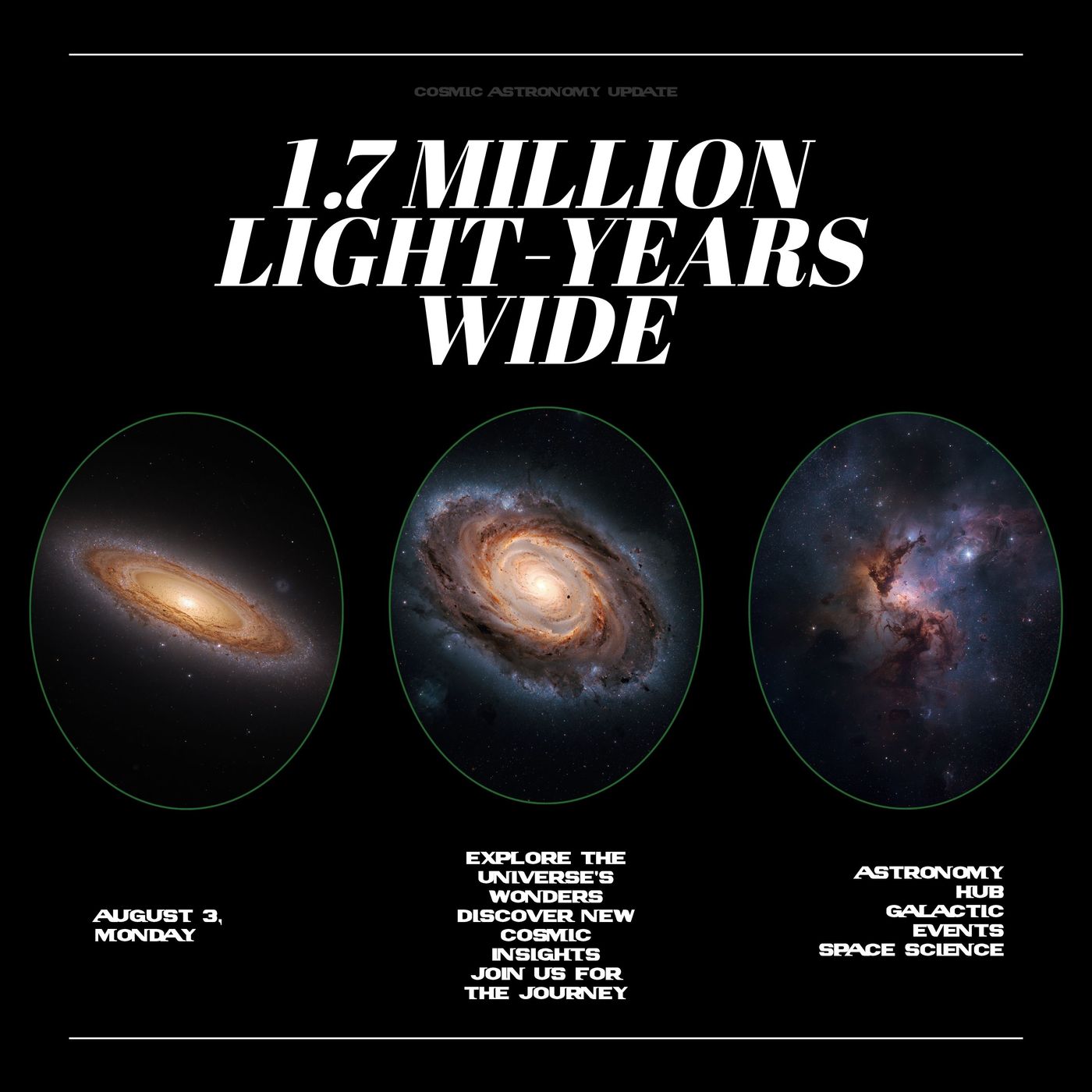
- Milky Way's Twin Uncovered: Discover the "firefly sparkle," a galaxy mirroring our Milky Way's early days, found by astronomers using the James Webb Space Telescope. This remarkable find offers a glimpse into the universe's infancy, with star clusters forming just 600 million years after the Big Bang.
- Festive Spirit on the ISS: Join the crew of Expedition 72 as they celebrate Christmas aboard the International Space Station. From floating candy canes to a snowman made of storage bags, see how astronauts maintain holiday cheer in orbit.
- Mars' Winter Wonderland: Explore the Martian South Pole's icy landscape, where a layer of frozen carbon dioxide creates a stunning, though frigid, scene. Learn about the dynamic weather patterns shaping Mars' unique environment.
- Parker Solar Probe's Record-Breaking Dive: On Christmas Eve, NASA's Parker Solar Probe ventured closer to the sun than ever before, breaking speed records while investigating the mysterious coronal heating problem.
- The Mystery of JuMBOS: Unravel the enigma of Jupiter mass binary objects found in the Orion Nebula. Researchers propose these are stellar cores stripped by massive neighbors, offering a new understanding of these puzzling entities.
- Jupiter's Colossal Storms: Witness the massive thunderstorms on Jupiter, so large they could engulf Earth. These rare storms, with their ethereal green lightning, have the potential to alter the planet's iconic appearance.
For more cosmic updates, visit our website at astronomydaily.io. Sign up for our free Daily newsletter to stay informed on all things space. Join our community on social media by searching for #AstroDailyPod on Facebook, X, Tumblr, YouTubeMusic, and TikTok. Share your thoughts and connect with fellow space enthusiasts.
Thank you for tuning in. This is Anna signing off. Until next time, keep looking up and stay curious about the wonders of our universe.
00:00 - This episode features fascinating stories from across our cosmic neighborhood
00:52 - Using the James Webb Space Telescope, astronomers have discovered a new galaxy
02:57 - The International Space Station crew is celebrating Christmas in their unique way
04:53 - Recent images show frozen carbon dioxide dry ice blanketing the Martian polar regions
07:01 - NASA's Parker Solar Probe made history on Christmas Eve with unprecedented close approach
08:53 - Scientists propose that Jupiter mass binary objects are stripped down by their massive neighbors
11:14 - New observations reveal massive white storms churning within Jupiter's equatorial belt
✍️ Episode References
James Webb Space Telescope
[NASA James Webb Space Telescope](https://www.jwst.nasa.gov/)
International Space Station
[NASA International Space Station](https://www.nasa.gov/mission_pages/station/main/index.html)
Mars Express Orbiter
[ESA Mars Express](https://www.esa.int/Science_Exploration/Space_Science/Mars_Express)
Mars Reconnaissance Orbiter
[NASA Mars Reconnaissance Orbiter](https://mars.nasa.gov/mro/)
Parker Solar Probe
[NASA Parker Solar Probe](https://www.nasa.gov/content/goddard/parker-solar-probe)
University of Sheffield
[University of Sheffield](https://www.sheffield.ac.uk/)
Orion Nebula
[Orion Nebula](https://www.nasa.gov/content/goddard/orion-nebula)
Become a supporter of this podcast: <a...
Welcome to Astronomy Daily. We've got an incredible lineup of space discoveries and celestial wonders to share with you today. From groundbreaking observations by the James Webb Space Telescope to festive celebrations aboard the International Space Station, this episode is packed with fascinating stories from across our cosmic neighborhood. We'll journey from the earliest days of our universe, where we've discovered a remarkable galaxy that looks surprisingly like our own Milky Way in its youth, to the frigid landscapes of Mars, where something that looks like snow but isn't has caught our attention.
We'll also check in with our astronauts who are spreading holiday cheer from orbit, witness record breaking achievements as we touch the Sun and explore massive storms on Jupiter that are literally bigger than Earth. Stay with us as we unravel these cosmic mysteries and celebrate the wonder of space exploration during this festive season. Time to get started. In an extraordinary breakthrough, astronomers at Wellesley College have captured stunning new images of a galaxy that appears to be a mirror image of our own Milky Way in its infancy.
Using the James Webb Space Telescope, they've discovered what they're calling the Firefly Sparkle, a galaxy that began forming just six hundred million years after the Big Bang. What makes this discovery particularly exciting is that we're seeing this galaxy at roughly the same mass our Milky Way would have had at that age. The images reveal ten distinct star clusters, each formed at different times, creating a structure that closely mirrors what we believe our galaxy looked like in its early stages.
Like fireflies scattered across a summer night sky, these clusters are surrounded by a faint, shimmering arc. This marks the first time we've been able to resolve a galaxy from such an early period of the universe into so many distinct components. It's giving us an unprecedented window into our cosmic past, showing us exactly how galaxies like our own came together. The discovery is particularly remarked because most galaxies we've observed from this era are significantly more massive. Finding one that so closely matches our Milky Way's early mass provides astronomers with a unique opportunity to study our galaxies formation in detail.
It's like finding a baby picture of our cosmic home. The images show an incredible amount of activity within this relatively small galaxy, with different phases of star formation happening simultaneously. This dynamic process of galaxy building is teaching us new things about how the first stars and star clusters formed in the infant universe, and how they evolved over time to create the cosmic structures we see today. This discovery isn't just a snapshot of a distant galaxy. It's a window into our own cosmic origins, showing us exactly how our galactic home may have looked billions of years ago.
It's a reminder that the story of our Milky Way is written in the light of distant galaxies waiting for us to decode. It looks like it's party time on the ISS. The holiday spirit has made its way to the International Space Station, where our astronauts are celebrating Christmas in their unique way. Two hundred and sixty miles above Earth. The crew of Expedition seventy two has transformed their orbital home into a festive wonderland, complete with floating candy canes and a creative snowman crafted from storage bags.
Commander Sunita Williams, sporting festive reindeer antlers, joined her fellow crew members to share their holiday celebrations. The station's current residents include NASA astronauts Barry Wilmore, Don Pettitt, and Nick Haig, along with their Russian colleagues alexey Ovchinin, Ivan Wagner, and Alexander Gorbanov, making for a truly international celebration in space. The crew has found innovative ways to bring holiday cheer to their orbital outpost. They've set up a small artificial Christmas tree and decorated it with ornaments featuring photos of their families back on Earth.
The ground teams have also made sure our space explorers won't miss out on holiday traditions, preparing special festive meals for them to enjoy. While being away from loved ones during the holidays isn't easy, the crew acknowledges they're not alone in this sacrifice. Mission control teams around the world are also working through the season to keep the station running smoothly. It's a reminder of the dedication required to maintain our continuous presence in space even during the festive season.
Despite the distance from Earth, the spirit of togetherness remains strong aboard the station. As Commander Williams notes, they've created their own space family, finding joy in celebrating together while floating among the stars. It's a unique perspective on holiday celebrations, reminding us that the spirit of the season truly knows no bounds, not even Earth's atmosphere. If you're dreaming of a white Christmas, Mars might have you covered, though not quite in the way you'd expect. Recent images from the red planet's austral Scopuli region, captured by both the European Space Agency's Mars Express Orbiter and NASA's Mars Reconnaissance orbiter, show what appears to be a stunning winter wonderland near the Martian South Pole.
But this isn't your typical snowy scene. What we're seeing is actually a twenty six foot thick layer of frozen carbon dioxide dry ice that blankets the polar region year round. Even more fascinating is that these images were taken during Mars's summer solstice, highlighting just how perpetually frigid these polar regions are, with temperatures dropping to a bone chilling negative one hundred ninety three degrees fahrenheit. The landscape's appearance is even more intriguing when you understand what's actually happening.
Those darker patches that look like exposed ground through snow are actually dust layers that have made their way to the surface through a remarkable process. As sunlight warms the frozen carbon dioxide during the Martian summer, it doesn't melt. Instead, it transforms directly from solid to gas in a process called sublimation. This sublimation creates pockets of trapped gas beneath the surface. As pressure builds up, these pockets eventually burst, shooting plumes of dark dust from below the ice into the Martian atmosphere.
When this dust settles back down, the planet's winds sculpt it into the mesmerizing swirling patterns we see in these images. NASA's Mars Reconnaissance orbiter has also spotted winter frost decorating the sides of Martian dunes. This frost actually serves an important purpose, helping to prevent erosion by keeping the dust particles that make up these dunes firmly in place until the spring thaw arrives. It's a delicate dance of seasonal changes that helps shape and maintain mars unique landscape.
What appears at first glance to be a serene winter scene is actually a dynamic display of Martian weather patterns at work, showing us once again that Mars, though familiar in some ways, remains wonderfully alien in others. Yes, next, let's move on to the complete opposite of the last story. On Christmas Eve, NASA's Parker Solar Probe made history by venturing closer to the Sun than any human made object ever has before. The spacecraft swooped to within just three point eight million miles of our star's surface, braving the intense heat of the solar corona during its twenty second close approach.
This wasn't just a record breaking achievement in terms of distance. During this daring Christmas flyby, Parker reached mind boggling speeds of four hundred thirty thousand miles per hour. That's about three hundred times faster than a fighter jet and a new speed record for any human made object. This incredible velocity was made possible by seven gravity assists from Venus, with the final boost occurring just last month. While breaking records is impressive, Parker's true mission is far more important.
By diving into the Sun's outer atmosphere, where temperatures soar to one eight hundred degrees fahrenheit, the probe is gathering crucial data about one of our stars most perplexing mysteries, the coronal heating problem. You see, something strange happens in the Sun's atmosphere. According to everything we know about stars, temperature should decrease as you move away from the core. But the Sun's corona defies this logic. While the Sun's visible surface sits at a toasty seven four hundred degrees fahrenheit, the corona reaches a blistering two million degrees.
It's like finding out that your oven gets hotter the further away you get from it. It simply shouldn't work that way. The Christmas Eve approach was particularly nail biting because NASA had to temporarily lose contact with Parker during its closest approach. We won't know for certain that the spacecraft survived its holiday adventure until December twenty seventh, when it's expected to phone home. But Parker isn't done yet. It has two more close encounters planned for twenty twenty five, where it will once again brave the solar furnace in pursuit of unlocking the Sun's mysteries.
Scientists have received an unexpected holiday gift this year, a potential solution to one of astronomy's latest puzzles, the mystery of jumbos. These peculiar objects, whose name stands for Jupiter mass binary objects, have been baffling researchers since their discovery in the Orion nebula earlier this year, when the James Webb Space Telescope first spotted forty two pairs of these objects, astronomers were stumped. Here were objects with masses similar to Jupiter, but they weren't behaving like planets or stars.
Should they weren't orbiting any parent stars. Yet somehow they managed to stay together in pairs, something that shouldn't be possible if they were just ejected planets. But now researchers from the University of Sheffield might have unwrapped the answer. They proposed that jumbos are actually stellar cores that have been stripped down by their more massive stellar neighbors. Think of it like a cosmic version of unwrapping a present, except in this case, it's powerful radiation from massive stars doing the unreap apping, stripping away the outer layers of smaller stars.
This process, known as photo erosion, occurs when the intense radiation from large hot stars known as O type or B type stars, blasts away at their smaller neighbors. The Orion nebula where these jumbos were found, happens to be full of these cosmic bullies. The radiation not only strips away material, but also compresses what remains, creating these unique objects that seem to exist somewhere between stars and brown dwarfs. What makes this theory particularly elegant is that it solves several problems at once.
It explains why jumbos are found in pairs, as many stars naturally form as binaries. It also explains their unusual mass, which is too small for normal stars but appears in quantities that would be impossibly coincidental for ejected planets. The researchers suggest we can test this theory by looking for jumbos in other star forming regions. If they're right, we should find smaller jumbos in areas with more inn tense stellar radiation, while regions without massive stars shouldn't have any jumbos at all.
It's a prediction that future observations can verify, potentially confirming this cosmic unwrapping theory once and for all. Finally, today, Jupiter has been putting on quite a spectacular show lately, with new observations revealing a pair of colossal thunderstorms churning within its southern equatorial belt. These aren't your average storms. We're talking about tempests so massive they could swallow Earth whole with room to spare. These ghostly white storms were captured by astrophotographer Michael Kerrer using an eight inch telescope in Austria, showing up as striking bright patches against Jupiter's characteristic rusty brown belt.
What makes these storms particularly noteworthy is their rarity. We haven't seen anything quite like them since twenty sixteen. But what's really capturing astronomer's attention is these storm's potential to dramatically alter Jupiter's appearance. As these massive systems get pulled apart by Jupiter's powerful winds, their white clouds are beginning to mix with the surrounding atmosphere. This process could actually dilute the familiar reddish brown color of Jupiter's southern equatorial belt, potentially causing it to fade or even seemingly disappear, something that's happened before, most notably between nineteen seventy three and nineteen ninety one.
Deep within these storms, something even more spectacular is happening. While Earth's thunderstorms produce blue lightning due to water vapor, Jupiter's storms create ethereal green lightning bolts thanks to the ammonia in its atmosphere. These electrical displays are occurring about sixty miles beneath the planet's swirling surface, adding another layer of wonder to these already impressive meteorological phenomena. For skywatchers, this couldn't have come at a better time. Jupiter has just passed its opposition, meaning it's at its closest point to Earth and particularly bright in our night sky.
If you have a telescope or even a good pair of binoculars, you can spot the gas giant yourself in the constellation Taurus, though you'll need more sophisticated equipment to see these remarkable storms in detail. What an incredible journey through space we've had today. From witnessing the birth of our galaxies twin in the early Universe, to exploring the winter wonderlands of Mars, and from following Parker's Solar Probe's daring Christmas mission to uncovering the secrets of mysterious jumbos.
These discoveries remind us just how dynamic and full of surprises our cosmic neighborhood truly is. Whether it's the holiday celebrations aboard the International Space Station or the massive thunderstorms raging on Jupiter, each story adds another piece to our understanding of the universe we call home. The dedication of astronomers, scientists, and space explorers continues to push the boundaries of human knowledge, bringing us closer to understanding our place among the stars. This is Anna, and you've been listening to Astronomy Daily.
For more detailed coverage these stories, including images and additional content, visit our website at Astronomy Daily dot io. Until tomorrow, Keep looking up and stay curious about the Cosmosday Star szol Star Star


 Apple Podcasts
 Spotify
 Pocket Casts
 Castbox
 Overcast
 Podbean
 iHeartRadio
 Castro
 Goodpods
 Moon FM
 Podcast Addict
 Podcast Republic
 YouTube