
In this episode
Astronomy Daily - The Podcast: S04E48In this episode of Astronomy Daily, host Anna takes you on an exhilarating journey through the latest discoveries and developments from the cosmos. We explore ancient Martian beaches that hint at a watery past, cutting-edge advancements in quantum physics, and a busy week of space launches that promises to captivate your imagination.
Highlights:
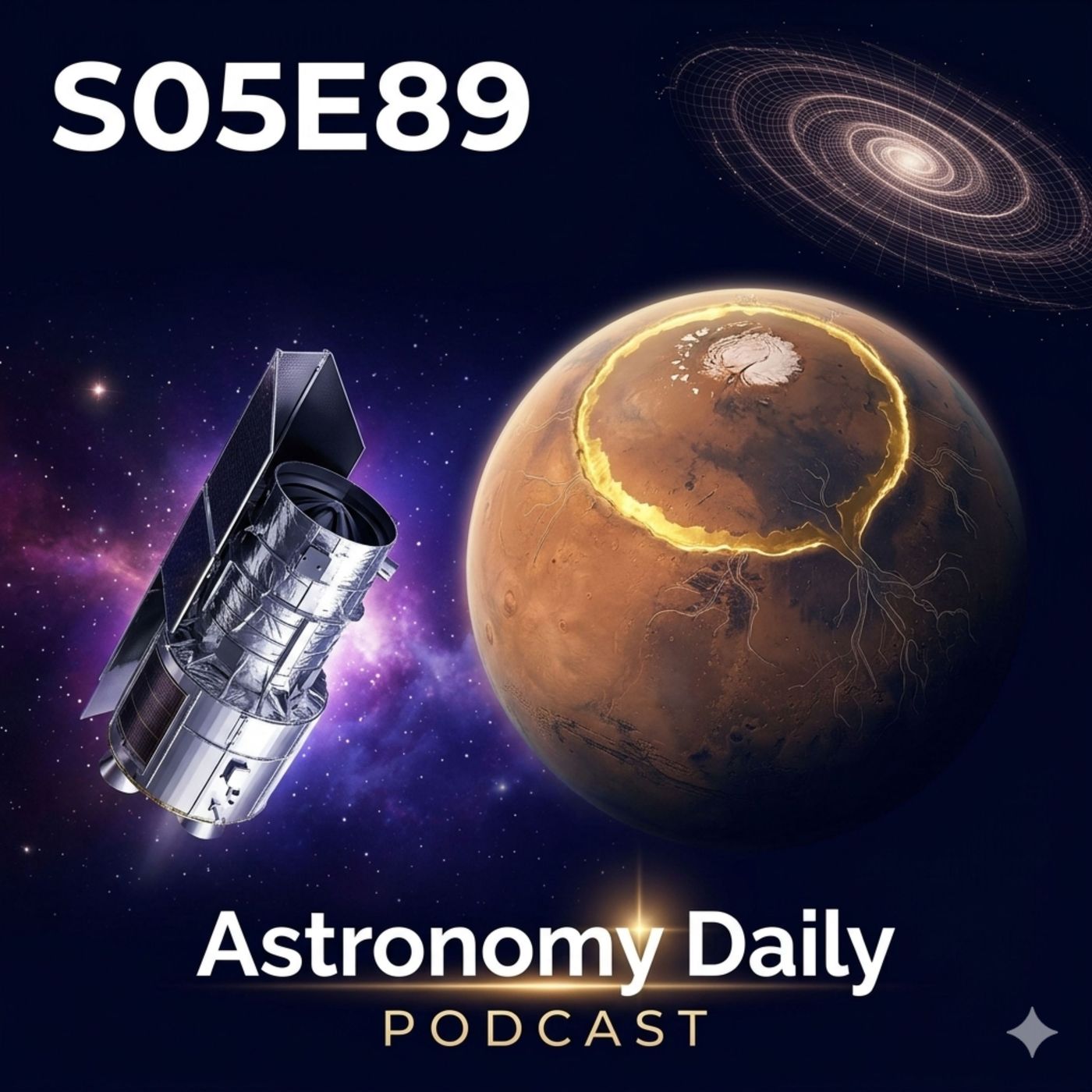
- Ancient Martian Beaches Discovered: Join us as we delve into the groundbreaking findings from China's Zhurong Rover, which has uncovered compelling evidence of ancient ocean shorelines on Mars. Learn how these structures, resembling Earth's coastal deposits, suggest a long-lived body of water on the Red Planet, potentially suitable for life.
- SpaceX's Starship Investigation: Discover the results of SpaceX's investigation into the dramatic end of Starship's seventh test flight. We discuss the unexpected factors that led to the explosion and the improvements made for future missions, including hardware modifications and new safety measures.
- Upcoming Space Launches: Get ready for an exciting week ahead as we break down the packed launch schedule featuring missions from Intuitive Machines, NASA's SphereX observatory, Blue Origin, and the highly anticipated eighth test flight of SpaceX's Starship.
- Solar Flare and Radio Blackouts: Learn about the recent powerful X2.0 solar flare that triggered radio blackouts across parts of the Pacific Ocean. We discuss the implications of this event and the sun's ongoing influence on our technology.
- Quantum Properties of Gravitational Waves: Explore new research suggesting that gravitational waves might possess quantum properties, potentially bridging the gap between general relativity and quantum mechanics. This discovery could reshape our understanding of the universe and the behavior of black holes.
For more cosmic updates, visit our website at astronomydaily.io. Join our community on social media by searching for #AstroDailyPod on Facebook, X, YouTubeMusic, and TikTok. Don't forget to subscribe to the podcast on Apple Podcasts, Spotify, iHeartRadio, or wherever you get your podcasts.
Thank you for tuning in. This is Anna signing off. Until next time, keep looking up and stay curious about the wonders of our universe.
00:00 - Welcome back to Astronomy Daily
01:05 - Ancient Martian beaches discovery
07:30 - SpaceX's Starship investigation findings
12:15 - Upcoming space launches overview
18:00 - Solar flare and its effects
22:30 - Quantum properties of gravitational waves
27:00 - Conclusion and upcoming content
✍️ Episode References
Zhurong Rover Findings
[China National Space Administration](https://www.cnsa.gov.cn)
SpaceX Starship Investigation
[SpaceX](https://www.spacex.com)
Upcoming Launches Overview
[NASA Launch Schedule](https://www.nasa.gov/launchschedule)
Solar Flare Information
[NOAA Space Weather Prediction Center](https://www.swpc.noaa.gov)
Gravitational Waves Research
[LIGO](https://www.ligo.caltech.edu)
Astronomy Daily
[Astronomy Daily](http://www.astronomydaily.io)
Become a supporter of this podcast: <a href="https://www.spreaker.com/podcast/astronomy-daily-space-news-discoveries--5648921/support"...
Today, we have a great lineup of stories from across the Cosmos that showcase just how dynamic and fascinating our universe truly is. From ancient Martian beaches that hint at a watery past, to cutting edge discoveries in quantum physics that could revolutionize our understanding of gravity. We're covering the full spectrum of space science. We'll dive into the latest findings from China's Jorong rover that's uncovered compelling evidence of ancient ocean shorelines on Mars, explore SpaceX's completed investigation into January's Starship test flight, and look ahead at an incredibly busy week of space launches.
We'll also examine a powerful solar flare that recently triggered radio blackouts, and discuss groundbreaking new research that suggests gravitational waves might have quantum properties. Get ready for a journey through some of the most exciting developments in space exploration and astronomy. Let's get started with news from our neighbor that keeps on surprising us. Fascinating news from the Red Planet today, as China's Jorong rov has uncovered compelling evidence of what appears to be ancient beaches buried beneath the Martian surface.
The rover's ground penetrating radar detected structures that strongly resemble Earth's coastal deposits, suggesting the presence of a vast ocean on Mars approximately three point five to four billion years ago. The data reveals layers of material similar to sand buried between ten and thirty five meters underground. These layers are all sloped in the same direction and at angles, matching those found on Earth's beaches where the sea meets the land. The structures span an impressive one point two kilometers along the rover's path in the Utopia Plantia region.
According to scientists, these beach deposits would have taken millions of years to form, indicating a long lived body of water with active waves and tides much like Earth's oceans. This ancient Martian ocean, known as Deuteronilus, would have existed during a time when Mars had a thicker atmosphere and one climate, conditions potentially suitable for life to emerge and thrive. What makes this discovery particularly significant is that while surface features suggesting ancient shorelines have been observed from orbit, billions of years of wind, erosion and geological processes have largely erased or distorted such evidence.
These newly found structures, however, have been beautifully preserved beneath the surface, protected by layers of material deposited by dust storms, meteorite impacts, and volcanic activity. The findings are especially intriguing for astrobiologists, as shorelines are considered prime locations to search for evidence of past life on Earth. It's believed that life may have first emerged in similar environments where air, water, and land interact. While this doesn't prove life existed on Mars, it provides valuable insight into where future missions might focus their search for potential biosignatures.
This groundbreaking discovery also suggests that significant amounts of marsrs ancient water may still exist today, either lost to space or trapped underground in vast reservoirs, as indicated by recent seismic data from NASA's Insight Lander. The implications of these findings continue to reshape our understanding of Mars's dynamic past and its potential to have once harbored life. SpaceX has recently concluded its investigation into the dramatic end of Starship's seventh test flight, which occurred this past January.
The investigation revealed that the explosion was caused by an unexpected combination of factors, primarily centered around harmonic resonance and propellant system issues. According to SpaceX's findings, the ship experienced harmonic vibrations several times stronger than what had been observed during ground testing. These intense vibrations led to increased stress on critical components within the propulsion system, ultimately resulting in propellant leaks that exceeded the vehicle's safety parameters.
The leaking propellants accumulated in what SpaceX calls the attic, an unpressure urized area located between the bottom of the liquid oxygen tank and the heat shield. The situation quickly escalated as the propellant leaks overwhelmed the spacecraft's venting capabilities, leading to sustained fires. These fires caused all but one of Starship's engines to initiate controlled shut down sequences and eventually resulted in a complete loss of communication with the vehicle. SpaceX has already implemented several improvements to address these issues for future flights.
The company conducted an extended sixty second static fire test with the ship that will fly on the upcoming eighth mission. This testing has informed multiple hardware modifications, including changes to the fuel feed lines for vacuum engines, adjustments to propellant temperatures, and the establishment of new operating thrust targets. To prevent similar issues in the attic section, engineers have added additional vents and implemented a new purge system that uses gaseous nitrogen. Future iterations of Starship will incorporate the new Raptor three PIS engine, which reduces the attic volume and eliminates many of the joints that could potentially leak.
The investigation was conducted under the oversight of the Federal Aviation Administration, with participation from NASA, the National Transportation Safety Board, and the US Space Force. SpaceX is now working closely with regulators to obtain necessary approvals for their next launch attempt, which could come as soon as this week, pending regulatory clearance. While on the subject of launches this week, let's take a look now at what's on the agenda. Space enthusiasts are in for a treat this week with an absolutely packed launch schedule featuring multiple significant missions.
Let's break down some of the most exciting launches on the calendar. Intuitive Machines is preparing for their second lunar mission, designated IM two. The Nova SA lander named Athena, will carry several NASA payloads aimed at exploring and analyzing the Moon's subsurface. This cutting edge mission will demonstrate new technologies crucial for future Artemis missions and lunar exploration. Also heading to deep space this week is NASA's sphere X Observatory. This innovative telescope will map hundreds of millions of galaxies to study the origins of our universe and search for the fundamental building blocks of life.
Using near infrared technology, it will observe the sky in over one hundred different color bands, giving us unprecedented views of our cosmic neighborhood. Blue Origin is set to resume their crude missions with New Shepherd's next flight carrying six passengers to the edge of space, and SpaceX continues their rapid fire pace with multiple Starlink launches scheduled to expand their global Internet constellation. Perhaps the most anticipated launch of the week could be Starship's eighth test flight, tentatively scheduled for Friday.
Following the recent completion of their Flight seven investigation. SpaceX is awaiting final regulatory approval to proceed with this crucial test of their massive rocket system. Over in Russia, Roscosmos is preparing to launch their Progress MS thirty cargo mission to the International Space Station, while China has two launches on their manifest, including a classified payload aboard their long March rocket. This impressive lineup of missions showcases just how busy and dynamic the space industry has become, with both government agencies and private companies pushing the boundaries of space exploration and commercial space operations.
Let's turn our attention now to our beautiful star. The Sun put on quite a spectacular show this weekend, unleashing a powerful X two zero solar flare from a sunspot rotating out of our view. The event peaked on Sunday afternoon at two twenty seven pm Eastern Time, triggering widespread radio blackouts across parts of the Pacific Ocean. This wasn't just any ordinary solar flare. It was an X class event, the most powerful category on our classification scale. To put this in perspective, each increase in class represents a tenfold increase in energy, making X class flares truly remarkable events.
The two point zero rating indicates this was a particularly potent example. The intense burst of ultraviolet radiation from the flare caused significant disruption to high frequency radio communications throughout the sunlit regions of the Pacific. During these blackout events, radio operators experience either a complete loss of signal or severe degradation of their high frequency communications. The National Oceanic and Atmospheric Administration's Space Weather Prediction Center classified this as an R three or strong radio blackout event on their space weather scale.
While this falls short of the most severe categories of R four severe or R five Extreme, it still represents a significant space weather event. Fortunately, the flare occurred just as its source, Sunspot, was rotating away from Earth. This positioning meant that while we experienced radio disruptions bared from any potential coronal mass ejection impacts, These massive eruptions of solar plasma can cause even more dramatic effects when they strike Earth's magnetic field. Space weather forecasters continue to monitor our star closely, noting that there remains a slight chance of additional powerful flares through the middle of the week.
These events serve as vivid reminders of the Sun's incredible power and its ongoing influence on our technological systems here on Earth. Two fascinating studies are reshaping our understanding of some of the universe's most fundamental mysteries. Theoretical physicists have discovered that gravitational waves, those ripples in space time first predicted by Einstein, might actually possess quantum properties, potentially bridging the gap between general relativity and quantum mechanics. When massive objects like black holes collide, they create gravitational waves that stretch and squeeze space by incredibly tiny amounts thousands of times smaller than an atom.
While current detectors like Ligo can spot these classical waves, researchers now believe that at the quantum level, these waves might behave very differently. Using sophisticated models, scientists found that quantum gravitational waves could cause detector mirrors to become entangled, meaning their movements become mysteriously linked in ways that classical physics simply cannot explain. It's similar to two windchimes swaying in perfect sinc despite having no visible connection between them. This discovery could revolutionize our understanding of the early universe, particularly around the time of the Big Bang, when quantum effects would have been most prominent.
It might also finally help reconcile Einstein's theory of gravity with quantum mechanics, a challenge that has puzzled physicists for decades. In a related breakthrough, researchers have developed a new mathematical model showing how black holes might form without developing the mysterious singularities where physics breaks down. Instead of requiring exotic forms of matter, they demonstrated that pure gravity alone could prevent these infinitely dense points from forming. This elegant solution relies solely on modifications to Einstein's equations that naturally arise from quantum gravity.
While the current model works in higher dimensions, the researchers believe the same principles should apply to our four dimensional space time. These findings don't just advance our theoretical understanding, they could have practical applications in helping us better understand the fate of matter falling into black holes, and potentially even lead to observable signatures that future telescopes might detect. It's a remarkable example of how exploring the quantum nature of gravity continues to unveil new secrets about our universe's most enigmatic phenomena.
Well. That brings us to the end of today's exploration of the cosmos. I'm Anna, and I want to thank you for joining me on another exciting episode of Astronomy Daily. We've covered some big stories today, from ancient Martian beaches to quantum mysteries and the fabric of space time itself. If you'd like to dive deeper into any of these fascinating topics, you can find all our stories and much more at Astronomydaily dot io. While you're there, be sure to sign up for our free daily newsletter to stay up to date with all the latest developments in space and astronomy.
Don't forget to check out our blog, catch up on previous episodes, and join our growing community of space enthusiasts. You can find us across all social media platforms. Just search for astro Daily Pod on Facebook, x, YouTube, YouTube music, and TikTok. Until tomorrow, keep looking up and wondering about the mysteries that surround us in this vast and beautiful cosmos. I'm Anna, and this has been Astronomy Daily story is control.


 Apple Podcasts
 Spotify
 Pocket Casts
 Castbox
 Overcast
 Podbean
 iHeartRadio
 Castro
 Goodpods
 Moon FM
 Podcast Addict
 Podcast Republic
 YouTube