
In this episode
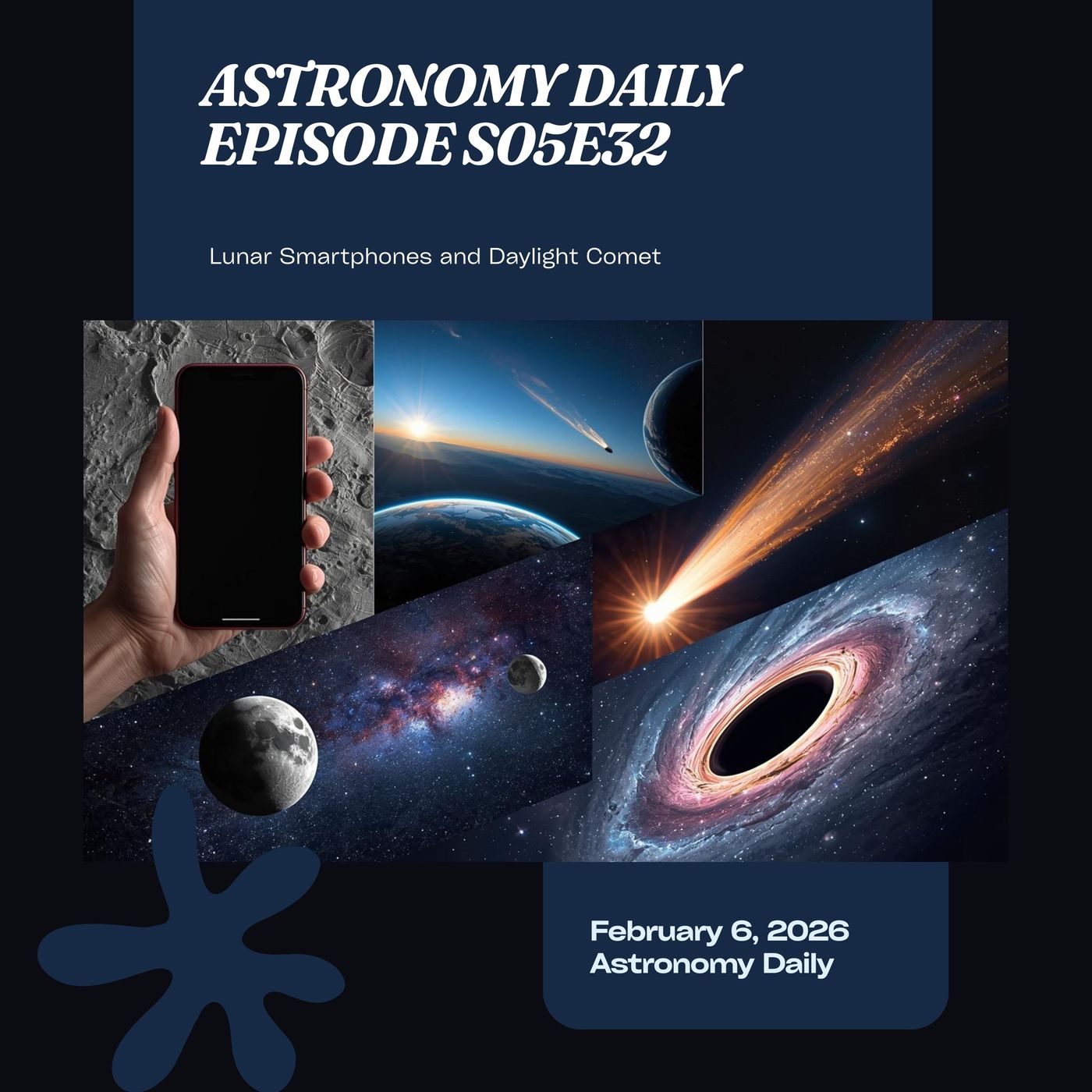
In this episode, we explore groundbreaking developments in lunar colonization and the intriguing behaviors of interstellar visitors. We kick off with a bold announcement from Russia, revealing plans to construct a nuclear power plant on the Moon in collaboration with China, aiming for completion by 2036. This ambitious project signifies a shift towards sustainable human presence on the lunar surface. Next, we dive into a sci-fi-inspired innovation as Russia's Energia rocket company patents a spacecraft design featuring artificial gravity, a game-changer for long-duration space missions, potentially mitigating the adverse effects of zero gravity on astronauts.Shifting gears, we celebrate a significant achievement in satellite technology with the launch of Bluebird 6, a record-breaking satellite designed to provide broadband internet directly to smartphones, boasting the largest communication array ever deployed in low Earth orbit. However, not all news is positive, as Japan faces a setback with the failure of its H3 rocket during a critical mission to deliver the Michibiki 5 satellite, crucial for enhancing GPS accuracy in East Asia.Finally, we journey beyond our solar system to investigate the interstellar comet 3I ATLAS, which exhibits unusual behavior, including a rare sun-facing anti-tail and wobbling jets of outgassing material. This discovery provides insights into the comet's rotation, revealing its nucleus spins once every 15.5 hours. Join us as we unpack these fascinating stories and more in this episode of Astronomy Daily!00:00 – **Today we're covering ambitious plans for lunar colonization and fascinating new discoveries00:36 – **Russia plans to build a nuclear power plant on the moon by 2036
01:49 – **Russian rocket company has just secured a patent for a new spacecraft design
03:11 – **Indian rocket recently launched the Bluebird 6 satellite, and it's a record breaker
04:27 – **Japan's ambitions for an independent satellite navigation system suffered a significant blow
05:31 – **Astronomers studying interstellar comet 3I ATLAS have observed unusual behavior
06:59 – **Today's featured news includes ambitious plans for nuclear power on the Moon### Sources & Further Reading1. NASA2. Roscosmos3. Space.com4. AST SpaceMobile5. JAXA### Follow & ContactX/Twitter: @AstroDailyPod
Instagram: @astrodailypod
Email: [email protected]
Website: astronomydaily.io
Clear skies and see you next time! 🌟Become a supporter of this podcast: Support Us.
Sponsor Details:
Ensure your online privacy by using NordVPN. To get our special listener deal and save a lot of money, visit www.bitesz.com/nordvpn. You'll be glad you did!
Sponsor Details:
Ensure your online privacy by using NordVPN. To get our special listener deal and save a lot of money, visit www.astronomydaily.io/nordvpn. You'll be glad you did!
Get the best secure and private email on the planet. Stop your Government, google and who knows who else spying on every email you write. Do...
Avery: Welcome to Astronomy Daily, the podcast that brings you the universe one story at a time. I'm Avery. Anna: And I'm Anna. It's great to be with you. Today we're covering everything from ambitious plans for lunar colonization to fascinating new discoveries about visitors from beyond our solar system. Avery: That's right. We'll be talking about a nuclear powered future on the moon, a sci fi concept for artificial gravity that's getting closer to reality, and a record breaking satellite launch.
We've also got news of a major setb for one nation space program and a wobbly interstellar comet. Anna: So let's get right to it. Our first story takes us to the moon, where Russia has announced some truly monumental plans. Avery: You can say that again, Avery. Anna: This isn't just about setting up a temporary outpost. Russia's space agency has stated its intention to build a full fledged nuclear power plant on the lunar surface within the next decade or so. Avery: A nuclear power plant on the moon?
That's a huge undertaking and they're not doing it alone, right? Anna: Exactly. This is part of a joint effort with China. The goal is to have the plant constructed and operational by 2036. The purpose is to provide a consistent and powerful energy source for a planned joint Russian Chinese research station. Avery: That makes sense. Solar power is great, but a, uh, lunar night lasts for about 14 Earth days. If you want a permanently functioning scientific station, you need a power power source that doesn't depend on sunlight.
Anna: Right. This really signals a shift in lunar exploration from temporary visits to establishing a long term sustainable human presence. It's a foundational step for what could become a true lunar settlement one day. Avery: It's fascinating. And speaking of ambitious Russian plans for the future of space travel, our next story sounds like it was pulled directly from a science fiction movie. Anna: Sounds intriguing. The details please. Avery: The state owned Energia rocket company has just secured a patent for a new spacecraft design.
And its main feature is something astronauts have dreamed of for decades. Artificial gravity. Anna: This is a critical piece of the puzzle for long duration space missions. We know that extended time in zero G has serious negative effects on the human body. Avery: Mm mhm. Serious effects. Things like muscle atrophy and significant bone density loss. It's one of the big hurdles for say, a manned mission to Mars. Anna: So how does this new design work? The concept of a rotating system to create centrifugal force isn't new, but what are the specifics here?
Avery: Well, the patent describes a rotating system designed to generate a gravitational force of about 0.5g. So half of Earth's gravity while Not a, uh, full one G. It's believed that even this level could profoundly mitigate the health problems astronauts face. Anna: Halfigy would make a world of difference. It means crews could arrive at Mars or return to Earth in much better physical condition. This could be a genuine game changer for the future of human spaceflight. Avery: Absolutely. From future tech to current accomplishments, let's shift our focus to a remarkable satellite that's now in orbit.
Anna, uh, tell us about Bluebird 6. Anna: This is a story about connectivity. An Indian rocket recently launched the Bluebird 6 satellite, and it's a record breaker. It was built by a Texas based company, AST Space Mobile. And its mission is to provide broadband Internet service directly to standard off the shelf smartphones on the ground, directly to phones. Avery: So no special equipment needed. That's the key. But what makes it a record breaker? Anna: Its size. To talk to a small device like a cell phone from orbit, you need a very, very large.
Bluebird 6 features a, uh, communication array of nearly 2,400 square feet. Avery: Wow, 2,400 square feet. That's massive. Anna: It is. In fact, it's the largest communication array ever deployed in low Earth orbit. The potential impact here is enormous, offering a way to connect the unconnected in the most remote parts of the globe. Avery: That's an incredible piece of engineering with a very noble goal. But as we know, getting these complex machines into orbit is the hardest part. Which brings us to our next story.
Unfortunately, not all recent launches have been successful. Anna: That's right, Avery. Japan's ambitions for an independent satellite navigation system suffered a significant blow after the second major failure of its flagship H3 rocket. Avery: This is a tough one for the Japanese space program. The rocket was supposed to deliver the Michibiki 5 satellite into orbit, but it failed during its flight. Anna: And this satellite was a crucial component of their Quasi Zenith Satellite System, or qzss.
Avery: Mhm. The QZSS is designed to augment GPS signals, providing much more accurate and reliable positioning for Japan and the rest of East Asia. This failure represents a major delay to the expansion and improvement of that system. Anna: It's a stark reminder that even for established spacefaring nations, rocket science is incredibly challenging. There's just no room for error. We certainly hope they can identify and fix the issue for future flights. Avery: Indeed, it's a reminder of the high stakes in space exploration.
Anna: It truly is. And for our final story, we're venturing far from Earth to look at one from another solar system that's been paying us a bit of a visit. Avery: Astronomers have been studying the interstellar comet 3I ATLAS, which has begun leaving our solar system. And they've observed some very unusual behavior. First, it has a rare sun facing anti tail. Anna: An anti tail. So a tail of dust and gas pointing towards the sun instead of away from it. Avery: It's an optical illusion caused by our, uh, viewing angle of the comet's dust trail.
But what's truly remarkable is what's happening within that tail. As the comet approached the sun, scientists observe jets of outgassing material that appear to be wobbling. Anna: Wobbling jets. That's new. Avery: Completely. This is the first time such an outgassing pattern has ever been observed from an interstellar comet. The jets were seen to wobble on a very specific cycle every 7 hours and 45 minutes. Anna: And that tells us something fundamental about the comet itself, doesn't it? Avery: It does.
This wobble implies a rotational period for the comet's solid nucleus. Based on the data, scientists have calculated that the nucleus is spinning on its axis once every 15 and a half hours. Anna: That is so cool. To be able to determine the length of a day on an object that came from an entirely different solar system just by watching its jets wobble. It's an amazing piece of cosmic detective work. Avery: It certainly is. And that's all the time we have for today's top stories. From ambitious plans for nuclear power on the Moon to the rotation of an interstellar comet, the cosmos never fails to inspire a.
Anna: Uh, big thank you to all of you for tuning in. We hope you'll join us again next time for another dose of Astronomy Daily. Until then, you can find us on all major podcast platforms and on social media. Just search for AstroDailyPod Daily Pod full details on our [email protected] from both of. Avery: Us here, keep looking up.


 Apple Podcasts
 Spotify
 Pocket Casts
 Castbox
 Overcast
 Podbean
 iHeartRadio
 Castro
 Goodpods
 Moon FM
 Podcast Addict
 Podcast Republic
 YouTube