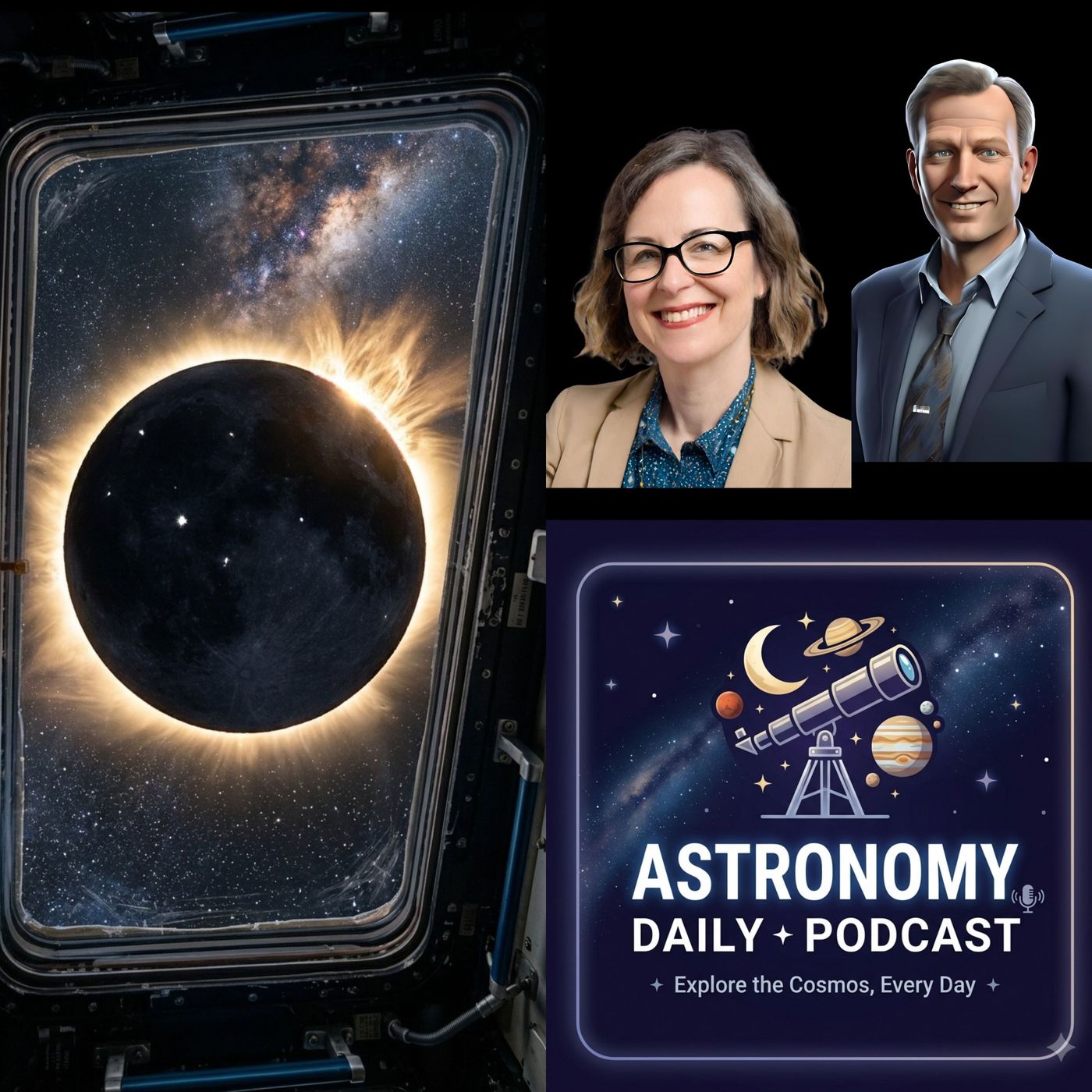
Cosmic Revelations: Artemis 2's Historic Observations and the Case of Hypernovae
In this episode
Show notes Six months after Artemis II swung around the far side of the Moon, NASA has published what the crew saw, said and sketched — including five faint impact flashes spotted during a 54-minute eclipse. Plus: two UCL papers that take apart the chemical evidence for hypernovae, Juno finds Jupiter's magnetodisk crumpled into ripples, and IISc simulations suggest magnetised white dwarfs could grow well past the Chandrasekhar limit. Skywatch: the crescent Moon meets Antares, Mercury and Venus favour the south, Mars leaves the Beehive, and Vesta at opposition. Artemis II Preliminary Lunar Science Report · Crew: Reid Wiseman, Victor Glover, Christina Koch (NASA) and Jeremy Hansen (CSA); lunar flyby 6 April 2026. · Five extremely faint impact flashes seen from ~74,000 km during a 54-minute eclipse behind the Moon; impactors estimated at no more than ~5 cm. · Crew-reported colours (blue = titanium-rich volcanic rock, brown = iron, green = glass); terminator observations as a proxy for south-pole lighting. · 'Hello, World' Earth image lit by moonlight; labelled southern Milky Way image (Crux, Carina, LMC). · Source: NASA Science, 'Artemis II: Sights & Sounds of Science', 7 Oct 2026 — science.nasa.gov/feature/artemis-ii-preliminary-lunar-science-report/ Hypernovae: the evidence that wasn't · Anmol Aggarwal & Ralph Schoenrich (Mullard Space Science Laboratory, UCL), two MNRAS papers; UCL release 5 Oct 2026. · Uneven ('stochastic') supernova enrichment explains three of four supposed hypernova-enriched stars; the fourth (silver- and uranium-rich halo giant) fits a neutron-star merger plus one ordinary supernova. · Source: ucl.ac.uk/news/2026/oct/ultra-powerful-star-explosions-might-not-have-occurred-after-all ; DOI 10.1093/mnras/stag610 Juno: Jupiter's rippling magnetodisk · Ruilong Guo (Shandong University) et al., Science China Earth Sciences 69(10), 2026; release 6 Oct 2026. · Repeated current-sheet crossings — four in ten minutes in one case — with reconnection signatures; a rotating, rippled sheet rather than a smooth flapping one. · Source: doi.org/10.1007/s11430-025-1870-9 White dwarfs beyond the Chandrasekhar limit · Zenia Zuraiq, Banibrata Mukhopadhyay (IISc) and collaborators incl. Christopher Tout, ApJL 2026; IISc release 9 Oct 2026. · Modified STARS code: a magnetised accreting white dwarf reaches ~2.4 solar masses vs ~1.4 without the field. · Source: iisc.ac.in/events/strong-magnetic-fields-could-allow-white-dwarfs-to-grow-beyond-the-chandrasekhar-limit/ Quick hit: Hera and MMX · ESA: Hera BRM-1, 93-minute braking burn early Thu 15 Oct; BRM-2 on 22 Oct. esa.int (Hera) · JAXA: MMX launch on H3 F10, 20 Oct 2026 04:41:03 JST from Tanegashima; samples to South Australia in 2031. Skywatch (computed for Sydney, LA, New York, London) · Tonight: crescent Moon near Antares — 1.3° from New York, 2.3° from LA and London (very low), 7° from Sydney. · Evening Mercury (24° up at sunset from Sydney) and Venus (heading to inferior conjunction ~24 Oct) favour the south. · Pre-dawn: Mars ~2° from the Beehive, Mars–Jupiter closing to ~1.2° on 16 Nov; Saturn in the evening; Southern Taurids; Vesta at opposition (mag 6.5, Cetus). · Solar safety: never view the Sun except through certified ISO 12312-2 filters.Become a supporter of this podcast: https://www.spreaker.com/podcast/astronomy-daily-latest-space-news--5648921/support.
Sponsor Details:
Ensure your online privacy by using NordVPN. To get our special listener deal and save a lot of money, visit
Anna: Six months ago, four people swung around the far side of the moon and for 54 minutes the sun disappeared behind it. Avery: And in that darkness, three of them saw something scientists weren't sure the human eye could catch. Tiny flashes of light. Rocks no bigger than a golf ball slamming into the lunar surface seen from 74,000 kilometres away. Anna: Last week NASA published what the Artemis 2 crew saw, said and sketched. And it is a lovely piece of science. That's our lead. Avery: Plus the case for the most powerful explosions in the universe springs a leak.
Jupiter's magnetic disc turns out to be crumpled and white dwarfs that may break a 90 year old weight limit. I'm M Anna, I'm Avery, this is astronomy daily. Anna: On the 6th of April this year, Orion, uh, the Artemis II capsule, callsign integrity went behind the moon. Reid Wiseman, Victor Glover, Christina Koch and the Canadian Space Agency's Jeremy Hansen had been flying for five days. And for about seven hours they took turns at the windows doing something no crew had done since Apollo 17, lunar science by eye.
Avery: And on 7 October, NASA released a the Artemis II Preliminary Lunar Science Report, a Lunar Science Operations Report, a data user's guide and the raw material itself in NASA's Planetary Data System. Photographs, recorded audio and the notes the crew drew on their tablets. Anna: I want to be clear up front about what kind of report this is. It is preliminary. It is a record of human observations. It is not a peer reviewed paper with a single headline number. Its value is that a trained human eye describing what it sees in real time gives scientists context that no orbiting camera provides on its own.
Avery: So let's start with the moment that made the science team gasp. As Orion passed behind the Moon, the sun went behind it too. From where the crew were, the Moon looked enormous and barely moved. So the sun stayed hidden for 54 minutes. A total solar eclipse almost an hour long. Anna: The lunar scientists had asked the crew to use that darkness to look for impact flashes, the brief burst of light when a small rock hits the Moon at thousands of kilometres an hour. The Moon has no atmosphere, so nothing burns up on the way in.
Avery: And they saw them. Five extremely faint pinpricks of light from Orion, roughly 74,000 kilometres away. NASA's page has the tablet annotations and they're wonderful. Wiseman marked his sightings in blue, Glover in green, Hansen in red. One flash number four has all three colours on it. Three people independently at the same spot. Which matters because the obvious question is, are you sure a cosmic ray hitting your retina, uh, can make a Flash. So can a reflection inside the spacecraft. The science team ruled both out before confirming the sightings.
Anna: From the brightness, scientists estimate each incoming rock was no more than about five centimetres across. Apollo crews reported similar flashes from lunar orbit, but these are likely the faintest ever seen with the unaided eye. Avery: And this happened during a planned loss of signal on the far side. So the crew saw it, recorded it and then Houston heard about it later. NASA's audio of the moment includes, I'm told a, uh, very scientific dude. No way. Anna: Why does it matter? Because nobody knows precisely how often small rocks hit the moon.
And if you're going to put a habitat on the surface for months, that rate is a design number Regular listeners will remember the new crater in the Chrysium region from episode 196. 220 metres wide. A ah, once in a century event. These flashes are the other end of the same distribution. Tiny, frequent and until now, poorly counted. Avery: There's a lovely listener tie in too. NASA runs a citizen science project called Impact Flash, where amateur astronomers with modest telescopes watch the dark part of the moon and record exactly these events.
Earth based observers have been counting them for years. The crew just did it from a much better seat. Anna: The second big theme is colour. Ask most people what colour the Moon is and they'll say grey. The crew reported grey, black, brown, tan, white, white, green and blue. Avery: And those aren't artistic licence. Blue tints point to titanium rich volcanic rock. Browns track iron content, greens signal glass made in volcanic fire fountains or melted by impacts. Christina Koch described one Regis as a jaundiced cheek of the moon, which I think is the best geology description I've heard this year.
Anna: The scientists will compare those descriptions and the handheld photographs with data from the Lunar Reconnaissance Orbiter. The point isn't to replace the orbiter, it's to learn how human perception of colour and brightness shifts with the angle of the light. Because astronauts on the surface will be making those judgments with no orbiter to check against. Avery: NASA shows one worked example, the crew's photographs of the Orientale Basin. The great bullseye on the moon's western limb matched pixel for pixel onto the orbiter's maps of elevation, roughness, rock cover and brightness.
A human snapshot pinned to years of orbiter data. Which brings us to the third theme, the terminator, the line between lunar day and night. The science team asked the crew to study it because the lighting there, sun skimming the horizon, shadows stretching for kilometres, mimics the Moon's south pole, where Artemis wants to land. Anna: Victor Glover described Islands of terrain standing completely surrounded by darkness. Peaks catching sunlight while everything around them is in shadow. NASA's image shows the crater Carnot, about 130 kilometres across, right on that line Avery: in Kock during the eclipse, as the limb lit up from behind, you can actually see mountains.
That's the practical payoff, knowing what level of detail, what cameras, what lighting future crews need to work safely near the pole. Anna: The crew also watched the sun's corona for nearly an hour. And Hansen sketched one streamer that appeared to pulse. That's an observation of the solar atmosphere that drives space weather, made by someone with no instrument but his eyes. Avery: And then there's hello world. The photo of the whole Earth taken on day two from about 10,000 kilometres out. It looks sunlit.
It isn't. It was lit by moonlight. Scientists stayed up through the night combing it and found weather systems, auroras at both poles. A Saharan dust plume, lightning over the Congo Basin, city lights across North Africa and Iberia and and zodiacal light capped by Venus. Anna: Koch put it beautifully. The Moon was a light sponge and the Earth a light mirror. Avery: Now the southern note. During the eclipse, the crew photographed the milky Way. And NASA's labelled version is a southern sky chart.
Bella Carina, Musca Crux, the Southern Cross, Centaurus, the Carina Nebula and the Large Magellanic Cloud. Four astronauts from North America beyond the Moon, pointing their camera at our sky. Anna: Hansen said the stars had a depth he'd never seen from Earth, that brighter ones seemed nearer. That's perception, not distance, and he knew it. But it's exactly the kind of honest human observation this report is full of. Avery: So the caveats one more time. This is a preliminary report. The flash count is five.
The sizes are estimates from brightness. And the real science happens now as researchers match what the crew said to where they were looking and what the orbiters measured. Anna: There's also a quieter result in the operations report. Artemis 2 was the first time NASA ran a modern science backroom for a crewed lunar flight. A lunar science team in Mission Control in Houston, new flight controller roles, Scientists talking through what the crew should look at next. Avery: NASA's photo of that room.
The deputy Lunar science lead, Marie Henderson and her colleagues reacting as the descriptions came in, tells you how much the moment meant to them. Learning how scientists and astronauts work together in real time is half the reason this flight carried a science plan at all. Anna: NASA calls it a relay race. Decades of robotic data handed to the crew and the crew's observations handed back. The next leg is Artemis 3. Then a Ah, crew on the surface and for once the science team had people at the window.
Five flashes says that was worth it. Avery: Next, hypernovae. In theory they're the most powerful stellar explosions. There are a very massive, fast spinning star collapsing and releasing at least 10 times the energy of an ordinary supernova. And one strand of evidence for them has been chemical. A handful of ancient stars whose makeup seemed only explicable if they'd formed from hypernova debris. Anna: This is stellar archaeology, isn't it? You can't watch a star explode 13 billion years ago, but you can read the debris in the stars that form formed from it.
Avery: Exactly. The oldest, most metal poor stars carry the chemical signature of the generation before them. So a ah, weird abundance pattern becomes evidence for a weird explosion. Anna: And a pair of papers from University College London says that Strand doesn't hold. Avery: Anmol Aggarwal, a PhD student at UH, UCL's Muller Space Science Laboratory, and Ralph Schoenrick, two papers in monthly Notices of the Royal Astronomical Society. Quick disclosure. The first was accepted back in March, the second is newer.
UCL announced both on the 5th of October. Anna: So what's the argument? Avery: The old models treated a supernova as a well stirred pot. The dying star's elements mixed evenly and the next generation of stars inherits that average. But real supernova remnants aren't like that. Oxygen can fly off one way, sulphur another. A star that forms downstream might be built from a few pieces of the explosion, not the whole recipe. Anna: So an odd chemical fingerprint doesn't need an exotic explosion. It might be an ordinary explosion, sampled unevenly.
Avery: Exactly. They looked at four stars previously attributed to hypernovae. In three, an ordinary lopsided supernova was statistically favoured. The fourth is a red giant in the Milky Way's halo, rich in heavy elements like silver and uranium. It had been argued that a neutron star merger couldn't explain it because the star seemed to form too early for one. Anna: But. Avery: But it's moving fast and orbiting backwards relative to most of the galaxy. Which suggests it was born in a small dwarf galaxy where metal pore stars can form much later.
And was swallowed afterwards. Their verdict, one neutron star merger plus one ordinary supernova. Anna: Now the caveat, and it's important we have directly observed some extraordinarily energetic explosions. Broad lined supernovae tied to gamma ray bursts like the one we covered in episode 160. This work doesn't say those didn't happen. It says the chemical fingerprints in these old stars no longer require hypernovae. Avery: And the southern footnote. Hunting the oldest stars is something Australia does well.
In 2014, the ANU's SkyMapper telescope at Siding Spring found one of the most iron poor stars known. And its chemistry was also explained by a low energy supernova. Same lesson. Be careful what you build on one strange star. Anna: Next story. Today, Jupiter's magnetic field is the biggest structure in the planetary solar system. And wrapped around the planet's equator is something called the magneto disc, a vast sheet of electric current fed by sulphur and oxygen, spewed out by the volcanic moon IO and flung outward by Jupiter's 10 hour spin.
Avery: And Juno is the right spacecraft to test it. Since 2016, it has looped over Jupiter's poles on long elongated orbits, slicing through the magnetosphere at different distances and local times, with instruments sampling the field and the particles directly. Anna: Which matters for what comes next. Avery: And the textbook picture of that sheet is fairly simple. Jupiter's magnetic axis is tilted, so as the planet turns, the sheet rocks up and down like a warped record. A spacecraft sitting in it should cross the sheet about twice per rotation.
Anna: A team led by Roylong Guo at Shandong University with co authors including Dennis Grodent and Bertrand Bonfont from Liege, went through Juno's magnetic field and energetic particle data published in Science China Earth sciences release on the 6th of October. The manuscript itself dates back to 2025. Avery: And what did they find? Anna: During active periods, Juno didn't cross the sheet twice. It crossed it again and again. In one case, four times in 10 minutes. And almost every crossing carried the signature of magnetic reconnection, where field lines snap and reconnect and release energy along with bursts of energised electrons and ions.
Avery: So it's not just flapping? Anna: No, um. The orientation analysis shows a kink like surface wave ripples lasting from minutes to over an hour. The authors argue that many small reconnection sites scattered across about 100 degrees of longitude keep breaking the field and shoving the sheet off balance. And because Jupiter spins so fast, the whole crumpled sheet is carried around with the planet. Their image is a crumpled tablecloth on a spinning turntable. Avery: That's different from Earth, isn't it?
Anna: Very. In Earth's magnetic tail, a kink wave travels away from a reconnection site. At Jupiter, there's no fixed period and reconnection everywhere, which points to a rotating rippled structure instead of. It matters, because that structure helps decide how IO's material is accelerated, how it's pushed inward, and how energy reaches Jupiter's auroras. A quiet sheet is a simpler machine. A crumpled one is messier and probably more honest. Avery: For about 90 years, white dwarfs have had a weight limit.
Subramani and Chandrasekhar showed that a white dwarf supported by electron pressure can, can't exceed about 1.4 solar masses. Push it past that and a, uh, carbon oxygen white dwarf ignites and explodes as a type 1A supernova. Anna: Which is why type 1A supernovae are such good standard candles. Same trigger, similar brightness. Avery: It's how cosmic acceleration was discovered and why we leaned on them for the dark energy story back in episodes 193 and 195. So a, uh, paper saying the limit can bend gets attention.
Anna: Who's saying that? Avery: Zenya zoo Reich, a PhD student, and Bani Brata Mukopadier at the Indian Institute of Science with collaborators including Christopher Tout, whose Cambridge group's Stellar Evolution Code Stars they modified Astrophysical Journal letters release on the 9th of October. Anna: And what did they do? Avery: They added magnetic fields and white dwarf cooling to stars and followed stars from the main sequence all the way to white dwarfs feeding off a companion. In their example, a, uh, 1.02 solar mass white dwarf born from an 8 solar mass star accretes.
Uh, slowly the field starts. Too weak to matter. But as mass piles on, the star contracts, the field is squeezed and strengthens and magnetic pressure starts carrying some of the load. Anna: So the field is doing work the electrons can't? Avery: In effect, yes, magnetic pressure adds support. So the usual relationship between a white dwarf's mass and its radius changes. The team even suggests it might explain why some well studied white dwarfs look larger than their masses predict. And it keeps growing to about 2.4 solar masses in their magnetised model against 1.4 without the field.
And observers have seen a few overluminous type Ia supernovae that hint at progenitors up to around 2.8 solar masses. So there's something to explain caveats? Several. That's one model, not a survey of outcomes. Super Chandrasekar white dwarfs have been argued over for more than a decade and the cosmology doesn't hinge on it directly. Astronomers calibrate type Ia supernovae empirically from their light curves. The real question is whether a hidden subpopulation is quietly mixed in. That's worth knowing either way.
Anna: Two missions in countdown mode. First, ESA's Hera. A week ago, on its second birthday in space, it caught its first glimpse of Didymus, a single pixel from about 236,000 kilometres. And early on Thursday the 15th European time, it fires three thrusters for 93 minutes to break towards the asteroid DART hit in 2022. Avery: That's BRM1. A second shorter burn follows on the 22nd. Then three small transition burns later this month and close in characterization from 25 to 30 kilometres in November and December.
And the Australian thread. ESA's Flight Dynamics Tim will check the burn using signals through its 35 metre antenna at uh, New Norcia in Western Australia. Anna: And Jax's Martian moons exploration mission launches on an H3 from Tanegashima at 6:41 Tuesday morning, Sydney time. Monday afternoon in the Americas. It will land on Phobos, deploy a French German rover and its samples are deemed to land in South Australia in 2031. Full curtain raiser on Monday. Skywatch and tonight starts with the Moon.
It's a slim crescent around a uh, sixth lit and it's sliding past Antares, the red heart of Scorpius. And how close depends very much on where you are. Avery: It does. From New York at the end of civil twilight about 6:45. The moon is only 1.3 degrees from Antares under three moon widths but just 11 degrees up. In the southwest, Los Angeles gets 2.3 degrees with the moon 16 degrees up London 2.3 degrees. But the moon is barely 2 degrees above the horizon, so you'll need a clear southwestern view.
Anna: And Sydney. Avery: From Sydney the pair are 7 degrees apart. But the moon is 36 degrees up at 7:30, high and easy. And in some parts of the world the Moon actually covers Antares tonight, though none of our four cities see that in a dark sky. Anna: Next, the inner planets. And this week favours the south. Avery: Mercury is still well placed after last week's greatest elongation. From Sydney it's 24 degrees up at sunset and sets about two hours after the sun. From Los Angeles it's 10 degrees up New York 7, London barely 3.
And Venus is diving towards the sun, passing closest around the 24th. From Sydney it's still 15 degrees up at sunset. A brilliant magnitude minus 4. From the northern cities it's already gone. Anna: Why the lopsided view? Avery: Our regular spring story around now the evening ecliptic stands almost straight up from the western horizon in the southern hemisphere and lies flat in the northern. A planet the same angle from the sun ends uh up far higher above a southern horizon. In March it flips and the north gets the good evening apparitions, which brings Anna: the eye safety reminder.
Avery: It does and it's non negotiable with Mercury and Venus so close to The Sun. Wait until the sun has fully set before you sweep with binoculars or a telescope. Never look at the sun through any optical instrument and only ever look at the sun directly with eclipse glasses or solar filter certified to the ISO 1123122 standard. Anna: Now the north gets its turn before dawn. Mars has just drifted through the Beehive cluster in Cancer closest on the 11th and it's still only about 2 degrees away.
A lovely binocular field at nautical dawn. Mars is 50 to 60 degrees up from the northern cities. Jupiter about 45 degrees up and brighter hm from Sydney. They're lower. Mars 23 degrees. They're 12 and a half degrees apart today and closing down to about 1.2 degrees on the 16th of November. And through the night. Avery: Saturn, 10 days past opposition, rising in the east at dusk. Magnitude 0.4. Its rings opened only about 7 degrees. The southern taurids Debris from Comet Encke reach an early peak around now just a few meteors an hour, but they're slow and the occasional one is a fireball.
And the radiant is well up from both hemispheres by 11pm the moon sets early this week, so the sky's dark Anna: and a, uh, binocular challenge. Avery: The asteroid Vesta at opposition yesterday. Magnitude 6.5 in northern Cetus, about 5 degrees north of Theta Cetae. And this one leans south at 11pm It's 49 degrees up from Sydney, around 40 to 45 from the US cities, 30 from London. Sketch the field, come back the next night and see which dot moved. First quarter Moon is on the 19th Sydney time. Anna: That's the show today.
Five faint flashes on the far side of the Moon, a crack in the case for hypernovae, Jupiter's crumpled magneta disc and white dwarfs that might be heavier than the rulebook allows. Avery: Tomorrow we'll have the result of Hera's big breaking burn. And on Monday, a full curtain raiser for MMX ahead of Tuesday's launch. Anna: If you've got a question or you've ever caught an impact flash on the Moon yourself, tell us through the contact [email protected] we read everyone. Avery: Show notes and links are there too.
And if you can catch Mercury low in the west after sunset this week, I'm Anna. I'm Avery. Clear Skies.
Anna: Sa.
 Apple Podcasts
 Spotify
 Pocket Casts
 Castbox
 Overcast
 Podbean
 iHeartRadio
 Castro
 Goodpods
 Moon FM
 Podcast Addict
 Podcast Republic
 YouTube