
In this episode
Astronomy Daily | Space News: S04E88In this episode of Astronomy Daily, host Anna takes you on an enthralling expedition across the cosmos, unveiling the latest discoveries and intriguing phenomena that are expanding our understanding of the universe. From the surface of Mars to the depths of black holes, this episode is a treasure trove of astronomical insights that will captivate your imagination.
Highlights:
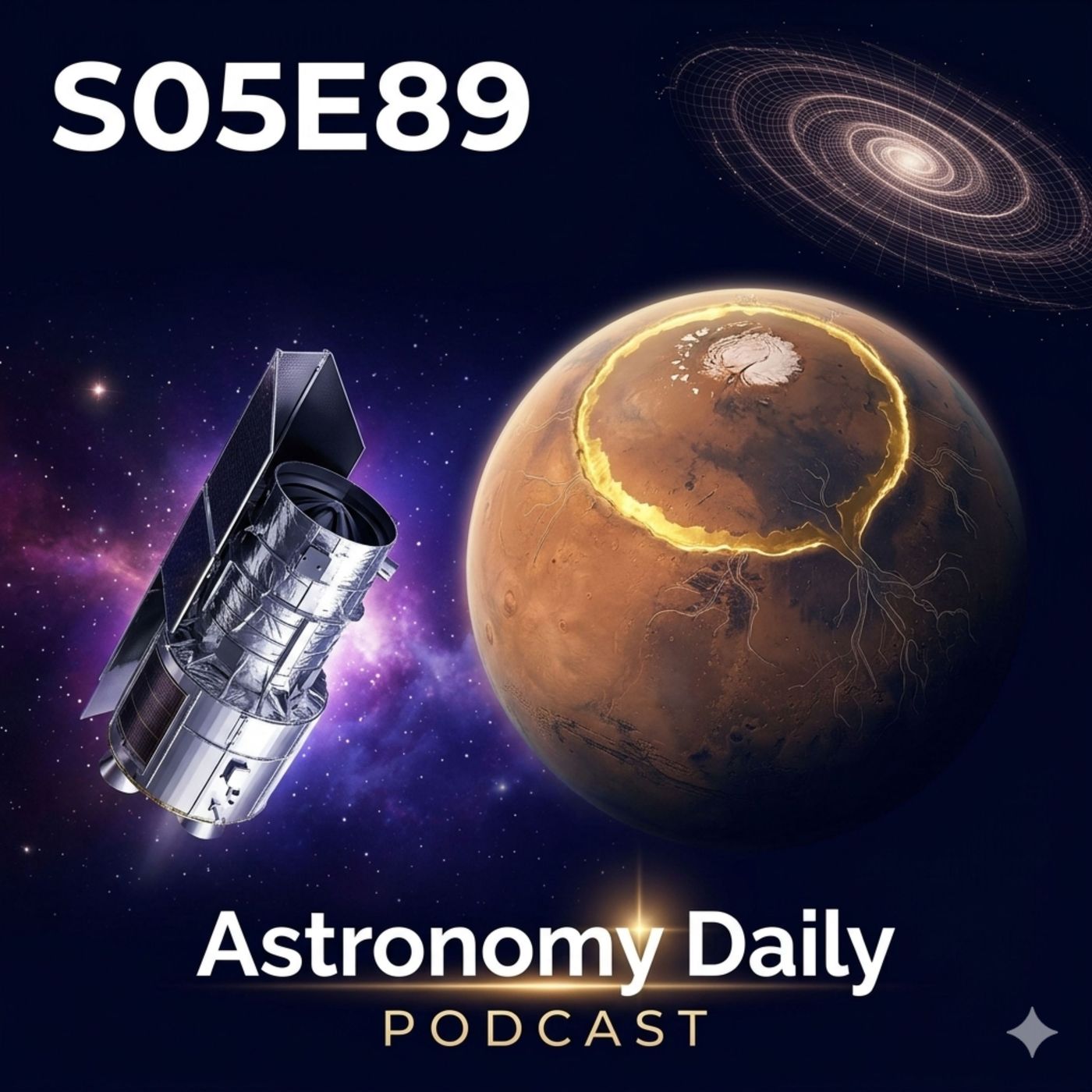
- Perseverance Rover's Discoveries on Mars: Join us as we delve into the latest findings from NASA's Perseverance rover, which has uncovered a variety of rocky outcrops on the rim of Jezero Crater. These samples are providing critical insights into Mars's geological history and the potential for past life on the Red Planet.
- The Astronomical Origins of Easter: Explore the fascinating intersection of astronomy and tradition as we explain why Easter 2025 will occur unusually late. Learn about the Paschal Moon and how ecclesiastical rules influence the celebration of this ancient holiday.
- Interstellar Objects from Alpha Centauri: Discover groundbreaking research suggesting that millions of interstellar objects from Alpha Centauri may be residing in our solar system. This study reshapes our understanding of cosmic interactions and the interconnectedness of star systems.
- Citizen Science Month: April is Citizen Science Month, and we discuss NASA's ambitious goal of achieving one million acts of science. Find out how you can contribute to real astronomical discoveries and become part of a global scientific community. To find out more visit: https://science.nasa.gov/citizen-science/
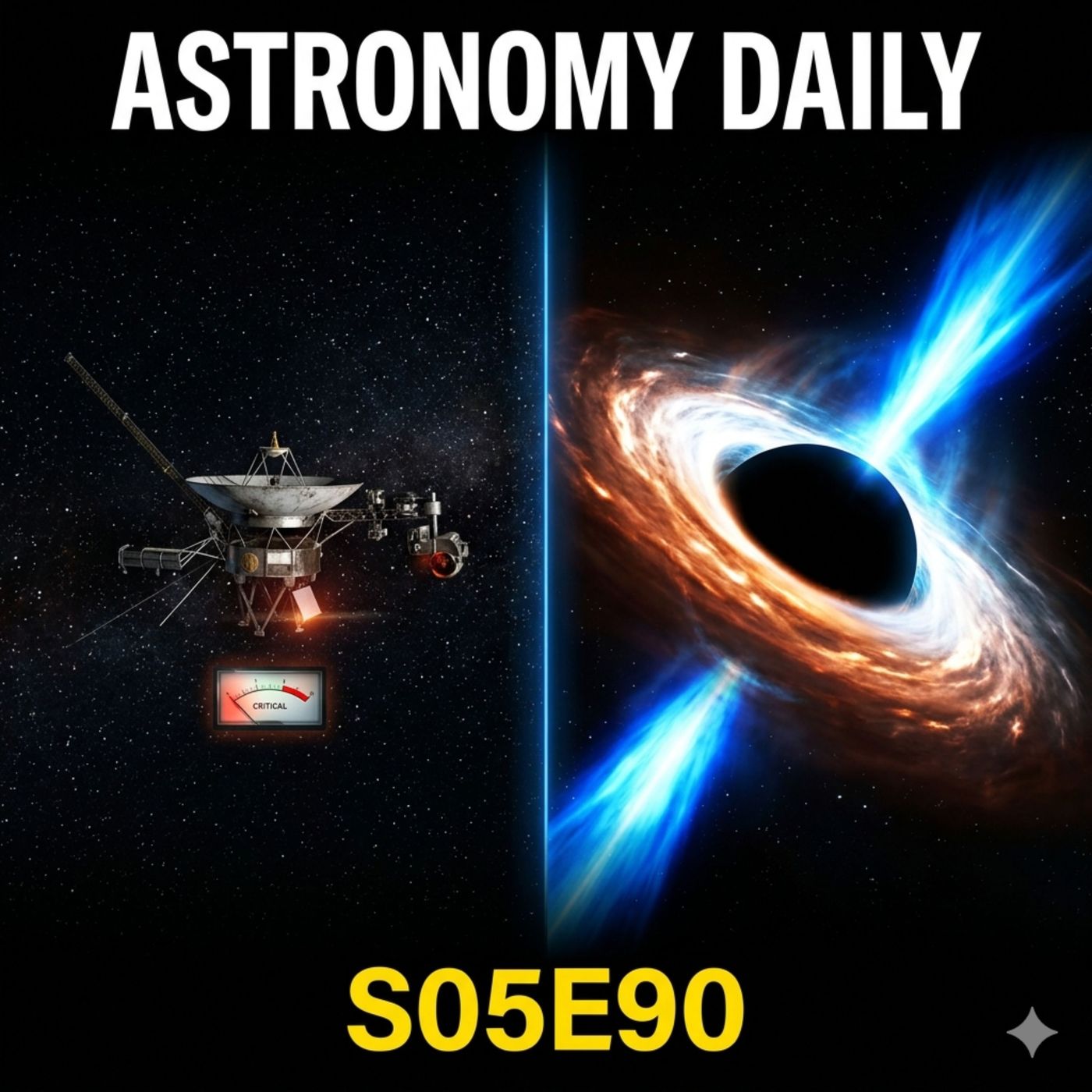
- Supermassive Black Hole Eruptions: Witness the dramatic awakening of a supermassive black hole, which has produced the most powerful X-ray eruptions ever recorded. This extraordinary event is challenging existing scientific models and providing new insights into black hole dynamics.
For more cosmic updates, visit our website at astronomydaily.io. Join our community on social media by searching for #AstroDailyPod on Facebook, X, YouTubeMusic, TikTok, and our new Instagram account! Don’t forget to subscribe to the podcast on Apple Podcasts, Spotify, iHeartRadio, or wherever you get your podcasts.
Thank you for tuning in. This is Anna signing off. Until next time, keep looking up and stay curious about the wonders of our universe.
00:00 - Welcome to Astronomy Daily
01:05 - Perseverance rover's discoveries on Jezero Crater
10:30 - The astronomical origins of Easter 2025
17:00 - Interstellar objects from Alpha Centauri
22:15 - Citizen Science Month initiatives
27:30 - Supermassive black hole eruptions
✍️ Episode References
Mars Perseverance Rover
[NASA](https://www.nasa.gov)
Easter and Astronomy
[The Church of England](https://www.churchofengland.org/)
Interstellar Research
[Planetary Science Journal](https://www.planetarysciencejournal.com/)
Citizen Science Projects
[NASA Citizen Science](https://science.nasa.gov/citizen-science)
Black Hole Observations
[Nature Astronomy](https://www.nature.com/natureastronomy/)
Astronomy Daily
[Astronomy Daily](<a href="http://www.astronomydaily.io/" target="_blank"...
Hello, and welcome to Astronomy Daily, your gateway to the cosmos. I'm Anna, and today we're exploring some fascinating developments across our universe, from our neighboring planets to distant galaxies. Coming up on today's episode, we'll venture to Mars, where the Perseverance Rover has discovered diverse, rocky outcrops on the rim of Jesuo Crater, providing new insights into the red planet's ancient history. We'll also dive into some celestial mathematics to explain why Easter will come unusually late this year despite the timing of the full moon.
It's a fascinating intersection of astronomy and tradition. Then we'll explore research suggesting that millions of interstellar objects from Alpha Centauri might be hiding in our own solar system, creating connections between star systems we never imagine. April is Citizen Science Month, and I'll tell you how you can join NASA's ambitious goal of achieving one million acts of science and become part of real astronomical discoveries. Finally, we'll witness the dramatic awakening of a super massive black hole erupting with the most powerful X ray blasts ever recorded, challenging scientists understanding of these cosmic behemoths.
So buckle up for a journey across the cosmos as we explore the latest discoveries and wonders of our universe. Let's get started with our favorite red planet. NASA's Perseverance rover has made a remarkable discovery on the rim of Mars's Jazero Crater, stumbling upon a treasure trove of diverse, rocky outcrops that have scientists buzzing with excitement. Since January, this plucky little rover has been analyzing what scientists describe as a hodgepodge of rocks on the crater rim, and the findings are proving more valuable than anticipated.
Perseverance has been working at an impressive pace, couring five rocks and successfully sealing samples from three of them in collection tubes. It has conducted detailed close up analysis of seven rocks while assessing another eighty three from a distance using its laser technology. While this might not sound like a substantial workload over several months, NASA reports this has actually been the rover's fastest science mission since landing on the red planet. In twenty twenty one. The rover reached the crater rim in December twenty twenty four and has been exploring a one hundred and thirty five meter tall slope that scientists have nicknamed which Hazel Hill.
What makes this location so special is the remarkable variety of rock types found in close proximity to each other. Project's scientist Katie stack Morgan from NASA's Jet Propulsion Laboratory, explains the significance. During previous science campaigns in Jezero, it could take several months to find a rock that was significantly different from the last rock we sampled and scientifically unique enough for sampling. But up here on the crater rim there are new and intriguing rocks. Everywhere the rover turns.
It has been all we had hoped for and more. The western rim of ja Zero Crater features numerous fragmented rocks that were once molten. Scientists bel leave these rocks were brought to the surface by meteor impacts billions of years ago, possibly including the very impact that created Jesero Crater itself. One particularly exciting sample was collected on January twenty eighth from a rock dubbed Shallow Bay. This rock likely formed around three point nine billion years ago, potentially making it the oldest sample collected by the rover so far.
About one hundred and ten meters away from Shallow Bay, another intriguing rock caught scientists attention because it contains minerals that crystallized from magma deep within the Martian crust. These diverse mineral compositions are crucial for scientists attempting to piece together Mars' geological history. By analyzing these rocks, researchers hope to better understand how the planet formed and evolved over billions of years, including weather conditions were ever suitable for life to exist.
The abundance and diversity of these rocks will help scientists determine if Mars was once habitable and if it might still harbor environments that could support life today. Each sample provides a window into different periods of Martian history and different environmental conditions. As Stack Morgan enthusiastically puts it, the last four months have been a whirlwind for the science team, and we still feel that which Hazel Hill has more to tell us. We'll use all the rover data gathered recently to decide if and where to collect the next sample from the Crater rim Crater rims.
You gotta love them. If you've ever wondered why the date of Easter seems to jump around the calendar from year to year, you're not alone. Easter twenty twenty five is coming particularly late, falling on April twentieth, and there's a fascinating astronomical reason behind this mobile holiday. Easter's date is determined by what's known as the paschal moon, the first full moon that occurs on or after the spring equinox. In theory, Easter should fall on the Sunday immediately following this full moon.
This connection between Easter and lunar cycles has ancient ord origins, linking the Christian celebration to the Hebrew calendar and Passover. In twenty twenty five, the April full moon, traditionally known as the pink full moon, will occur on April twelfth. Despite its name, this moon won't actually appear pink. The name comes from the blooming of moss pink flocks, flowers that typically coincide with this lunar event. Since this full moon happens after the spring equinox, it's also the paschal moon for twenty twenty five.
Given this timing, you might expect Easter to fall on April thirteenth, the Sunday immediately following the Paschal moon. However, Easter twenty twenty five will actually be celebrated a full week later, on April twentieth. This discrepancy highlights the complex relationship between astronomical observations and ecclesiastical rules. The explanation involves the difference between astronomical reality and church tradition. While astronomers calculate the exact moment of a full moon based on the moon's position relative to Earth and the Sun, the Church follows ecclesiastical tables that don't always align perfectly with astronomical events.
Additionally, there's a geographical factor at play. In North America, the Paschal full moon occurs on Saturday, April twelfth, but in European longitudes, including the Vatican, this same full moon happens after midnight, technically placing it on Sunday April thirteenth. Since the first Sunday after the Paschal Moon in the Old World would be April twentieth, that's when Easter will be celebrated globally. The rules for determining Easter's date have other interesting quirks. For instance, the Church fixes the vernal equinox on March twenty first, even though astronomically it now falls no later than March twentieth.
This can lead to some peculiar situations. In twenty thirty eight, for example, the equinox will fall on March twentieth, with a full moon the very next day, but Easter won't be celebrated until April twenty fifth, the latest possible date it can occur. Easter can fall as early as March twenty second, which last happened to eighteen eighteen and won't happen again until twenty two eighty five, and as late as April twenty fifth. Interestingly, when Easter occurs in March, it's always preceded and followed by April Easters.
In adjacent years. Between two thousand and seven thousand, nine hundred and ninety nine, Easter will fall most frequently on April nineteenth, occurring on that date two hundred and thirty one times. However, if we narrow our focus to just this millennium, April sixteenth becomes the most common Easter date. So when you mark Easter twenty twenty five on your calendar for April twentieth. Remember you're participating in a tradition that blends ancient astronomical observations with ecclesiastical calculations, a fascinating intersection of science and faith that continues to evolve through the centuries.
Next up today, have you ever wondered if objects from other star systems might be passing through our cosmic neighborhood. A fascinating new study from Western University suggests that our Solar System could be home to millions of interstellar visitors, primarily from our nearest stellar neighbor, Alpha Centauri. Astrophysicists Cole Greg and Paul Wiegert have developed a groundbreaking computer model that simulates interstellar activity between our Solar System and Alpha Centauri. Their research, published in the Planetary Science Journal this March, points to Alpha Centauri as a likely source of interstellar material found within our Solar system.
Alpha Centauri is particularly interesting because it's a triple star system, unlike our single Sun arrangement. Yet the researchers believe it might behave similarly to our own Solar system when it comes to ejecting material into space. As Greg explains giant planets introduce a degree of chaos, perturbing orbits and giving objects the velocity boost they need to escape their star's gravitational pull. The model suggests something truly remarkable. Approximately one million interstellar objects larger than one hundred meters in diameter originating from Alpha Centauri may currently be within our solar systems or at cloud, that vast shell of icy objects surrounding our planetary neighborhood, and this number is expected to increase as Alpha Centauri moves closer to us, with its closest approach predicted in about twenty eight thousand years.
Assuming Alpha Centauri is ejecting material, which it should be, there are plenty of reasons to expect some of that material is making its way to us, notes Professor Wigert, who has discovered more than eighty minor planets during his career. This research builds on our understanding of interstellar objects that began with the twenty seventeen discovery of um Wahmua, the first confirmed interstellar visitor spotted by Western scientist Robert Warrick. Umwahmua, a reddish object estimated to be between one hundred and one thousand meters long was just the first glimpse of what could be a much larger population of interstellar wanderers.
Before you worry about interstellar impacts, the researchers offer reassurance. Their model projects that while as many as ten met years from Alpha Centauri might enter Earth's atmosphere annually, these would be microscopic, no larger than one hundred micrometers in size. In fact, only about one in a trillion meteor striking Earth might originate from Alpha centaury. The real significance of this research lies in how it transforms our understanding of cosmic systems. As Greg eloquently puts it, throughout the history of astronomy, every time we look at a system, we think of it as a closed system.
The galaxy isn't a collection of all these individual star systems. Rather, they should be studied as an interconnected system, one that shares all of this interstellar material among the stars. This interconnected view of our galaxy challenges the traditional notion of star systems as isolated entities. Instead, it suggests a cosmic ecosystem where matter regularly travels between neighboring stars, creating a complex web of interstellar exchange that has been ongoing for billions of years. Next something you may like to take part in.
April marks a special time for science enthusiasts around the world. It's Citizen Science Month, and NASA is embarking on an ambitious mission they're calling one million Acts of Science. This initiative aims to harness the collective power of volunteers everywhere to help solve some of astronomy's greatest mysteries. Citizen Science represents a beautiful intersection of professional research and public participation. Through these programs, ordinary people like you and me can contribute meaningfully to scientific discovery without specialized degrees or equipment.
NASA's citizen Science projects are designed to address real world problems, protect our planet, and unravel the secrets of the universe. The concept is simple yet powerful. By distributing scientific tasks across thousands of volunteers, researchers can accomplish what would be impossible for even the largest professional teams. Your contribution, combined with others around the globe, creates a formidable force for scientific advancement. So what exactly counts as an act of science? It could be as straightforward as categorizing galaxies based on their shapes, identifying features on Mars, tracking changes in cloud patterns, or monitoring light pollution in your local area.
Many projects require nothing more than a smartphone and a curious mind. What makes these initiatives particularly valuable is that they're not just busy work. The data collected through citizen science efforts has led to genuine discoveries and appears in peer reviewed scientific publications. Your contributions help NASA scientists understand our changing planet, identify new asteroids, study distant galaxies, and monitor space weather. The beauty of citizen science is its accessibility. Projects are designed to accommodate various interests, time commitments, and skill levels.
Whether you have five minutes while waiting for your coffee or want to dedicate several hours each week, there's a project perfectly suited to your availability. If you're in interested in participating, NASA's Citizen Science website offers a comprehensive directory of active projects, from helping classify exoplanets to tracking wildlife responses to solar eclipses. The diversity of opportunities means you're bound to find something that captures your imagination by joining this worldwide community of citizen scientists, you become part of something much larger than yourself, a global effort to expand human knowledge and address some of our most pressing challenges.
And during this special month celebrating citizen Science, your participation helps NASA reach that ambitious goal of one million scientific contributions. Remember, science isn't just for professional researchers in labs. It belongs to all of us, and through citizen science, we all have the opportunity to push the boundaries of human understanding just a little bit further. If you're interested in finding out more, I'll leave a link in the show notes for you. We've all experienced grumpy mornings, but nothing compares to the cosm tantrum recently thrown by a supermassive black hole in a galaxy far far away.
Astronomers have observed something truly extraordinary, a monster black hole, unleashing the longest and most powerful X ray eruptions ever recorded from such an object. The black hole in question sits at the center of galaxy sdss on Thy three hundred thirty five plus zero seven two eight, approximately three hundred million light years from Earth. After decades of inactivity, this cosmic giant has suddenly awakened with a vengeance, beginning to devour surrounding matter and producing what scientists call quasi periodic eruptions or qpease.
This active region at the galaxy's heart, nicknamed Anski by researchers, first showed signs of awakening in late twenty nineteen. By February of this year, astronomers using NASA's Swift X ray space telescope observed the black hole erupting with flares at surprisingly regular intervals, providing a rare opportunity to monitor a feeding black hole in real time. What makes these observations particularly remarkable is their unprecedented scale. As MIT researcher Joheen Chakraborti explains, the bursts of X rays from Anski are ten times longer and ten times more luminous than what we see from a typical QPE.
Each eruption releases one hundred times more energy than previously observed elsewhere, with eruptions occurring roughly every four and a half days, the longest interval ever seen. These extreme behaviors are challenging existing scientific models and forcing astronomers to reconsider their understanding of such events. Typically, qpes have been associated with super massive black holes capturing and shredding stars, then consuming the stellar remnants. However, this doesn't appear to be happening with Anski, leaving scientists puzzled about what's triggering these massive outbursts.
The observations were made possible through an international collaborative effort utilizing multiple space telescopes, the European space agencies XMMM, Newton, NASA's NISS and Chandra missions, and archived data from Arisida. These repetitive bursts may also be generating gravitational waves, ripples, and space time that could potentially be detected by future missions like the Laser Interferometer Space Antenna, a joint ESA NASA space based detector scheduled for launch in twenty thirty seven.
Having complementary X ray observations alongside gravitational wave data could prove crucial in solving the mysteries of massive black hole behavior. The research on this extraordinary cosmic event was published in the journal Nature Astronomy just last month, marking an important step forward in our understanding of black hole dynamics. As astronomers continue monitoring Anski's volatile behavior, we may gain valuable insights into the extreme physics governing these cosmic behemoths that lurk at the centers of most galaxies, including our own Milky Way, and that brings us to the end of another fastening journey through the cosmos.
Today, we've explored everything from Martian geology to the mysteries of black holes, with some interesting astronomical calendar facts and citizen science opportunities along the way. We've seen how Perseverance is uncovering Mars's geological history through diverse rock samples on the Jesuo Crater, rim potentially revealing clues about the planet's habitability. We've demystified why Easter will arrive later than expected this year thanks to the complex interplay between astronomical events and ecclesiastical rules.
We've learned that millions of interstellar visitors from Alpha Centauri might be hiding in our Solar system, challenging our view of star systems as isolated entities. We've discovered how you can participate in NASA's Citizen Science Month and contribute to their ambitious goal of one million acts of science. And finally, we've witnessed the dramatic awakening of a monster black hole, producing unprecedented X ray eruptions that are forcing scientists to rethink their understanding of these cosmic giants.
I'm Anna, your host for Astronomy Daily, and I hope you've enjoyed today's cosmic exploration. If you'd like to stay updated on all things astronomy, please visit our website at Astronomy Daily dot io, where you can sign up for our free daily newsletter and access all our previous episodes. If you're enjoying the podcast, we'd be thrilled if you'd share it with your family, friends, or anyone else who gazes up at the night sky with wonder. Until next time, keep looking up and stay curious about our magnificent universe.
Sunday Stars Star

 Apple Podcasts
 Spotify
 Pocket Casts
 Castbox
 Overcast
 Podbean
 iHeartRadio
 Castro
 Goodpods
 Moon FM
 Podcast Addict
 Podcast Republic
 YouTube