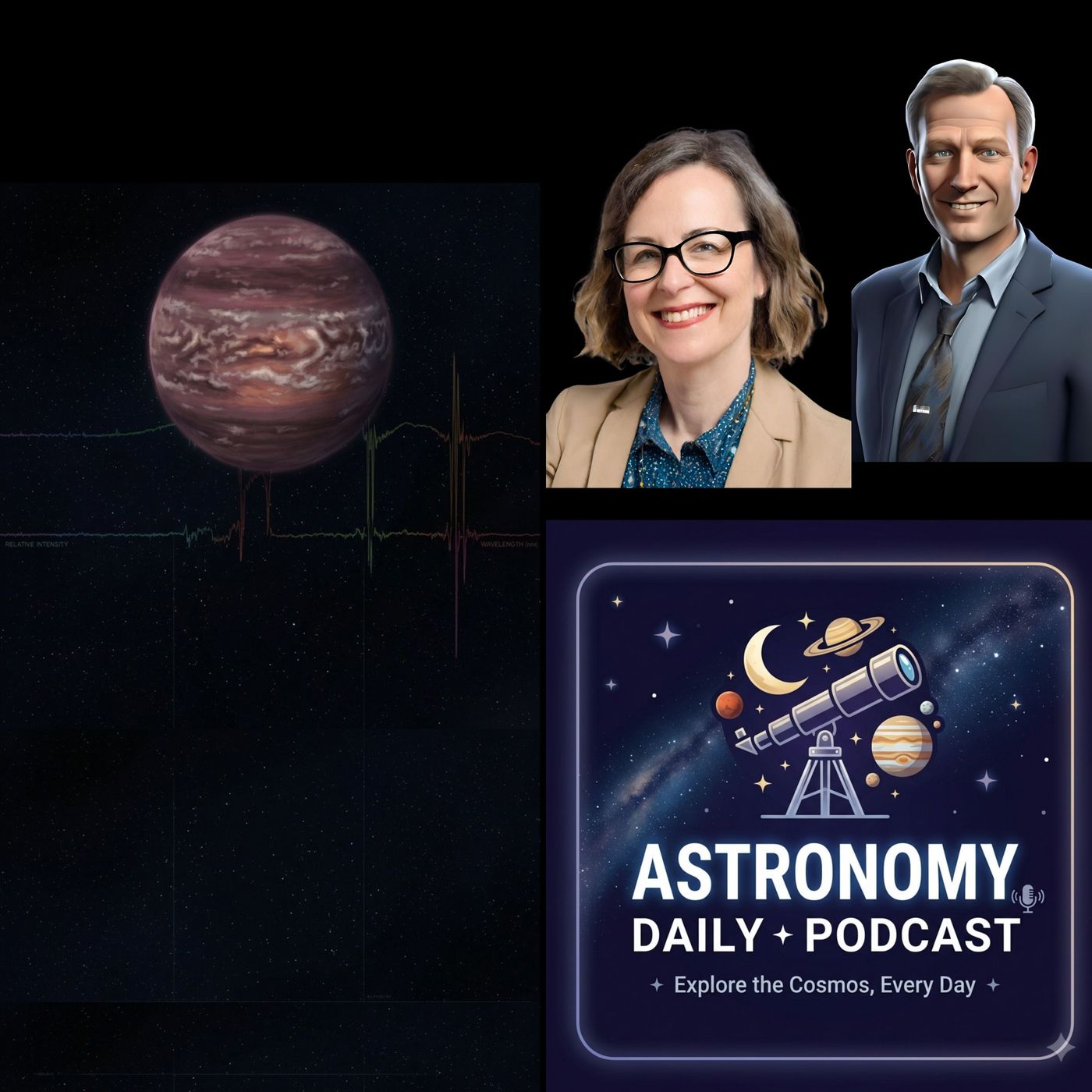
Cloudy with a Chance of Water: The Mysteries of WISE 0855 Unveiled
In this episode
The coldest brown dwarf we know has weather. JWST watched water clouds thicken and thin on WISE 0855, a sunless world seven and a half light-years away — plus a star slowly eating a brown dwarf, ten minutes of X-rays after a half-second burst, a Soviet satellite breaking up over Western Australia, NASA's lunar cave hunt, and Mercury's best evening show of the year for the south. Stories Weather on a World Without a Sun Miles et al. used JWST NIRSpec to take a spectrum of WISE 0855 every 15 minutes for 11 hours. Carbon monoxide and phosphine rise and fall together as convection dredges deep gas upward, while patchy water clouds thicken and thin higher up — the first variable water clouds seen outside the Solar System. Source: University of Arizona release, 9 Oct 2026; arXiv:2609.20664 The Star That Eats Slowly ZTF J0440+2325: a red dwarf drawing gas from a 25-Jupiter-mass brown dwarf on an 87-minute orbit — the first confirmed stable mass transfer from a substellar object onto a star. Householder, Burdge et al., Nature Astronomy, 5 Oct 2026. Source: Nature Astronomy (2026); arXiv:2603.17039 Ten Minutes After Half a Second Einstein Probe caught ~560 s of soft X-rays after the 0.37 s GRB 250704B, at redshift 0.661 with no supernova — pointing to a compact-object merger and possibly a newborn magnetar. Science Bulletin, 2026. Source: DOI 10.1016/j.scib.2026.08.021; arXiv:2601.14137 A Dead Satellite Comes Apart Soviet weather satellite Meteor 2-7 (launched 1981) fragmented on 5 Oct at ~850 km, detected by LeoLabs' Western Australian radar. Cause unknown. Source: EarthSky, 9 Oct 2026; Space.com Quick hit: NASA Goes Caving on the Moon NASA's PRISM picks for the Moon Base program include GIMLI, which will probe the Marius Hills Pit for a lava tube, plus LEMS-SP and DISCO. Source: NASA RELEASE26-080, 30 Sept 2026 Skywatch Mercury at greatest eastern elongation — 24° up at sunset from Sydney vs 10° LA, 7.5° NY, 3° London. Crescent Moon near Venus and Mercury, Venus heading to inferior conjunction on the 24th, pre-dawn Mars and Jupiter for the north (Mars through the Beehive), Orionids 21–22 Oct. Source: Computed with PyEphem Sources · https://astrobiology.com/2026/10/09/first-detection-of-variable-water-clouds-outside-of-our-solar-system/ · https://arxiv.org/abs/2609.20664 · https://dspace.mit.edu/handle/1721.1/175765 · https://arxiv.org/abs/2603.17039 · https://www.arxiv.org/abs/2601.14137 · https://earthsky.org/?p=560313 · https://www.space.com/space-exploration/satellites/a-dead-soviet-satellite-just-broke-apart-in-orbit-again-experts-say-its-part-of-a-worrying-trend · https://nasa.gov/news-release/nasa-adds-new-science-investigations-for-moon-baseBecome a supporter of this podcast: https://www.spreaker.com/podcast/astronomy-daily-latest-space-news--5648921/support.
Sponsor Details:
Ensure your online privacy by using NordVPN. To get our special listener deal and save a lot of money, visit www.astronomydaily.io/nordvpn. You'll be glad you did!
Get the best secure and private email on the planet. Stop your Government, google and who knows who else spying on every email you write. Do what we did and use ProtonMail. They beleive in privacy and there are no ads in their business model...yet they still provide a free forever service. Check them out and get out special deal at www.astronomydaily.io/protonmail
Become a supporter of Astronomy Daily by joining our...
Anna: Seven and a half light years away, there's a world with no sun, um, colder than a Sydney winter's night. And this week, we watched its clouds change. Avery: Not a picture, a single point of light measured every 15 minutes for 11 hours by the James Webb Space Telescope. Getting a little brighter and a little dimmer as the weather moved. Anna: Also today, a small star slowly eating a brown dwarf in an orbit that would fit inside the sun. 10 minutes of X rays from a collision that should have been over in half a second.
And a dead Soviet satellite that came apart over Western Australia. Avery: Plus, NASA goes caving on the Moon. And Mercury puts on its best evening show of the year for the Southern Hemisphere. Anna: I'm Anna. Avery: And I'm Avery. This is Astronomy AstroDailyPod. Anna: Let's start with the object itself, because it's a strange one. WISE 0855 was found in 2014 by Kevin Lumen at Penn State in data from NASA's WISE infrared survey. It sits about seven and a half light years away, which makes it the fourth closest system to the sun after Alpha Centauri, Barnard Star, and the brown dwarf pair Luhman 16.
And it's the coldest brown dwarf we know of, roughly 265 kelvin. That's about minus 8 Celsius. Avery: A brown dwarf is an object that formed the way a star does, collapsing out of a gas cloud, but never gathered enough mass to fuse hydrogen. So it just slowly cools. Wise 0855 has been cooling for billions of years, and it drifts through space on its own. No parent star, no sunlight. Every bit of light we get from it is its own leftover heat. Anna: How heavy is it? Avery: Somewhere between a few and about 10 times Jupiter's mass, depending on whose models you use.
The universities really says about twice Jupiter. It's about Jupiter's size either way, which is why astronomers have wanted it so badly. It's the closest thing we have to a Jupiter we can study without a star blinding the view. But here's the part I didn't know until I read this. On Jupiter, the water clouds are there, but you can't see them because there's a deck of ammonia clouds sitting on top of right. Anna: At wise 0855's temperature, ammonia doesn't condense into clouds, so the water clouds are the top layer.
That means if you could watch this object closely enough, you'd be looking straight at water weather. Avery: And, um, this isn't the first time someone has said water clouds about wise 0855. Anna: No. And we should be careful because a lot of Headlines this week said first water clouds outside the solar system. That claim was made for this exact object in 2014 from a ground based detection and again in 2016 when the first spectrum showed water vapour and the signature of clouds. What's new is the word variable.
This is the first time anyone has watched water clouds outside our solar system change. Avery: And that 2014 detection has an Australian name on it. Anna: It does. The 2014 paper that first saw Y0855 from the ground, led by Jacqueline Verity and using the Magellan telescope at Las Campanas in Chile, had Chris Tinney from UNSW as a co author. Verity's on this new paper too. So it's a 12 year thread and it began in the south. Avery: So what did the new study actually do? Anna: The team was led by Brittany Miles at the University of Arizona's Steward Observatory.
With more than 25 CO authors. They pointed Webb's Nurse Spec Instrument at WISE 0855 for 11 hours and took a Spectru 15 minutes. That's about 44 snapshots of its light. Each one split into hundreds of infrared wavelengths from about 3 to 5 micrometres. Avery: And wise 0855 is just a point. You can't see a cloud on it. Anna: Exactly. You can't resolve it into a disc. You get one dot of light and you watch how that light changes over time, wavelength by wavelength. Different molecules absorb at different wavelengths.
Clouds dim things in a different pattern. So if the brightness at a carbon monoxide wavelength wobbles while the water wavelengths hold steady, that tells you which part of the atmosphere is changing. Avery: Which sounds like the Simp 0136 story we did back in episode 197. Anna: It's the same tool that team used Principal Component Analysis to reduce a brown dwarf's weather to two underlying patterns. Miles and colleagues used the same technique here, sorting the changes into a few patterns that move together so the signal isn't drowned by the sheer number of wavelengths.
So what moved two things at two different heights. The biggest swing was carbon monoxide changing by up to about 10% at some wavelengths. And phosphine moved in step with it. The two rise and fall together. Avery: Phosphine. That's the molecule from the Venus argument a few years back. Anna: Same molecule, completely different story here. Phosphine is a tracer. Neither carbon monoxide nor phosphine should survive in this cold upper atmosphere for long. They're made deep down, where it's hot and dense and carried up by convection faster than chemistry can destroy them.
Jupiter does the same thing that's where Jupiter's phosphine comes from. So when both gases brighten and dim together, you're seeing deep air welling up. Avery: Wasn't phosphine supposed to be missing on this object? Anna: It was a genuine puzzle. A 2018 ground based study which Miles was also part of found no sign of phosphine at all in Ys 0855 spectrum. Even though Jupiter style chemistry says it should be there now with Webb, it isn't just present, it's, it's moving with the carbon monoxide. That's a reminder that a non detection is often a statement about the instrument, not the object.
The observing time itself came from a web cycle one programme led by Andrew Schemer at UC Santa Cruz who also led that 2016 spectrum. Same team 10 years on, finally with the telescope to answer its own question Avery: and the water higher up. Anna: Comparing the data to models, the team found that the overall shape of the spectrum needs water clouds and that the clouds are patchy and getting thicker and thinner. Biles own line was that they can watch the water clouds thicken and thin and the deep gases rise and fall as it happens.
Two layers of weather stacked on top of each other and both visible at once. Avery: There's a nice quote from Mark Marley, one of the co authors. Anna: He compared the atmosphere to a screen door. The light from deep inside has to pass through it. So you can't understand what's behind the screen until you understand the screen. That's really the point of this work. Clouds are the screen on almost every cold planet we'll ever study. Avery: So what are the caveats? Anna: 3. First, we don't actually know how long a day is on Y0855.
Its rotation period hasn't been pinned down so we can't yet say whether 11 hours caught a full turn, half a turn or more. The teen's next step is more web time to measure the rotation and map the weather in three dimensions. Second, um, it's one object the physics probably carries over to cold gas giant exoplanets and that's the hope. But. But that's a suggestion from the authors, not a demonstrated result. And third, everything here depends on atmosphere models. Marley's screen door cuts both ways.
The clouds are the finding and the clouds are also the hardest part to model. Avery: And where was this published? I've seen two answers. Anna: So have we. The preprint went up in mid September and says the paper is accepted to the Astronomical Journal, while the university's release says the Astrophysical Journal. Both are American Astronomical Society journals. So we'll just say it's out this month in an AAS journal. Avery: Bring it home for me. Why does a cloudy brown dwarf matter? Anna: Because it's the bridge.
We know Jupiter in detail, but only one Jupiter. The cold exoplanets that future telescopes will image directly will mostly be faint dots orbiting bright stars. Wise 0855 is a faint dot with no star in the way. Cold enough to have water. Weather close enough that Webb can take a spectrum every 15 minutes. If we can learn to read weather from one point of light here, that's the method we'll use for every cold giant planet after it. Avery: A rehearsal for exoplanet weather forecasting. Anna: And the forecast for wise 0855 as far as anyone can tell, is minus 8 Cloudy with patchy water clouds and a chance of phosphine.
Avery: From one brown dwarf to another and this one is being eaten. The system is called ZTFJ0440 2325, about 300 light years away in Taurus. It's a small red dwarf star about 85 times Jupiter's mass with a brown dwarf of about 25 Jupiter masses orbiting it every 87 minutes. Anna: 87 minutes, that's a full year and under an hour and a half and Avery: the whole orbit would fit inside the Sun. At that range the star's gravity pulls gas off the brown dwarf in a steady stream. The paper led by MIT graduate student Aaron Householder with Kevin Burge came out in nature astronomy on the 5th of October.
Housekeeping first. The preprint went up in March, so this is a seven month old result that's now been through peer review. Anna: How did they find? Avery: Started as a puzzle. Burge was going through data from the Zwicky Transient Facility at Palomar, which photographs the northern sky over and over, looking for things that change. One source traced a uh, triangle shaped light curve rising and falling in straight lines. His reaction roughly was that stars don't do that. Anna: So what does make a triangle?
Avery: A hotspot. Because the star is much bigger than the stream, the gas doesn't form a disc. It slams straight into the star's surface at high speed. Birch compared it to an asteroid hitting the moon that heats one patch of the star. And as the pair orbits, the hot patch swings into view and out again. Anna: And the obvious alternative was a black widow, right? Avery: A pulsar slowly eroding a uh, light companion. But a pulsar is heavy and it would make the visible star wobble a lot. Householder measured the wobble with follow of spectroscopy and it was far too small.
A red dwarf and a brown dwarf was the only thing that fit. Anna: And why is a slow um, meal surprising? Avery: Because the usual expectation is that when a star and a substellar companion get too close, it ends quickly. The orbit decays or the star swells and the companion is swallowed. Here the lighter object is the one giving up mass. And when the lighter partner is the donor, the orbit tends to respond by widening slightly, which keeps the flow gentle rather than runaway. The team estimates the brown dwarf loses roughly a hundred thousandth of an Earth mass each year.
Burge's line was that the star can gradually eat it for billions of years. Anna: Is it the only one? Avery: It's the first confirmed case of stable mass transfer from a substellar object onto a normal star. They also present a strong ZTF J1444 4820, a 67 minute pair sitting inside a triple system. No Australian team on this one. And Taurus sits low in the north from here. So this is an honestly northern discovery. But it suggests that some of the brown dwarfs we count as missing close to their stars, may not have been swallowed.
They may just be getting slowly eaten. Anna: Next, on 4 July 2025, two gamma ray instruments, the Chinese French SVOM mission and China's Insight HXMT recorded a short Gamma Ray Burst. GRB2507 04B lasted about 0.37 seconds. Avery: Short bursts are the ones we associate with neutron star collisions. Anna: Usually yes. A quick spike of gamma rays, then a fading afterglow. But China's Einstein probe, which has a wide field soft X ray camera, was watching the same patch of sky and the X rays didn't stop.
They kept coming in bursts for about 560 seconds. Nearly 10 minutes after a half second flash. Avery: That's the longest prompt X ray flash ever seen from a merger like this. Anna: That's the team's claim. The paper is in Science Bulletin with the release at the start of this month for disclosure. The preprint dates back to January and the event itself is from July last year. Avery: How sure are they about what made it graduate? Anna: Uh, student Nikolo Pasaleva led follow up with the X shooter spectrograph on ESO's Very Large Telescope at Paranal in Chile.
That pinned the redshift at 0.661. So the light has been travelling for more than 6 billion years. Then they looked for a supernova because the collapse of a massive star could also produce long lasting X rays. There wasn't one. Avery: So a short burst A known distance and no supernova. Anna: All of which points to two compact objects merging. The paper's own wording is a compact object merger and we'll keep that. Two neutron stars is the favoured reading, but a neutron star meeting a black hole fits that description too.
Avery: And what was powering 10 minutes of X rays? Anna: The team favours a magnetar. If two neutron stars merge and the combined object doesn't immediately collapse into a black hole, you can get a very rapidly spinning neutron star with an enormous magnetic field. Its spin energy drives a magnetised wind that keeps radiating the rapid flickering. The change in the spectrum and a later kick of energy into the debris all fit. Avery: Which connects to episode 191. The paper suggesting magnetars could be about half of all neutron stars.
Anna: It does, but this is indirect evidence. Nobody saw the magnetar at this distance. No gravitational wave detector could have heard the merger and any kilonova would have been too faint to catch. Avery: So why does it matter? Anna: Because it suggests long X ray tails may be common and we've been missing them since. Gamma ray instruments only see the first second. If that's right, then the next time Ligo, Virgo and Kagra hear a nearby merger, a soft X ray camera like Einstein probes may be the thing that finds it in the sky.
And that matters more with Swift, the old workhorse of burst astronomy, expected to re enter the atmosphere early next month. Avery: Lets move to some news. A satellite that stopped working decades ago has broken into pieces. Meteor 27 was a Soviet weather satellite launched in May 1981 to photograph clouds. On 5 October it fragmented in low Anna: Earth orbit and it was caught from Australia. Avery: It was. The tracking company LeoLabs picked up several new objects next to the satellite as it passed over its radar site in Western Australia.
And other radars confirm the debris generating event. The orbital debris analyst Jim Shell has narrowed the timing to about 9:45 UTC, give or take 10 minutes. That's quarter to nine on the evening of the fifth Sydney time? Anna: Hell higher. Avery: Roughly 850 kilometres in a steep polar orbit inclined about 81 degrees. And it came apart near the top of that orbit, where it reaches its highest latitude. That's a crowded part of the sky for debris because so many polar orbits cross there. The reports so far say tens of new trackable fragments.
Anna: Do we know what caused it? Avery: No. There are two broad options. Something inside let go, like an old battery or leftover propellant after 45 years of heating and cooling. Or it was hit by a piece of debris too small to track. Chao leans towards a collision, but he's also said we'll likely never know because a, uh, dead satellite sends no data. Anna: And this isn't a one off, it isn't. Avery: LeoLabs calls it the latest in a series it has detected over the past six months. A Starlink satellite in March that SpaceX put down to an internal energy source.
A Chinese Long March rocket body in August. And Space.com reports the Cold War era US satellite USA 32 broke up in September. The point about altitude is the important one. At around 850 kilometres, the air is so thin that debris can stay up for decades or even centuries. Anna: And for astronomers, every fragment is another Avery: thing for operational satellites to dodge. In an FCC filing earlier this year, SpaceX said each Starlink satellite averaged more than 40 avoidance manoeuvres a year. And every bright fragment is another possible streak across a telescope image.
One breakup doesn't close off space. The worry is the trend and the fact that nobody owns the job of cleaning up after a satellite launched in 1980. One. Anna: Quick one before the sky. NASA has chosen three new science payloads for its M Moon Base programme, announced on 30th September. They'll fly to the surface on commercial landers through the CLPS programme. And the one with the best story is called Gimli, like the dwarf from Avery: the Lord of the Rings who would definitely approve of going underground.
Anna: Bewud it stands for Geophysical Instruments for Marius Lunar Pit Investigation led by Nathaniel Putzig at the Planetary Science Institute. The target is the Marius Hills pit, a hole about 34 metres deep found by Japan's Kaguya orbiter in 2009. The idea is that it's a skylight, a spot where the roof of an old lava tube collapsed. Gimli will use ground penetrating radar, seismic sensors and gravity measurements to see whether a tunnel actually runs away from the Avery: pit, which would be a natural shelter from radiation and temperature swings.
Anna: If it's there, nobody has yet confirmed a lava tube on the moon from the surface. The other two picks are a long term monitoring station for the South Pole from Medi Bena at UMBC and Disko from NASA Ames, which will look for ice in tiny cold traps and measure how rocket exhaust disturbs the ground. No launch dates yet and no dollar fifth year's in the announcement to the sky. Avery: And um, this week the Southern hemisphere gets the best of it in the evening with a, uh, fair trade for the north before dawn.
Quick note for Australian listeners, daylight saving started on the 4th, so the Sydney Times are AEDT. Anna: Mercury reached greatest eastern elongation on Monday evening, about 25 degrees from the sun. That's as far from the sun as it gets on this path. So this is the week to find Avery: it and the geometry is wildly unequal. Our calculations for Tuesday evening. From Sydney, the sun sets at 7:06pm and mercury is still 24 degrees up, setting a little over two hours after the sun. From Los Angeles, it's about 10 degrees up at sunset and gone within an hour.
From New York, seven and a half degrees, gone in under 50 minutes. And, uh, from London, just three degrees. Anna: This is the same steep spring ecliptic we talked about at the equinox. From the south, the planets stack almost straight up from the western horizon after sunset. Avery: So for Southern Hemisphere listeners, it's the easiest Mercury of the year. Look west about 40 minutes after sunset for a steady pinkish point of light well clear of the horizon. Northern listeners, you need a flat western horizon and good timing about 20 to 30 minutes after sunset and binoculars help.
Anna: Venus is the brilliant object lower down and to the left of Mercury from the south, but it's sinking fast. It heads into inferior conjunction on the 24th, passing between us and the Sun. From Sydney, it's still about 17 degrees up at sunset this week and sets around an hour and a half after the Sun. From North America, it's already lost in Avery: the glare and the Moon joins them. The thin Crescent was about 3 degrees from Venus on Monday evening. On, um, Tuesday, it's climbed to about 6 degrees from mercury, 8% lit with earthshine on the dark part.
If your sky is clear, that's a lovely pairing from Australia, New Zealand and South America. Anna: Now the trade before dawn, the Northern hemisphere has Mars and Jupiter at nautical dawn on Wednesday. Mars is about 58 degrees up from Los Angeles and 56 from New York, with Jupiter in the mid-40s. From Sydney, they're only about 23 and 18 degrees. Avery: And Mars has been doing something lovely. It passed right through the Beehive cluster M44 in cancer over the weekend, coming within about a tenth of a degree of the cluster centre on Saturday UTC.
It's still close enough this week for a binocular view. Anna: And Mars and Jupiter are closing in about 13 degrees apart now two and a half by the 10th of November and about one and a quarter degrees by the 15th. That conjunction is worth a full sky watch closer to the date. Avery: And coming up, the Orionids. The meteor shower made of dust from Holly's comet peak on the night of the 21st into the 22nd, the moon will be about 78% lit, but it sets around three in the morning in all four of our cities Sydney, Los Angeles, New York and London.
So the dark hour or two before dawn is your window from either hemisphere. And Saturn, just past opposition, is up all evening. For anyone with a small telescope, one Anna: safety point, and it matters, especially this week. Mercury and Venus are close to the sun, so wait until the sun has fully set before you sweep binoculars or a telescope anywhere near the western horizon. Never look at the sun through any optics. If you ever do want to look at the sun, use only a certified solar filter or eclipse glasses that meet the ISO 1123122 international standard.
Fitted properly over the front of the instrument, sunglasses are not safe. Avery: That's the show today. Water clouds changing on the coldest brown dwarf we know. A star patiently eating a Brown Dwarf every 87 minutes. 10 minutes of X rays after a half second burst, a dead Soviet satellite falling to pieces over Western Australia and NASA going looking for caves on the moon. Anna: If you've got a question about anything we covered or something you'd like us to follow, the contact form at astronomydailyio comes straight to the team and a lot of what we chase starts there.
You'll also find show notes, the newsletter and the full back catalogue on the site. And we're astrodaily pod on social. Avery: And if you're in the south, go and find Mercury this week. It won't be this easy again for a while. Anna: I'm Anna. Avery: And I'm Avery. Anna: Clear skies, everyone.
 Apple Podcasts
 Spotify
 Pocket Casts
 Castbox
 Overcast
 Podbean
 iHeartRadio
 Castro
 Goodpods
 Moon FM
 Podcast Addict
 Podcast Republic
 YouTube