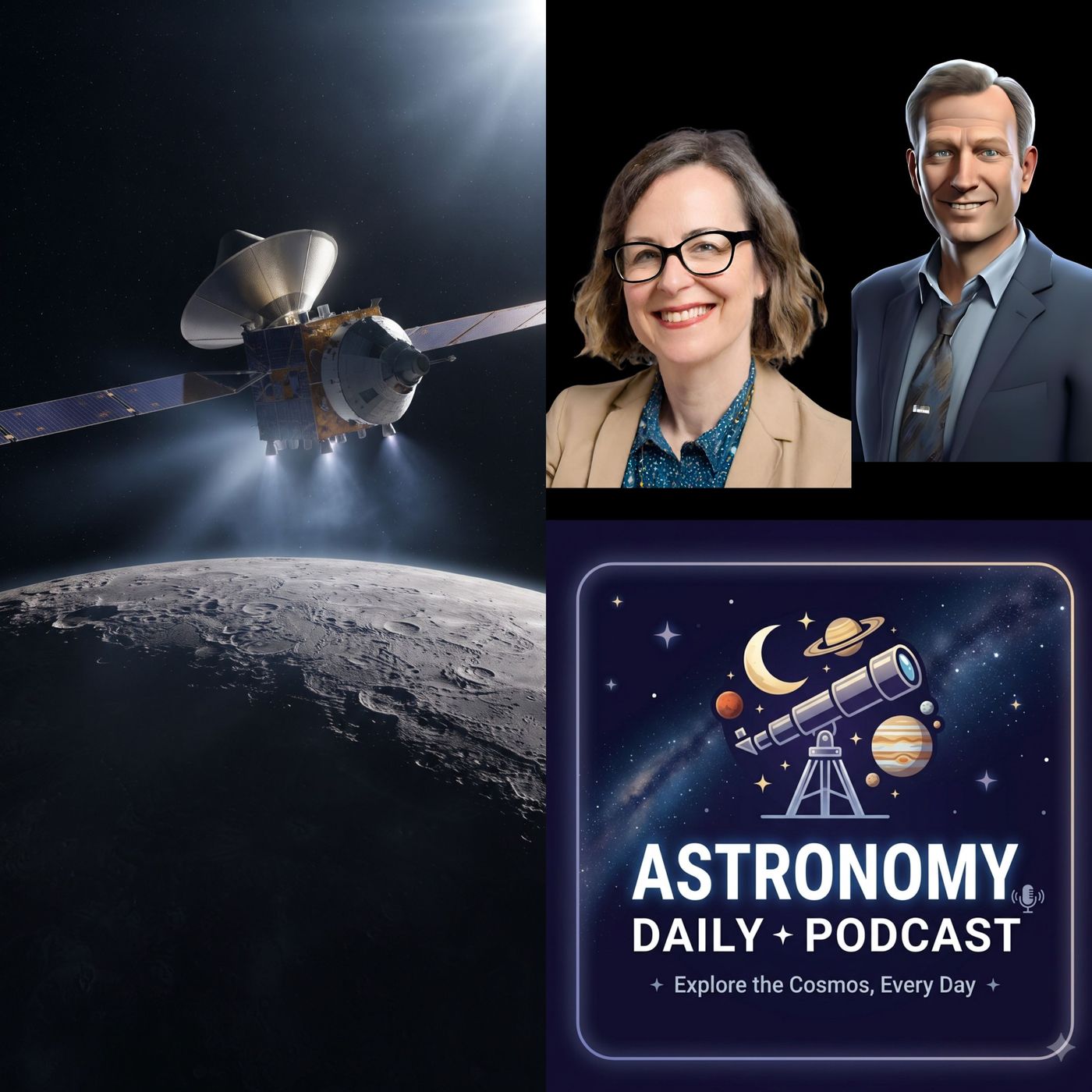
BepiColombo: Caught, But Not Quite to Plan
In this episode
Show notes BepiColombo is in orbit around Mercury after an eight-year journey, but the capture burn ended early because of a software issue. We go through what is known, what isn't yet, and why the spacecraft is safe either way. Also: Europa's sodium cloud traced to the moon's own salt, a Sydney-led study finding the Milky Way's bar is long, slow and forming stars, and a theory for how an atom-sized black hole could blow up a star from the inside. Skywatch: Mercury at dawn, Mars and Jupiter, Saturn, and the Beaver supermoon. BepiColombo captured by Mercury, burn cut short ESA/JAXA's BepiColombo achieved orbital capture on 21 November 2026, becoming the second spacecraft ever to orbit Mercury. On 22 November the team reported the burn was shorter than planned due to a software issue; the spacecraft is safe and an update was promised for Monday. Mio separation is planned around 9–10 December and science from 6 April 2027. Europa's sodium cloud comes from its ocean Keck/HIRES data spanning more than 20 years show Europa's sodium cloud is remarkably stable regardless of Io's volcanism, pointing to Europa's own salt as the source (Lovett, Schmidt et al., JGR: Space Physics). The Milky Way's bar is long, slow and star-forming A University of Sydney-led team argues masers once assigned to the Norma arm trace the bar's shock front, giving a bar half-length of ~4.3 kpc and a slow pattern speed (Davis, Bland-Hawthorn et al., Nature Astronomy). How an atom-sized black hole could destroy a star Gottlieb (MIT) and colleagues show a captured primordial black hole could sink to a star's core, grow, form a disc and launch jets that blow the star apart, a possible new way to search for primordial black holes (ApJ). Quick hit: Hera and Roman dates ESA releases detailed Dimorphos images on 25 November; NASA unveils Roman's first images on 7 December at 3:30 pm EST (07:30 AEDT, 8 December). Sources • [BepiColombo] ESA — Latest updates: BepiColombo's arrival at Mercury — https://www.esa.int/Science_Exploration/Space_Science/BepiColombo/Latest_updates_BepiColombo_s_arrival_at_Mercury • [BepiColombo] ESA — BepiColombo entering orbit around Mercury (animation, 19 Nov 2026) — https://www.esa.int/media/about-us/directorates/science/bepicolombo-entering-orbit-around-mercury • [BepiColombo] Space.com — BepiColombo becomes 2nd ever to arrive in orbit around Mercury (updated 22 Nov) — https://www.space.com/space-exploration/missions/esa-jaxa-bepicolomobo-mission-mercury-orbit-arrival • [Europa] Keck Observatory — Astronomers reveal the oceanic origin of Europa's sodium cloud (19 Nov 2026) — https://keckobservatory.org/europa-sodium-cloud/ • [Europa] Lovett et al., Europa's Neutral Sodium Exosphere Is Quasi-Stable Over Decades, JGR: Space Physics, DOI 10.1029/2026JA035421 — https://doi.org/10.1029/2026JA035421 • [Galactic bar] Davis, Bland-Hawthorn, Tepper-Garcia, Agertz & Iles, The nature of the Norma arm as a bar-driven star-forming shock front, Nature Astronomy (20 Nov 2026) — https://www.nature.com/articles/s41550-026-03010-5 • [Galactic bar] arXiv:2610.38607 (29 Oct 2026) — https://arxiv.org/abs/2610.38607 • [Primordial black holes] MIT News — If tiny primordial black holes exist, here's how we might find them (19 Nov 2026) — https://news.mit.edu/2026/if-tiny-primordial-black-holes-exist-heres-how-we-might-find-them-1119 • [Primordial black holes] Gottlieb et al., The Life and Death of Stars that Capture Primordial Black Holes, ApJ, DOI 10.3847/1538-4357/aeb7e1 — https://doi.org/10.3847/1538-4357/aeb7e1 • [Hera] DLR — Hera spots its target (12 Nov 2026) — https://www.dlr.de/en/latest/news/2026/hera-spots-its-target-a-first-glimpse-into-the-study-of-the-didymos-binary-asteroid-system • [Roman] NASA — NASA Invites Media, Public to View Roman Telescope's First Images — https://www.nasa.gov/?p=1065857Become a supporter of this podcast: <a...
Anna: Hi, everyone. Welcome back to another week of astronomy and space news. Eight years, nine planetary flybys, billions of kilometres. And on Saturday evening, European time, a, uh, spacecraft fired its thrusters behind Mercury and asked the smallest planet in the solar system to catch Avery: worked. BepiColombo is in orbit. But on Sunday, the mission team added a sentence nobody wanted to read. The burn was shorter than planned because of a software issue. Anna: So today, what we know, what we do not know yet, and why the spacecraft is safe either way.
Avery: Plus, Europa's sodium cloud turns out to be the moon's own salt. A Sydney team finds the Milky Way's bar is long, slow and making stars. And a theory for how a black hole the size of an atom could blow up a star from the inside. Anna: This is Astronomy AstroDailyPod. I'm Anna. Avery: And I'm Avery. Let's go to Mercury. Anna: At, uh, 24 minutes past 6 on Saturday evening, Universal Time, which was 24 past 5 on Sunday morning here in Sydney, four thrusters on the European Space Agency's Mercury planetary orbiter began to fire.
The job was to slow the spacecraft stack just enough for Mercury's gravity to take hold. Avery: And then, um, the hard part for everyone on the ground, waiting. Confirmation did not come for several hours. Anna: When it did, the mission account posted that they had heard back from Bepe that the spacecraft was in contact with the ground and that flight dynamics had already confirmed orbital capture around Mercury, Avery: which makes Bepicolombo only the second spacecraft ever to orbit Mercury. The first was NASA's messenger, which worked there from 2011 until it was deliberately crashed into the surface in 2015.
Anna: It is worth pausing on why this took eight years. Mercury is close to the sun and falling towards the sun makes you faster, not slower. So getting there is easy. Stopping there is the problem. Avery: It takes more energy to settle into orbit around Mercury than it would take to reach Pluto. So BP Colombo, which launched from Kourou in French Guiana in October 2018, spent its crews bleeding off speed. One flyby of Earth, two of Venus, six of Mercury, plus years of ion thrust. Anna: There was a setback along the way.
In 2024, a power problem limited the thrust from that electric propulsion system and engineers redesigned the trajectory that pushed arrival from December 2025 to this month. Avery: And the arrival itself was designed to be gentle. ESA calls it weak stability boundary capture. The trajectory brings the spacecraft into Mercury's neighbourhood, already moving at, uh, nearly the planet's own speed. So a, uh, comparatively modest push, near closest approach is enough. Anna: That matters for what comes next, because it means capture was never balanced on a knife edge.
Avery: So here is Sunday's news. The mission team said, and I'll quote it directly, because the wording during the manoeuvre, the thruster burn was shorter than planned due to a software issue. The spacecraft is safe and teams at, uh, ESA's operations centre in Darmstadt are working to understand what happened. Updates on Monday, European time. Anna: Let's be careful about what that does and does not say. It says the spacecraft was captured, it says the burn ended early, it does not say how early and it does not say what orbit BepiColombo is actually in.
Avery: Some reports have quoted a burn of 37 minutes. We are not repeating a figure because without the planned length beside it, a number on its own tells you nothing. Anna: What we do know is the plan. ESA's own animation released last Thursday shows the stack approaching on Mercury's night side and settling into an elliptical orbit roughly 590 by 11,640 kilometres. A shorter burn would most likely leave the orbit somewhat higher or more stretched than that. Avery: And that is not necessarily a crisis, because this orbit was only ever the first step.
The arrival plan was always a long staircase of manoeuvres, more than a dozen of them, progressively lowering and reshaping the orbit Anna: at the time of recording. That update is still to come. We'll have the full picture in tomorrow's episode. Avery: Assuming the plan holds, here is the timetable. Around the 9th or 10th of December, the two spacecraft finally separate. Japan's MIO, the Mercury Magnetospheric orbiter, is released into its own highly elongated polar orbit. Anna: On 16 December, ESA's orbiter lets go of Mio's sunshield, the structure that has protected the Japanese spacecraft all the way from Earth.
Then the European orbiter uses its thrusters to work down towards its own lower orbit, arriving there on 10 March 2027. Avery: Routine science starts on 6 April 2027. And that is the real prize. The first time any planet other than Earth has been studied by two orbiters at once. One close in, mapping the surface, one further out, watching the space around it. Anna: So why go to all this trouble for a small, airless, cratered world? Because Mercury keeps refusing to behave like the planet we expected.
Avery: Start with the insight. Mercury's iron core takes up roughly 85% of the planet's radius. Earth's is a little over half. Either Mercury formed from unusually iron rich material or something stripped away much of its rocky outer layers. Perhaps a giant impact early on. Anna: Then the magnetic field. Mercury has one which surprised everyone when Mariner 10 found it in the 1970s, because a planet that small should have cooled and frozen solid long ago. Messenger then found the field is lopsided, its centre shifted well to the north of the planet's equator.
Avery: Messenger also found strange bright hollows, shallow pits that look as if something in the rock has been evaporating away. It found more volatile elements like sulphur and potassium than a planet baked this close to the sun should keep. And it confirmed water ice hiding in permanently shadowed craters at the poles on a planet where the dayside can top 400 degrees Celsius. Anna: The trouble is that Messenger's orbit was very elongated and favoured the north. Its best views were of one hemisphere.
Bepi Colombo's two orbiters are designed to cover the whole planet, north and south evenly. Avery: And the name is a nice touch. Giuseppe Colombo, known as Bepi, was the Italian mathematician who explained why Mercury spins exactly three times for every two orbits of the sun. He also suggested the trajectory that let Mariner 10 fly past Mercury three times instead of once. Fifty years on, the mission carrying his nickname, is finishing what Mariner 10 began. Anna: The European orbiter has already been testing its kit.
In September, with the transfer module gone and the view finally clear, every instrument was switched on together. The BELA laser altimeter fired more than 700,000 pulses. The Mertis infrared spectrometer showed little or no loss of sensitivity since 2013. Avery: Remember E191, when we covered Bepicolombo? Watching a solar storm pour energetic particles onto Mercury's surface during a flyby? That bombardment knocks atoms off the rock and makes a glow in X rays. Reading that glow is how the orbiter will work out what Mercury is made of.
Anna: And on F192, we covered the paper suggesting Mercury has shrunk more than we thought, maybe losing up to 23 kilometres of diameter. BELA is the instrument that can test that scarp by scarp. Avery: There's a threat to our part of the world, too. When the transfer module separated in September, the confirmation came through ESA's Deep Space Stations at Cerberos in Spain and Malargue in Argentina. Southern Hemisphere antennas are part of how Europe talks to Mercury. Anna: So the honest summary?
Bepicolombo is caught. The spacecraft is safe. Something in the software cut the burn short, and we'll know tomorrow what that means for the orbit and the calendar. Avery: After eight years, a few more hours of patience seems fair. Anna: I guess so, but some of us are impatient. Avery: From the innermost planet to an icy moon, Jupiter's Europa has a global ocean under its ice. And one of the big questions is whether anything from that ocean reaches the surface where we can study it. Anna: A new study says something does, and it has been hiding in plain sight for decades in a cloud of sodium gas around the Moon.
Avery: The cloud has been known since the 1990s. It stretches as far as 30 times Europa's radius and is elongated east to west. The question was where the sodium comes from, Anna: and there was an obvious suspect. Next door is IO, the most volcanic body in the solar system, which sprays sodium all around the Jupiter system. Perhaps IO simply paints Europa's surface and Europa gives it back. Avery: Emma Lovett, a graduate student at Boston University, led the work with Carl Schmidt of Queen's University Belfast and Boston University.
They used Keck Observatory's High Res spectrograph on Mauna Kea, combining new observations with archival Keck data going back to 1999. Anna: There's a clever trick in the method. Europa's ice is so bright that it drowns out the faint sodium glow close to the moon. So the team watched while Europa was in Jupiter's shadow. With no sunlight on the ice, electrons from Jupiter's surroundings make the sodium glow on its own. Avery: One key observation was 29 September 2022, when NASA's Juno spacecraft flew past Europa so they could compare the sodium with the local plasma measured on the spot.
Anna: The result? The sodium abundance has stayed remarkably stable for more than 20 years through all the changes in Jupiter's plasma environment and regardless of what IO's volcanoes were doing. Avery: Schmidt put it simply. Europa is indifferent to IO's volcanic activity. And if IO is not to supply, the most natural source is Europa's own salt, sodium chloride, that has come up from the ocean below. Anna: Now the caveat, and it matters this is not a measurement of the ocean. It is an inference that the sodium in the cloud traces salty material that came from it.
The models of what releases the sodium and how sunlight pushes it around still need testing. Avery: It is also not brand new work out of nowhere. The team has been presenting this AT conferences since 2024, and it is now published in the Journal of Geophysical Research, Space Physics. Anna: What makes it useful is the timing. NASA's Europa Clipper arrives at Jupiter in 2030 and ESA's juice will make two Europa flybys too. A stable ocean fed sodium cloud is a baseline both missions can test, Avery: and the team isn't waiting.
This month they are using the Hubble Space Telescope to look for magnesium in Europa's atmosphere. Another possible ingredient of those ocean Salts. Anna: A moon whose atmosphere may be leaking its ocean's chemistry into space one atom at a time. Avery: Now a story from just up the road. A team at the University of Sydney has taken a fresh look at the middle of our own galaxy. And they think a structure astronomers have been calling a spiral arm. Maybe something else entirely. Anna: Start with the setup.
The Milky Way is usually drawn with four major spiral arms and a central bar, a long, elongated concentration of stars across the middle. But we are inside the disc, so we can't step back and photograph it. Its size, its tilt, and its spin rate are, uh, all still debated. Avery: One clue comes from masers, natural microwave lasers that switch on around young, massive stars. A string of them, about a million years old, runs out from one end of the bar, and it has been read as part of the NORMA Army.
Anna: Hilary Davis led the study with Jos Bland Hawthorne, Thor Tepper Garcia, and Elizabeth Iles in Sydney and Oscar Agertz at Lund. It's published in Nature Astronomy. Avery: They ran a new generation of simulations following both the stars and the gas. In barred galaxies, gas flowing around the bar piles up into a shock front along its leading edge. That is the dustling we see in other barred galaxies. Anna: Their argument is that those young masers are not tracing a spiral arm at all. They trace the shock front along one end of our own bar, which would mean our bar's dust lane is actively forming stars.
Avery: And if you line the masers up with a simulated shock, you can measure the bar. They get a half length of about 4.3 kiloparsec, roughly 14,000 light years, a half width of about 2.3 kiloparsecs, a tilt of about 20 degrees, and a slow rotation. Anna: Their summary is that the galactic bar is long, slow, and star forming. And that raises fresh questions about the Milky Way's spiral structure. Avery: Two honest caveats. First, everything hinges on matching the masers to the simulated shock. Other teams read the same masers as a spiral arm or as stars following the orbits that make up the bar itself.
Those readings are still on the table. Anna: Second, the spin rate is an upper limit, not a measurement. And a, uh, disclosure from us. The preprint appeared in late October, three weeks before the Journal version this week. Avery: The southern threat here is unusually strong. A Sydney team, an ARC Laureate fellowship, and a region of sky that belongs to us. Norma is a southern constellation from Sydney. It can climb above 70 degrees from. From New York and London. It never rises at all. Anna: It's a good reminder that we still argue about the shape of our own Home.
Rubin and Gaia will keep tightening the measurements. For now, one more piece of the Milky Way may need redrawing. Avery: It's never boring as spaceism. Um, Anna: our last story today is pure theory, and we'll say that up front. Nobody has ever seen a primordial black hole. But a new paper suggests where we might catch one. Avery: Primordial black holes are, uh, hypothetical. They would have formed in the first fraction of a second after the Big Bang from tiny, dense pockets that collapsed under their own gravity.
Some could be as massive as an asteroid, but no bigger than an atom. Anna: And they're interesting because they could be part of the dark matter. The asteroid mass range is one of the last windows where they might still make up a big share of it. Avery: Org Gottlieb at MIT led the study with Matteo Cantiello at the Flatiron Institute, Cameron Norton and Matthew Klebben at New York University, and Ken Van Tilberg at Stanford. It was published last week in the Astrophysical Journal. Anna: The idea A single star can't trap a, ah, passing primordial black hole on its own.
But a star with a companion, a second star or a planet can. Once captured, friction with the star's gas slowly drags the black hole's orbit inward over thousands to millions of years until it reaches the core. Avery: There, it m eats. It grows by swallowing stellar gas. And once it reaches about 1% of the star's mass in a rapidly spinning star, the gas no longer falls straight in. It forms a spinning disc. Anna: That is where it turns violent. The spinning black hole and disc twist the magnetic field and launch jets which punch through the star in a few dozen seconds.
Avery: Gottlieb's words. Once the disc forms, it is essentially a death sentence for the star. Anna: The predicted signal X rays and gamma rays first, then optical and infrared light, and later radio with a blue and ultraviolet flash bright enough for today's telescopes if it isn't too far away. Avery: The catch is that other events can make similar flashes. One giveaway would be a star that should not have been able to explode at all for its mass, as if something inside had been eating it. Anna: The paper doesn't estimate how often this would happen, so it's a search strategy, not a forecast.
But if such flashes turn up or keep failing to, that limits how much of the dark matter. Primordial black holes can be. Avery: Two dates for your diary, both from missions we've been following. Anna: First, Hera, ESA's spacecraft arrived at the asteroid pair Didymos and Dimorphos earlier this month. And has been sending back first looks into including views of didymos from just 28.5 kilometres. On Wednesday 25 November, ESA plans to release the first detailed images of dimorphos. The moonlit NASA's DART spacecraft hit in September 2022.
Avery: That will be our first close look at Dimorphos since Dart's final frames and the start of what ESA calls uh, a crash site investigation. We'll cover it when the pictures land. Anna: Deccan Roman NASA has confirmed the first images from the Nancy Grace Roman Space Telescope will be unveiled at the American Geophysical Union meeting in San Francisco on Monday the 7th of December at 3:30 in the afternoon Eastern. That's half past 12 Pacific and half past 7 on the morning of Tuesday the 8th here in Sydney.
Avery: We followed Roman from before launch, so we'll be there for that one. Anna: Let's look up starting with the planet of the day. On Saturday, the very day Bepicolombo arrived, Mercury reached its greatest western elongation, 19 and a half degrees from the sun. That puts it in the morning sky this week, low in the east before dawn. Avery: And this time the geometry favours the north. At this time of year, the morning ecliptic stands steeply from the eastern horizon in the Northern Hemisphere and lies much flatter here in the south.
It's the reverse of what we described back in September. Anna: The numbers for Wednesday morning from Los Angeles and New York. Mercury rises more than an hour and a half before the sun and is nearly 10 degrees up 40 minutes before sunrise. From London, it rises almost two hours early. From Sydney, it rises only 52 minutes before the sun and sits about 2 degrees up at the same point. A clear, flat eastern horizon is essential here. Avery: Brilliant Venus, at magnitude -4.4 is the easy guide. Higher and to Mercury's upper right at, uh, nautical dawn, it's about 24 degrees up from Los Angeles, 22 from New York, 18 from London and 10 from Sydney.
Anna: Now the safety line, which we never skip. Mercury and Venus are close to the sun at dawn. If you sweep with binoculars, stop well before sunrise and never point binoculars or a telescope at or near the sun for any solar viewing, use only filters Certified to the ISO 123122 standard. Avery: Higher up in the same predawn sky, Mars and Jupiter are still close together, about 3 degrees apart on Wednesday and slowly separating. That pair is high for the north, more than 60 degrees up from Los Angeles and New York at, uh, nautical dawn and about 35 degrees from Sydney.
Jupiter is the bright one at uh, magnitude minus two. Anna: In the evening, Saturn is the planet to find. From Sydney, it is well placed, about 55 degrees up in the north. As twilight ends from the north, it is lower in the Southeast, about 42 degrees from Los Angeles, 36 from New York and 27 from London. Avery: Then the moon, this week's full moon, the Beaver moon, falls at 14:53 Universal Time on Tuesday the 24th. That's just before 10 on, um, Tuesday morning in New York and 7 in the morning in Los Angeles, Mid afternoon in London and seven minutes to two on Wednesday morning in Sydney.
Anna: So it's the same instant, but northern calendars say the 24th and Australian calendars say the 25th. It looks full on both nights Avery: and it's a supermoon. The moon reaches perigee, its closest point, about 30 hours after full at around 359,000 kilometres. At full, it's about 361,000 kilometres away. Anna: On Tuesday evening, look for moonrise around a quarter past three in London, a quarter past four in New York, a quarter to five in Los Angeles, and just after half past seven in Sydney.
A moon close to the horizon always looks larger, though that part is our brains, not the orbit. Avery: One more for the south. The Norma region from our Milky Way story is setting now about 10 degrees up in the southwest as twilight ends from Sydney. It's a winter object for us, best in the middle of the year. And it never rises at all from New York or London. Anna: So this week the north gets the better Mercury and the higher planets at dawn. And the south gets Saturn high overhead and a supermoon rising into a summer evening.
Avery: That's Astronomy daily for today. BepiColombo is safely in orbit. Europa's sodium looks like its own salt. Our galaxy's bar may be making stars, and atom sized black holes might one day give themselves away inside a star. Anna: And tomorrow, ESA's update on that shortened burn. We'll tell you what it means for the orbit and for December's separation. Avery: You'll find show notes, sources and our newsletter at astronomydaily IO and we're, uh, astrodaily Pod on social media. If you have a question, use the contact form on the website.
Some of our best segments have started that way. Anna: Clear skies wherever you are. I'm Anna. I'm Avery. See you tomorrow.
: To.
 Apple Podcasts
 Spotify
 Pocket Casts
 Castbox
 Overcast
 Podbean
 iHeartRadio
 Castro
 Goodpods
 Moon FM
 Podcast Addict
 Podcast Republic
 YouTube