Whatever You Call It, Tonight Is Pluto’s Night
Astronomy Daily · 27 July 2026
There is a faint dot in the constellation Capricornus tonight that you almost certainly cannot see, and it is the most argued-about object in the Solar System. Pluto reaches opposition on 27 July — sitting directly opposite the Sun in our sky, rising at sunset, riding highest around midnight, and sitting about as close to Earth as it ever gets, a little under 35 astronomical units away. That makes tonight its brightest of the year. “Brightest,” for Pluto, still means magnitude 15 — millions of times too dim for the naked eye, a target that realistically needs an eight-inch telescope and a good chart. But the faintness is the point. Almost everything about Pluto is a lesson in how much can hide inside a dot.
A farm boy, a blink comparator, and a schoolgirl
The hunt began with Percival Lowell, who was convinced an unseen “Planet X” was tugging on Uranus and Neptune. He died in 1916 without finding it. The search fell, in 1929, to Clyde Tombaugh — 23 years old, from a Kansas farm, no college degree. His method was heroic tedium: photograph the same star field on different nights, then flick between the plates in a blink comparator, hunting for the one point of light among hundreds of thousands that shifted. On 18 February 1930, one did. The name came not from an astronomer but from 11-year-old Venetia Burney in England, who suggested the god of the underworld — and, neatly, its first two letters honoured Lowell.
The vote that never really ended
For 76 years Pluto was the ninth planet. Then, as telescopes found more icy worlds in the Kuiper Belt — including Eris, which initially appeared larger than Pluto — astronomers faced an awkward question: if Pluto is a planet, how many more must we crown? In August 2006 the International Astronomical Union defined “planet” for the first time: orbit the Sun, be round under its own gravity, and “clear the neighbourhood” of other debris. Pluto fails the third test and was reclassified a dwarf planet.
It is worth being fair to both camps, because this is a definition, not a discovery. The dynamical view says a useful definition must capture how the Solar System is actually organised — and the eight major planets dominate their orbits in a way Kuiper Belt objects simply do not. The geophysical view, championed by New Horizons lead Alan Stern, counters that “clearing the neighbourhood” judges an object by where it sits rather than what it is — move Earth out to Pluto’s orbit and even Earth wouldn’t clear it. By their preferred definition, if it’s round and it isn’t a star, it’s a planet. Reasonable scientists genuinely disagree.
The world New Horizons found
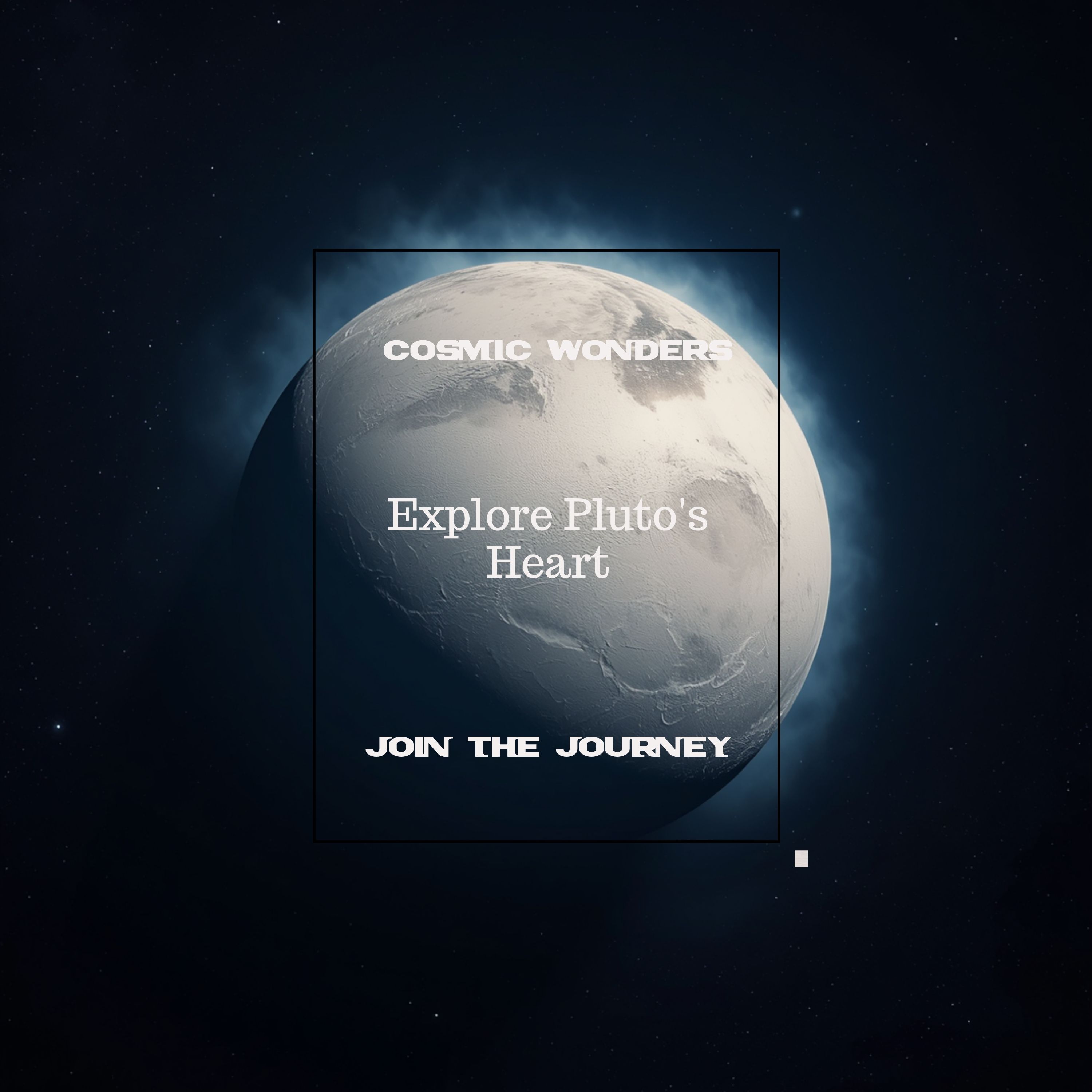
And then came the twist. New Horizons launched in January 2006 — seven months before the vote — so it set out for a planet and arrived, in July 2015, at a “dwarf planet.” What it saw ended any idea that small and distant means dull. A vast plain of frozen nitrogen, Sputnik Planitia, slowly convects like a lava lamp, erasing its own craters. Mountains of water ice — rock-hard at Pluto’s temperatures — rise like the Rockies. A thin nitrogen atmosphere holds layers of blue haze. There may be a liquid-water ocean beneath the crust. And Pluto keeps five moons, the largest, Charon, so big the pair pirouette around a point in empty space between them.
So point a scope south tonight
If you have the aperture, tonight and this week are your best shot of the year — though a nearly full Moon will fight you, so patience (or a week’s wait) helps. Sketch or photograph the field over a few nights and watch for the “star” that moves. That mover is a churning, hazy, possibly-ocean-bearing world with a heart on its face — the world Clyde Tombaugh found, and whose ashes New Horizons carried past it. Call it a planet or a dwarf planet; the label changed nothing about the place. Clear skies.