Voyager’s second wind: how NASA bought its oldest explorer another year
Related Episode
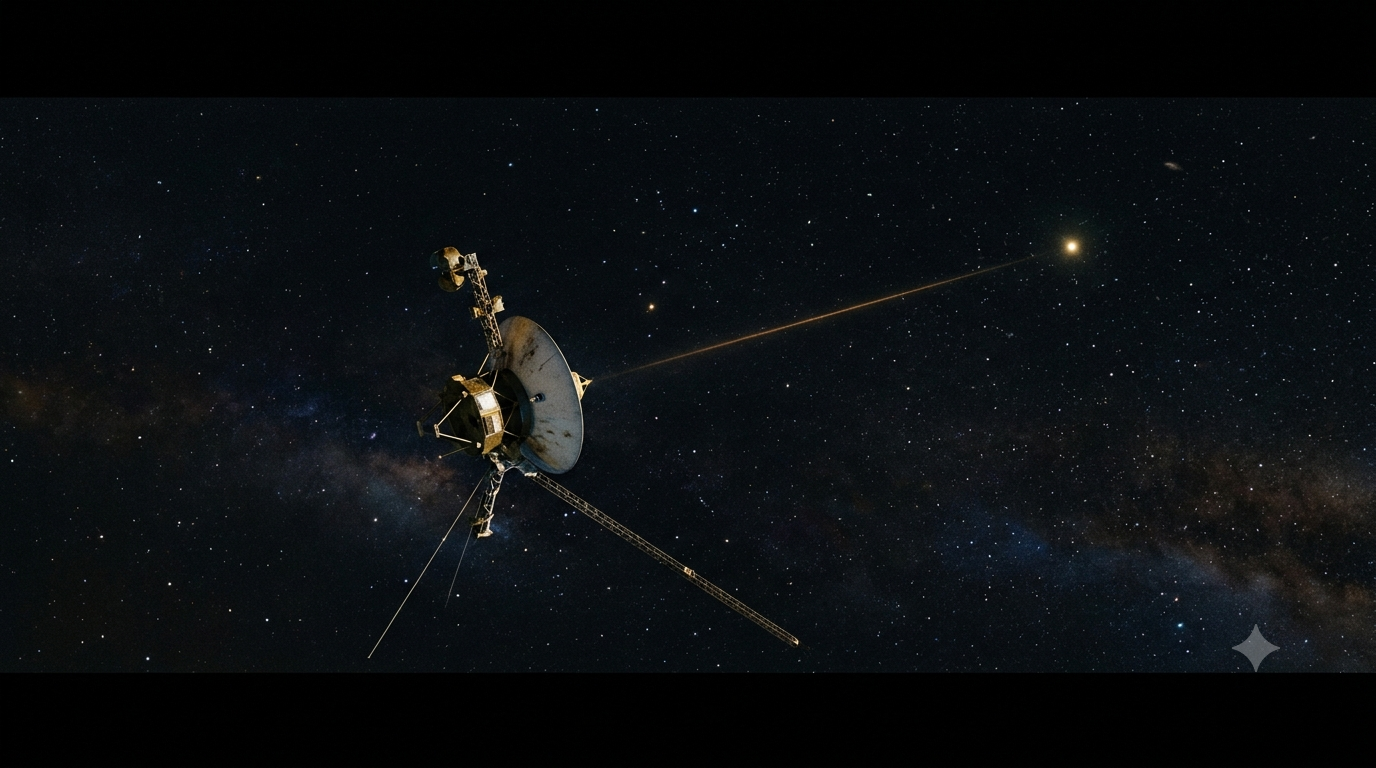
Voyager 2’s “Big Bang” Rescue: One More Year in Deep SpaceThere is a spacecraft, older than most of the people reading this, drifting through the space between the stars more than twenty-one billion kilometres from Earth. It has no camera trained on anything anymore. It cannot see. But it can still feel — the tug of a magnetic field, the hiss of charged gas, the patter of cosmic rays from the wider galaxy — and this week, NASA found a way to keep it feeling for a little longer.
Voyager 2 launched in 1977. It crossed the heliopause — the boundary where the Sun’s bubble of influence gives way to true interstellar space — in November 2018, becoming one of only two human-made objects ever to make that crossing. The other, its twin Voyager 1, is further still. Neither runs on sunlight; out there, the Sun is just another bright star. Instead they carry radioisotope thermoelectric generators, which convert the heat of decaying plutonium into electricity. It is a beautifully simple idea with one unavoidable flaw: the plutonium keeps decaying, and the power keeps falling — by roughly four watts every year.
Four watts is nothing much on its own. But subtract it, year after year, for nearly half a century, and eventually you are choosing which of your remaining senses to switch off. Since 2024, the mission has already had to power down two science instruments on each spacecraft. Voyager 2 was staring at another such decision before the end of 2026.
Enter a manoeuvre the Jet Propulsion Laboratory team nicknamed, with some affection, the “Big Bang.” The name oversells the drama: what actually happened was careful, coordinated housekeeping. Engineers simultaneously switched off certain powered components and substituted lower-power alternatives, all while keeping the spacecraft warm enough to keep working — no small thing, when a frozen propellant line can end a mission outright. The result: enough power freed up to keep three instruments — the magnetometer, the plasma wave subsystem and the cosmic ray subsystem — operating for at least another year. The team plans the same swap on Voyager 1 in the months ahead.
For an Australian audience there is a lovely wrinkle here. Voyager 2’s path carried it south, below the plane of the planets, and from that vantage the only antenna on Earth that can send it commands is the great 70-metre dish at the Canberra Deep Space Communication Complex. Every life-extending instruction — including this one — reaches the probe through the Southern Hemisphere. Humanity’s most distant working emissary stays in touch through a dish in the New South Wales bush.
It is hard not to read the Voyagers as a story about people as much as hardware. The mission today pairs NASA retirees in their eighties — who helped design these subsystems in the 1970s — with young engineers whose parents had not been born at launch. Every watt now is a decision about what humanity still gets to learn from beyond the Sun’s bubble. The honest truth is that the Voyagers are in their twilight. But this week the twilight got a little longer, and the record of what lies out there — the only such record we have — grew by another year.
The rest of today’s Astronomy Daily kept a foot in the present and the future: AST SpaceMobile’s BlueBird 11–13 carried the largest commercial antennas ever flown to low Earth orbit, edging closer to a world where an ordinary phone talks straight to a satellite; NASA’s Curiosity rover, fourteen years to the day since it landed, rolled into a breathtaking “sea” of honeycomb cracks that whisper of ancient Martian water; and a shoebox-sized NASA telescope called Aspera prepared to launch from New Zealand to map the faint gas around galaxies and help find the universe’s missing ordinary matter. Old machine, new machines — all of them, in their way, reaching.