Two Minutes of Totality: Inside the August 12 Eclipse
Related Episode
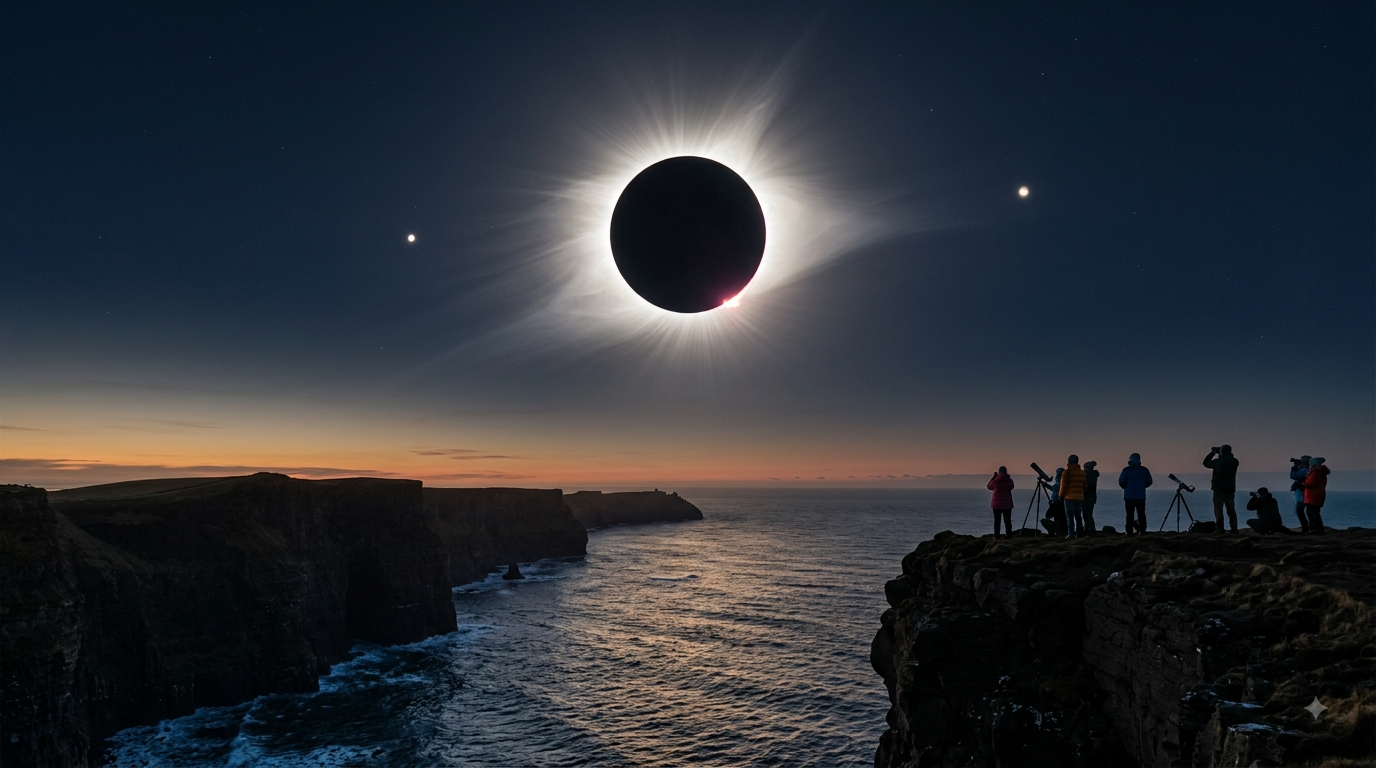
Two Minutes of Totality: Inside the August 12 EclipseYesterday, for two minutes and eighteen seconds, the sky over a windswept cliff on the western tip of Iceland went dark in the middle of the afternoon. It was the longest point of totality anywhere on land during the August 12 total solar eclipse — a shadow 182 miles wide that raced from the Arctic Ocean, down across eastern Greenland and western Iceland, and out across northern Spain before finally slipping off the edge of the Mediterranean.
On today’s episode, Anna and Avery go deep on that eclipse, then run through three more stories that broke in the last 48 hours: a first-of-its-kind trio of supermassive black holes found sharing a single distant galaxy, Virgin Galactic’s decision to push its commercial comeback flight into 2027, and Rocket Lab’s habit of signing new customers for a rocket that still doesn’t have a launch date. Here’s the rundown, with links to everything we referenced.
A shadow from the Arctic to the Mediterranean
The eclipse’s path was about as varied as it gets. It started over Siberia and the Arctic Ocean, crossed eastern Greenland and western Iceland, and then — after a stretch over open water — swept across northern Spain, the Balearic Islands, and out into the Mediterranean. Two very different eclipse-watching experiences, a few hours of shadow-travel apart: stark Arctic ice on one end, sunbathers on the Spanish coast on the other.
Iceland got the longest show. The maximum point of the eclipse sat about 45 kilometers offshore, but the longest totality on land — 2 minutes 18 seconds — happened at Látrabjarg, a dramatic bird-cliff on Iceland’s westernmost point. Because it hit mid-afternoon, roughly four hours before sunset and at that far a latitude, observers also got some unusual side effects: an extended twilight window either side of totality, and in places, a visible view of the lunar shadow moving through the high atmosphere. There was even a chance of aurora showing up further north in Russia if geomagnetic activity cooperated — the rare double bill of eclipse and aurora in the same sky.
In Spain, the path crossed A Coruña, Bilbao, Zaragoza, Valencia and Palma — though Madrid and Barcelona both fell just outside the line, sending plenty of people on short-notice road trips. Millions gathered in smaller towns along the path, including Valoria la Buena and Segur de Calafell, where totality arrived about an hour before sunset, low on the horizon and dramatically lit.
The reactions were the kind eclipse-chasers always talk about and never quite manage to explain to everyone else. Space.com’s Daisy Dobrijevic put it simply: “I knew what to expect, I’ve seen thousands of photos, but nothing compares to that feeling you get when you watch the Sun transform before your very eyes.” Another observer in Spain, Anthony Wood, described something closer to a primal reflex: it “strikes the lizard part of your brain that just tells you this shouldn’t be real.”
It wasn’t just spectacle, either. During totality, observers got a rare, direct look at the Sun’s corona — its faint outer atmosphere, normally drowned out by the Sun’s own brightness — streaming visibly out into space, along with a solar prominence and a cameo from Jupiter, Mercury and Venus in the darkened sky. Coronal observations like these feed directly into research on the Sun’s magnetic structure and the space weather it drives, which matters well beyond eclipse day given how active this solar cycle has been.
If you missed it, partial phases were visible across a huge stretch of the globe — Somerset in England, the northeastern US, Michigan, Canada and Alaska all got a bite taken out of the Sun. And if two minutes wasn’t enough, mark the calendar: Spain gets another total solar eclipse on August 2, 2027, less than a year from now.
Three black holes, one galaxy, two of them on a collision course
From one Sun to three black holes. Astronomers led by Hannah Übler at the Max Planck Institute for Extraterrestrial Physics have confirmed the first known case of three actively feeding supermassive black holes sharing a single galaxy — J0148-4214, sitting 12.5 billion light-years away, seen as it looked roughly 1.2 billion years after the Big Bang.
The team used the James Webb Space Telescope’s NIRSpec instrument and a technique called spectro-astrometry — measuring tiny spatial shifts in hydrogen emission — to pin down three distinct black holes packed close together on the sky: roughly 80 million, 2 million, and 0.6 million solar masses. For comparison, the black hole at the center of our own Milky Way, Sagittarius A*, is about 4 million solar masses — meaning the largest of this trio is twenty times heavier. Two of the three are already on course to merge.
The finding matters for more than the novelty of “three in one.” It’s evidence for how supermassive black holes might get so big, so fast, in the early universe: if they can grow through mergers with each other, not just by slowly swallowing surrounding gas, that offers a much faster route to supermassive status than previously assumed. If triple systems like this aren’t a fluke, there may be plenty more waiting to be found now that astronomers know what to look for.
Virgin Galactic’s comeback flight slips to February 2027
Virgin Galactic has pushed back the start of commercial service with its new Delta-class spaceplane from the fourth quarter of this year to February 2027, citing extra time needed to complete avionics and systems installation on the first operational vehicle. The market wasn’t thrilled — shares fell about 12% in after-hours trading on the news.
There’s a more encouraging thread in the same filing, though: the company’s $750,000-a-seat flight packages were oversubscribed, and CEO Michael Colglazier said “higher price points” would be on offer when ticket sales reopen this autumn. Financially, the picture is improving too — net loss narrowed to roughly $56 million, down from $67 million a year earlier, with $286 million still in cash and securities on hand. The demand and the balance sheet both look solid; it’s the hardware timeline that keeps moving.
Rocket Lab’s Neutron: a slipping date, a growing customer list
Rocket Lab’s medium-lift, reusable Neutron rocket — built to compete directly with SpaceX’s Falcon 9 — is looking less likely to debut before the end of 2026, with the company now openly hedging that the window could slide into 2027. That’s not stopping customers from signing on: Rocket Lab just announced a new five-launch deal with Kepler Communications for payloads that will fly once Neutron does get off the ground, on the back of a record revenue quarter for the company overall.
It’s a familiar pattern in new rocket development — Starship, New Glenn and Ariane 6 all had their own well-documented slips before reaching the pad. For now, Rocket Lab’s execution record with its smaller Electron rocket appears to be enough to keep customers committed, even with Neutron’s first flight still an open question.
Listen to the full episode
Anna and Avery cover all four stories in full on today’s episode of Astronomy Daily — S05E166, out now. [Listen here] and find full show notes, timestamps and sources on the episode page.
Sources: Space.com eclipse live coverage · Space.com eclipse recap · CNN eclipse photos · Wikipedia — Solar eclipse of August 12, 2026 · Max Planck Institute — three black holes · SpaceNews — Virgin Galactic delay · Spaceflight Now — Neutron debut window · Rocket Lab — Kepler Communications deal