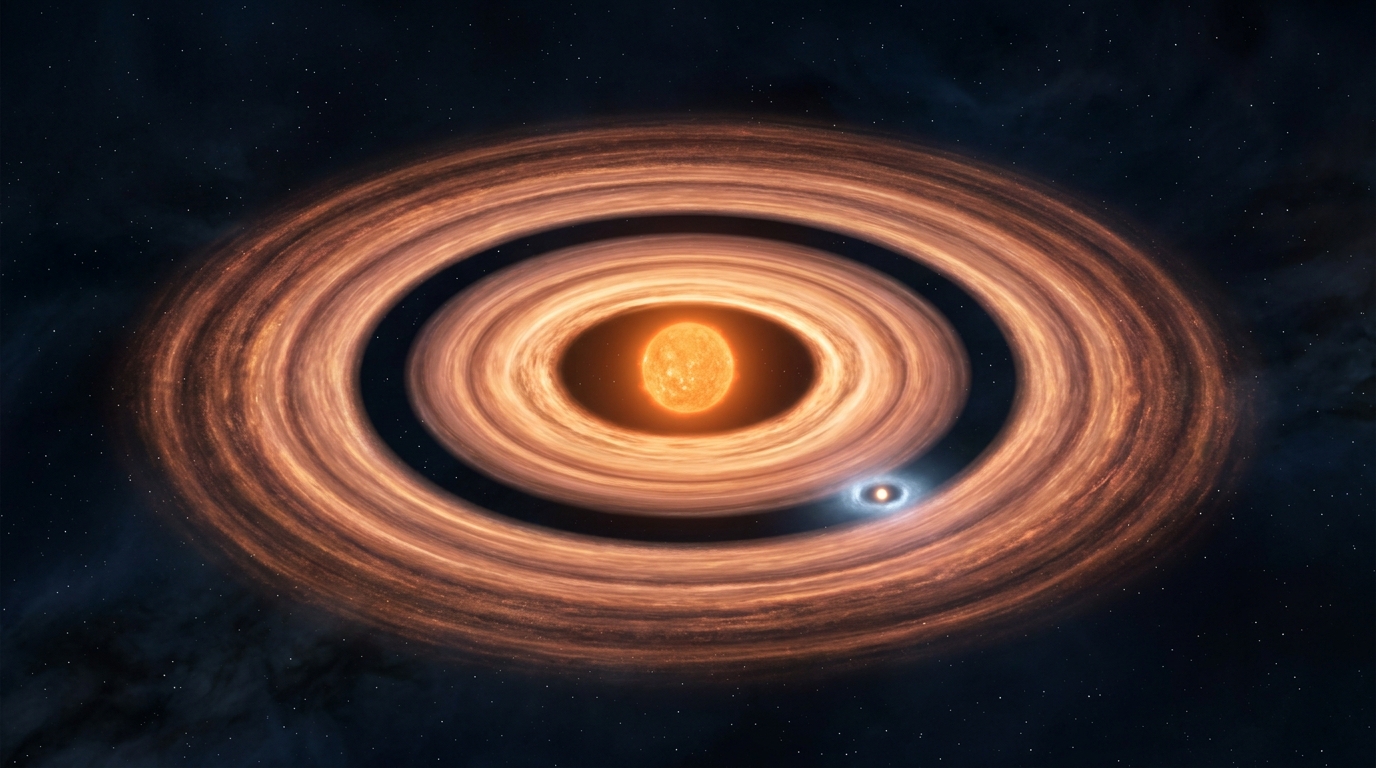
The Youngest Planet We Have Ever Found
Related Episode
The Youngest Planet Ever FoundElias 2-24 b is less than a million years old and still sitting in the gap it is carving. Every previous record holder was at least five times older - and the detection was waiting in an archive the whole time.
Companion post for Astronomy Daily S05E196 | Thursday, 17 September 2026
There is a quiet assumption buried in almost everything we know about planets: that we only ever see the finished article. Of the roughly six thousand confirmed exoplanets, very nearly all of them are grown up. Their birth discs dispersed hundreds of millions of years ago. We study the result and reason backwards to the process.
On 16 September, a team led from Chile published a genuine exception in The Astrophysical Journal Letters. Elias 2-24 b is a planet roughly the mass of Jupiter, orbiting a young star about 450 light-years away in the Ophiuchus molecular cloud - and it is less than one million years old. Every previously confirmed young planet was at least five million. This is not a planet that recently finished forming. It is a planet in the middle of forming.
A gap, and nine years of waiting
The story starts in 2017, when Lucas Cieza and colleagues used ALMA - the millimetre array on the Chajnantor plateau in northern Chile - to image the dusty disc around Elias 2-24. What they found was a set of clean dark rings: gaps swept through the dust.
A gap is a strong hint: the standard reading is that something massive is orbiting inside it, herding dust out of its path the way a snowplough clears a road. But a gap is a footprint, not a foot, and dust rings can also be produced by ice lines, magnetic effects or turbulence. For nine years, Elias 2-24 was a beautiful piece of circumstantial evidence.
Andrea Bernardi, at Universidad Diego Portales in Santiago, went looking for the foot - and found it in data that had been in an archive since 2018. The W. M. Keck Observatory on Maunakea had observed the system in 2018 and again in 2020 using a coronagraph on its NIRC2 infrared camera, masking the star so that fainter neighbours become visible. Reprocessed, those frames show a point of infrared light inside one of the gaps. ESO’s Very Large Telescope at Paranal had caught the same faint source.
“The planets should be found within the gaps, since they are carving them,” Bernardi said. “And that’s exactly where we found Elias 2-24 b.”
Why this is awkward for the models
The planet sits about 55 astronomical units from its star - well beyond Neptune’s 30, out where our own Kuiper Belt begins. Building a gas giant that far out is exactly what our mainstream model finds hardest.
Core accretion assembles a solid core from colliding pebbles, and once that core is heavy enough it begins pulling down gas and runs away into a giant. But discs thin out with distance and orbits get slower, so there is less material and fewer collisions per orbit. The timescales stretch into many millions of years. Elias 2-24 b had, at the outside, one.
“Our planet-formation models already struggled to explain the previous record holders,” said Lucas Cieza, of the Instituto de Estudios Astrofísicos. “Elias 2-24 b shows us that even our best models are still missing some important processes.”
The obvious alternative is gravitational instability - a patch of disc dense enough to collapse under its own gravity all at once, making a giant planet the way a star forms. That is fast, and it works better at large separations where discs are cooler. A young, massive, distant planet is precisely the kind of object its advocates point to.
The caveats worth keeping
Directly imaged protoplanets have a difficult history. Candidates around LkCa 15 and AB Aurigae were both announced and then disputed - in some cases turning out to be bright knots of disc material, or artefacts of starlight subtraction. PDS 70 is the system everyone agrees on, and that took years. Elias 2-24 b is a strong three-telescope detection, and it will be tested hard, as it should be.
The mass figure needs similar care. At this age you cannot weigh a planet directly; you measure infrared brightness and convert using models of how young giants cool. Those models diverge most at exactly this age, and some of the light may be gas falling onto the planet rather than the planet’s own surface. Read “Jupiter-mass” as “Jupiter-ish”. An earlier kinematic estimate for whatever carves that gap ran as high as five Jupiter masses.
A result that needed both hemispheres
ALMA and the VLT are both in Chile. Keck is in Hawaii. Ophiuchus lies at about 24 degrees south, high in southern winter skies and reachable from both. The southern telescopes found the gap; the northern telescope had the planet waiting in its archive; and the confirmation needed all three, at two epochs two years apart, to show the source moving with its star rather than sitting behind it.
Which is the quiet second story. The planet has been in Keck’s archive since 2018. The gap has been in ALMA’s since 2017. This discovery was not made by building something new - it was made by asking an old question of data somebody had already taken.
Elias 2-24 b was published in The Astrophysical Journal Letters on 16 September 2026 (DOI 10.3847/2041-8213/ae9bb6). Hear the full story on Astronomy Daily S05E196, Thursday 17 September 2026 - astronomydaily.io
Word count: 812