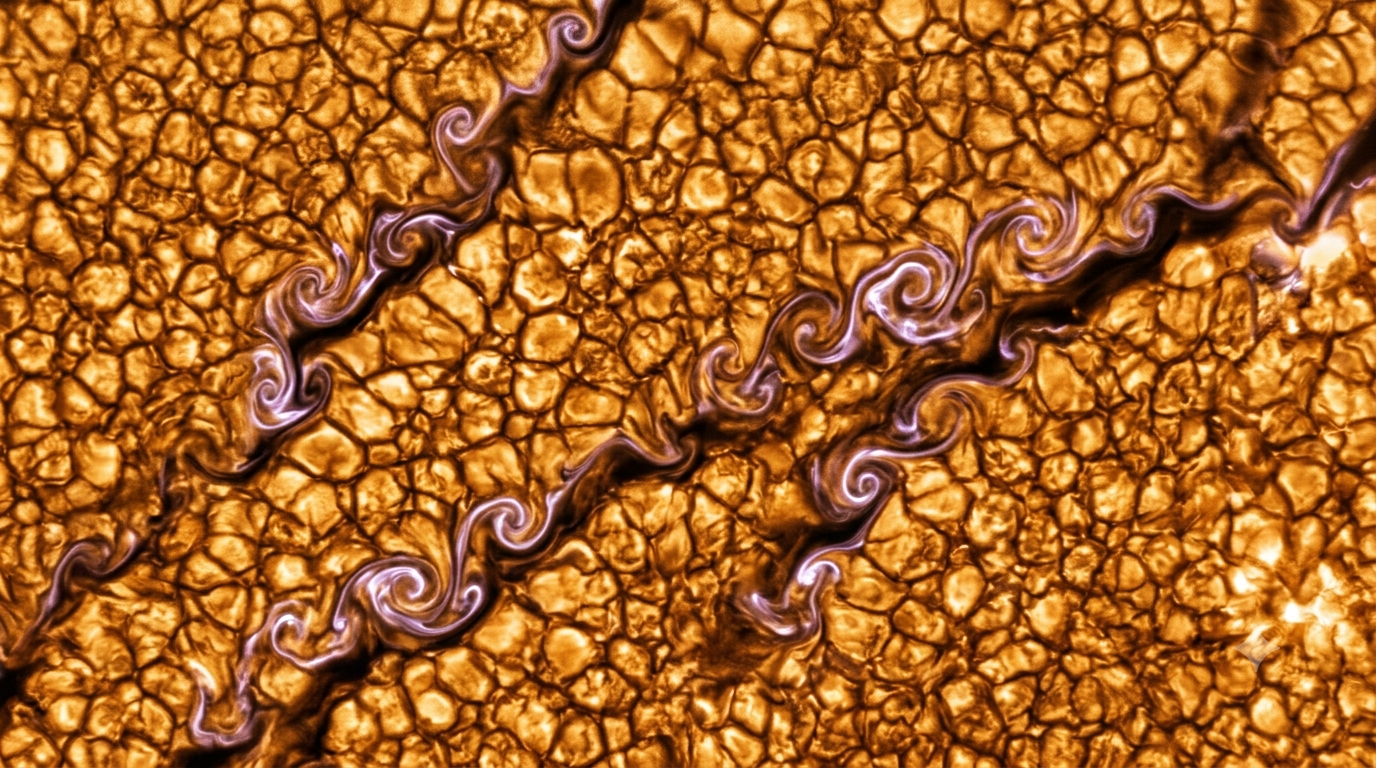
The Sun Has Whirlpools: Inouye Catches a 150-Year-Old Prediction in the Act
Related Episode
Whirlpools Found on the Sun’s Surface for the First TimeFor more than a century, physicists have known that whenever two fluids slide past each other at different speeds, the boundary between them can curl into a row of spiralling vortices. You have seen it yourself: wind peeling the crest off an ocean wave, or those tidy rows of breaking-wave cloud that ripple across an evening sky. Lord Kelvin and Hermann von Helmholtz set down the mathematics around 1870, and their names have been attached to the effect ever since. We have since spotted these Kelvin–Helmholtz instabilities in Earth’s atmosphere and oceans, in the banded clouds of Jupiter and Saturn, and even hinted at them high in the Sun’s outer atmosphere. But never, until this week, on the Sun’s visible surface.
That changed with a paper published on 5 August in Nature, led by David Kuridze of the US National Solar Observatory. Using the National Science Foundation’s Daniel K. Inouye Solar Telescope — a four-metre giant perched near the summit of Haleakalā in Hawai’i, and the most powerful solar telescope ever built — the team captured the highest-resolution images of the Sun’s photosphere ever taken. Where older instruments showed a smooth, slightly blurred boundary at the edges of the Sun’s granules, Inouye revealed something far busier: small, dynamic swirls forming and dissipating everywhere along the edges of magnetic regions, some barely twenty kilometres across.
To understand why the surface is the crucial place to catch them, picture the photosphere as a pot on the boil. Bright cells of hot plasma — granules — rise, cool, and sink in ceaseless convection. At their edges, flows moving at different speeds crash together, and the Sun’s magnetic field lines get squeezed into tighter bundles. Pack the field lines closer and the field grows stronger; a stronger field resists the plasma flow; and that abrupt change in velocity is exactly the shear that sets a Kelvin–Helmholtz vortex spinning. It is textbook fluid dynamics, playing out on a star.
Crucially, the researchers did not stop at a striking image. They ran the same magnetic region through MURaM, a state-of-the-art simulation built purely from the laws of physics, and the virtual Sun grew the same swirls, in the same places, with the same shapes. The Max Planck Institute for Solar System Research, a partner on the work, called the agreement between telescope and simulation remarkable. That handshake between observation and theory is what elevates the result from a curiosity to a genuine discovery: the team can say not only what they saw, but why it is there.
The stakes reach well beyond a beautiful picture. The first prize is one of solar physics’ most stubborn puzzles — the coronal heating problem. The Sun’s surface simmers at around six thousand degrees, yet its outer atmosphere, the corona, blazes at millions of degrees. Something must be ferrying energy upward and depositing it far from the heat source, and these newly revealed, near-ubiquitous vortices are a strong candidate for part of that hidden pipeline.
The second prize is far more down to earth. The same swirling motions could feed the build-up of magnetic energy that the Sun eventually unleashes as flares and coronal mass ejections. When those outbursts are aimed our way, they can disturb satellites, degrade GPS, and put strain on power grids. Next, the team plans to turn pattern-recognition algorithms loose on long sequences of Inouye data to measure how much energy these instabilities actually carry aloft. Pin down that figure, and the models that forecast space weather grow sharper — a practical dividend from a very fundamental observation.
There is a pleasing symmetry in the timing. This discovery arrives just as much of the world prepares to turn its attention to the Sun for the total solar eclipse on 12 August. For decades, the idea that Kelvin–Helmholtz instabilities pervade the solar surface lived only as a prediction on a chalkboard, beyond the reach of our telescopes. This week it became something we can point at. The surface of our star is not the smooth, glowing disc of the imagination. It is a sea — and it is full of breaking waves.
— Astronomy Daily, astronomydaily.io